I-360

Petition for Amerasian, Widow(er), or Special Immigrant

Agency
USCIS
Revision
Edition 01/20/25
Fillable fields
510
Pages
19
Official source
USCIS form page
Checked
October 20, 2026
Fill I-360 online
Page 1 of form I-360

Form I-360: Petition for Amerasian, Widow(er), or Special Immigrant

Form I-360, Petition for Amerasian, Widow(er), or Special Immigrant, is used to classify an alien as an Amerasian, the widow or widower of a U.S. citizen, a VAWA self-petitioning spouse, child or parent, or a special immigrant. The USCIS page lists special immigrants such as religious workers, special immigrant juveniles, certain Panama Canal employees, certain physicians, G-4 international organization or NATO-6 employees and family members, U.S. armed forces members, certain Afghan and Iraqi nationals, and broadcasters for the U.S. Agency for Global Media or a grantee.

Some categories are filed by an employer, an organization or another person for a beneficiary, and others are self-petitions. The USCIS page says a person filing for someone else completes Part 1 about themselves and Part 3 about the beneficiary, while a self-petitioner skips Part 1 and completes Part 3.

Each category has its own eligibility list and initial evidence in the instructions. The form also has separate parts that are completed only for an Amerasian, a widow(er), a special immigrant juvenile, a religious worker or a VAWA self-petitioner.
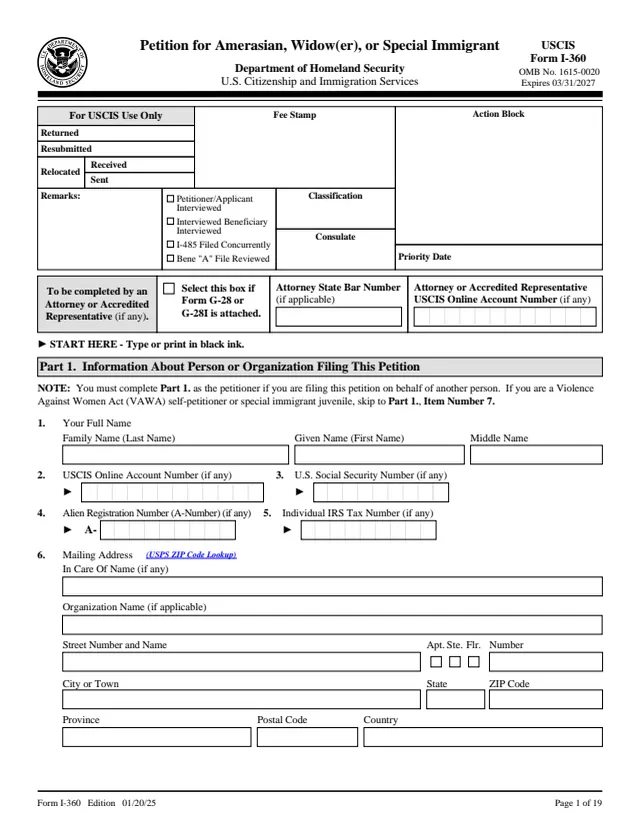
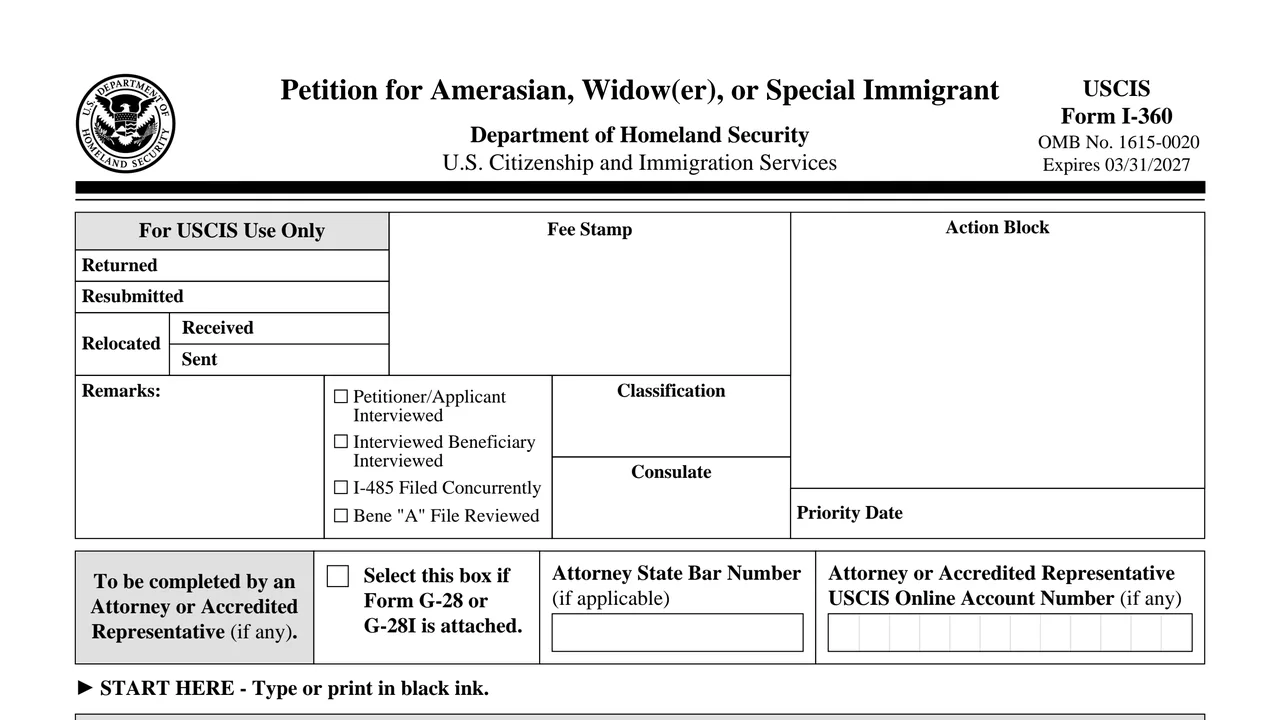
Top of page 1 of Form I-360: Petition for Amerasian, Widow(er), or Special Immigrant, as printed by USCIS

What's on Form I-360

Part 1: Person or organization filing

The petitioner's name, USCIS online account number, Social Security number, A-Number, IRS tax number and mailing address, plus Item 7 for an alternate or safe mailing address for VAWA self-petitioners and special immigrant juveniles.

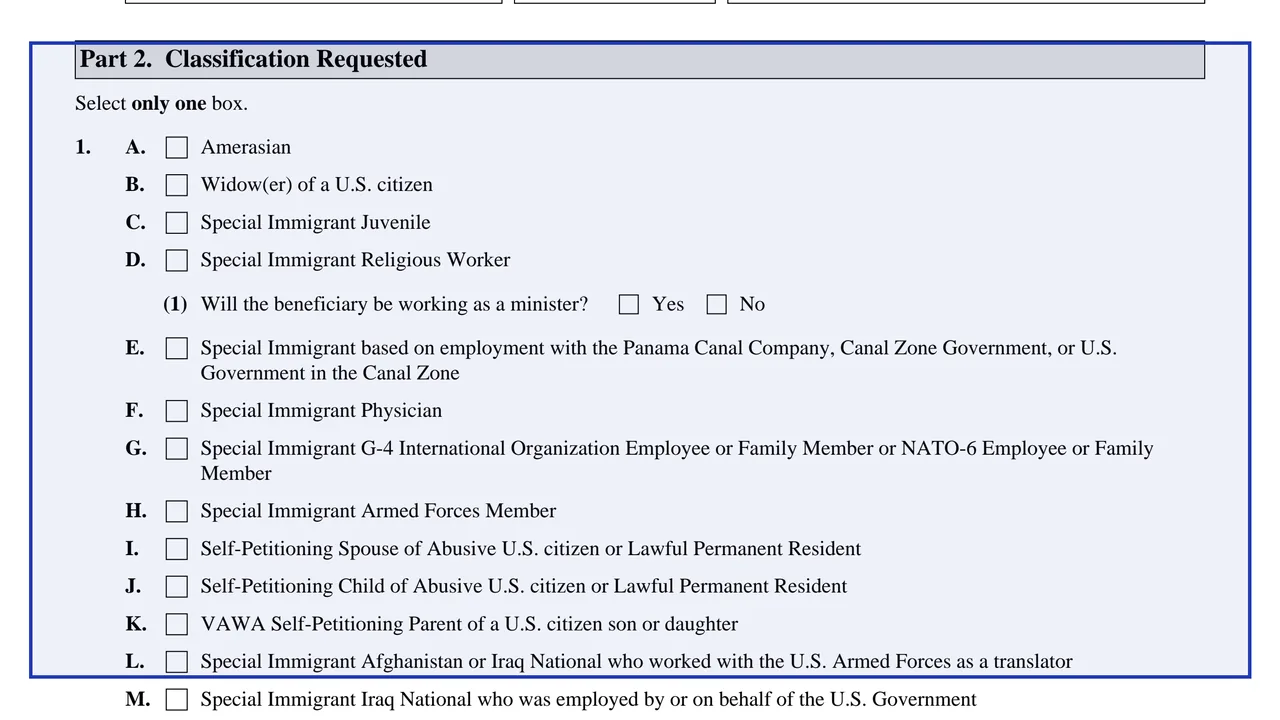
Part 2: Classification requested

One box from A (Amerasian) to P (Other), including widow(er), special immigrant juvenile, religious worker with a question on whether the job is a minister, the VAWA categories, Afghan and Iraqi nationals and broadcasters.

Parts 3 to 5: Beneficiary, processing and family

The beneficiary's name, address, birth details, marital status and last arrival with Form I-94, then a consulate abroad or adjustment in the United States, removal proceedings, unauthorized work, other petitions filed, and the beneficiary's spouse and children.

Parts 6 to 10: Category sections

Completed only for an Amerasian, a widow(er), a special immigrant juvenile, a religious worker (with the Prospective Employer Attestation and, where it applies, the Religious Denomination Certification) or a VAWA self-petitioner.

Parts 11 to 15: Statements, signatures and extra space

Part 11 for an individual filing for themselves, Part 12 for someone filing for another person or as an authorized signatory, the interpreter and preparer sections, and Part 15 for additional information.

How to fill out Form I-360

  1. 1

    Select one classification in Part 2

    The form says to select only one box. Each classification has its own eligibility list and evidence in the instructions.

  2. 2

    Fill in the parts for who is filing

    A petitioner filing for another person completes Part 1 and Part 3. A VAWA self-petitioner or special immigrant juvenile skips to Part 1, Item 7, which holds an optional alternate or safe mailing address, and completes Part 3.

  3. 3

    Complete only the category part that applies

    Parts 6 to 10 each cover one category. For a religious worker, the USCIS page says the employer attestation is submitted with Form I-360, and the religious denomination certification where it applies.

  4. 4

    Gather the initial evidence

    Examples from the instructions: a widow(er) sends the marriage certificate, proof the spouse was a U.S. citizen and the death certificate. A special immigrant juvenile sends proof of age and the court documents with the specific findings of fact.

  5. 5

    Enter passport and Form I-94 details

    The instructions ask for the Form I-94 number and the date the authorized stay expires, and for the passport or travel document used, even if it is expired. For Items 8 to 15 in Part 3, the form says to leave a space blank when it does not apply or the answer is none.

  6. 6

    Sign Part 11 or Part 12

    Part 11 is only for an individual filing for themselves; Part 12 is for filing for another person or as an authorized signatory. A stamped or typewritten name is not accepted. This page lets you fill the form online free, then print it for signature.

Why fill Form I-360 on indox

You get the real form, filled in a browser tab, with nothing standing between you and the finished PDF.

  • Fill the form right in your browser, no software to install
  • Free to fill and free to download, with no account
  • The official blank straight from the USCIS, not a copy someone retyped
  • Works on a phone, tablet or computer

Where to file, timing, evidence and fees

Filing by mail

The USCIS page says the filing location changed on Oct. 7, 2026. The address depends on the category, where the filer lives and whether Form I-485 is filed at the same time, so check the Direct Filing Addresses for Form I-360 page. Forms postmarked on or before Nov. 9, 2026, and sent to a prior location are accepted.

Filing online

The USCIS page says certain Form I-360 petitions can be filed online by uploading a PDF through a USCIS online account, and its Forms Available to File Online page says when that applies.

Fee

The fee is on the USCIS Fee Schedule page, and the instructions point to Form G-1055. Fees can change, so check it on the day you file.

Special immigrant juvenile timing

The USCIS page says the petition is filed before the 21st birthday, and that within the 2 weeks before it, an expedite appointment to file in person at a USCIS field office can be requested through the USCIS Contact Center.

VAWA employment authorization

The instructions say that if a VAWA self-petition is approved and the self-petitioner lives in the United States, USCIS issues an Employment Authorization Document with category (c)(31). Item 12 in Part 10 asks whether it is requested.

Rejections and E-Notification

The instructions say a form that is not signed or lacks the correct fee is rejected and may be corrected and resubmitted. For an email or text when a lockbox accepts it, the USCIS page says to clip Form G-1145 to the first page.

Who files Form I-360?

  • Amerasians

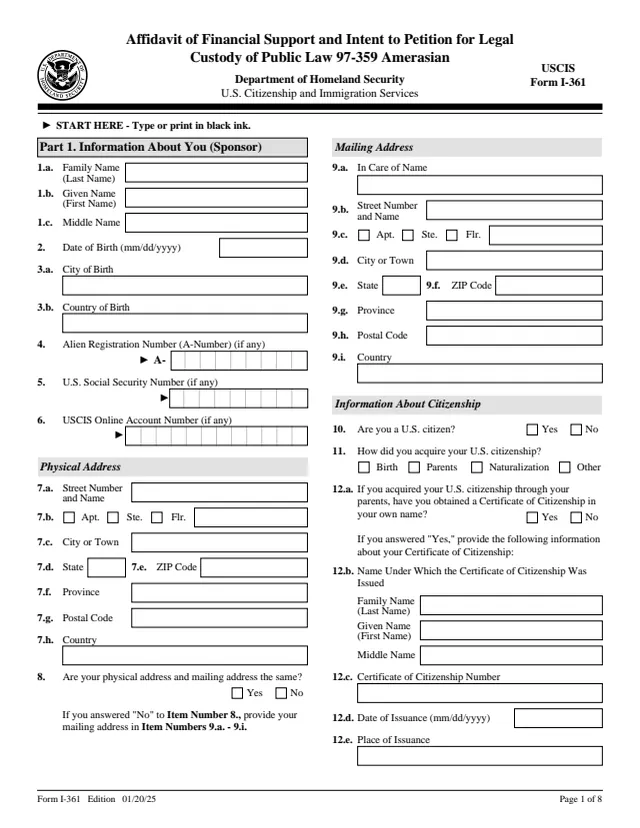
    A person 18 or older, or a U.S. corporation, may file for a beneficiary born in Korea, Vietnam, Laos, Kampuchea or Thailand after December 31, 1950, and fathered by a U.S. citizen. The instructions give the end date as before October 22, 1982, while the USCIS page says before Oct. 23, 1982. A sponsor completes Form I-361.

  • Widow(er)s of U.S. citizens

    The USCIS page says the petition is filed no later than 2 years after the citizen spouse's death. The instructions also list not being legally separated at the time of death and not having remarried.

  • VAWA self-petitioners

    A spouse or child of an abusive U.S. citizen or permanent resident, or a parent of an abusive U.S. citizen son or daughter who is 21 or older. The USCIS page says a self-petition may be filed without the abusive family member's knowledge or consent.

  • Special immigrant juveniles

    The instructions describe a juvenile present in the United States, unmarried and under 21, with juvenile court findings about dependency or custody, parental reunification and best interest. The USCIS page says the petition is filed before the 21st birthday.

  • Religious workers and other special immigrants

    A U.S. employer files for a religious worker, or the worker files for themselves, with two years of membership in the denomination and of continuous work in a qualifying position. Other special immigrants include Panama Canal employees, physicians, G-4 or NATO-6 employees, armed forces members, Afghan or Iraqi nationals and broadcasters.

  • Afghan nationals after July 20, 2022

    The USCIS page says Afghans who start the Special Immigrant Visa process on or after July 20, 2022, no longer file Form I-360 and seek classification with the Department of State on Form DS-157 instead.

Official sources and the blank

Do it all with indox

View all 94 tools

Questions about Form I-360

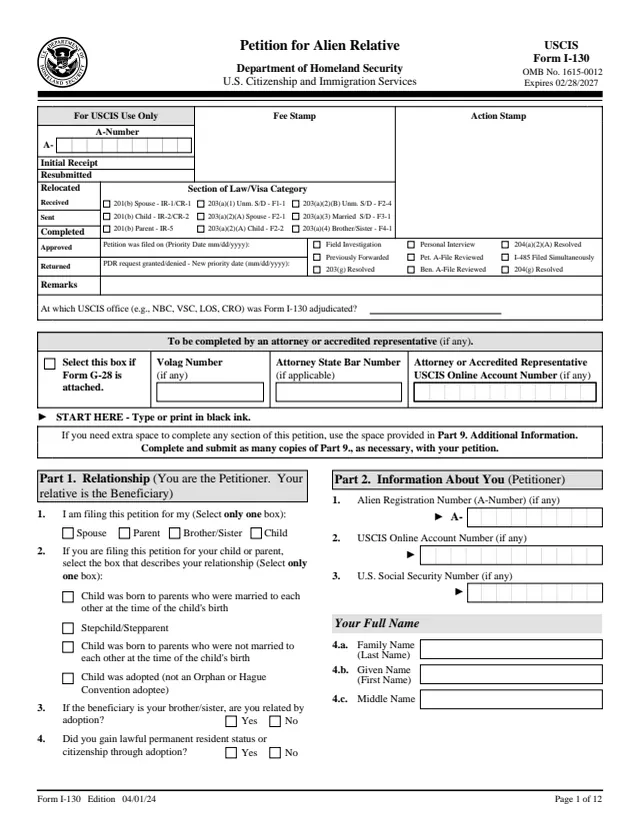
Does a widow(er) need Form I-360 if the spouse already filed Form I-130?

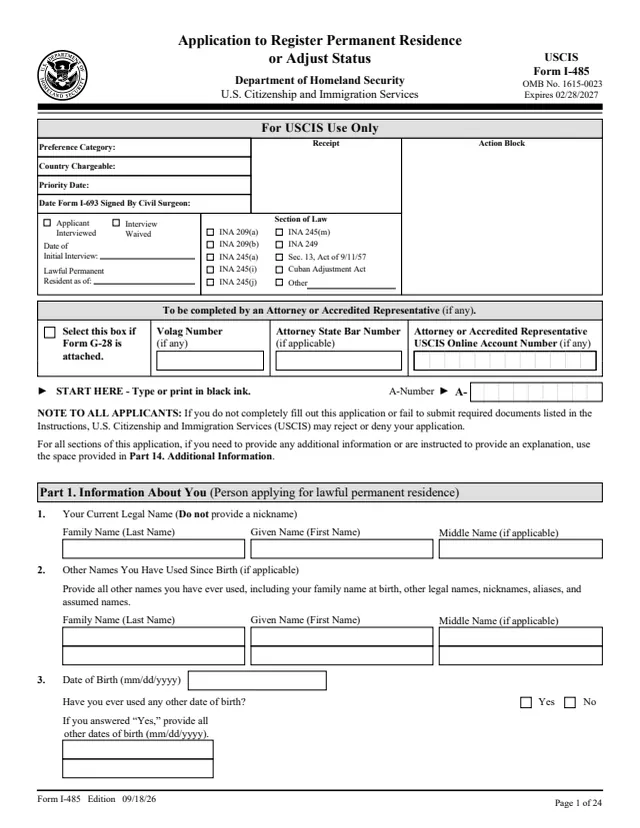
No. The USCIS page says a Form I-130 filed by the citizen spouse before death was automatically converted to a Form I-360, so a new one is not needed.

How long does a widow(er) have to file Form I-360?

The USCIS page says no later than 2 years after the spouse's death. It adds that eligibility based on a Form I-360 filed after the death ends if the widow(er) remarries before immigrating or adjusting status.

Can a VAWA self-petition be filed without the abuser knowing?

Yes. The USCIS page says a VAWA self-petition may be filed on Form I-360 without the abusive family member's knowledge or consent, and the form allows a safe mailing address.

Do Afghan nationals still file Form I-360?

It depends on when the process started. The USCIS page says those who start the SIV process on or after July 20, 2022, file Form DS-157 with the Department of State instead, while some with earlier Chief of Mission approval still file Form I-360.

Can Form I-360 be filed online?

For certain petitions, yes. The USCIS page says some can be filed online by uploading a PDF through a USCIS online account, and others go by mail.

What is the Form I-360 filing fee?

USCIS fees change, so this page does not list one. The I-360 page points to the USCIS Fee Schedule, and the instructions point to Form G-1055.