I-356

Request for Cancellation of Public Charge Bond

Agency
USCIS
Revision
Edition 09/18/26
Fillable fields
225
Pages
9
Official source
USCIS form page
Checked
October 20, 2026
Fill I-356 online
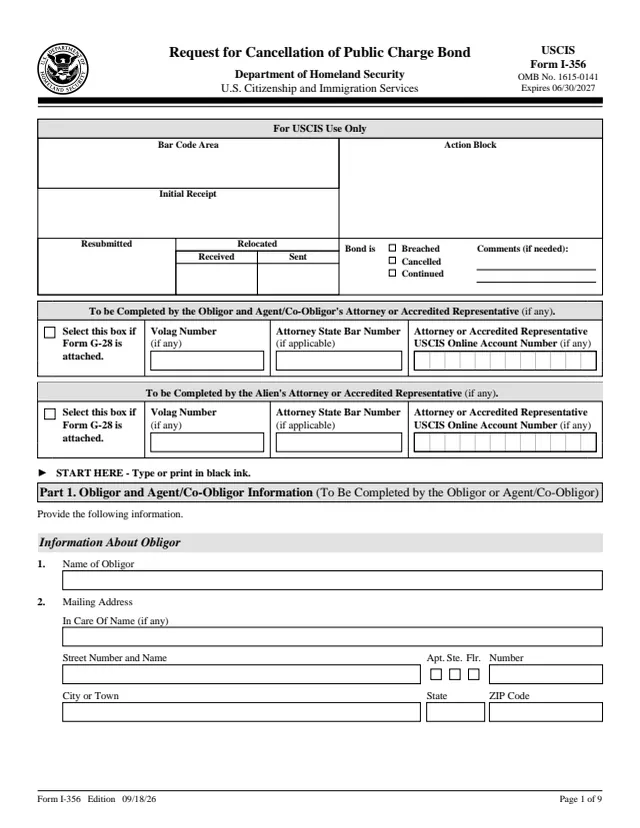
Page 1 of form I-356

Form I-356: Request for Cancellation of Public Charge Bond

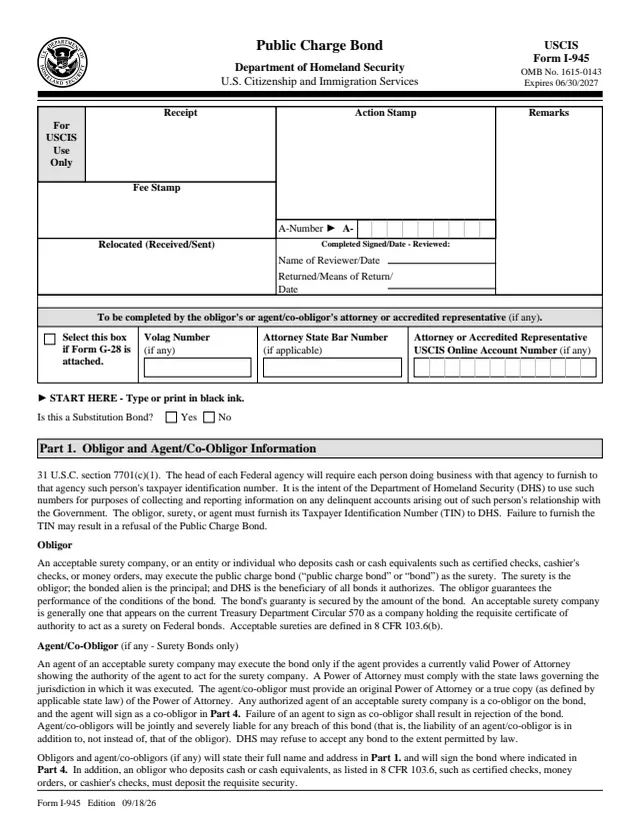
Form I-356, Request for Cancellation of Public Charge Bond, asks USCIS to cancel a public charge bond submitted for an alien on Form I-945, Public Charge Bond. It can be filed by the alien the bond was posted for, the alien's attorney or accredited representative, the executor of the alien's estate if the alien has died, the obligor who posted the bond, or the obligor's authorized agent (co-obligor, for surety companies only).

The USCIS page says a public charge bond will be canceled when the alien dies, permanently leaves the United States, becomes a U.S. citizen, or 5 years after the date the alien becomes a lawful permanent resident, citing INA section 213 and 8 CFR 103.6(c)(1). It adds that USCIS may also cancel a bond at any time if it finds the alien is not likely at any time to become a public charge.

The instructions say USCIS checks whether the bond was breached, for example through receipt of any means-tested public benefit, and whether all requirements for cancellation are met. If the request and evidence do not show that, the bond stays in effect until the conditions are met, unless it is breached.

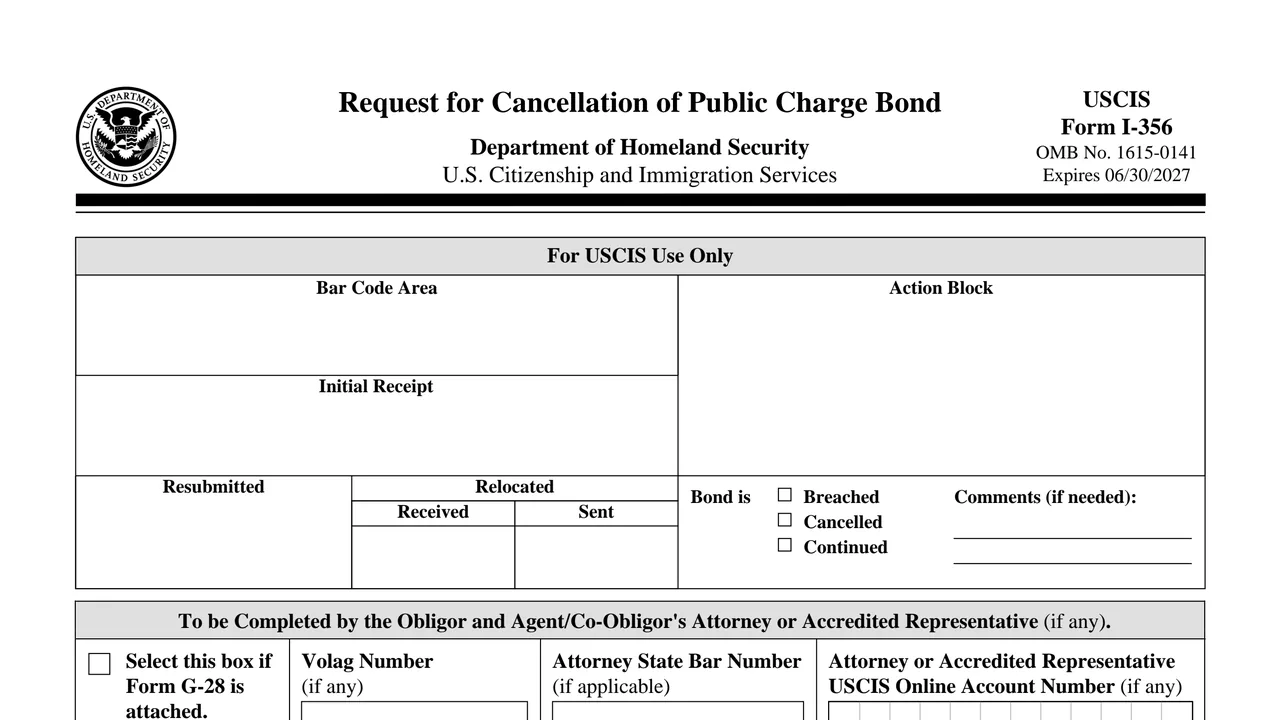
Top of page 1 of Form I-356: Request for Cancellation of Public Charge Bond, as printed by USCIS

What's on Form I-356

Part 1: Obligor and agent or co-obligor

Names, mailing and physical addresses, phone numbers, email and Taxpayer Identification Numbers, a power of attorney number, the bond receipt number and amount, and the date DHS accepted the bond as shown in Section D of Form I-945.
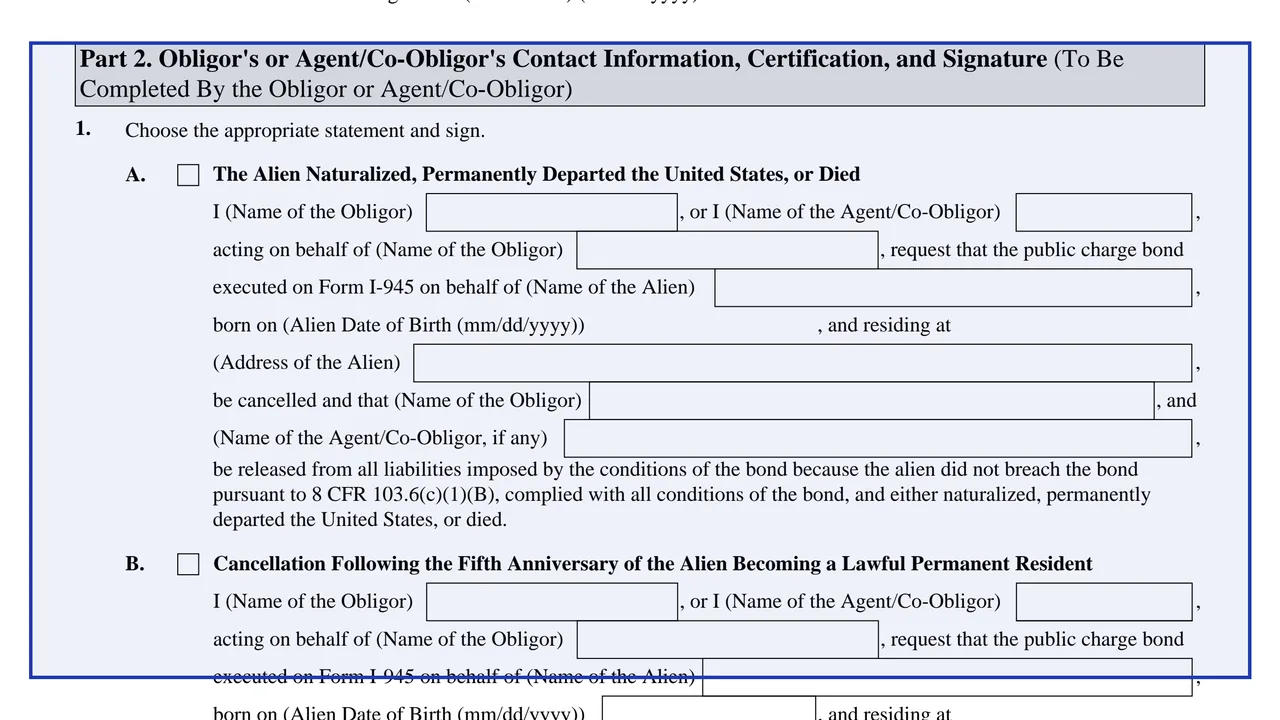
Part 2: Obligor's certification and signature

One of two statements: A, the alien naturalized, permanently departed or died; or B, cancellation after the fifth anniversary of the alien becoming a permanent resident. The obligor and any agent sign below.

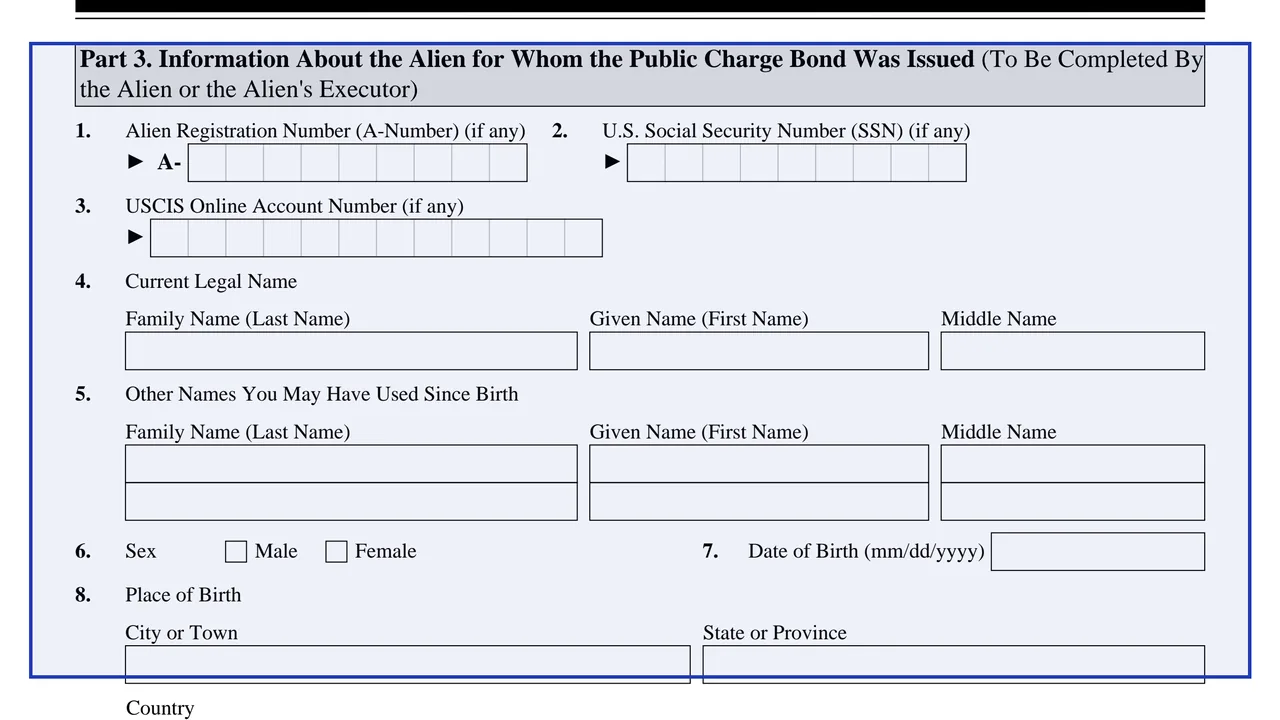
Part 3: The alien

A-Number, Social Security number, USCIS online account number, current and other names, sex, date and place of birth, citizenship, and mailing and physical addresses.

Part 4: Reason for cancellation

One reason in Item 1, then the matching item: U.S. citizenship, permanent departure, death, or five years as a permanent resident. Item 6 asks whether any means-tested public benefits were received before that event.

Parts 5 to 8: Signatures and extra space

The alien's or executor's contact information, Social Security Administration authorization, certification and signature, then the interpreter and preparer sections and Part 8 for additional information.

How to fill out Form I-356

  1. 1

    Pick one reason in Part 4

    Select the reason in Item 1 and answer the item it points to. The instructions ask whether any of these events happened since the alien adjusted to permanent resident status, and an executor answers for the deceased alien.

  2. 2

    Attach proof for that reason

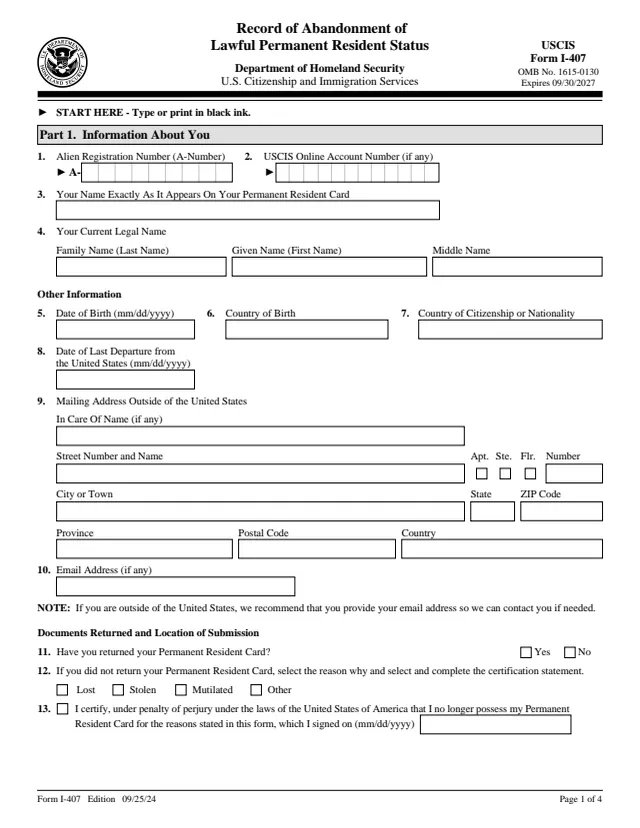
    Proof of citizenship for naturalization, a copy of the permanent resident card for the five-year reason, and for permanent departure, evidence such as Form I-407 filed from outside the United States or at a port of entry, or a departure under a final order or a voluntary departure order.

  3. 3

    Answer the public benefits question

    Item 6 asks whether the alien received any means-tested public benefits after becoming a permanent resident and before the event. A Yes answer lists which benefits, when, and the government entity that provided them.

  4. 4

    Know when USCIS will not cancel

    The instructions list cases where status may have been abandoned or lost but the bond is not canceled, such as leaving to live abroad without filing Form I-407 as its instructions say, or an outstanding removal or voluntary departure order without a departure.

  5. 5

    Label any extra sheets

    Type or print in black ink. Extra answers go in Part 8, and the instructions ask for the alien's name and A-Number plus the obligor's name and bond receipt number at the top of each sheet.

  6. 6

    Sign in Part 2 or Part 5

    The obligor signs Part 2 and the alien or executor signs Part 5. A stamped or typewritten name is not accepted, and an unsigned or incomplete form is rejected. This page lets you fill the form online free, then print it for signature.

Why fill Form I-356 on indox

You get the real form, filled in a browser tab, with nothing standing between you and the finished PDF.

  • Fill the form right in your browser, no software to install
  • Free to fill and free to download, with no account
  • The official blank straight from the USCIS, not a copy someone retyped
  • Works on a phone, tablet or computer

Where to file, decision and fees

Where to file

The USCIS page gives one address: USCIS, Attn: Form I-356, 10 Application Way, Montclair, CA 91763-1350.

When to file

The USCIS page says to use this form only when requesting cancellation based on meeting the criteria for cancellation.

Fee

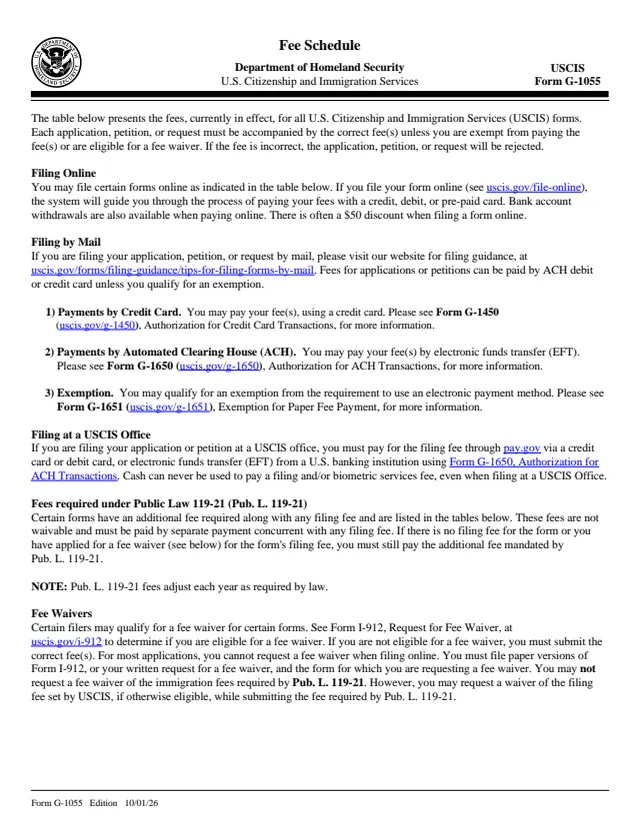
The fee is on the USCIS Fee Schedule page, and the instructions point to Form G-1055. Fees can change, so check it on the day you file.

Decision and appeal

The instructions say USCIS informs the obligor and the alien of the decision. The obligor, but not the alien or the alien's representative, may appeal under 8 CFR 103, Subpart A.

Edition and pages

The USCIS page lists edition 09/18/26. For a printed form, it says the edition date and page numbers need to be visible on every page, all from the same edition, or the form may be rejected.

Copies and translations

Send legible photocopies unless an original is requested, and include a full English translation with the translator's certification for any foreign-language document. An incomplete or unsigned form may be resubmitted once corrected.

Who files Form I-356?

  • The alien the bond was posted for

    The person on whose behalf the public charge bond was posted, or that person's attorney or accredited representative. The alien completes Parts 3 to 5 about themselves and the reason for cancellation.

  • Executor of a deceased alien's estate

    The instructions ask the executor for a certified copy of the document giving legal authority over the estate, such as a small estate affidavit, a will or a court order, and a certified copy of the death certificate.

  • The obligor

    The person who posted the bond for the alien. The obligor completes Part 1 with the obligor and bond details and signs the certification in Part 2.

  • Agent or co-obligor

    The obligor's authorized agent, which the USCIS page describes as a co-obligor for surety companies only. For surety bonds, the instructions ask for the name of the surety company.

  • When it is not needed

    The instructions say this request does not have to be filed when a substitute bond is submitted to release an obligor from the current liability, and point to Form I-945 and its instructions for substitution.

Official sources and the blank

Do it all with indox

View all 94 tools

Questions about Form I-356

Who can file Form I-356?

The alien the bond was posted for, their attorney or accredited representative, the executor of a deceased alien's estate, the obligor who posted the bond, or the obligor's authorized agent (co-obligor, for surety companies only).

When is a public charge bond canceled?

The USCIS page says when the alien dies, permanently leaves the United States, becomes a U.S. citizen, or 5 years after becoming a lawful permanent resident. USCIS may also cancel it if it finds the alien is not likely at any time to become a public charge.

What counts as a breach of the bond?

The instructions say a bond is breached when there has been a substantial violation of the stipulated conditions, such as the receipt of any means-tested public benefit. USCIS cancels only a bond that was not breached.

Can the alien appeal if USCIS does not cancel the bond?

No. The instructions say the obligor may appeal the decision under 8 CFR 103, Subpart A, but the alien or the alien's representative may not.

Is Form I-356 needed when a substitute bond is filed?

No. The instructions say this request does not have to be filed when a substitute bond is submitted to release an obligor from the current bond's liability.

What is the Form I-356 filing fee?

USCIS fees change, so this page does not list one. The I-356 page points to the USCIS Fee Schedule, and the instructions point to Form G-1055.