Part I: Authorization for Release of Information
The consent to release financial records, consumer reports and foreign travel records, the conditions for its use, and its three-year expiration after access to classified information ends.
SF713
Consent for Access to Records
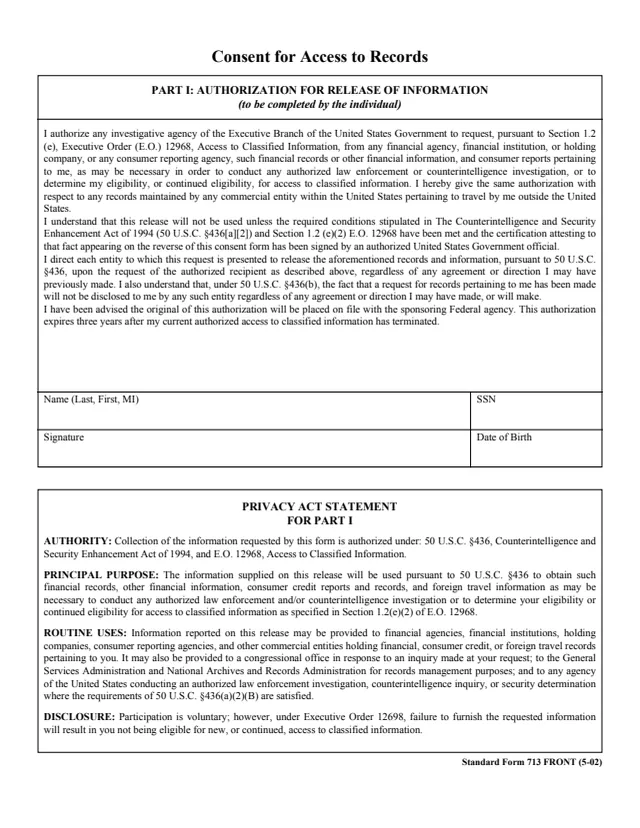
Standard Form 713 (SF 713), Consent for Access to Records, is a two-page consent form, edition 5-02. The form does not name an issuing agency. GSA hosts a copy in its forms library.
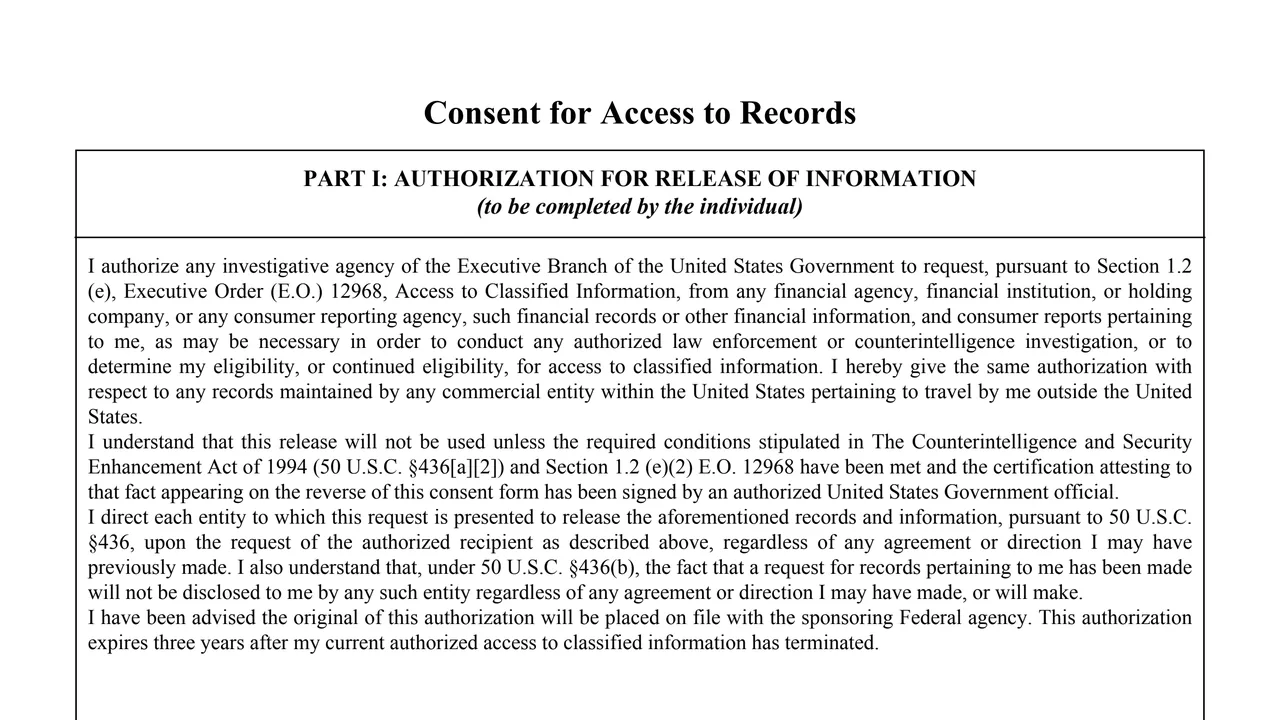
In Part I, completed by the individual, the person authorizes any investigative agency of the Executive Branch to request financial records, other financial information, consumer reports and records of travel outside the United States, under Section 1.2(e) of Executive Order 12968 and 50 U.S.C. §436. The form says this is for an authorized law enforcement or counterintelligence investigation, or to determine eligibility, or continued eligibility, for access to classified information. Part II is completed by the certifying official, and Part III by the investigative entity for each specific request.
The form says the original is placed on file with the sponsoring Federal agency and the authorization expires three years after the person's current authorized access to classified information has terminated. You can fill it out free in your browser on this page and download the result without an account.
The consent to release financial records, consumer reports and foreign travel records, the conditions for its use, and its three-year expiration after access to classified information ends.
Name (last, first, middle initial), SSN, signature and date of birth. The back repeats the name and SSN boxes.
Authority, principal purpose, routine uses and disclosure.
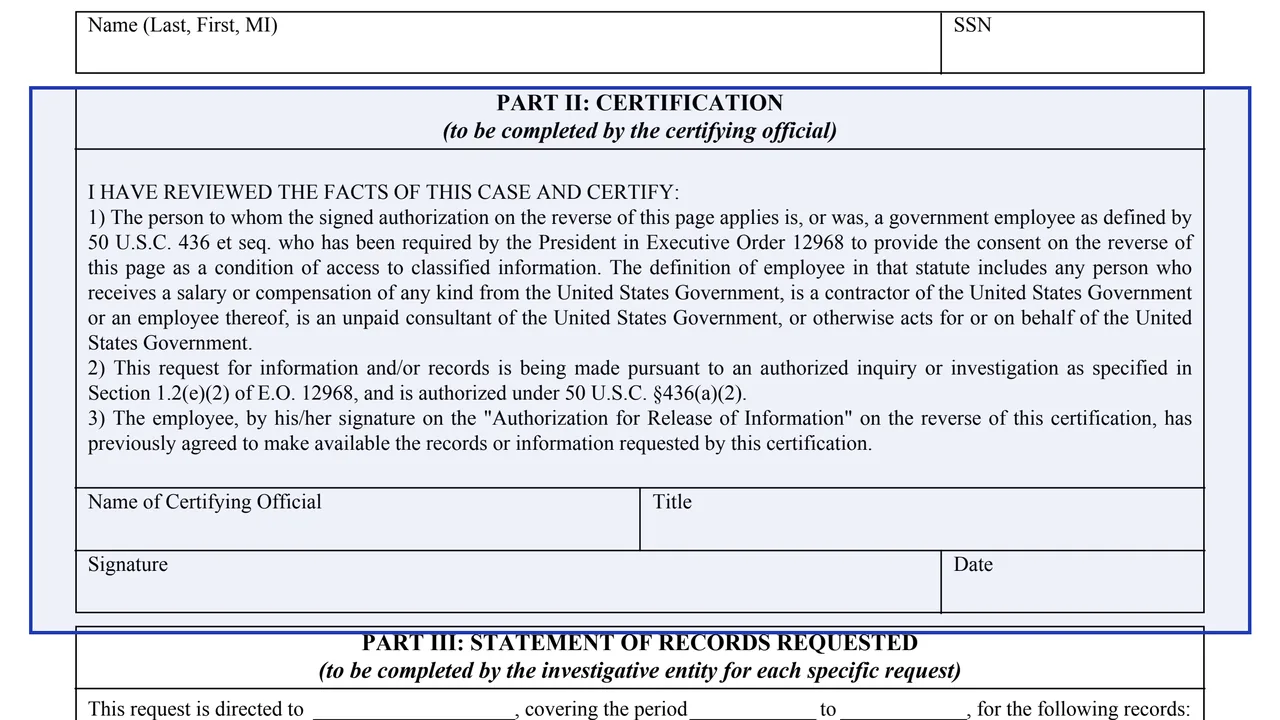
Three statements: who the signer is under 50 U.S.C. 436, that the request is made under an authorized inquiry or investigation, and that the employee previously agreed by signing Part I.
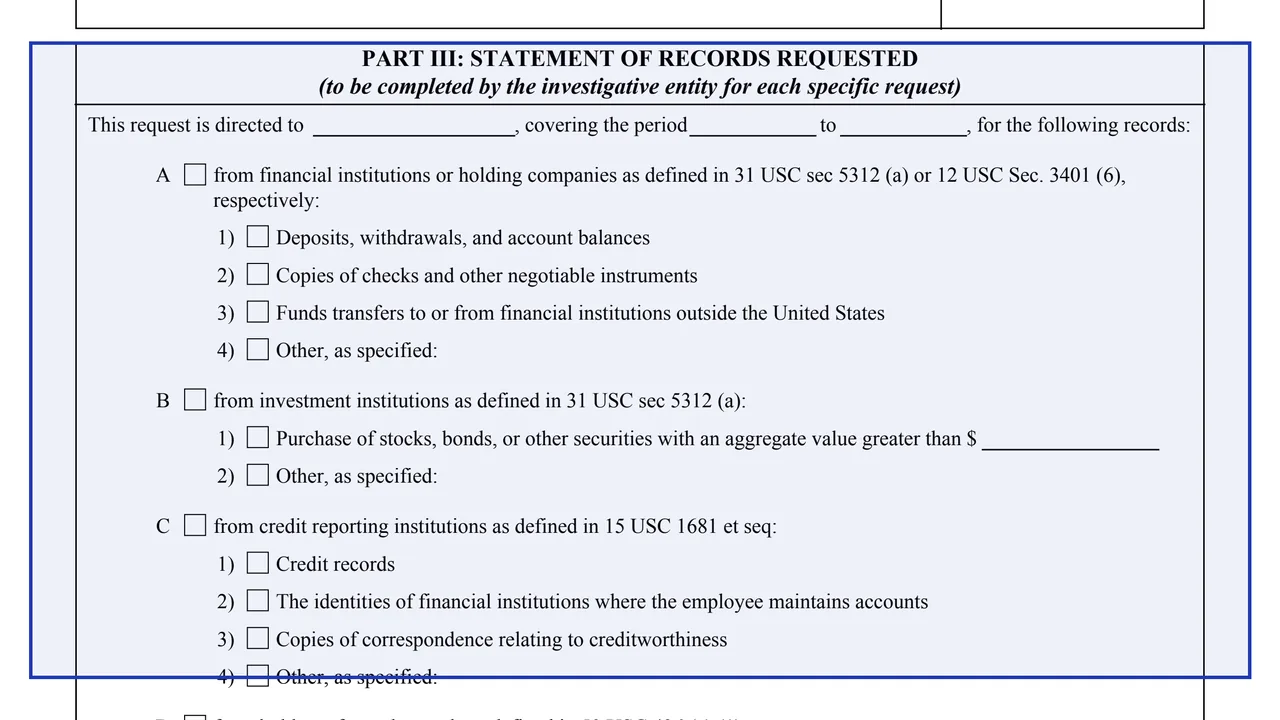
Who the request is directed to, the period covered, and records from A, financial institutions or holding companies; B, investment institutions; C, credit reporting institutions; and D, holders of travel records.
Limits on disclosing that a request was received, and the time for an entity to make the records available.
Part I says the release will not be used unless the conditions in 50 U.S.C. §436[a][2] and Section 1.2 (e)(2) E.O. 12968 have been met and the certification on the reverse has been signed by an authorized United States Government official.
Enter name (last, first, middle initial), SSN and date of birth, and sign. Add the name and SSN at the top of the back page.
The certifying official reviews the facts of the case, then enters name, title, signature and date under the certification.
For each specific request, name the entity it is directed to and the period covered, and mark the records requested under A to D.
You get the real form, filled in a browser tab, with nothing standing between you and the finished PDF.
The form says the original of the authorization will be placed on file with the sponsoring Federal agency.
The authorization expires three years after the person's current authorized access to classified information has terminated.
The Privacy Act statement says participation is voluntary, but failure to furnish the requested information will result in not being eligible for new, or continued, access to classified information.
Part I says that under 50 U.S.C. §436(b), the fact that a request for records has been made will not be disclosed to the individual by any entity that receives it.
The warning says an entity receiving a request must make the records available within 30 days for inspection or copying, citing 50 U.S.C. §436[b] and [c].
Each part names who completes it.
No tool matches that search.
The form does not name an issuing agency. Its footer reads Standard Form 713 (5-02), and GSA hosts a copy in its forms library.
The individual signs Part I. A certifying official signs Part II, and the investigative entity completes Part III for each specific request.
Part III lists records from financial institutions or holding companies, investment institutions, credit reporting institutions and holders of travel records, such as account balances, credit records and records of trips outside the United States.
The form says it expires three years after the person's current authorized access to classified information has terminated.
Part I says that under 50 U.S.C. §436(b), the fact that a request for records has been made will not be disclosed to the individual by any such entity, regardless of any agreement or direction.
The Privacy Act statement says participation is voluntary, but failure to furnish the requested information will result in not being eligible for new, or continued, access to classified information.