History and muscle key
A PROBLEM AND BRIEF CLINICAL HISTORY block and a KEY TO MANUAL MUSCLE EVALUATION from 100% 5 N Normal to 0% 0 O Zero, each grade with its own description.
SF527
Medical Record - Group Muscle Strength, Joint R.O.M. Girth and Length Measurements
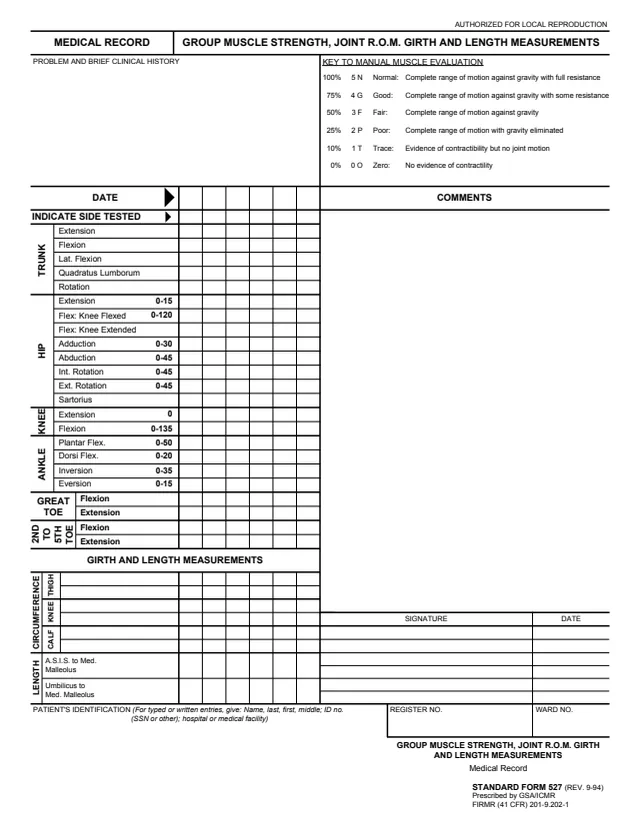
Standard Form 527 (SF 527), Group Muscle Strength, Joint R.O.M. Girth and Length Measurements, is a two-sided medical record printed as STANDARD FORM 527 (REV. 9-94). Its footer says Prescribed by GSA/ICMR, FIRMR (41 CFR) 201-9.202-1, and the top is marked Authorized for Local Reproduction. GSA hosts a copy in its forms library.
The front holds the problem and brief clinical history, a key to manual muscle evaluation, and rows for the trunk, hip, knee, ankle and toes, with ranges such as 0-120 printed beside many motions, then girth and length measurements of the leg. The back covers the neck, scapula, shoulder, elbow and forearm, wrist, thumb and each finger, plus upper extremity girth, grip strength and pinch strength.
The PDF prints no instructions. You can fill it out free in your browser on this page and download the result without an account.
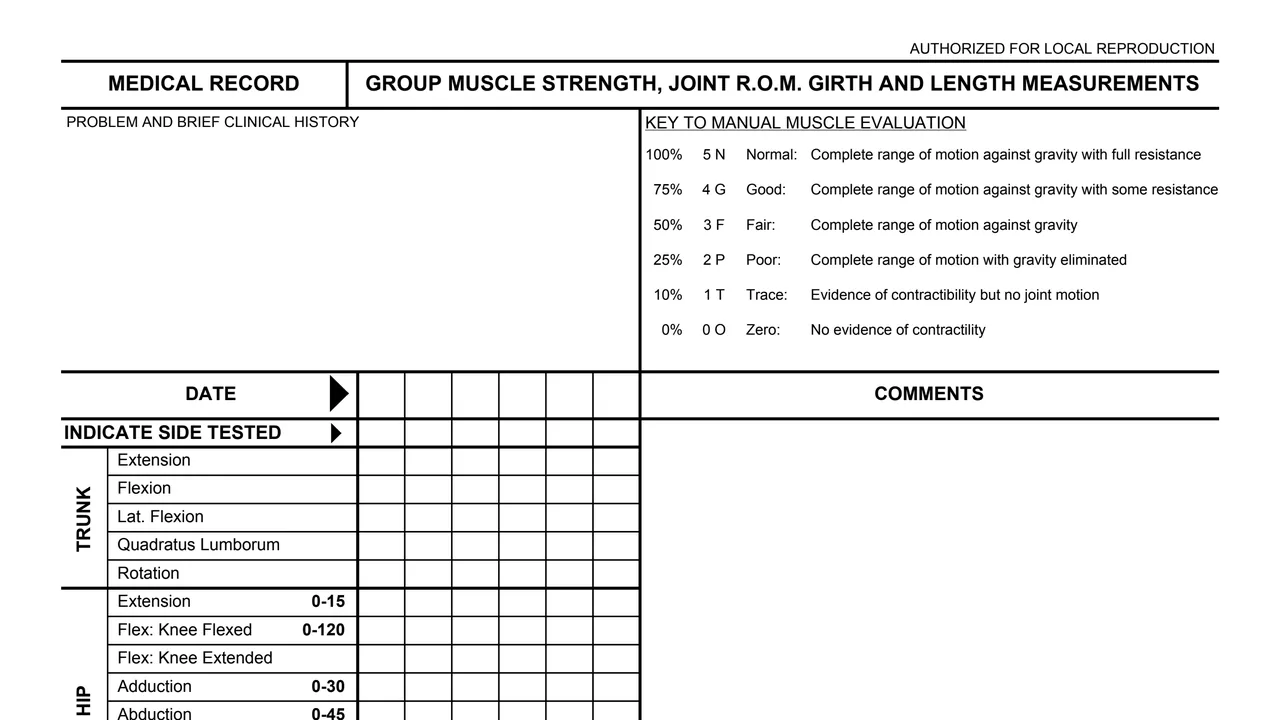
A PROBLEM AND BRIEF CLINICAL HISTORY block and a KEY TO MANUAL MUSCLE EVALUATION from 100% 5 N Normal to 0% 0 O Zero, each grade with its own description.
Trunk extension, flexion, lateral flexion, quadratus lumborum and rotation; hip motions with ranges such as Flex: Knee Flexed 0-120; and knee extension and flexion.
Plantar flexion, dorsiflexion, inversion and eversion of the ankle, then flexion and extension of the great toe and of the 2nd to 5th toes.
Circumference rows for the thigh, knee and calf, and length rows for A.S.I.S. to Med. Malleolus and Umbilicus to Med. Malleolus.
Rows for the neck, scapula, shoulder, elbow and forearm, and wrist, with ranges such as Flexion 0-180 for the shoulder.
Thumb, index, middle, ring and little finger rows, upper extremity girth, finger tip to palm crease and thumb tip to 5th digit distances, grip strength, pinch strength and comments.
Fill in the problem and brief clinical history at the top of the front.
Enter the date and the side tested at the head of a column, on the front and on the back.
Enter results in the rows for each joint. The key on the form gives the grades 5 N, 4 G, 3 F, 2 P, 1 T and 0 O.
Fill in the leg girth and length rows on the front, and the upper extremity girth, distances, grip and pinch strength on the back.
Use the COMMENTS column, then sign and date in the SIGNATURE and DATE rows.
Complete the patient's identification with the register and ward numbers at the foot of the front.
These steps follow the order of the blocks on the two pages.
You get the real form, filled in a browser tab, with nothing standing between you and the finished PDF.
The PDF prints no filing address. It is labeled Medical Record, and the identification block names the hospital or medical facility.
The footer says Prescribed by GSA/ICMR, FIRMR (41 CFR) 201-9.202-1.
The top of the front says AUTHORIZED FOR LOCAL REPRODUCTION.
The PDF prints no instructions, Privacy Act statement or burden estimate.
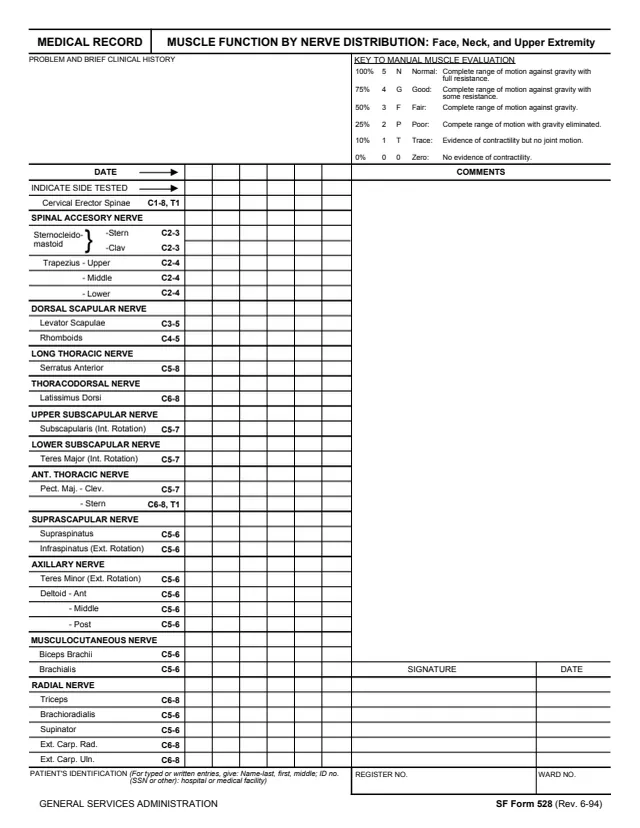
SF528
480 fields, 2 pages
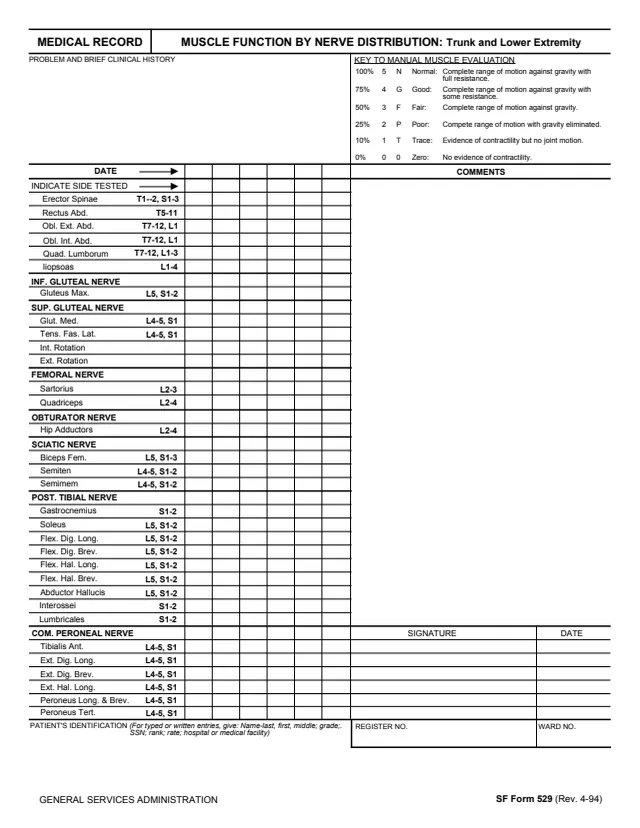
SF529
221 fields, 2 pages
SF507
9 fields, 2 pages
SF509
92 fields, 2 pages
SF513
34 fields, 1 page
SF600
127 fields, 2 pages
The form prints no instructions. Its blocks show who signs and whose record it is.
No tool matches that search.
The footer says Prescribed by GSA/ICMR, FIRMR (41 CFR) 201-9.202-1. GSA hosts a copy in its forms library, printed as STANDARD FORM 527 (REV. 9-94).
The key runs from 100% 5 N Normal, complete range of motion against gravity with full resistance, down to 0% 0 O Zero, no evidence of contractility, with Good, Fair, Poor and Trace in between.
Thigh, knee and calf circumference, two leg length rows, upper extremity girth, the distance from finger tip to palm crease and from thumb tip to 5th digit, grip strength and pinch strength.
The front has SIGNATURE and DATE rows. The form does not name a role for the signer.
No. The PDF prints only the form's labeled blocks and the muscle key.
The top of the front is marked Authorized for Local Reproduction.