Items 1 to 4: action and service
The action code, the date the service is required (MMDDYYYY), the Service User Service ID and, only for code C or D, the TSP Authorization Code.
SF315
Telecommunications Service Priority (TSP) System Request for Service Users
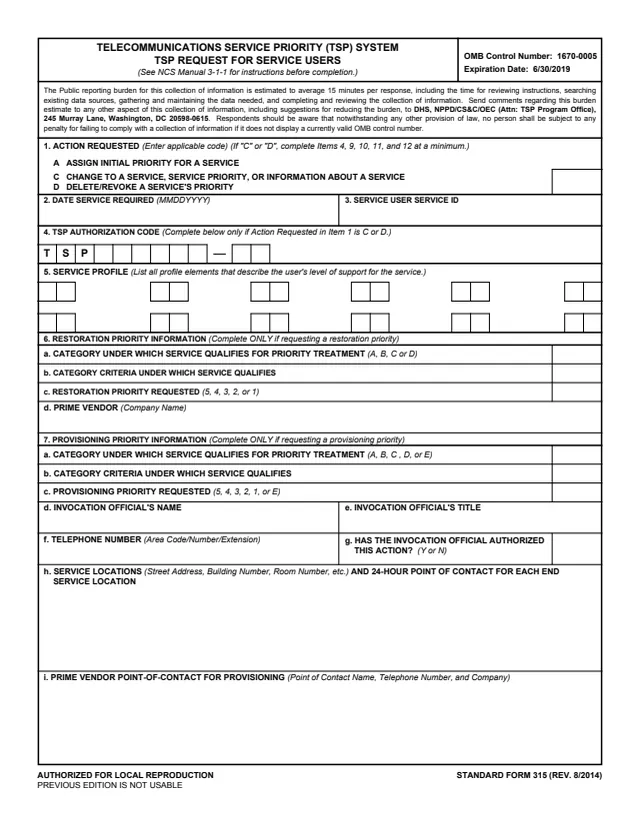
Standard Form 315 (SF 315), printed under the heading Telecommunications Service Priority (TSP) System as the TSP Request for Service Users, asks for action on a service's TSP priority. Item 1 offers three codes: A to assign initial priority for a service, C to change a service, its priority or information about it, and D to delete or revoke a service's priority.
The form is sent to DHS, NPPD/CS&C/OEC (Attn: TSP Program Office), and its Privacy Act notice says the Department of Homeland Security (DHS) will use the information. It carries OMB Control Number 1670-0005 with an expiration date of 6/30/2019, refers to NCS Manual 3-1-1 for instructions, and its footer reads STANDARD FORM 315 (REV. 8/2014). GSA hosts a copy in its forms library. The service user can be a government, the private sector, the U.S. military or other, and the form says non-Federal users send it to their Federal Government sponsor.
You can fill it out free in your browser on this page and download the result without an account.
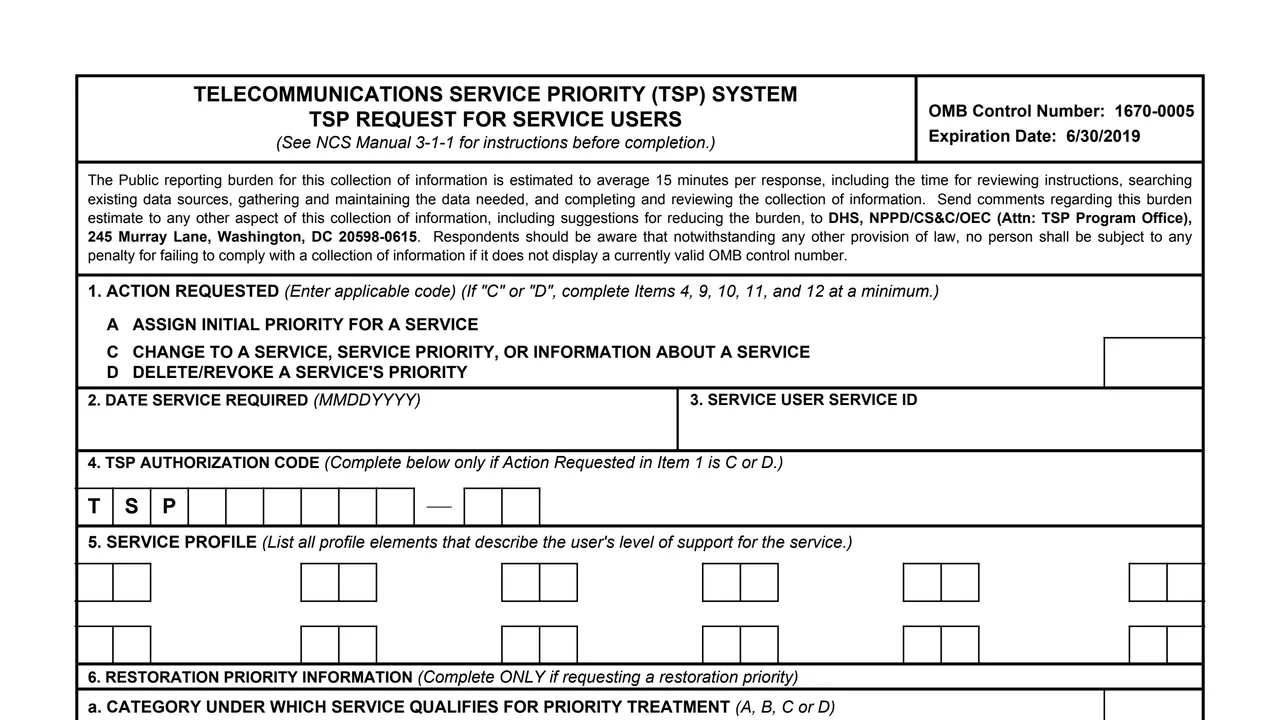
The action code, the date the service is required (MMDDYYYY), the Service User Service ID and, only for code C or D, the TSP Authorization Code.
All profile elements that describe the user's level of support for the service.
Completed only when requesting a restoration priority: the category (A, B, C or D), the category criteria, the restoration priority requested (5, 4, 3, 2, or 1) and the prime vendor.
Completed only when requesting a provisioning priority: the category (A, B, C, D, or E), criteria, priority requested (5, 4, 3, 2, 1, or E), invocation official, service locations with 24-hour contacts and the prime vendor contact.
Supplemental information such as circuit specifications or a justification, the service user code, the organization (with FIPS Code for a Federal agency) and the point of contact's addresses, phone, fax, 24-hour number, email and signature.
Completed by the sponsor: agency and FIPS code, name, title, telephone, recommended disposition (approve, disapprove, or approve with priority level change) and signature.
Use A, C or D. For C or D, the form says to complete items 4, 9, 10, 11 and 12 at a minimum.
Enter the date the service is required, the Service User Service ID and the service profile in items 2, 3 and 5.
The form says to complete item 6 only if requesting a restoration priority, and item 7 only if requesting a provisioning priority.
Item 8 holds circuit specifications for provisioning priority only, a justification for a priority level higher than qualified for, or a justification for a sponsor's disapproval or priority change.
Complete items 9 to 11. The point of contact signs and dates item 11h to confirm this is a National Security and Emergency Preparedness (NS/EP) service.
The form says non-Federal users send it to their Federal Government sponsor, and Federal users or sponsors send the completed form to the TSP Program Office.
The form says to see NCS Manual 3-1-1 for instructions before completion.
You get the real form, filled in a browser tab, with nothing standing between you and the finished PDF.
Federal users or sponsors send the completed form to DHS, NPPD/CS&C/OEC (Attn: TSP Program Office), 245 Murray Lane, Washington, DC 20598-0615.
The form says non-Federal users send it to their Federal Government sponsor, who completes item 12.
The burden statement estimates an average of 15 minutes per response, including time for reviewing instructions and gathering the data.
The form prints OMB Control Number: 1670-0005 and Expiration Date: 6/30/2019, and refers to NCS Manual 3-1-1 for instructions. The manual is not part of the PDF.
The Privacy Act notice cites 5 U.S.C. §301 and 44 U.S.C. §3101. It says furnishing the information is voluntary, but failure to do so may delay or prevent registration or verification for continued use of service.
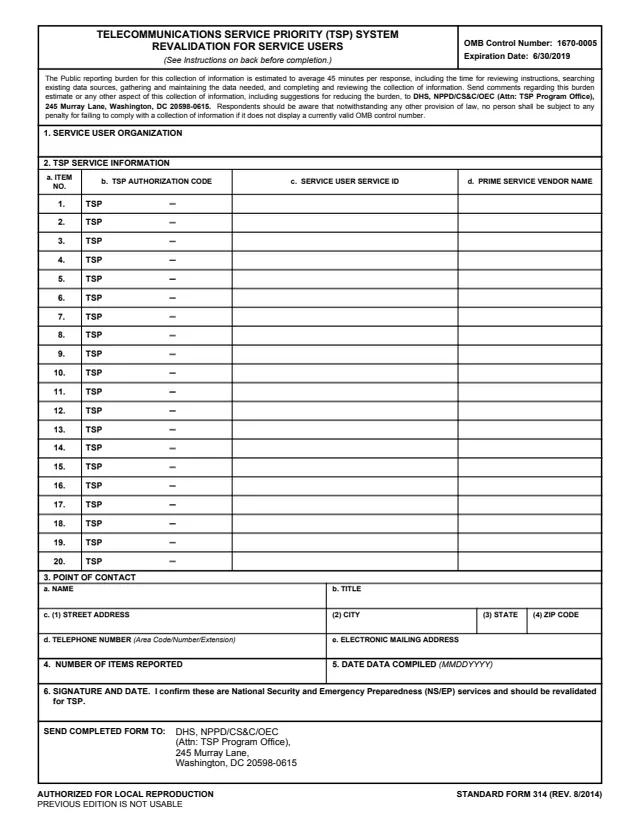
SF314
93 fields, 2 pages
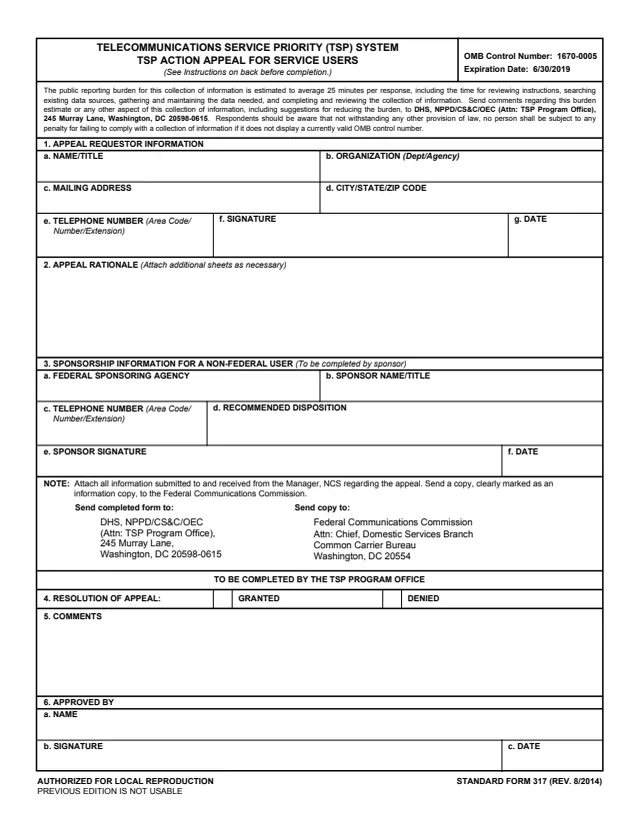
SF317
20 fields, 2 pages
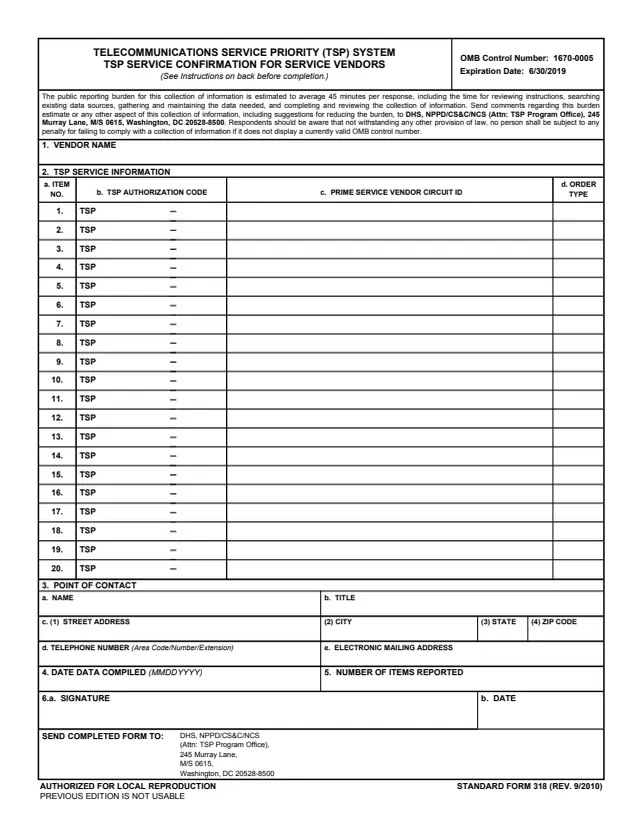
SF318
93 fields, 2 pages
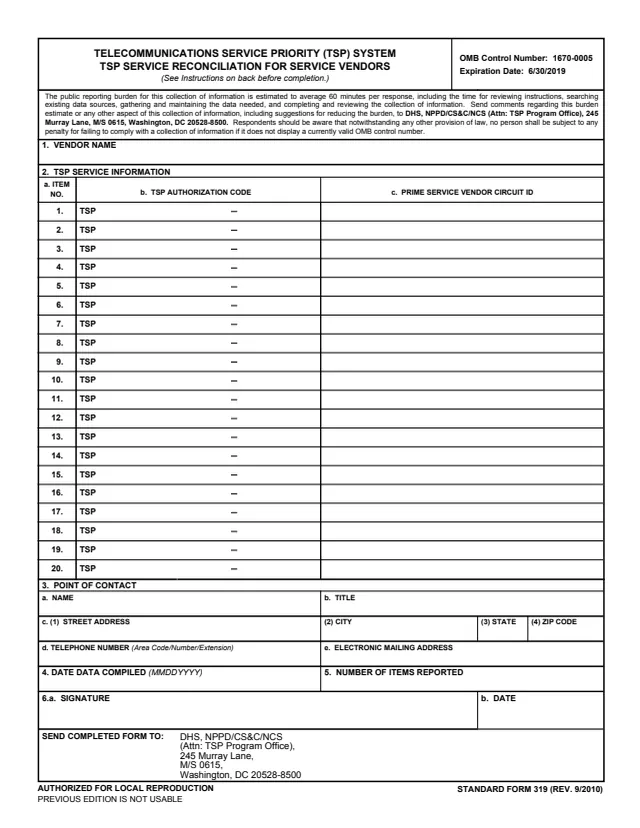
SF319
73 fields, 2 pages
The form names these roles in its items and routing instructions.
No tool matches that search.
The form is sent to the DHS TSP Program Office, and its Privacy Act notice says DHS will use the information. It carries OMB Control Number 1670-0005. GSA hosts a copy in its forms library.
A is assign initial priority for a service, C is change to a service, service priority, or information about a service, and D is delete or revoke a service's priority.
The form says to complete item 6 only if requesting a restoration priority, and item 7 only if requesting a provisioning priority.
The form says non-Federal users send it to their Federal Government sponsor. Item 12 is completed by the sponsor, and Federal users or sponsors send the completed form to the TSP Program Office.
The form says to see NCS Manual 3-1-1 for instructions before completion. The PDF itself does not include the manual.
The burden statement estimates an average of 15 minutes per response.