Section A: identifying information
Name, other names used, mailing address, daytime phone after retirement and the best time to call, email, fax, date of birth, Social Security Number, U.S. citizenship and whether this is a disability retirement.
SF3107
Application for Immediate Retirement FERS
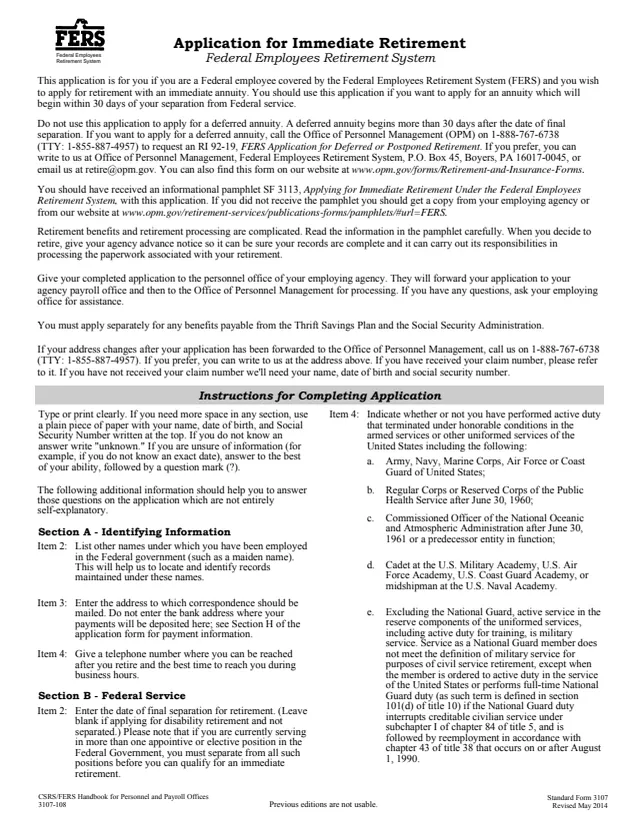
Standard Form 3107 (SF 3107) is the Application for Immediate Retirement under the Federal Employees Retirement System (FERS). The form says it is for Federal employees covered by FERS who want an annuity that begins within 30 days of separation from Federal service. Your agency's personnel office forwards it to your agency payroll office and then to the Office of Personnel Management (OPM) for processing. GSA hosts a copy in its forms library.
The package holds the application (Sections A to I and an applicant's checklist), Schedules A, B and C, SF 3107-1 Certified Summary of Federal Service, SF 3107-2 Spouse's Consent to Survivor Election, and Schedule D, the agency checklist. The form refers to pamphlet SF 3113, Applying for Immediate Retirement Under the Federal Employees Retirement System.
The form says not to use it for a deferred annuity, one that begins more than 30 days after final separation; for that it points to RI 92-19. Thrift Savings Plan and Social Security benefits are applied for separately. You can fill it out free in your browser on this page and download the result without an account.
Name, other names used, mailing address, daytime phone after retirement and the best time to call, email, fax, date of birth, Social Security Number, U.S. citizenship and whether this is a disability retirement.
The agency you are retiring from, the date of final separation, your position title, pay plan and occupational series, and whether you have military service or military retired pay.
Section C asks about a current spouse and any former spouse with a court-ordered benefit. Section D lists five annuity types, each chosen by initialing its box: maximum or partial survivor annuity for a spouse, lifetime only, insurable interest, or former spouse.
Whether you can continue Federal Employees Health Benefits and Federal Employees' Group Life Insurance as a retiree, any court or administrative order for child health coverage, and enrollment in FEDVIP and the Federal Long Term Care Insurance Program.
Workers' compensation and earlier CSRS or FERS applications, an optional list of unmarried dependent children, and how annuity payments are sent: direct deposit, a Direct Express card, or an address abroad, plus tax withholding.
Your signature under a warning about false statements (18 U.S.C. 1001), an applicant's checklist of attachments, and Schedules A, B and C for military service, military retired pay and workers' compensation.
The form says to read the pamphlet that comes with it, and to give your agency advance notice when you decide to retire so it can complete your records.
Type or print clearly. The form says to write "unknown" if you do not know an answer, and to add a question mark after an answer you are unsure of. Extra space goes on plain paper with your name, date of birth and SSN at the top.
The applicant's checklist lists the attachments, such as Schedules A, B and C, a discharge certificate, SF 3107-2, SF 2818, a W-4 form and copies of court orders. Section C asks for a copy of the marriage certificate if married.
Your employing office completes and certifies the Certified Summary of Federal Service. The form says to review it, make sure it lists all of your service, and complete Section E, Employee's Certification.
Sign (do not print) and date Section I after reviewing the warning. Schedules A, B and C have their own certification and signature line.
Hand the completed application to the personnel office of your employing agency, which sends it to the agency payroll office and then to OPM.
You get the real form, filled in a browser tab, with nothing standing between you and the finished PDF.
The personnel office of your employing agency forwards the application to your agency payroll office and then to the Office of Personnel Management for processing.
Schedule D is completed by the office that keeps your Official Personnel Folder and by the payroll office, which the form says closes out your Individual Retirement Record and sends it to OPM no later than 30 days after the pay date of the final paycheck.
The form says a deposit for military service on or after January 1, 1957 is paid to your agency while you are still employed, and that it cannot be paid to OPM after you retire.
Benefits from the Thrift Savings Plan and the Social Security Administration are applied for separately.
If your address changes after the application reaches OPM, the form gives 1-888-767-6738 (TTY 1-855-887-4957) or OPM, Federal Employees Retirement System, P.O. Box 45, Boyers, PA 16017-0045.
The form says it is for Federal employees covered by FERS who are applying for retirement with an immediate annuity.
No tool matches that search.
No. The form says it is not for a deferred annuity, which begins more than 30 days after final separation. It points to RI 92-19, FERS Application for Deferred or Postponed Retirement, from OPM at 1-888-767-6738, [email protected] or www.opm.gov/forms/Retirement-and-Insurance-Forms.
The form says to give it to the personnel office of your employing agency. That office forwards it to your agency payroll office and then to OPM for processing.
The applicant's checklist asks whether SF 3107-2, Spouse's Consent to Survivor Election, is attached if you are married and did not initial box 1 of Section D. The spouse completes Part 2 in front of a notary public or another person authorized to administer oaths, and the form says that consent is final.
The instructions say to write "unknown". If you are unsure, such as about an exact date, answer as best you can and add a question mark.
No. The form says benefits from the Thrift Savings Plan and the Social Security Administration are applied for separately.
Section D says no change will be permitted after the annuity is granted except as explained in pamphlet SF 3113, and it asks applicants to read the pamphlet and consider the election carefully.
The form says the Treasury pays Federal benefits electronically, by direct deposit to a checking or savings account or to a Direct Express debit card. Instead of filling in the bank details, a cancelled personal check can be attached.