Part A: identification
Name, date of birth, Social Security number, whether you are an employee, a retiree or a former employee, any CSA claim number, the department or agency and its location, and the retirement system.
SF3102
Designation of Beneficiary - Civil Service and Federal Employees Retirement Systems
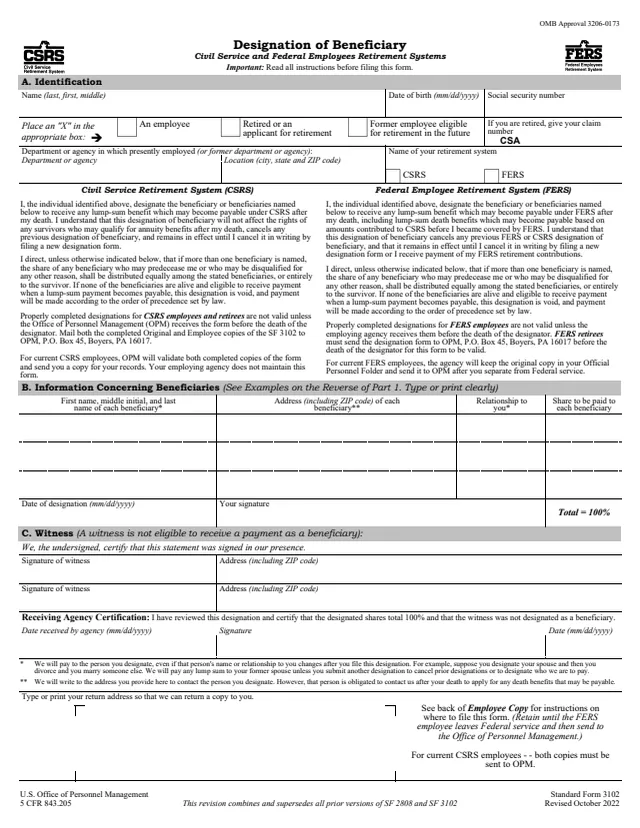
Standard Form 3102 (SF 3102), Designation of Beneficiary, Civil Service and Federal Employees Retirement Systems, is a U.S. Office of Personnel Management (OPM) form, Revised October 2022, citing 5 CFR 843.205, with OMB Approval 3206-0173. GSA hosts a copy in its forms library. The form says this revision combines and supersedes all prior versions of SF 2808 and SF 3102.
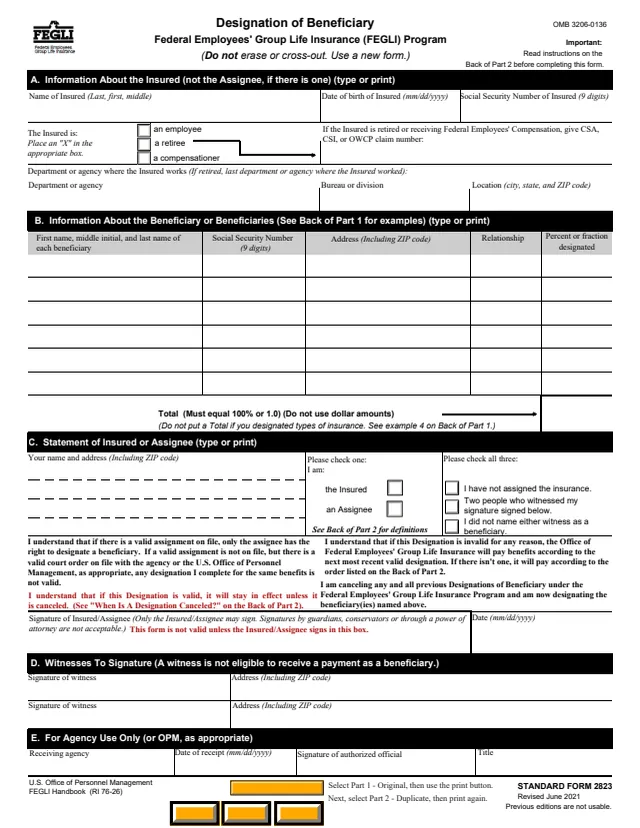
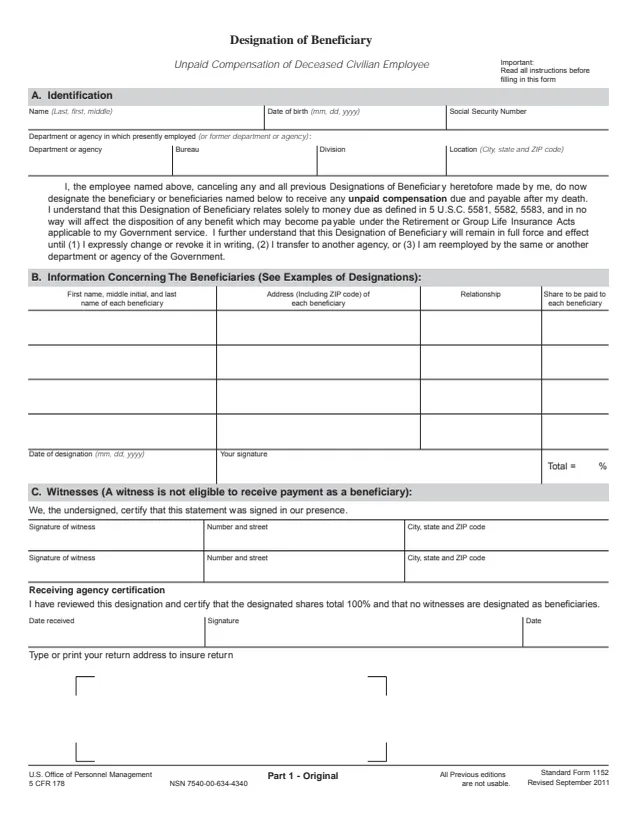
The form says it is used to designate who is to receive a lump-sum payment which may become payable under CSRS or FERS. It does not affect the right of any person who is eligible for survivor benefits, and it may not be used to elect a survivor annuity. It names three other designation forms not to confuse it with: SF 2823 for Federal Employees' Group Life Insurance, TSP-3 for the Thrift Savings Plan and SF 1152 for unpaid compensation.
The form has Part A for identification, Part B for the beneficiaries and their shares, Part C for two witnesses, and a receiving agency certification. OPM estimates an average of 15 minutes per response. You can fill it out free in your browser on this page and download the result without an account.
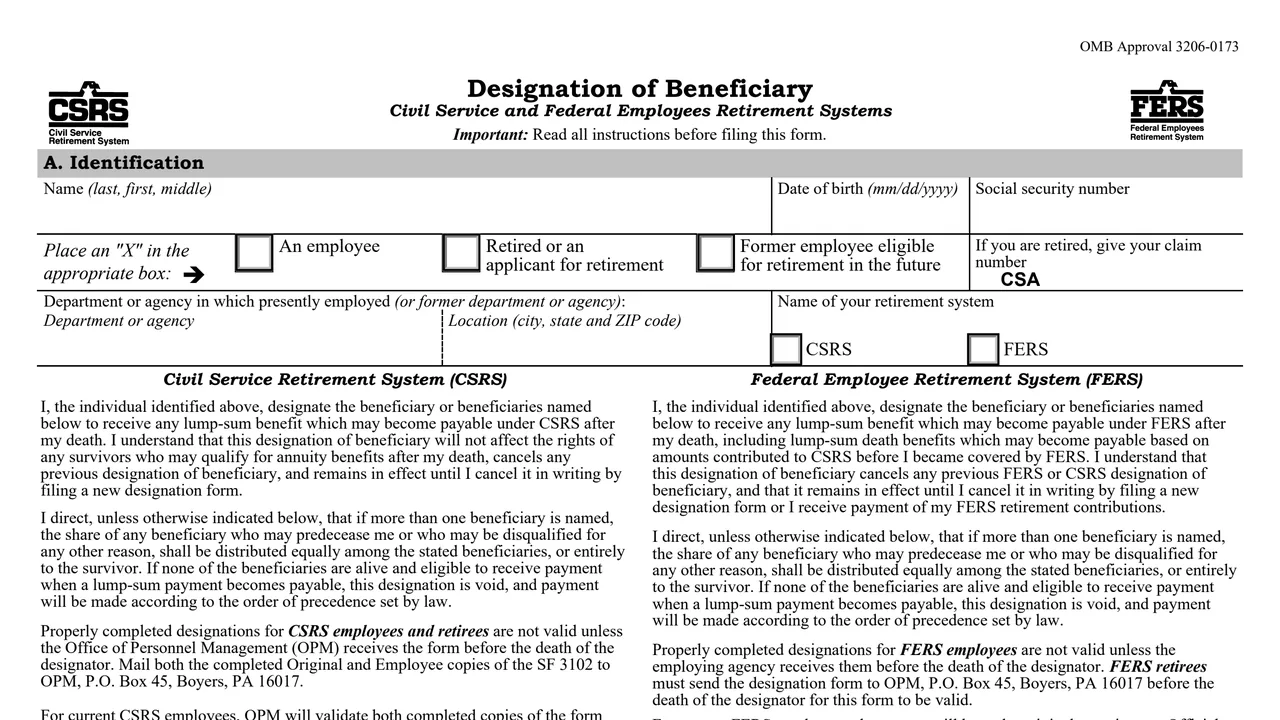
Name, date of birth, Social Security number, whether you are an employee, a retiree or a former employee, any CSA claim number, the department or agency and its location, and the retirement system.
Two statements, one for CSRS and one for FERS, say the designation covers any lump-sum benefit, cancels any previous designation and stays in effect until cancelled in writing by a new form.
Each beneficiary's name, address, relationship to you and share to be paid, with a total of 100%, followed by the date of designation and your signature.
Two witness signatures with their addresses, then the receiving agency certification with the date received, a signature and a date.
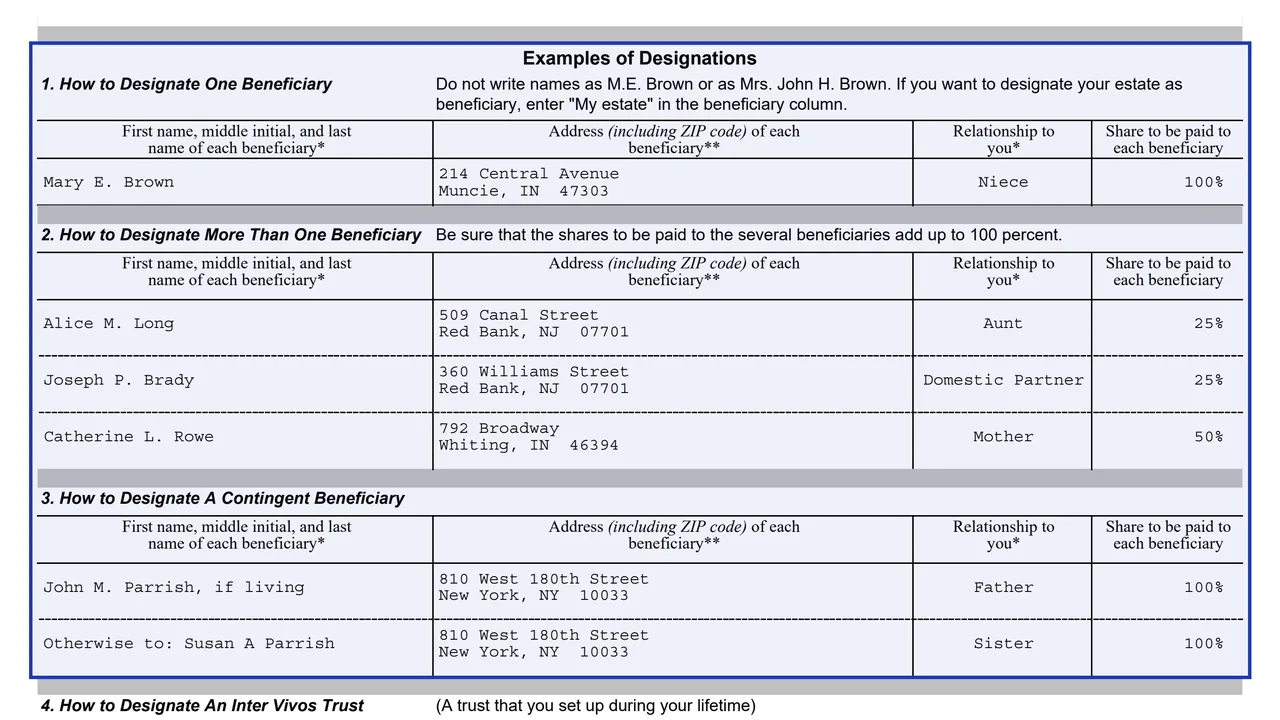
The back of Part 1 shows how to name one beneficiary, several beneficiaries, a contingent beneficiary, an inter vivos trust or a testamentary trust, and how to cancel prior designations.
The instructions list the order the law sets when no designation is on file: widow or widower, children, parents, the executor or administrator of the estate, then other next of kin.
The form says not to fill it out until you have read the information and instructions. Filing it completely cancels any designation under CSRS or FERS filed before.
Do not write names as initials or as Mrs. John H. Brown. To name your estate, the form says to enter "My estate". Shares are percentages, not dollar amounts.
For more than three persons in Part B, attach a blank sheet with your name and date of birth at the top. The same witness signs both the form and the attachment.
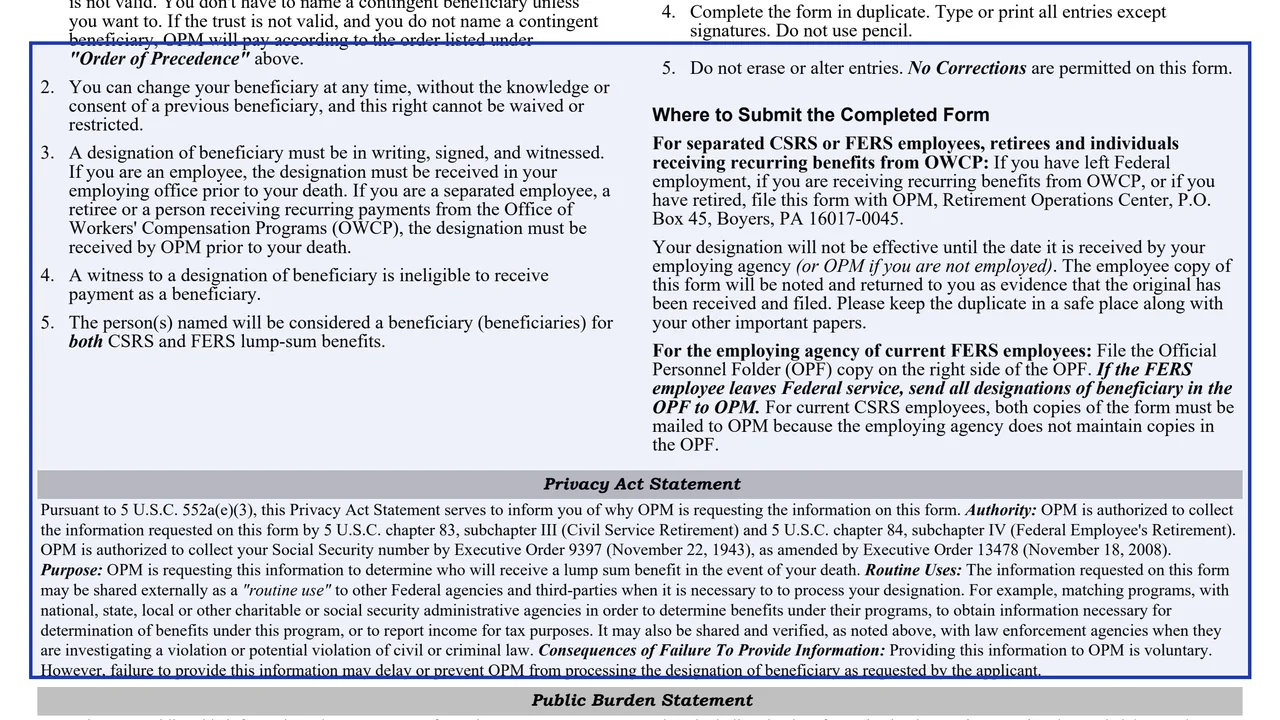
Complete the form in duplicate and type or print all entries except signatures, without pencil. The form says no corrections are permitted on it.
Sign and date in front of two witnesses who are not beneficiaries, and type or print your return address so a copy can be sent back to you.
Current FERS employees file with the employing agency. CSRS employees, retirees and separated employees send the form to OPM at the Boyers, PA address on it.
You get the real form, filled in a browser tab, with nothing standing between you and the finished PDF.
The form says the agency keeps the original copy in the Official Personnel Folder and sends it to OPM after the employee separates from Federal service.
The form says to mail both completed copies to OPM, P.O. Box 45, Boyers, PA 16017. The instructions give OPM, Retirement Operations Center, P.O. Box 45, Boyers, PA 16017-0045.
The form says a designation is not effective until the date it is received by the employing agency, or OPM if you are not employed. The employee copy is returned as evidence the original was filed.
Until it is cancelled by a new designation, or until a refund of retirement deductions is received before retirement. The form says to file a new one if a beneficiary's name or address changes.
OPM collects the information under 5 U.S.C. chapter 83, subchapter III and 5 U.S.C. chapter 84, subchapter IV. The form says providing it is voluntary but not providing it may delay or prevent processing. OPM estimates 15 minutes per response.
SF2823
64 fields, 3 pages
SF1152
33 fields, 4 pages
SF3104
223 fields, 8 pages
SF2800
204 fields, 7 pages
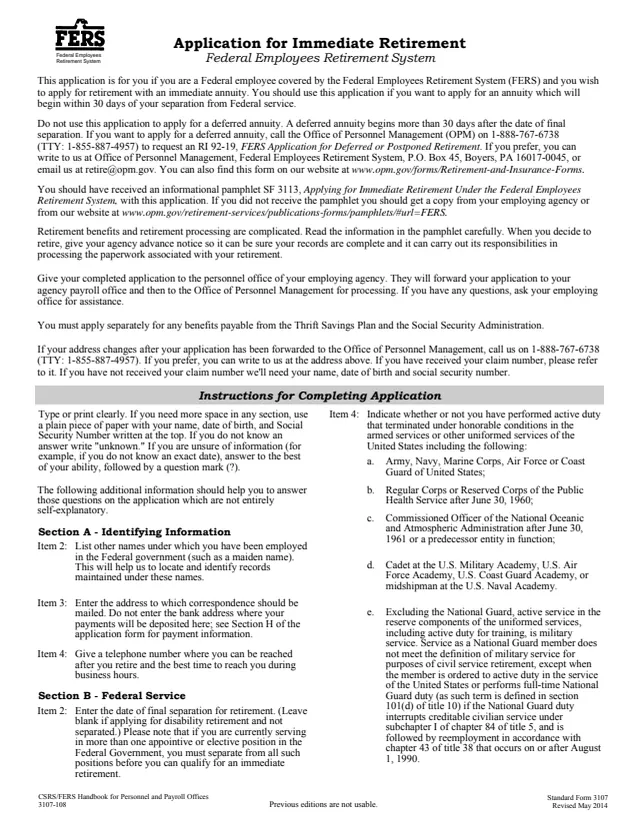
SF3107
470 fields, 14 pages
The form names who designates, who witnesses and who certifies receipt.
No tool matches that search.
The form is printed as a U.S. Office of Personnel Management form, Revised October 2022, OMB Approval 3206-0173, citing 5 CFR 843.205. GSA hosts a copy in its forms library.
No. The form says not to confuse it with SF 2823 for Federal Employees' Group Life Insurance, TSP-3 for the Thrift Savings Plan, or SF 1152 for unpaid compensation of a deceased civilian employee.
The form says a designation is not needed if you are satisfied with the order of precedence the law provides: widow or widower, children, parents, the executor or administrator of the estate, then other next of kin.
The form says payment goes to the person designated even if that person's name or relationship changes. Its example says a former spouse is paid unless another designation is submitted to cancel the earlier one.
No. The form says a witness to a designation of beneficiary is ineligible to receive payment as a beneficiary.
The form says any person, firm, corporation, trust or legal entity can be designated. It shows examples for an inter vivos trust and a testamentary trust, each with a contingent beneficiary.
No. The form says it may not be used to elect, or demonstrate the intent to elect, a survivor annuity for a spouse, former spouse or an individual with an insurable interest.