Section A: identification
Name, date of birth, Social Security number, and the department or agency, bureau, division and location.
SF1152
Designation of Beneficiary - Unpaid Compensation of Deceased Civilian Employee
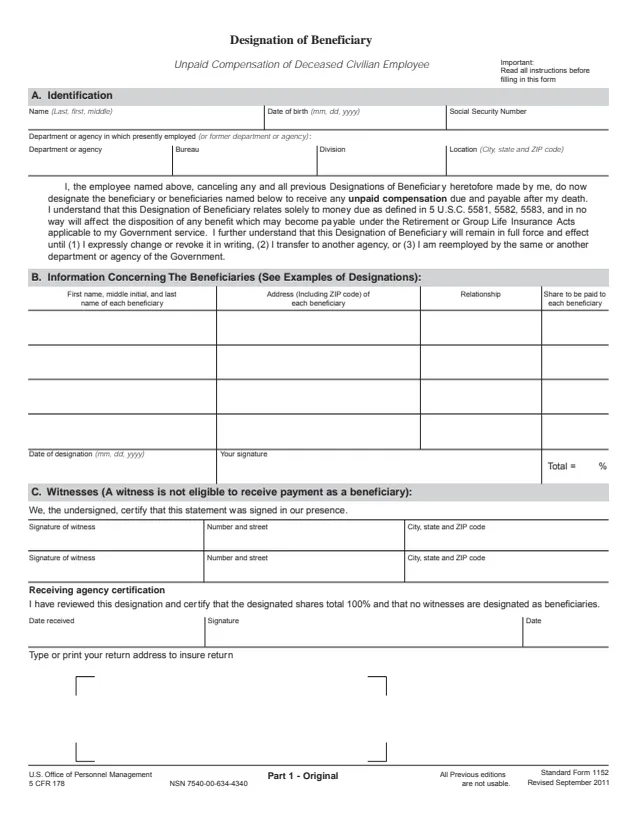
Standard Form 1152 (SF 1152), Designation of Beneficiary, Unpaid Compensation of Deceased Civilian Employee, is a U.S. Office of Personnel Management (OPM) form under 5 CFR 178, Revised September 2011. GSA hosts a copy in its forms library.
On the form, an employee names the beneficiary or beneficiaries to receive any unpaid compensation due and payable after the employee's death. The form says the designation relates solely to money due as defined in 5 U.S.C. 5581, 5582, 5583, and does not affect benefits under the Retirement or Group Life Insurance Acts. It is printed in two parts, the original and an employee copy, with examples, an order of precedence, instructions and a Privacy Act statement on the backs.
The form says filing it completely cancels any Designation of Beneficiary filed before. You can fill it out free in your browser on this page and download the result without an account.
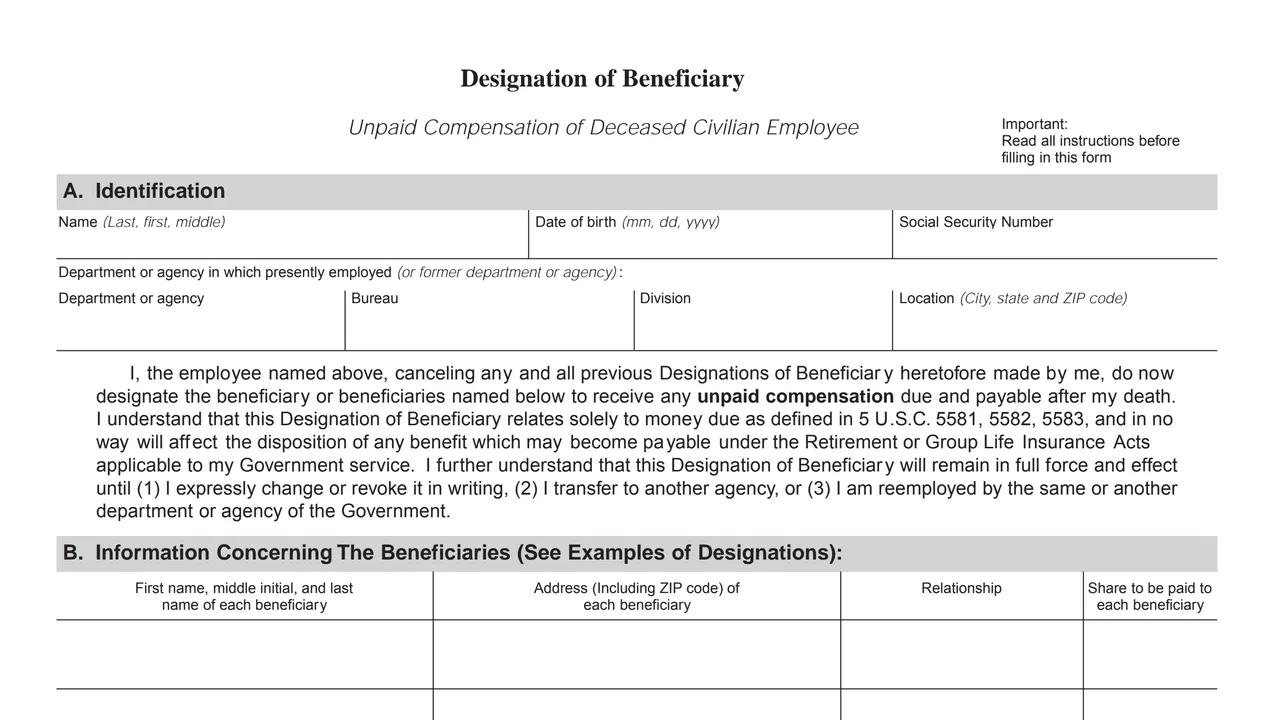
Name, date of birth, Social Security number, and the department or agency, bureau, division and location.
The employee cancels earlier designations and names the beneficiaries below. The statement says the designation stays in effect until changed or revoked in writing, a transfer to another agency, or reemployment.
Each beneficiary's name, address with ZIP code, relationship and share, a total in percent, the date of designation and the employee's signature.
Two witness signatures and addresses, the receiving agency certification, and a space for the return address.
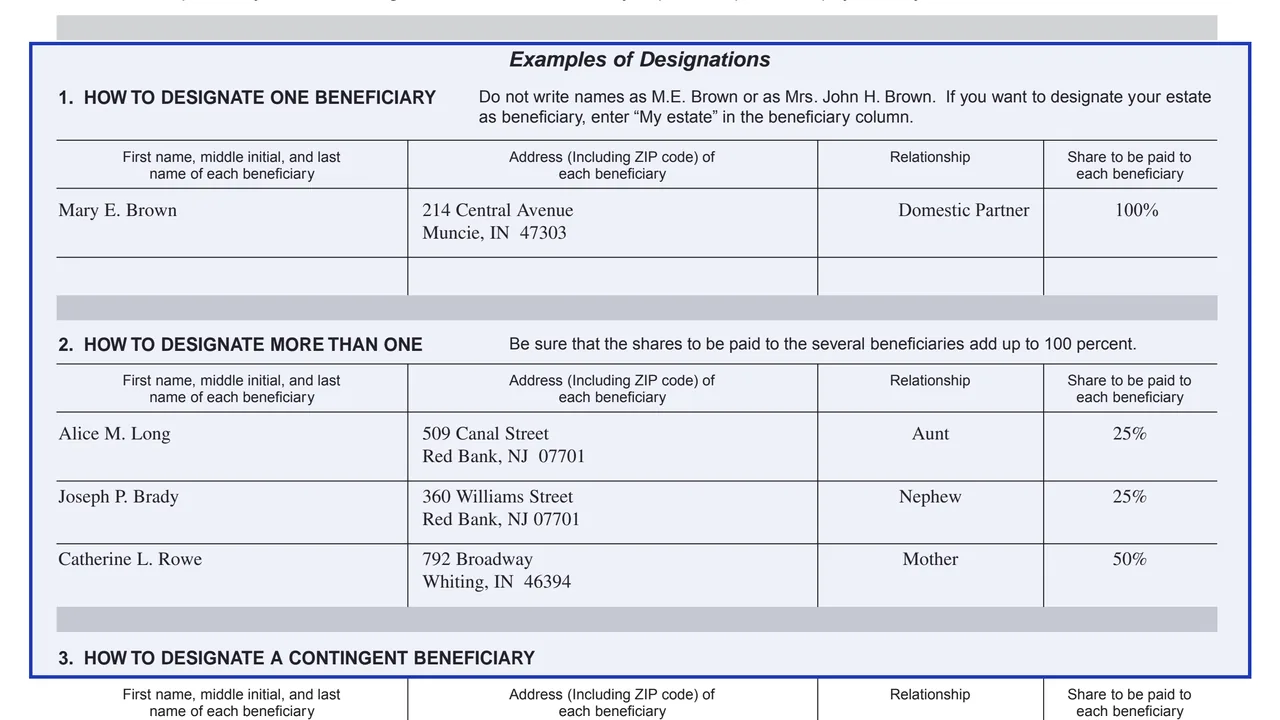
How to designate one beneficiary, more than one, a contingent beneficiary, and how to cancel a designation so payment follows the order of precedence.
The back of the employee copy lists who is paid if no designated beneficiary is alive, seven numbered instructions, and the Privacy Act statement.
The examples say not to write names as M.E. Brown or as Mrs. John H. Brown, and to enter My estate to designate the estate.
The instructions say to type or print all entries in ink except signatures, typing preferred, and to keep the form free of erasures or alterations.
Name each beneficiary with address, relationship and share. The examples say the shares should add up to 100 percent.
The instructions say the form is signed and witnessed. Witnesses sign Section C with their addresses and cannot be beneficiaries.
The form is completed in duplicate and filed with the employing agency. The instructions say the agency receives it before the employee's death for it to be valid.
The duplicate is annotated and returned as evidence the original was received and filed. The instructions suggest filing it with your important papers.
You get the real form, filled in a browser tab, with nothing standing between you and the finished PDF.
To the employing agency. The instructions say that to be valid, the agency receives the completed form before the employee's death.
If no designated beneficiary is alive, the form says unpaid compensation goes in this order: widow or widower, children in equal shares, parents, the legal representative of the estate, then persons entitled under the laws of the State or other domicile.
A name or address change does not need a new form. The designation ends on a change or revocation, a transfer to another agency, or reemployment by the Federal Government.
The form says it is not to be confused with Standard Form 2808 (Civil Service Retirement System), Standard Form 2823 (Federal Employees' Group Life Insurance Program) or Standard Form 3102 (Federal Employees Retirement System).
Solicitation is authorized by the Code of Federal Regulations, Part 178, Subpart B. The information is used to determine the amount, validity and persons entitled to the unpaid compensation, and the statement cites Public Law 104-134 on Social Security or tax identification numbers.
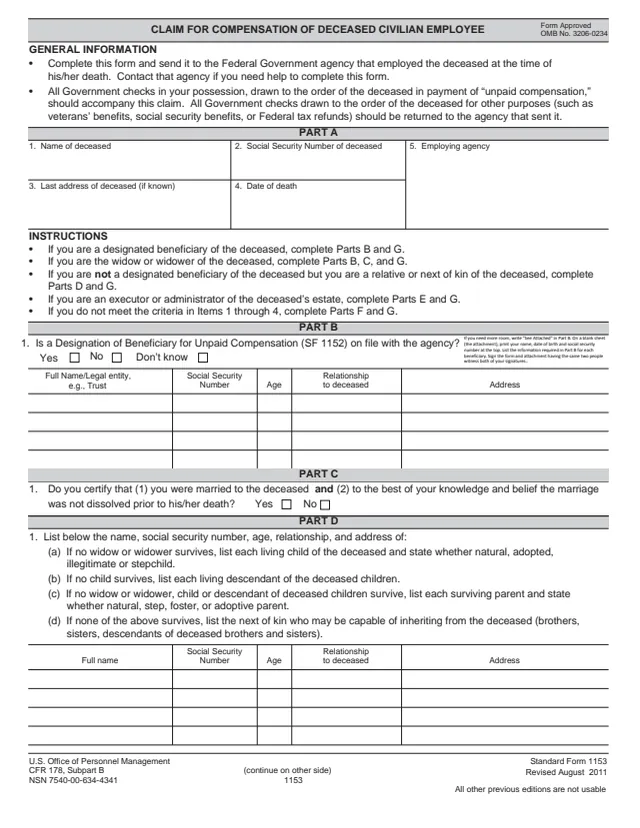
SF1153
73 fields, 2 pages
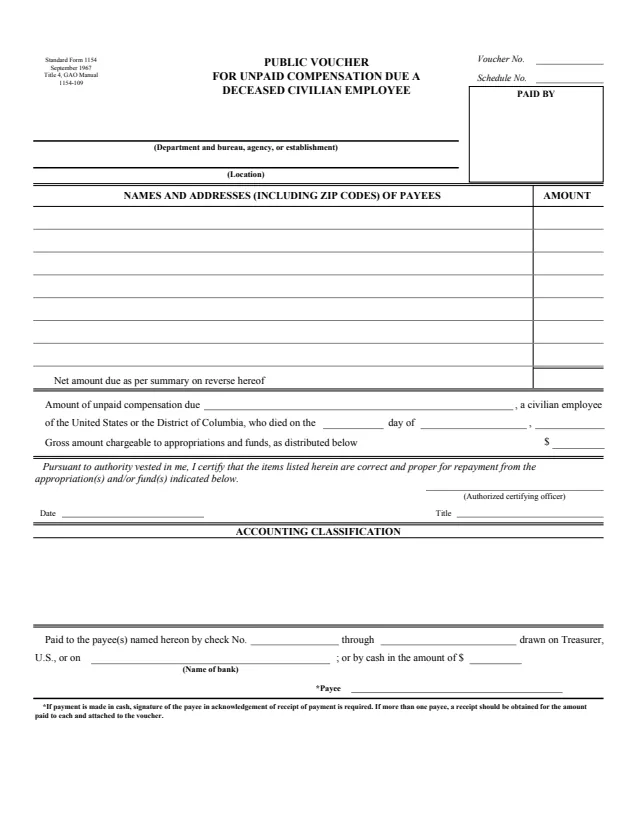
SF1154
79 fields, 2 pages
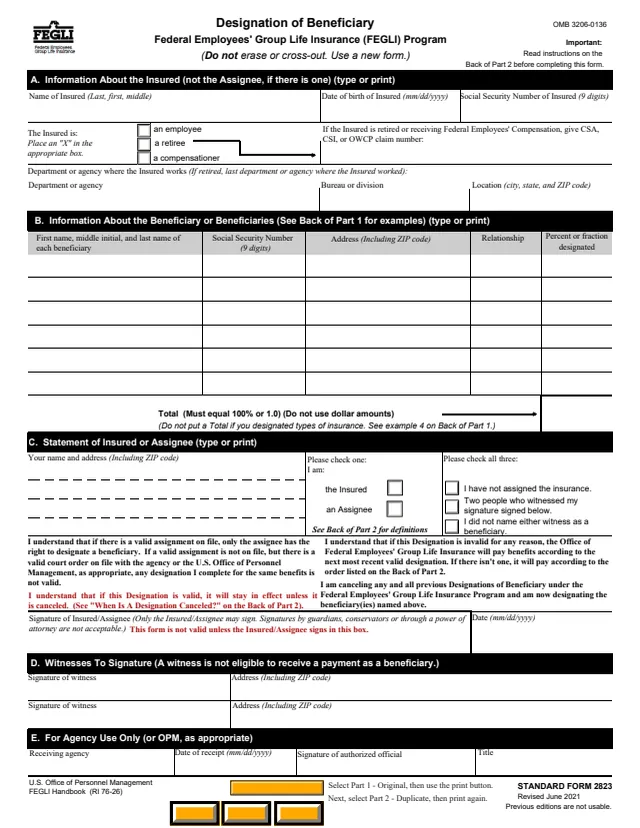
SF2823
64 fields, 3 pages
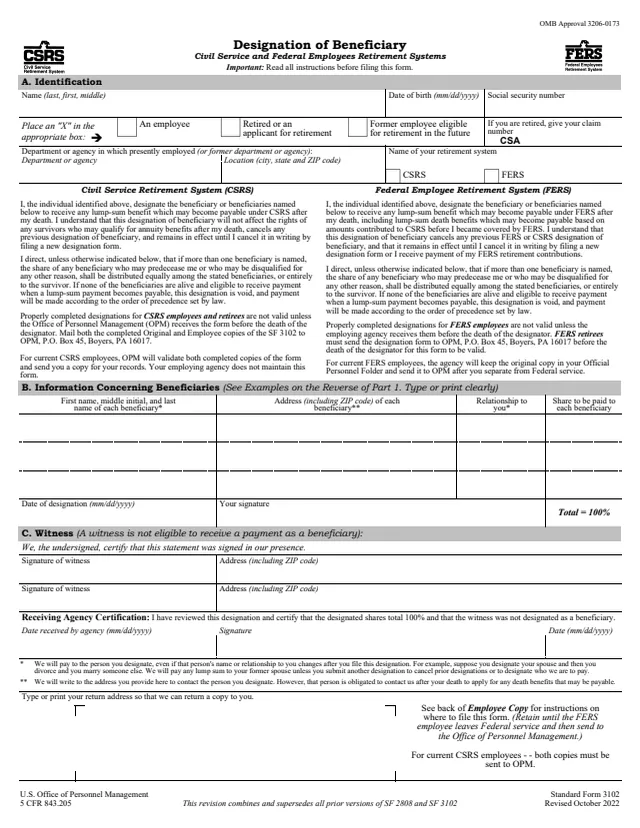
SF3102
34 fields, 3 pages
The form names the employee, the beneficiaries, two witnesses and the receiving agency.
No tool matches that search.
The form is printed as a U.S. Office of Personnel Management form under 5 CFR 178, Revised September 2011. GSA hosts a copy in its forms library.
The form says it relates solely to money due as defined in 5 U.S.C. 5581, 5582, 5583, and in no way affects benefits under the Retirement or Group Life Insurance Acts.
The form lists an order of precedence: widow or widower, then children in equal shares, then parents, then the legal representative of the estate, then persons entitled under State law. It says a designation is not needed unless you want to name someone not listed or change the order.
No. Section C says a witness is not eligible to receive payment as a beneficiary, and the receiving agency certifies that no witnesses are designated.
The instructions say a new form is not needed when your name or address changes or when a beneficiary's name or address changes.
The instructions say to complete a new form and insert Cancel prior designations where the beneficiary name goes. Payment then follows the order of precedence.
No. The form says it is not to be confused with SF 2808 for the Civil Service Retirement System, SF 2823 for Federal Employees' Group Life Insurance or SF 3102 for the Federal Employees Retirement System.