Name, date of birth and SSN
Name (Last, First, Middle Initial), Date of Birth (MM/YYYY) and Social Security Number, followed by the Purpose statement.
SF256
Self-Identification of Disability
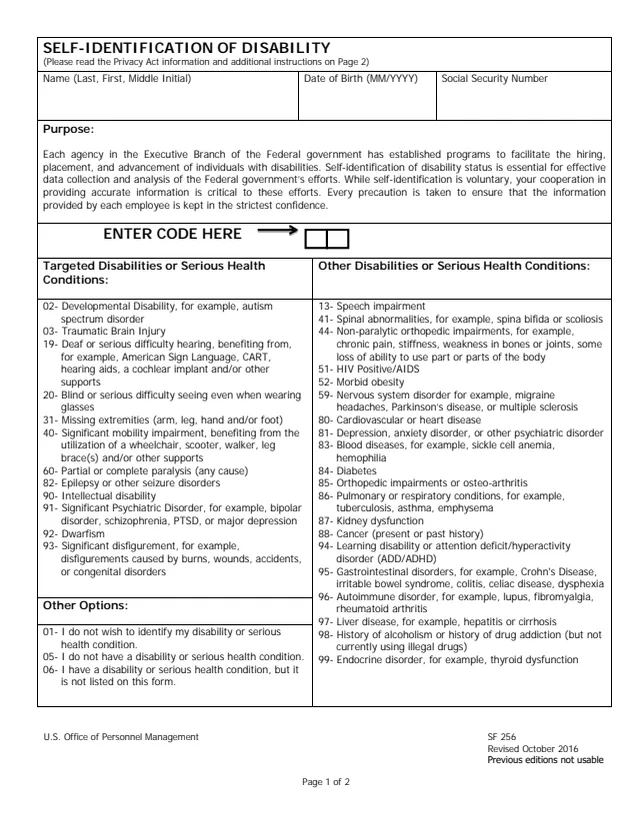
Standard Form 256 (SF 256), Self-Identification of Disability, is a U.S. Office of Personnel Management (OPM) form. Its footer prints SF 256, Revised October 2016, Previous editions not usable, and GSA hosts a copy in its forms library. GSA's page lists the authority as The Rehabilitation Act of 1973, as amended (29 U.S.C. 701, et seq.).
The form says each agency in the Executive Branch of the Federal government has established programs to facilitate the hiring, placement, and advancement of individuals with disabilities, and that self-identification of disability status is essential for effective data collection and analysis of those efforts. It says self-identification is voluntary.
Page 1 asks for a name, date of birth and Social Security Number, and has a box for entering a code from its lists of targeted disabilities, other disabilities and other options. Page 2 holds the definition of disability, the Rehabilitation Act background and the Privacy Act Statement. You can fill it out free in your browser on this page and download the result without an account.
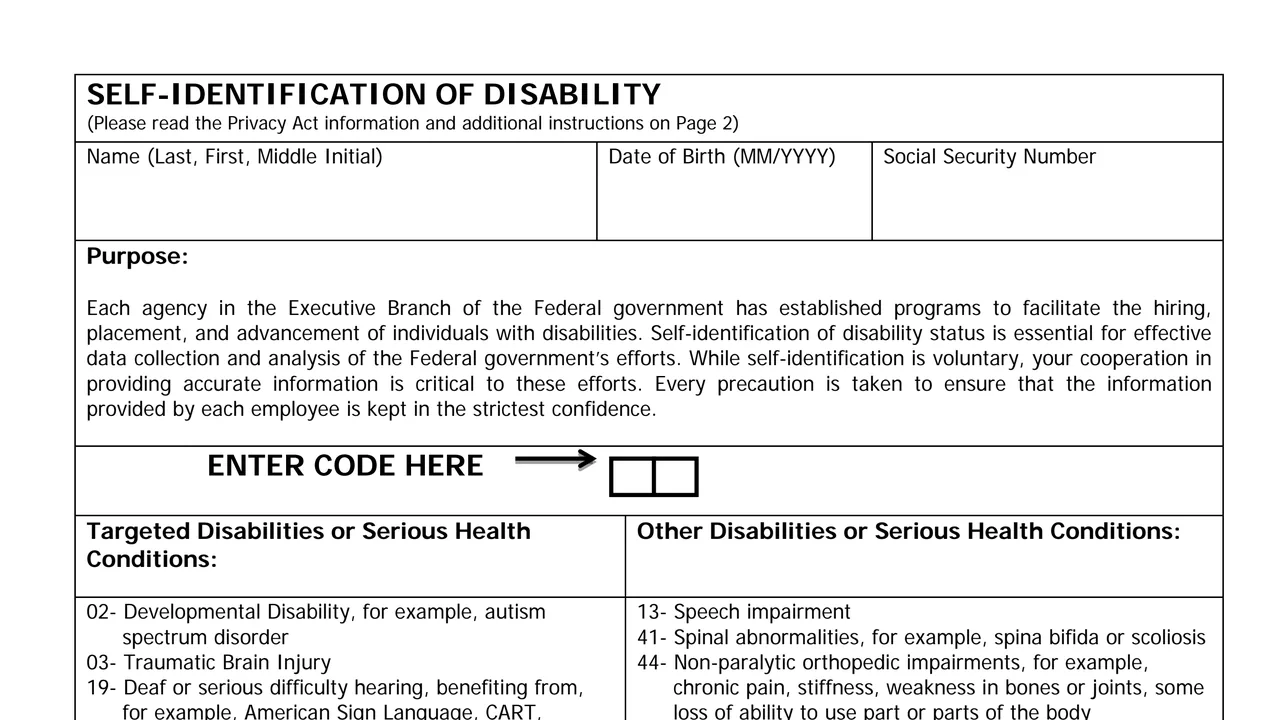
Name (Last, First, Middle Initial), Date of Birth (MM/YYYY) and Social Security Number, followed by the Purpose statement.
A single box where the chosen two-digit code is written. The codes are listed below it in three groups.
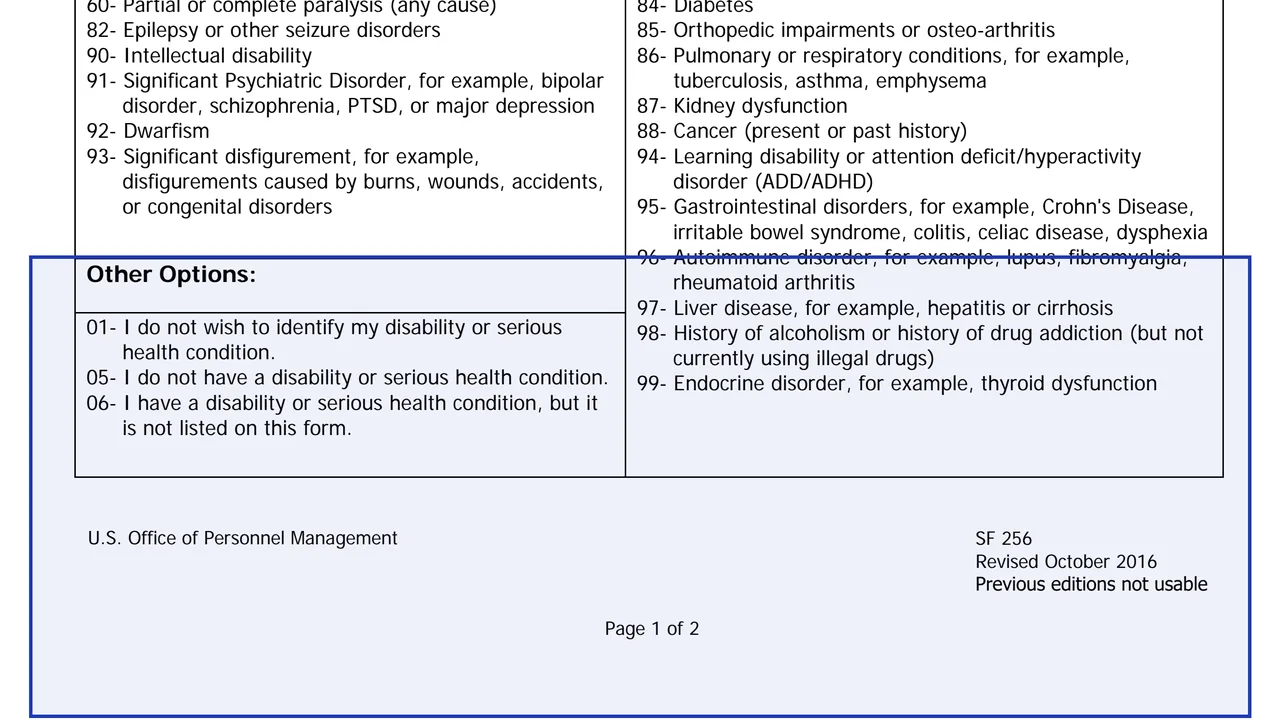
Codes such as 02 Developmental Disability, 03 Traumatic Brain Injury, 19 Deaf or serious difficulty hearing, 20 Blind or serious difficulty seeing, 60 Partial or complete paralysis and 92 Dwarfism.
Codes from 13 Speech impairment through 99 Endocrine disorder, including 80 Cardiovascular or heart disease, 84 Diabetes and 88 Cancer (present or past history).
01 I do not wish to identify my disability or serious health condition, 05 I do not have a disability or serious health condition, and 06 I have one that is not listed on this form.
The definition of an individual with a disability from the Rehabilitation Act of 1973, how the data is used in reports, and the Privacy Act Statement.
The form has two pages: the entries and code lists on page 1, and the background and privacy text on page 2.
The top of the form says to read the Privacy Act information and additional instructions on Page 2.
Write the name as Last, First, Middle Initial and the date of birth as MM/YYYY. The Privacy Act Statement says that where individuals decline to furnish their SSN, it will be obtained from other records.
Find the code that matches in the targeted or other disabilities lists, or one of the Other Options codes 01, 05 or 06.
Enter the two-digit code in the box below the Purpose statement.
The form says the information is known only to those individuals in the agency Personnel Office who obtain and record it. The PDF prints no mailing address.
The form says employees may ask their Personnel Officer for a printout of the code and definition from their individual records.
You get the real form, filled in a browser tab, with nothing standing between you and the finished PDF.
The form says self-identification is voluntary and participation in the disability reporting system is entirely voluntary, except for employees appointed under 5 CFR 213.3102(u).
The form says the data will be used only in the production of reports and not for any purpose that will affect employees individually, except for selective placement and selecting special populations for mailing of voluntary personnel research surveys.
Collection is authorized by the Rehabilitation Act of 1973, as amended (29 U.S.C. 701, et seq.). The form says solicitation of the SSN is authorized by Executive Order 9397 and the SSN is used only to record the correct disability code.
The form says the code in the agency's system will be identical to that carried in OPM's system.
The footer prints U.S. Office of Personnel Management, SF 256, Revised October 2016, Previous editions not usable.
The form is written for employees of Executive Branch agencies. Page 2 describes who collects and uses the information.
No tool matches that search.
The form is printed as a U.S. Office of Personnel Management form, Revised October 2016. GSA hosts a copy in its forms library.
The form says self-identification is voluntary. The one exception it names is employees appointed under the Schedule A authority at 5 CFR 213.3102(u), whose code may be taken from medical documentation if they decline.
The Other Options list includes code 01, I do not wish to identify my disability or serious health condition. Code 06 is for a disability or serious health condition that is not listed on the form.
It quotes the Rehabilitation Act of 1973: a person who has a physical or mental impairment which substantially limits one or more major life activities, has a record of such an impairment, or is regarded as having such an impairment.
The Privacy Act Statement says the SSN is used only to ensure the correct disability code is recorded with other employee information, and that where it is not furnished it will be obtained from other records.
The form says every precaution will be taken to keep it in the strictest confidence and that it is known only to those individuals in the agency Personnel Office who obtain and record it.
The form says employees may ask their Personnel Officer for a printout of the code and definition from their individual records.