Part 1: Certificate Request
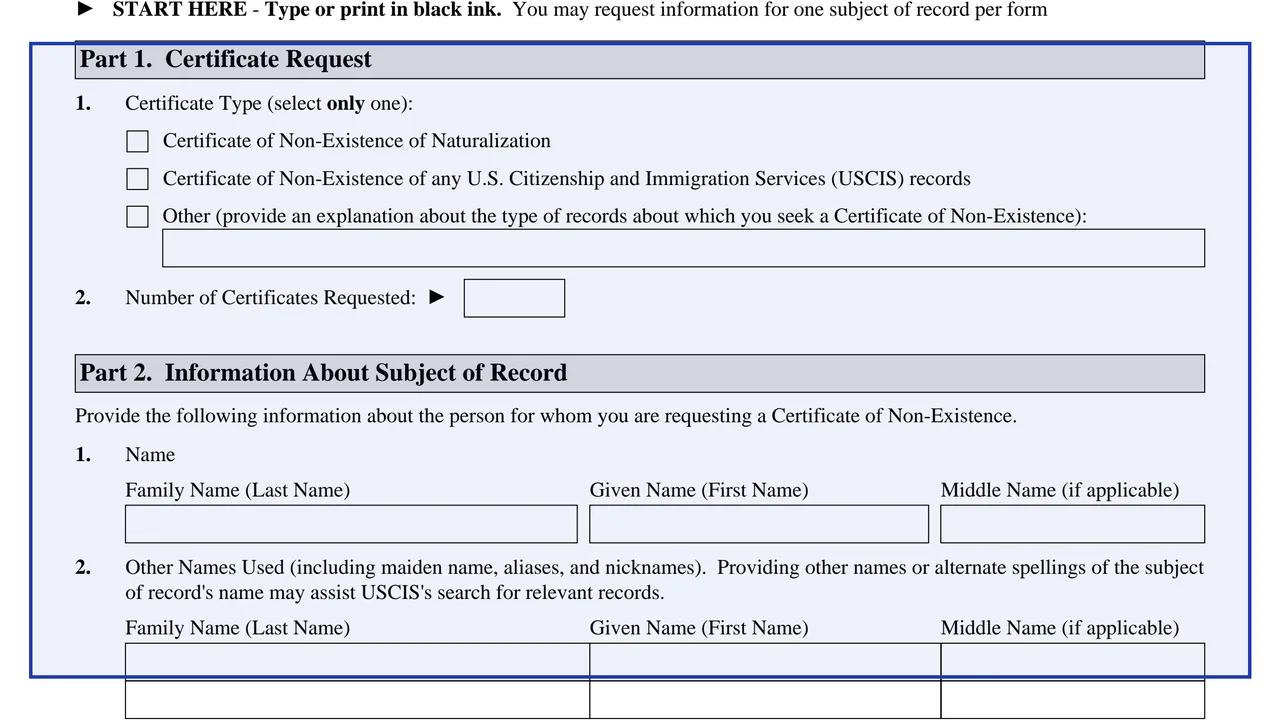
One certificate type: non-existence of naturalization, non-existence of any USCIS records, or Other with an explanation, plus the number of certificates requested.
G-1566
Request for Certificate of Non-Existence
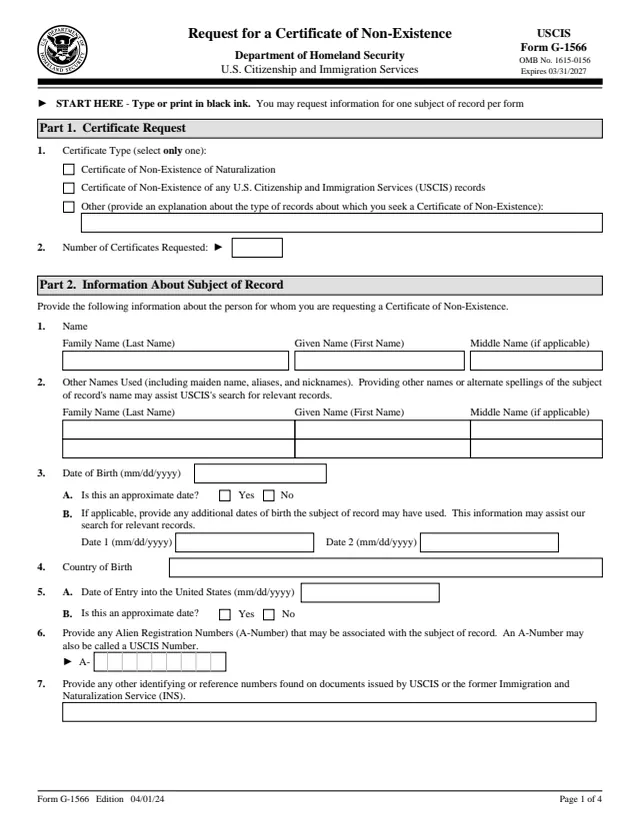
Form G-1566, Request for a Certificate of Non-Existence, asks USCIS to check whether specific immigration records exist for one person, called the subject of record. The USCIS page says that if the records do not exist, USCIS issues a Certificate of Non-Existence. If it finds the records, it responds with additional information and does not issue a certificate.
The instructions say people request these certificates for various purposes, including for use in litigation as evidence as anticipated in 8 U.S.C. 1360(d). USCIS searches records in its custody and control. The instructions say certain records may have been transferred, such as naturalization records before September 27, 1906 and passenger manifests for arrivals before December 1982, and point to the National Archives for those.
One form covers one subject of record. The USCIS page lists filing online or by mail.
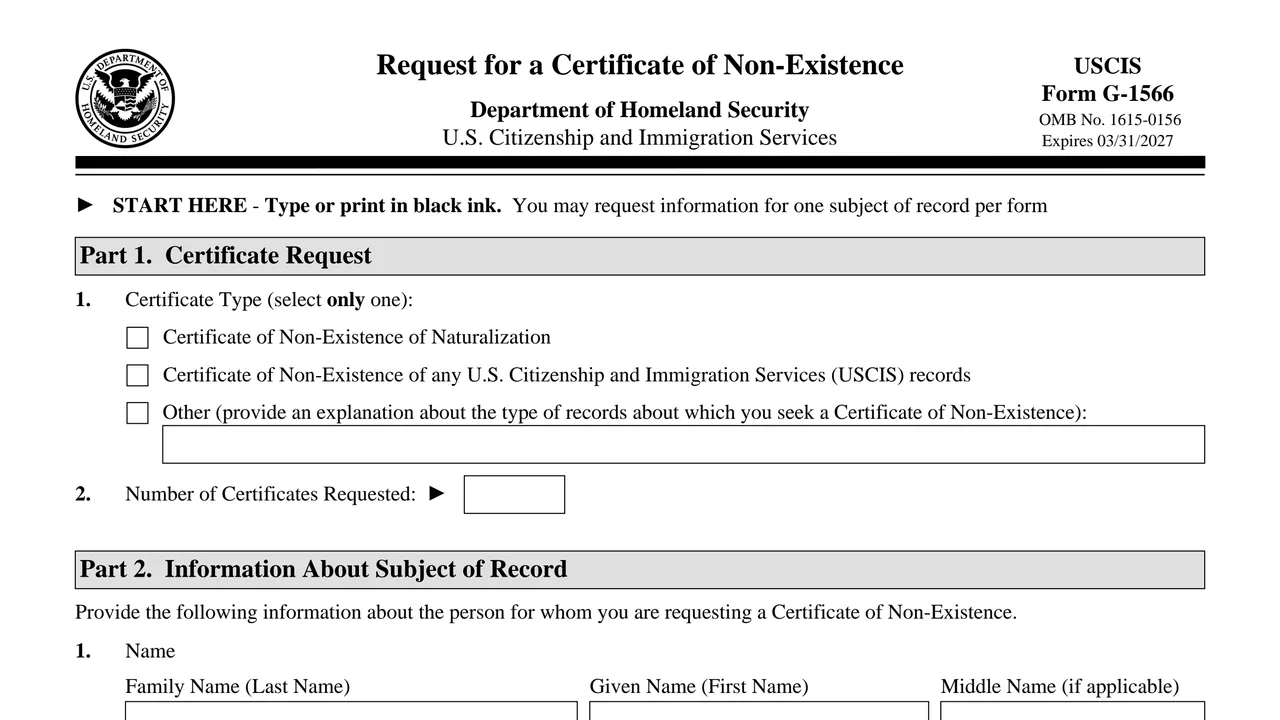
One certificate type: non-existence of naturalization, non-existence of any USCIS records, or Other with an explanation, plus the number of certificates requested.
Name, other names and spellings, date of birth and whether it is approximate, other dates of birth, country of birth, date of entry, A-Numbers, other INS or USCIS numbers, and spouse and children's names.
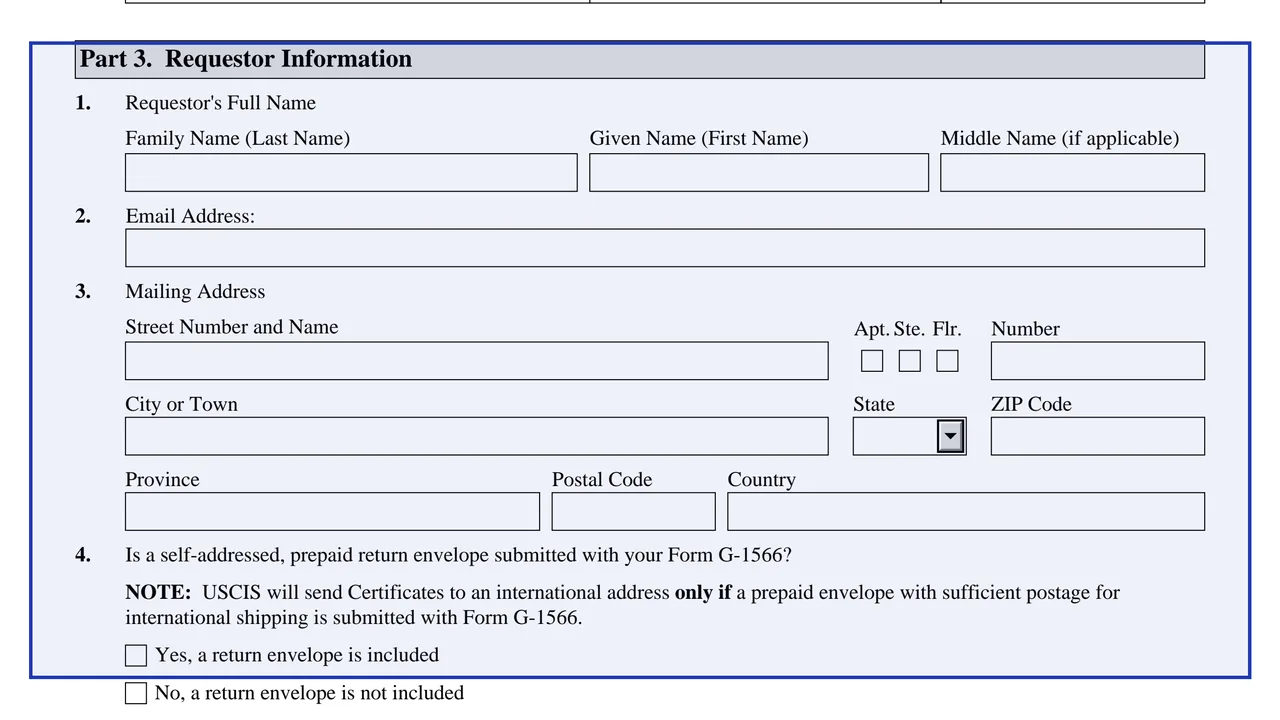
The requestor's name, email address, mailing address, and whether a self-addressed, prepaid return envelope is included.
A declaration under penalty of perjury or a notarized affidavit of identity for a living subject, a box for a deceased subject, and the requestor's signature.
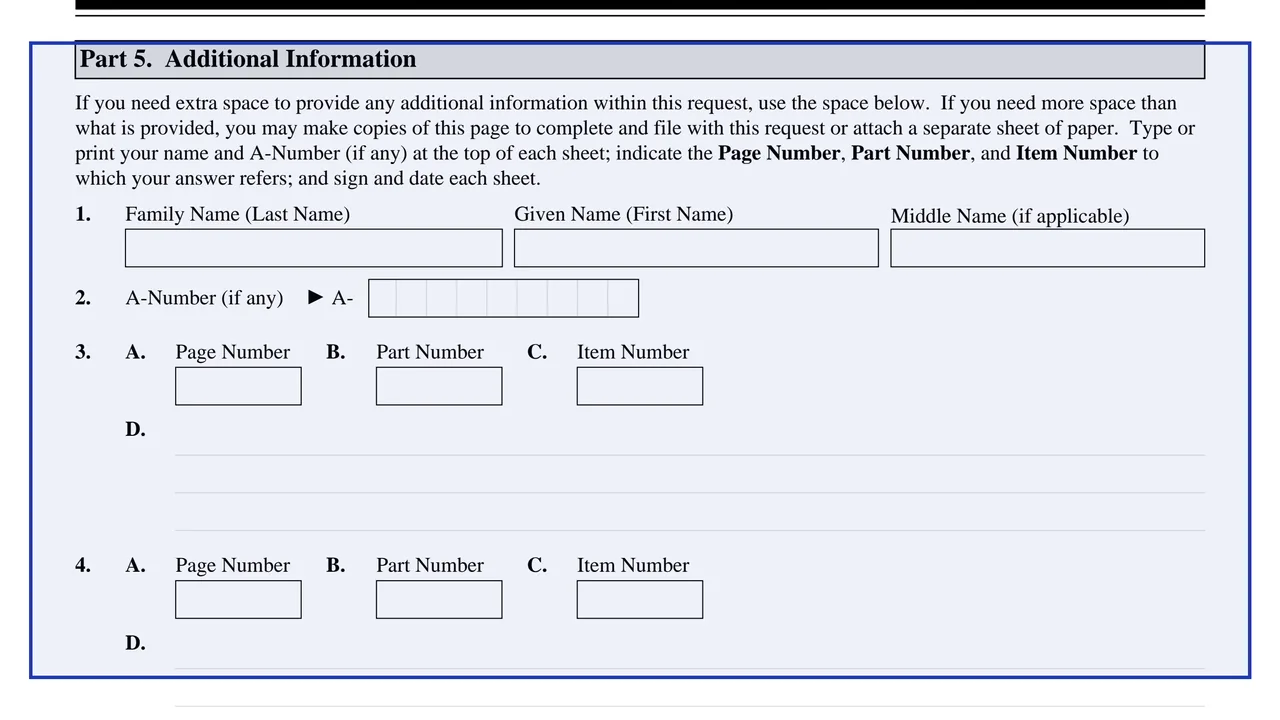
Extra space for longer answers, with the page, part and item number each answer refers to.
Select only one option in Part 1, Item 1, and enter how many certificates are requested. The form allows one subject of record per form.
The form says other names, alternate spellings and additional dates of birth may assist the USCIS search. The page checklist asks for all possible names, aliases and dates of birth, and the country of birth.
The page checklist asks for a valid U.S. mailing address. The form says USCIS sends certificates to an international address only if a prepaid envelope with enough international postage is included.
A living subject signs Item 1 (declaration under penalty of perjury) or Item 2 (notarized affidavit, signed only when the notary gives instructions). For a deceased subject, check Item 7 and the requestor signs Item 8.
The instructions say proof of death is required when the subject was born less than 100 years ago and is deceased. For a U.S. citizen who married a foreign national between 1907 and 1922, proof of marriage is required.
Type or print in black ink and write N/A or None where a question does not apply. The instructions say a stamped or typed name is not accepted. This page lets you fill the form online free, then print it.
You get the real form, filled in a browser tab, with nothing standing between you and the finished PDF.
The USCIS page lists two options: online through the USCIS Certificate of Non-Existence submission page, or by mail. Case status can be viewed on the Check Case Status page.
The page lists the USCIS Elgin Lockbox, Attn: G-1566 Manual Process: P.O. Box 4074, Carol Stream, IL 60197-4074 for USPS, or 2500 Westfield Drive, Elgin, IL 60124-7836 for FedEx, UPS and DHL.
The fee is on the USCIS Fee Schedule page (Form G-1055), which can change. Check it on the day you file.
The current edition is 04/01/24. The USCIS page says it will also accept the 07/19/22 edition.
The instructions ask for legible photocopies unless an original is requested. A foreign-language document needs a full English translation with the translator's certification.
The USCIS page says it rejects any unsigned form. It lists [email protected] for questions about submitting Form G-1566.
No tool matches that search.
The instructions say a Certificate of Non-Existence is not issued. Instead the requestor is notified and given a response.
No. The form says information may be requested for one subject of record per form.
No. The instructions say proof of death is required if the subject was born less than 100 years ago, and is not required if the subject was born 100 years ago or more.
Yes. The USCIS page lists online filing through its Certificate of Non-Existence submission page, as well as filing by mail to the Elgin Lockbox.
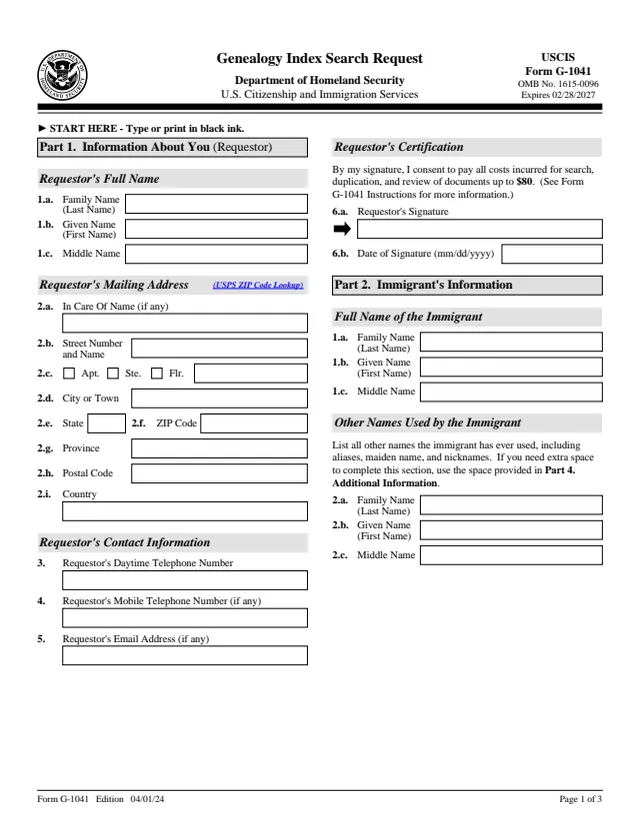
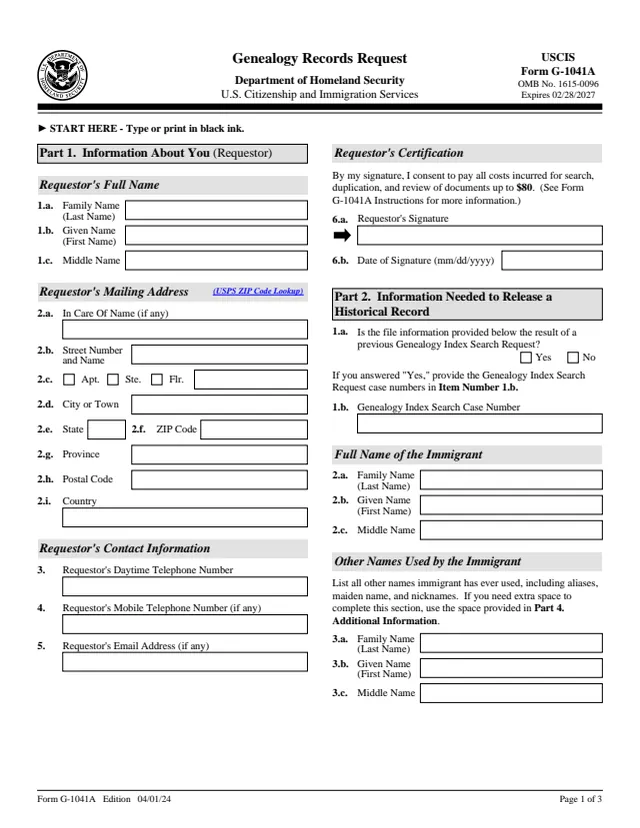
No. The instructions point to Form G-1041 or Form G-1041A for genealogy searches and historical records, and to a FOIA request (Form G-639) for other immigration records.
The instructions say USCIS searches records in its custody and control. Naturalization records before September 27, 1906 and arrival manifests before December 1982 may have been transferred, and the instructions point to the National Archives.