EOIR-29

Notice of Appeal to the Board of Immigration Appeals from a Decision of a DHS Officer

Agency
USCIS
Revision
Edition 02/01/26
Fillable fields
25
Pages
4
Official source
USCIS form page
Checked
October 20, 2026
Fill EOIR-29 online
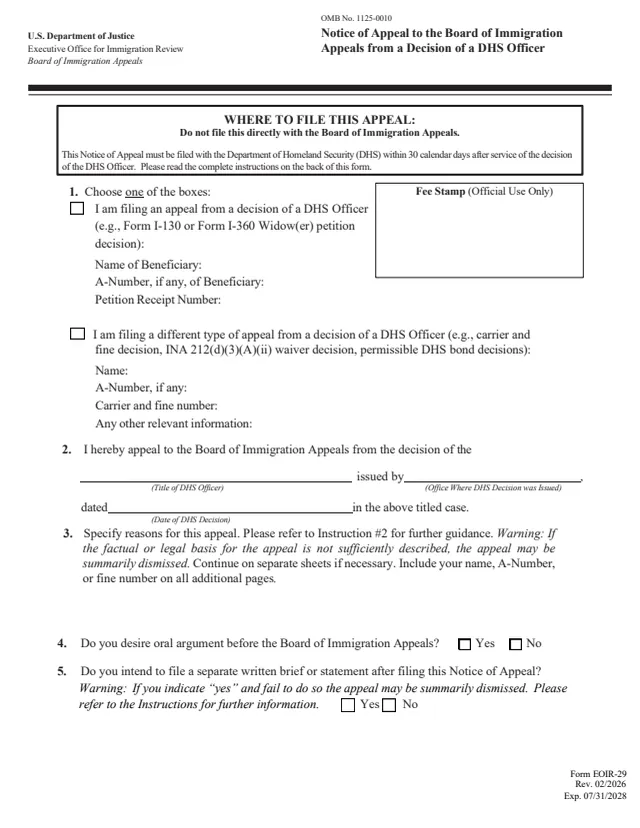
Page 1 of form EOIR-29

Form EOIR-29: Notice of Appeal to the BIA from a Decision of a DHS Officer

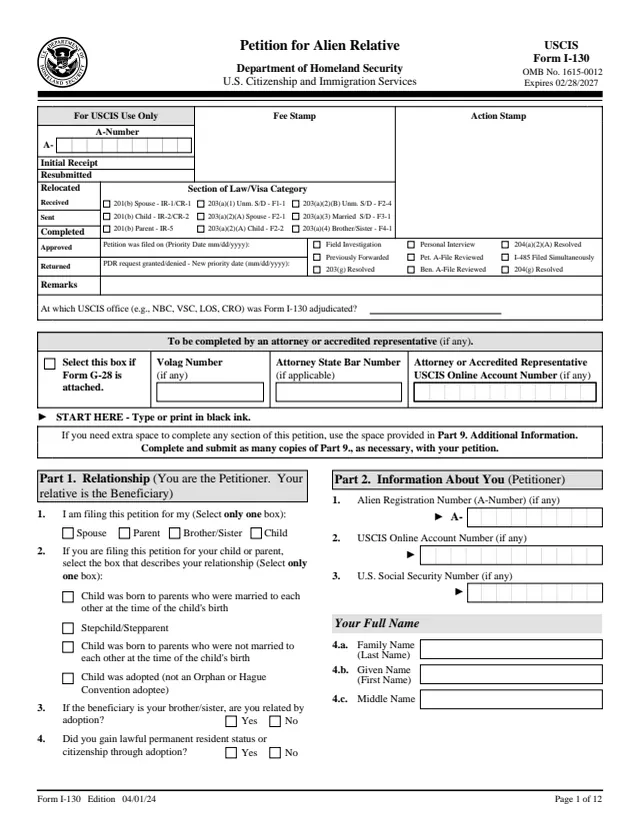
Form EOIR-29, Notice of Appeal to the Board of Immigration Appeals from a Decision of a DHS Officer, is a U.S. Department of Justice form (OMB No. 1125-0010) from the Executive Office for Immigration Review. USCIS says to use it to appeal an unfavorable USCIS decision on a Form I-130, Petition for Alien Relative, or a Form I-360 for widow(er) filings only.

The form itself says not to file it directly with the Board of Immigration Appeals. It is filed with the Department of Homeland Security (DHS), and the instructions name USCIS or U.S. Customs and Border Protection (CBP). The form also covers other DHS officer decisions, such as carrier and fine decisions, INA 212(d)(3)(A)(ii) waiver decisions and permissible DHS bond decisions.

USCIS says not to use this form to appeal a Department of State consular officer's denial of a visa application, for example DS-157, DS-230 or DS-260. The general instructions are printed on the back of the form.

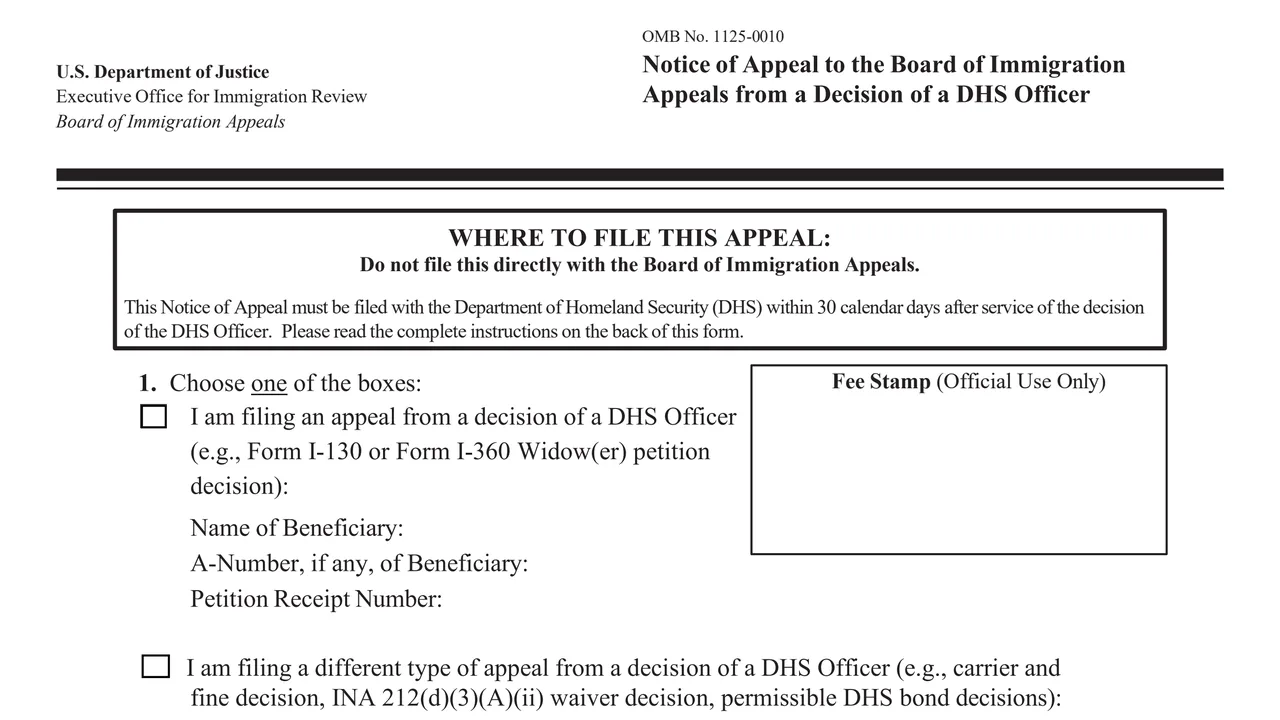
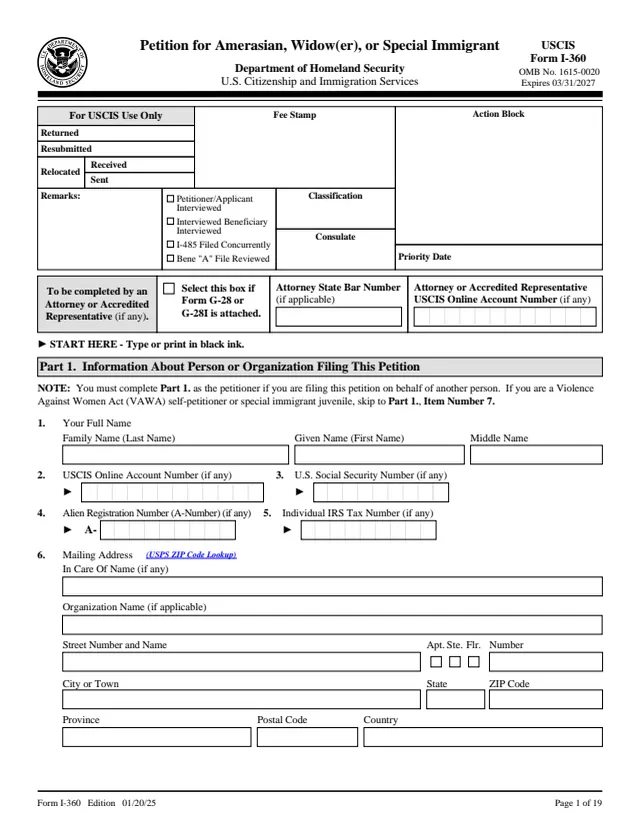
Top of page 1 of Form EOIR-29: Notice of Appeal to the BIA from a Decision of a DHS Officer, as printed by USCIS

What's on Form EOIR-29

Item 1: Type of appeal

One box for a Form I-130 or Form I-360 widow(er) decision, with the beneficiary's name, A-Number if any and petition receipt number. The other box is for a different DHS appeal, with name, A-Number, carrier and fine number and other relevant information.
Item 2: The decision being appealed

The title of the DHS officer, the office where the decision was issued and the date of the DHS decision.

Item 3: Reasons for the appeal

A statement of the reasons. The form warns that if the factual or legal basis is not sufficiently described, the appeal may be summarily dismissed. Extra sheets carry the name, A-Number or fine number.

Items 4 and 5: Oral argument and brief

Yes or No for oral argument before the Board, and Yes or No for whether a separate written brief or statement will follow the notice.

Item 6: Signature and mailing address

The date, the signature of the appellant or petitioner or of an attorney or representative who filed Form EOIR-27, the printed name and a mailing address, which may be a safe address.

How to fill out Form EOIR-29

  1. 1

    Use an accepted edition

    The USCIS page lists edition 02/01/26 and still accepts the July 2025, July 2019, March 2018, July 2015, January 2015, October 2013, October 2012 and April 2009 editions. Keep the edition date and page numbers visible on every printed page.

  2. 2

    Check one box in Item 1

    For a Form I-130 or Form I-360 widow(er) decision, the instructions say to list the beneficiary's name and A-Number at the top of the form, plus the petition receipt number.

  3. 3

    Copy the decision details into Item 2

    The officer's title, the issuing office and the decision date come from the denial or revocation letter. The instructions say to follow the appeal instructions included with the decision.

  4. 4

    Describe the reasons in Item 3

    Give the factual or legal basis for the appeal. A request for review by a three-judge panel can name the specific basis, and the instructions list the cases where a panel reviews.

  5. 5

    Answer Items 4 and 5 with care

    The form warns that answering Yes to a separate brief and not filing one may lead to summary dismissal. The instructions say briefs go to DHS, at the same office as the notice, within the time DHS sets.

  6. 6

    Sign Item 6

    USCIS says it rejects any unsigned form. For an I-130 or I-360 widow(er) appeal, the instructions say the beneficiary or their representative should not sign. This page lets you fill the form online free, then print it to sign.

Why fill Form EOIR-29 on indox

You get the real form, filled in a browser tab, with nothing standing between you and the finished PDF.

  • Fill the form right in your browser, no software to install
  • Free to fill and free to download, with no account
  • The official blank straight from the USCIS, not a copy someone retyped
  • Works on a phone, tablet or computer

Where to file, timing and fees

Not with the Board

The form says not to file the appeal directly with the Board of Immigration Appeals. The instructions say it is filed with DHS: USCIS or CBP, as the decision says.

Where USCIS takes it

USCIS says that since May 26, 2026, the filing location depends on the office that issued the I-130 or I-360 widow(er) denial or revocation letter: the Phoenix lockbox for a field office or the National Benefits Center, and the Dallas lockbox for a service center. The addresses are on the USCIS page.

30 calendar days

The instructions say a decision handed over in person is appealed within 30 calendar days, and for a mailed decision the notice has to be received within 30 calendar days from the date it was mailed.

Fee

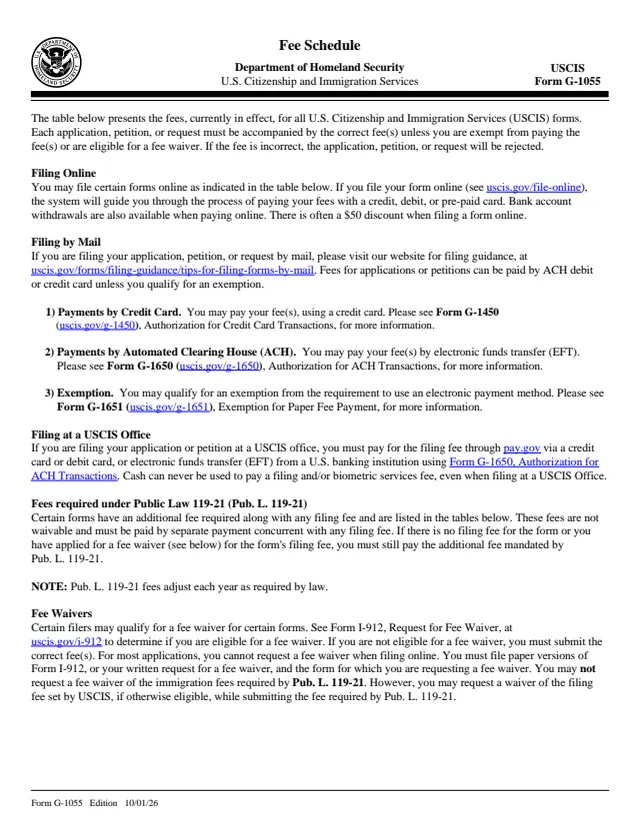
USCIS fees change, so this page does not list one. The USCIS page points to its Fee Schedule (Form G-1055), and the form's instructions point to the EOIR website. The instructions say the fee cannot be refunded and payment details are on the USCIS page.

What to include

USCIS says to include a copy of the denial or revocation letter. An attorney or accredited representative adds Form EOIR-27.

Briefs after filing

USCIS says a written brief sent after Form EOIR-29 goes to the USCIS office listed on the denial or revocation letter.

Who files Form EOIR-29?

  • Form I-130 petitioners

    The instructions say only the petitioner, or a self-petitioner, may appeal the denial of a visa petition by DHS. For a denied Form I-130, the petitioner signs, not the beneficiary.

  • Form I-360 widow(er) self-petitioners

    USCIS says the form covers Form I-360 decisions for widow(er) filings only. The widow(er) self-petitioner, or their attorney or representative, signs the appeal.

  • Attorneys and accredited representatives

    USCIS says an attorney or an accredited representative of an organization recognized by the Board must file a separate Form EOIR-27, Notice of Entry of Appearance, with Form EOIR-29.

  • Other DHS officer decisions

    Item 1 has a second box for a different type of appeal from a DHS officer decision, with examples such as a carrier and fine decision, an INA 212(d)(3)(A)(ii) waiver decision or a permissible DHS bond decision.

  • Not for consular visa denials

    USCIS says not to use Form EOIR-29 to appeal a Department of State overseas consular officer's denial of a visa application, and points to the Department of State website instead.

Official sources and the blank

Do it all with indox

View all 94 tools

Questions about Form EOIR-29

Do I send Form EOIR-29 to the Board of Immigration Appeals?

No. The form says not to file it directly with the Board. It is filed with DHS, and for I-130 and I-360 widow(er) decisions the USCIS page names the Phoenix or Dallas lockbox.

How long is there to file the appeal?

The instructions say 30 calendar days. For a decision mailed by DHS, the notice has to be received within 30 calendar days from the date the decision was mailed.

Can Form EOIR-29 appeal a visa denial at a U.S. consulate?

No. USCIS says not to use it for a Department of State consular officer's denial of a visa application, and points to the Department of State website.

Who signs Form EOIR-29 for a denied Form I-130?

The instructions say only the Form I-130 petitioner, a Form I-360 widow(er) self-petitioner, or their attorney or representative should sign. The beneficiary should not.

What if I check Yes for a brief and do not send one?

The form warns the appeal may be summarily dismissed. The instructions list this among the reasons the Board may summarily dismiss an appeal, unless the failure is reasonably explained.

Will the Board hear oral argument?

The instructions say oral argument may be requested, and the Board considers every case on the record whether or not oral argument is presented. If a request is approved, the appellant is notified.