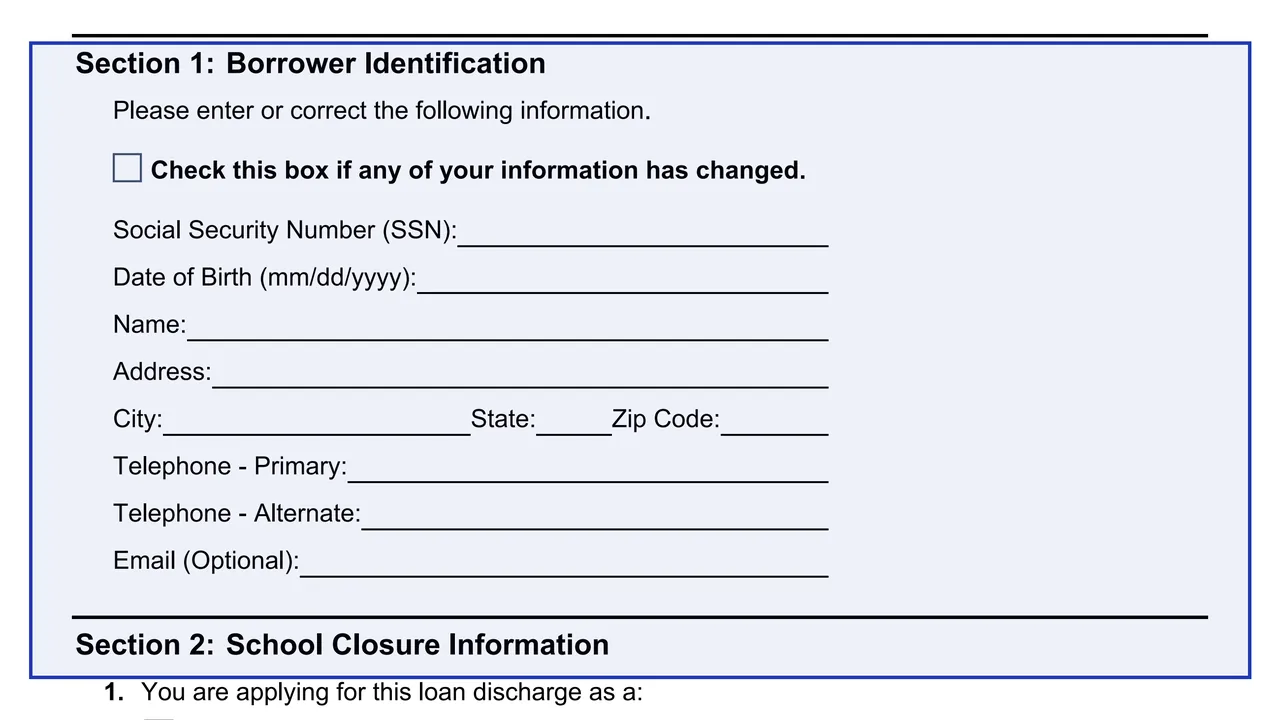
Section 1: Borrower identification
Your SSN, date of birth, name, address and phone numbers, an optional email, and a box to check if any of your information has changed.
Closed School Discharge
Closed School Loan Discharge Application
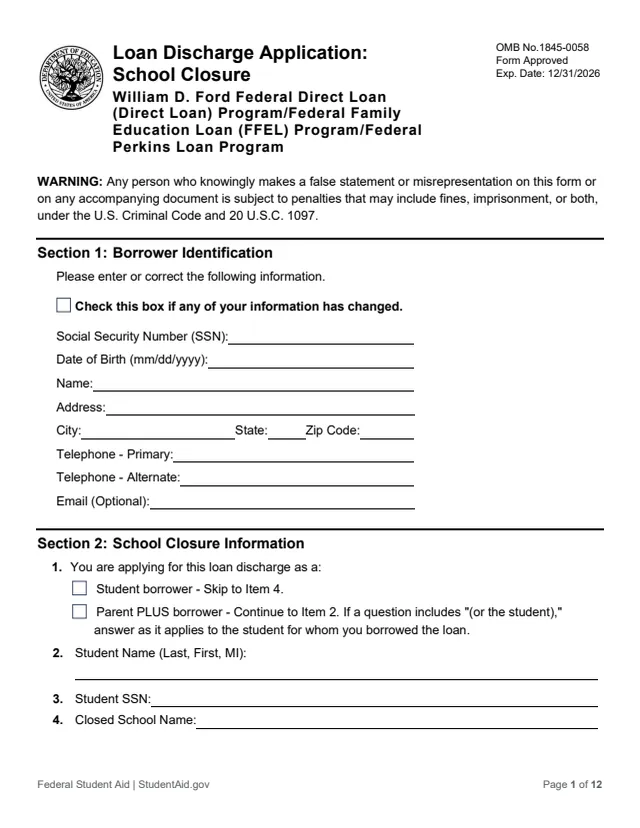
The Loan Discharge Application: School Closure is the U.S. Department of Education form for asking to have federal student loans discharged because the school closed. It covers loans from the William D. Ford Federal Direct Loan, Federal Family Education Loan (FFEL) and Federal Perkins Loan programs, and the form says only loans made on or after January 1, 1986 are eligible.
The form says a discharge means you, and any endorser, do not have to repay the rest of the loan, payments made voluntarily or through forced collection are reimbursed, and the loan holder asks credit bureaus to remove adverse credit history tied to the loan. For a consolidation loan, only the part that represents eligible original loans is discharged.
The form also says the Department may grant this discharge without an application one year after the school closed, if it finds you eligible from the information it has. You can fill out the form free in your browser on this page and download the result without an account.
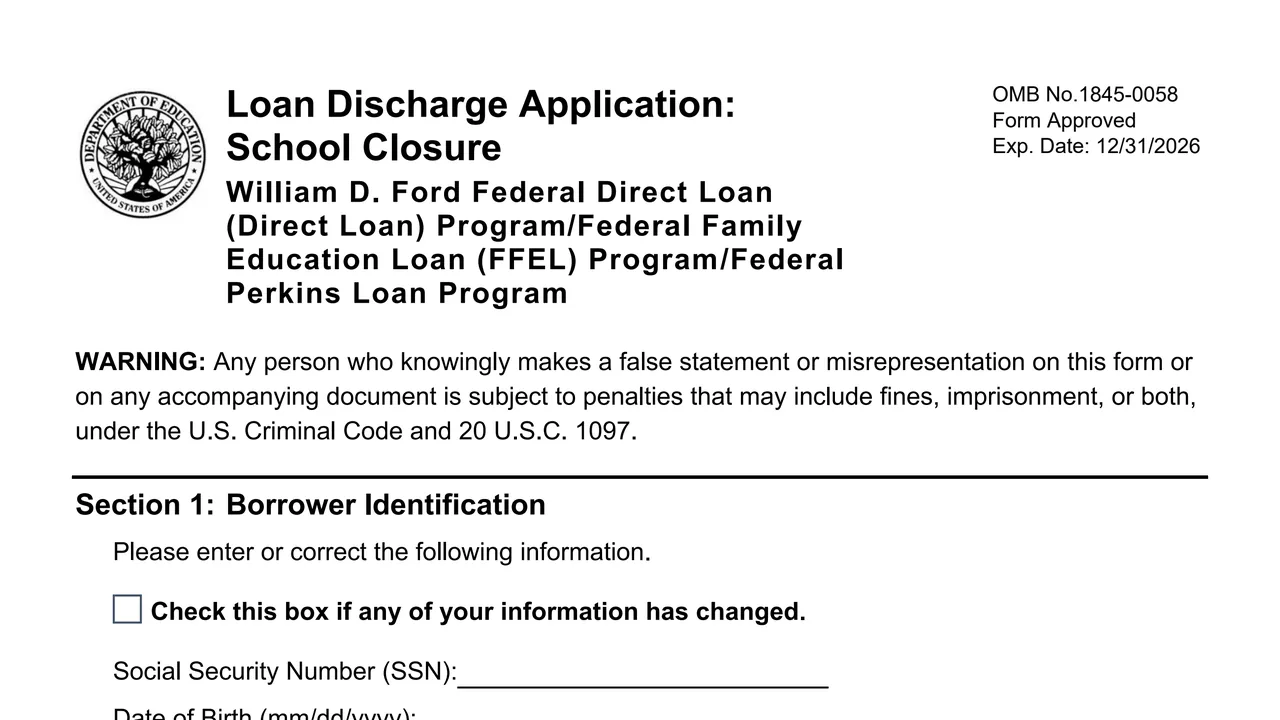
Your SSN, date of birth, name, address and phone numbers, an optional email, and a box to check if any of your information has changed.
Whether you are the student or a parent PLUS borrower, the student's name and SSN, the closed school's name and address, the first and last dates attended, and the program of study.
Whether the program was completed before the closure, whether the student was still enrolled or on an approved leave of absence, and whether and when the student withdrew.
Whether the student accepted a teach-out agreement or continued at another branch, and whether they completed it, withdrew from it or are still enrolled.
Whether a refund or payment was requested or received because of the closure from the school or a third party, such as a state tuition recovery program, with the party's details, the amount and the status.
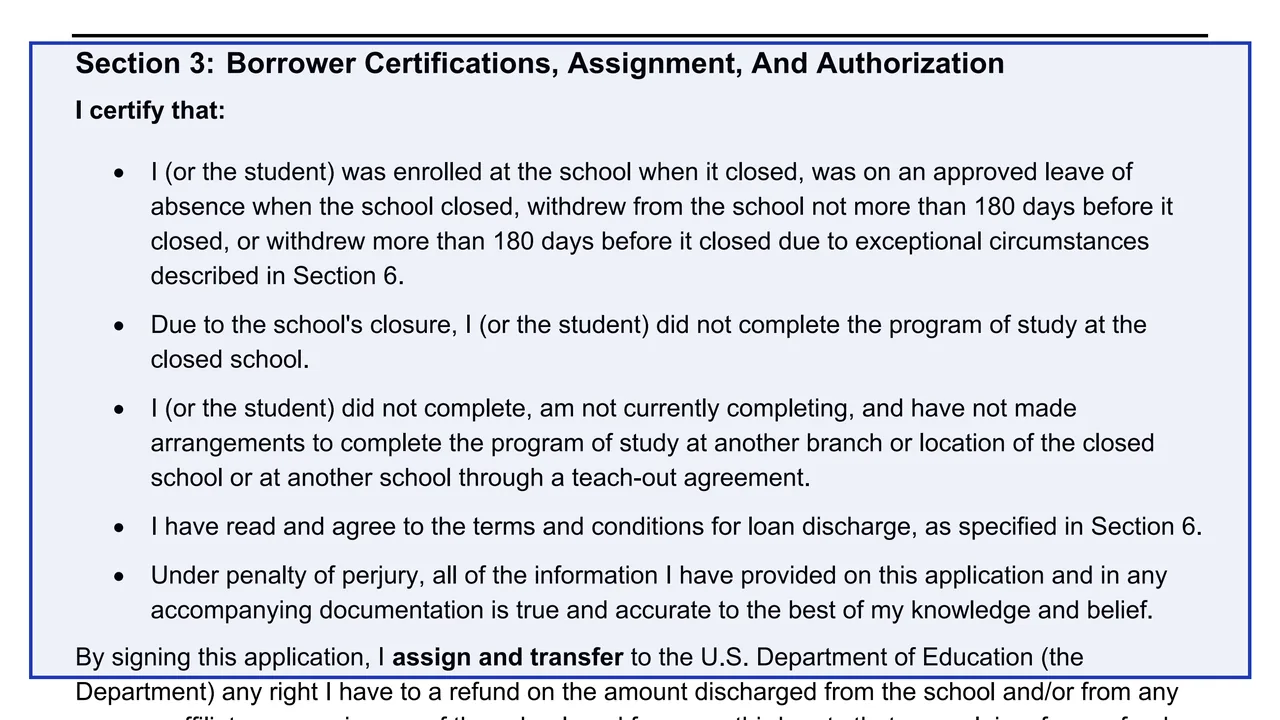
You certify the enrollment facts, agree to the terms in Section 6 and sign under penalty of perjury. Signing assigns to the Department your right to a refund on the discharged amount.
Section 6 sets out who can get the discharge, including the 180-day withdrawal window and the examples of exceptional circumstances.
Type or print in dark ink and enter dates as mm/dd/yyyy. Check the box if any of your details have changed.
Each answer says which item comes next. The form marks some answers, such as completing the program before the closure, as not eligible.
Continue on separate sheets with the item number. Put your name and SSN at the top of pages 2 through 4 and on every attached page.
Sign and date the certification on page 5.
Send the application and any documents to the address in Section 7, or to your loan holder if no address is shown. The form says to leave out pages 6 to 12 when mailing or faxing.
You get the real form, filled in a browser tab, with nothing standing between you and the finished PDF.
To the address printed in Section 7. If no address is shown, the form says to return it to your loan holder. A loan holder may use a servicer, and the form treats the two the same.
Section 8 gives a phone number for help. If no number is shown, the form says to call your loan holder.
Direct, FFEL and Perkins loans made on or after January 1, 1986. The Department holds Direct Loans, FFEL loans may be held by a lender, a guaranty agency or the Department, and Perkins loans by a school or the Department.
The form says the Department may grant the discharge without an application one year after the closure, or one year after your last enrollment date in an unfinished teach-out.
By signing, you agree to provide testimony, a sworn statement or documents on request. The form says not doing so can lead to the application being denied or the discharge revoked.
The form's Paperwork Reduction Notice estimates an average of 30 minutes per response.
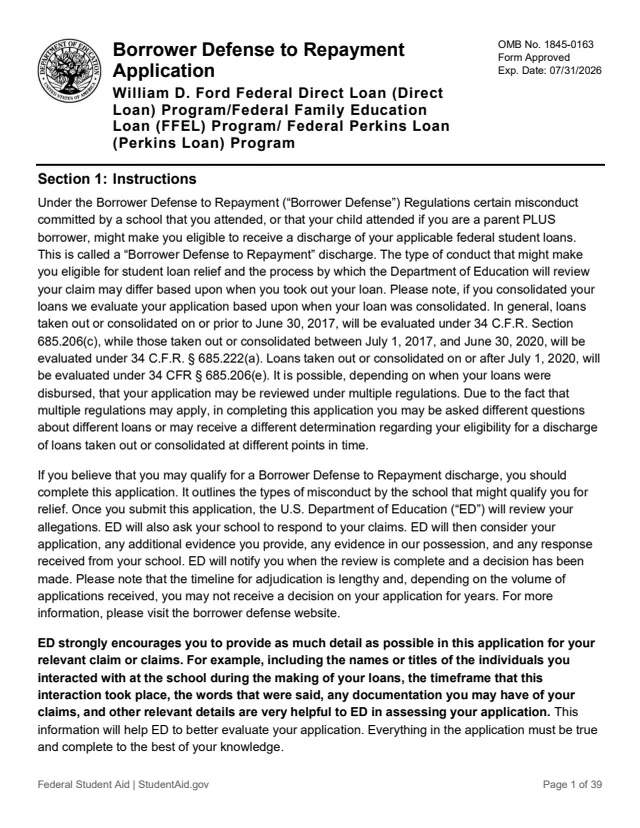
Borrower Defense
150 fields, 39 pages
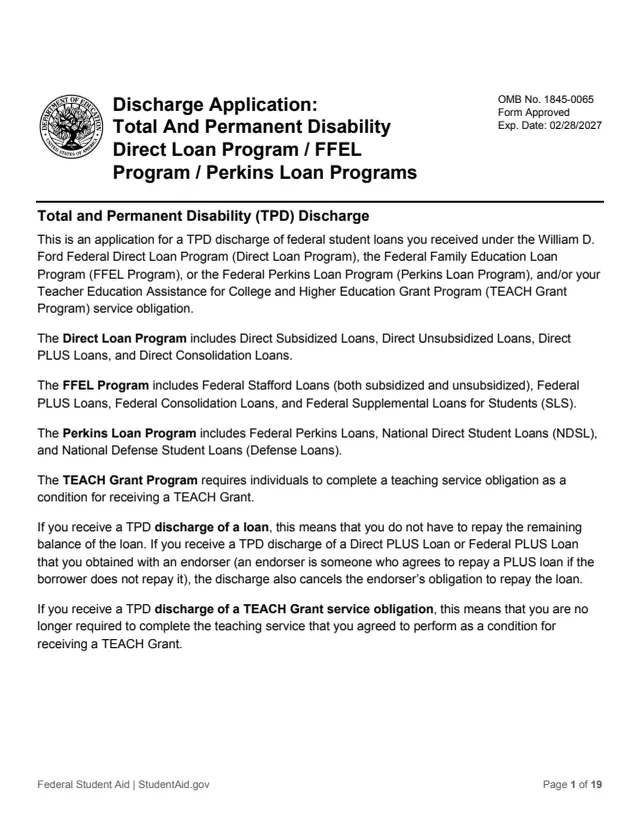
TPD Discharge
45 fields, 19 pages
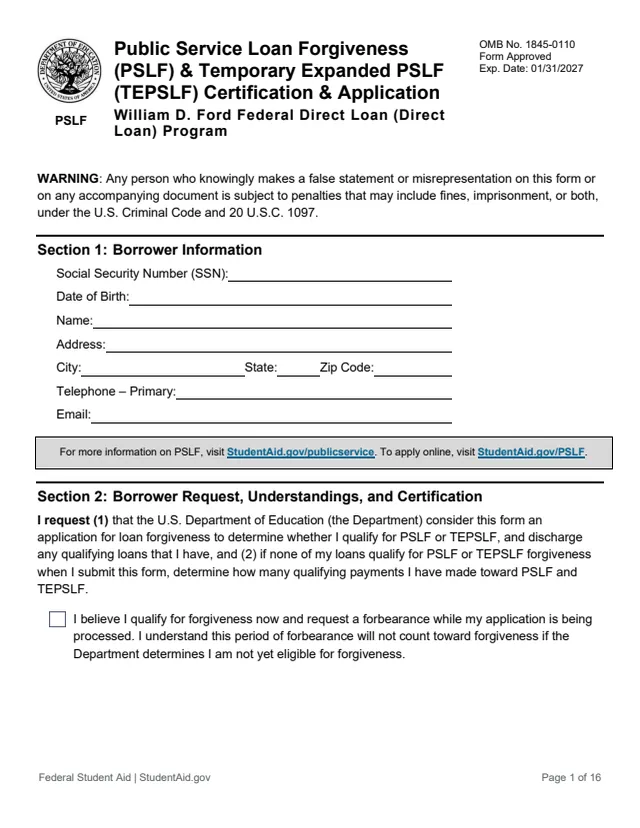
PSLF
30 fields, 16 pages
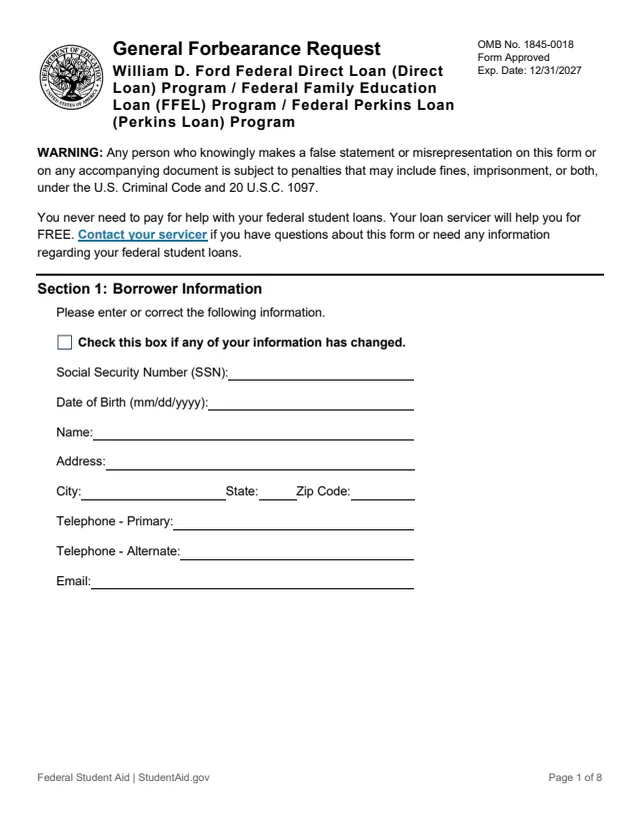
General Forbearance
24 fields, 8 pages
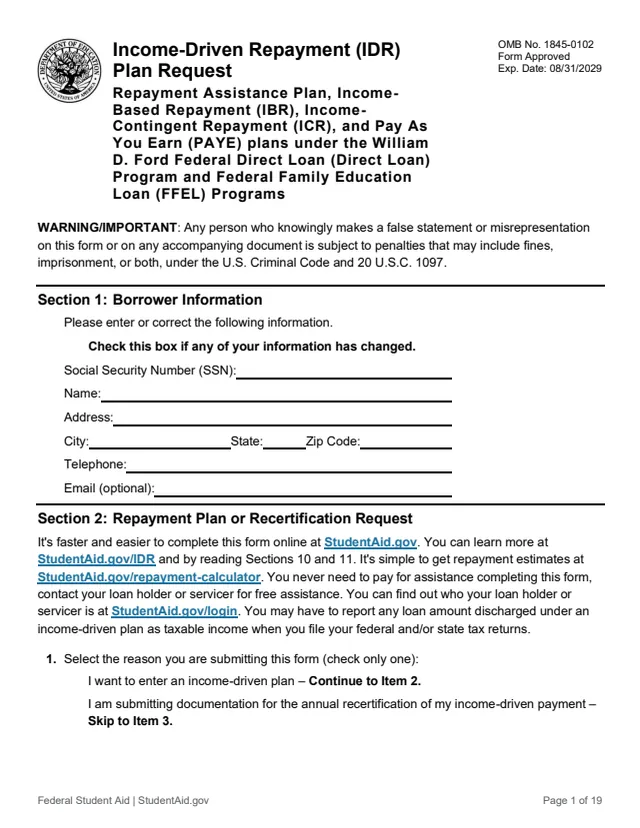
IDR Plan Request
52 fields, 19 pages
The form describes these borrowers in its certification and its terms in Section 6.
No tool matches that search.
The form says the Department sets it: the earlier of the date the school stopped instruction in programs most of its students were enrolled in, or the date it stopped instruction for all students.
The form says you may still be eligible if the Department finds that exceptional circumstances related to the closing justify a longer period. Examples include loss of accreditation, loss of state authorization, or closing most in-person locations while keeping online programs.
The form marks students still enrolled in a teach-out as ineligible at this time and those who completed one as ineligible. If you withdrew from the teach-out, it sends you on to item 15.
The form says a discharge reimburses payments you made voluntarily or through forced collection, such as wage garnishment or Treasury offset.
The form says the Department may grant it automatically one year after the school closed if it finds you eligible from the information it has.
Items 15 to 20 ask whether you requested or received a refund or payment from the school or a third party, such as a state tuition recovery program, because of the closure, and for the amount.
The form says that if you were denied because the school reported a completed program at a lower credential level, you may become eligible by providing evidence of the credential level you were enrolled in.