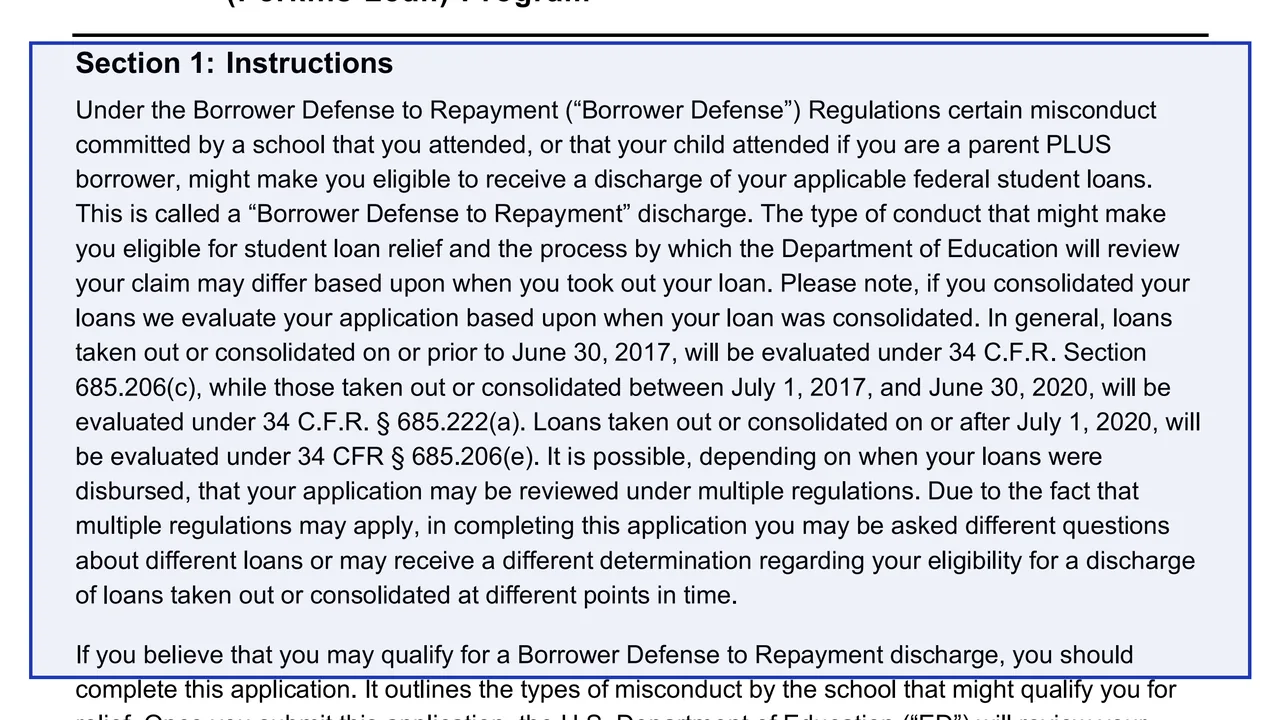
Section 1: Instructions
Which rules apply by loan date, the kinds of school conduct that can qualify, and the documents to include, such as emails, catalogs, ads, transcripts and enrollment agreements.
Borrower Defense
Borrower Defense to Repayment Application
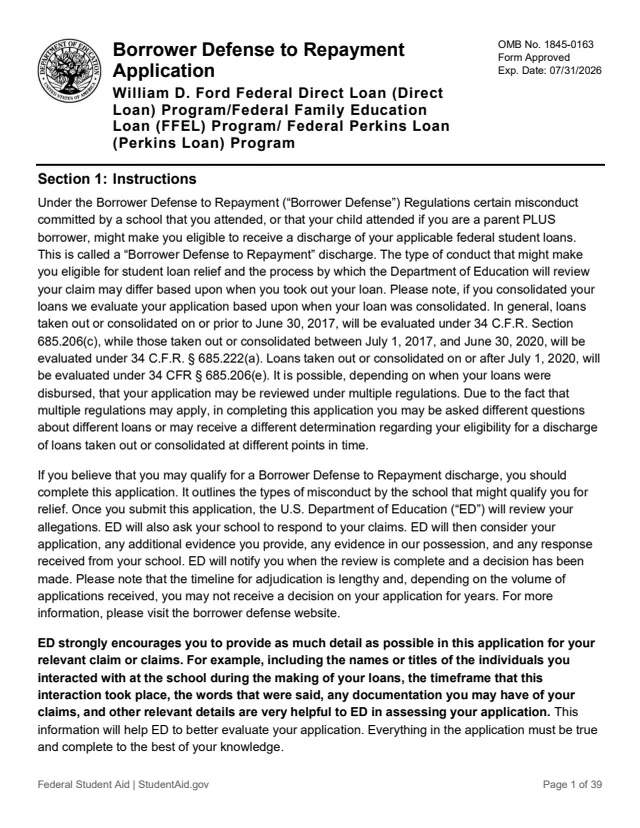
The Borrower Defense to Repayment Application is the U.S. Department of Education (ED) form for asking for a discharge of federal student loans because of misconduct by the school you attended, or the school your child attended if you took out a parent PLUS loan. It covers loans from the William D. Ford Federal Direct Loan, Federal Family Education Loan (FFEL) and Federal Perkins Loan programs.
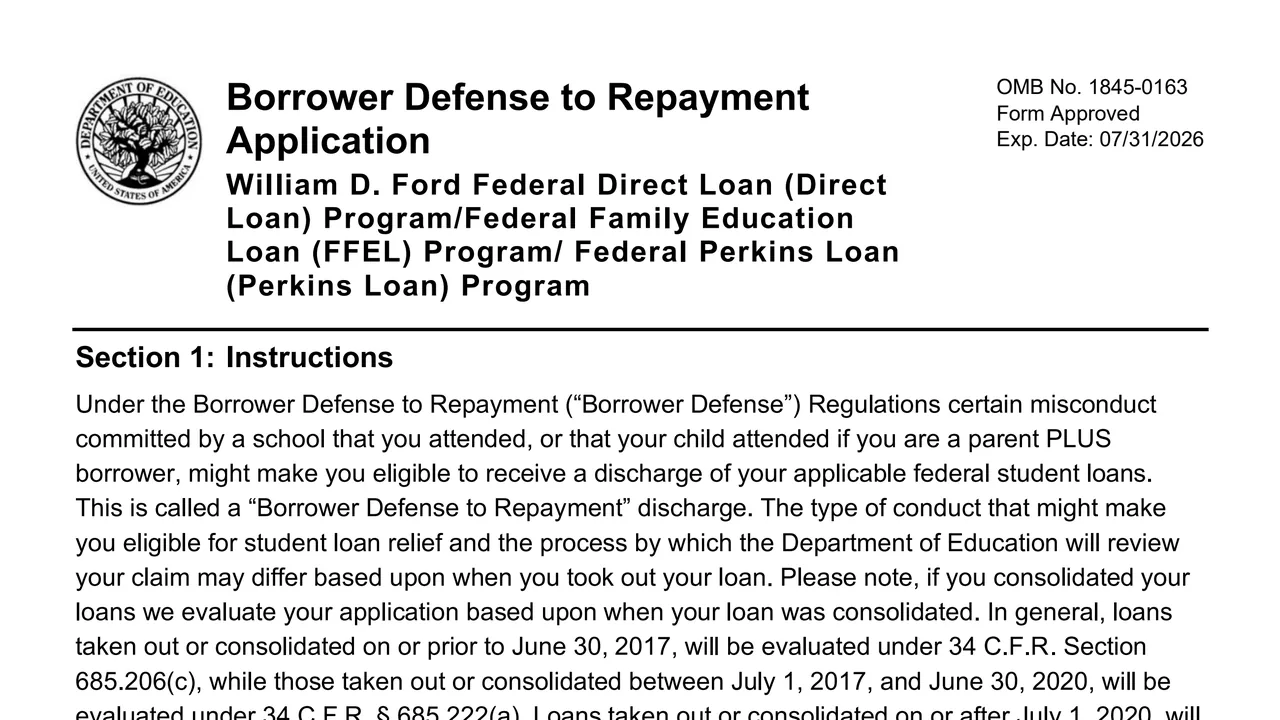
The form says the kind of conduct that can qualify, and how ED reviews the claim, depend on when you took out or consolidated each loan. Loans taken out or consolidated on or before June 30, 2017 are reviewed under 34 C.F.R. 685.206(c), loans from July 1, 2017 through June 30, 2020 under 34 C.F.R. 685.222(a), and loans from July 1, 2020 on under 34 CFR 685.206(e). One application can be reviewed under more than one of these rules.
ED reviews your allegations, asks the school to respond, and then decides. The form says a decision may take years. ED recommends applying online at StudentAid.gov/borrower-defense, and the PDF is the paper version. You can fill it out free in your browser on this page and download the result without an account.
Which rules apply by loan date, the kinds of school conduct that can qualify, and the documents to include, such as emails, catalogs, ads, transcripts and enrollment agreements.
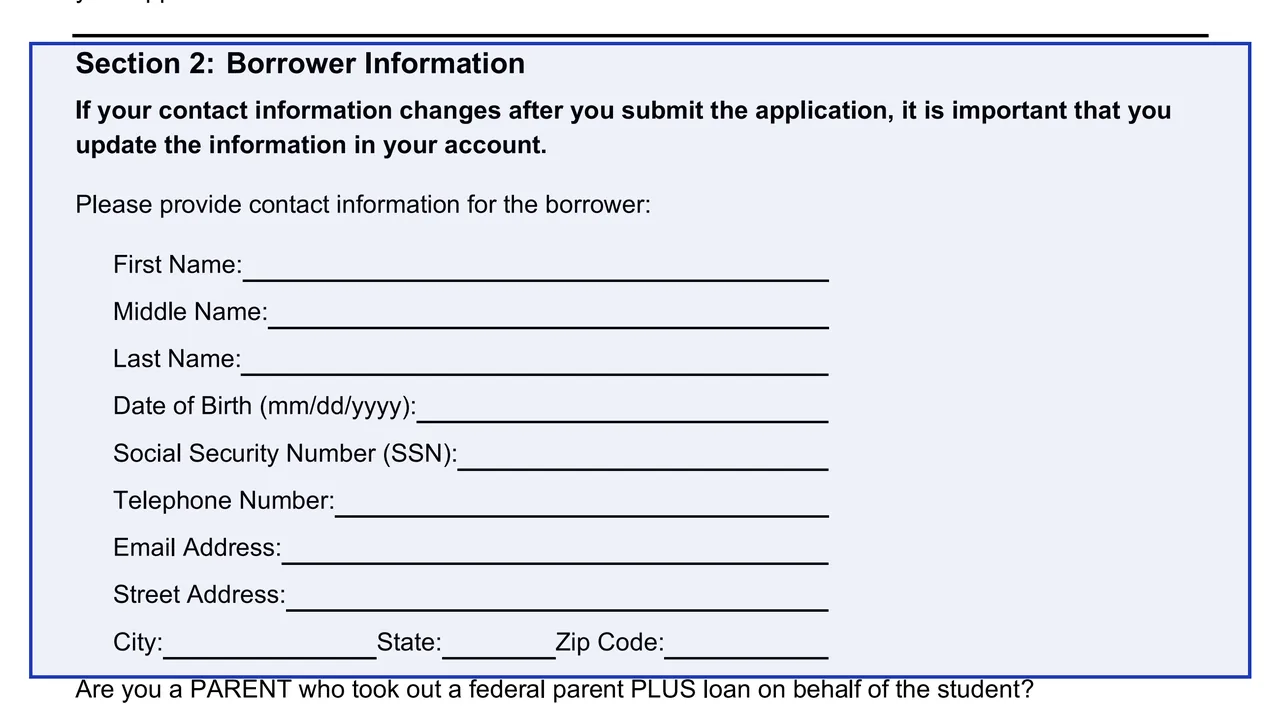
Your name, date of birth, Social Security number, phone, email and address, and whether you are a parent with a PLUS loan for a student.
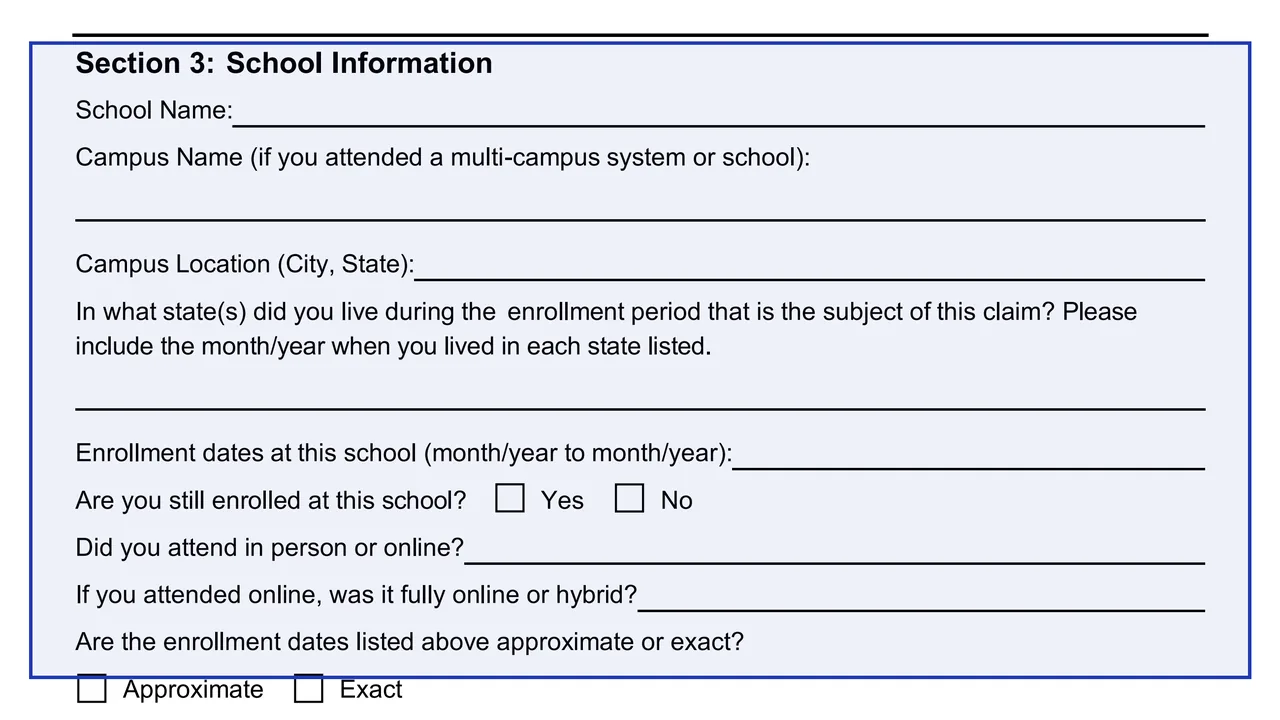
The school and campus, the states you lived in while enrolled, enrollment dates, in person or online, program and credential sought, your current status and your education level when you enrolled.
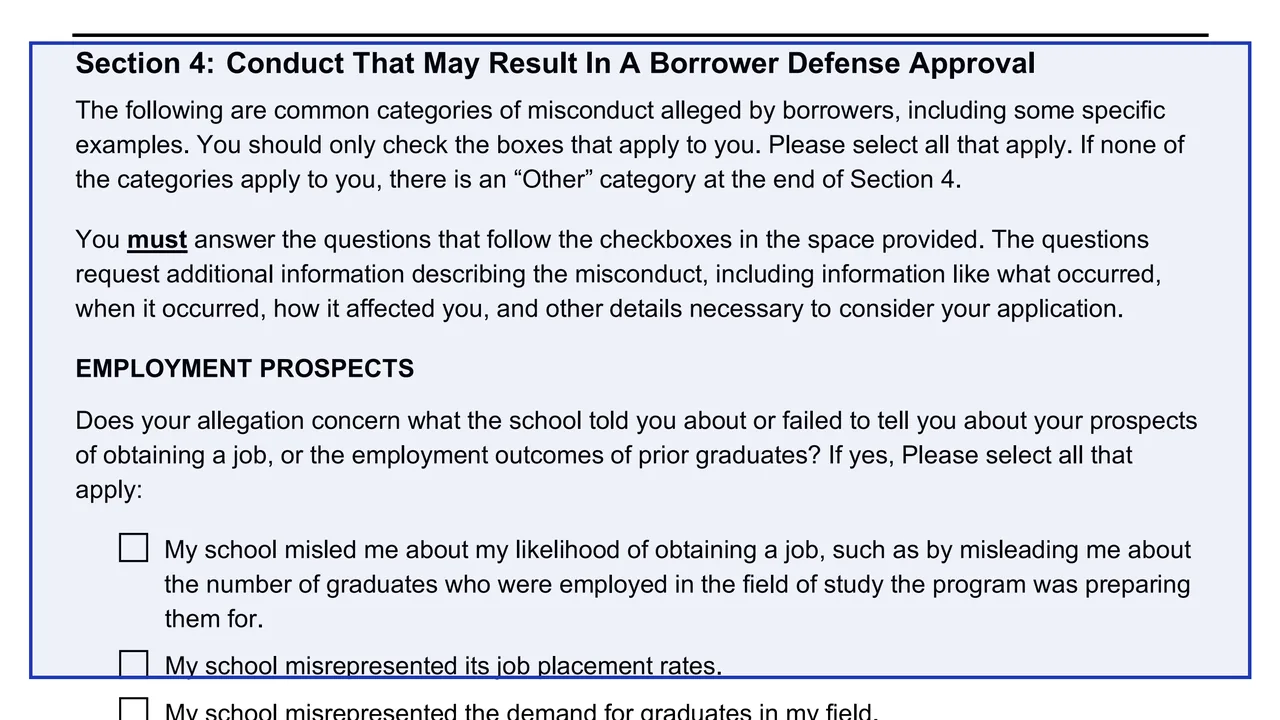
Checkboxes for employment prospects, career services, accreditation and licensure, transferring credits, educational services, program cost and loans, representations to third parties, judgment, breach of contract and other. Each asks what was said, by whom, when, how it misled you and how it harmed you.
How all the misconduct together harmed you. Section 5a covers financial harm for Direct Loans received on or after July 1, 2020, including the amount, the jobs the program said it prepared you for and the jobs you applied for.
Other attempts to recover tuition or have loans forgiven, any arbitration with the school, your choice about forbearance or stopped collections, and the certification you sign under penalty of perjury.
Write down when each loan was taken out or consolidated. The form uses June 30, 2017 and July 1, 2020 as dividing dates, and some sections apply only to certain dates.
The form lists emails and other messages with the school, course catalogs, student manuals, ads and brochures, a court judgment, your contract with the school, transcripts and diplomas.
Check the boxes that apply in Section 4 and answer the questions under each one in your own words. ED asks for names or titles of school staff, when it happened, the words used and any proof.
Section 5 asks how the misconduct affected you. If Section 5a applies to your loans, it asks about financial harm and your job search in your field.
Section 7 asks whether your loans go into forbearance, or stopped collections if in default, during the review. If you pick neither, the form says ED applies the one that fits your loans.
Sign Section 8 under penalty of perjury. ED recommends applying online at StudentAid.gov/borrower-defense. A paper form goes by mail to the address in Section 9.
You get the real form, filled in a browser tab, with nothing standing between you and the finished PDF.
ED recommends submitting online at StudentAid.gov/borrower-defense. The paper form and documents go to U.S. Department of Education, Federal Student Aid Information Center, P.O. Box 1854, Monticello, KY 42633. The form says to leave out pages 38 and 39 when mailing or faxing.
Unless you ask otherwise, loans not in default go into forbearance and loans in default go into stopped collections status while ED reviews the application. The form says the total you owe may be higher if the application is denied.
ED asks the school to respond, then considers your application, your evidence, its own evidence and the school's response. The form says a decision may take years, depending on how many applications ED receives.
The form's Paperwork Reduction Act notice estimates an average of 3 hours per response.
The Borrower Defense Customer Contact Center is at 1-855-279-6207. The form also points to StudentAid.gov/help-center/contact.
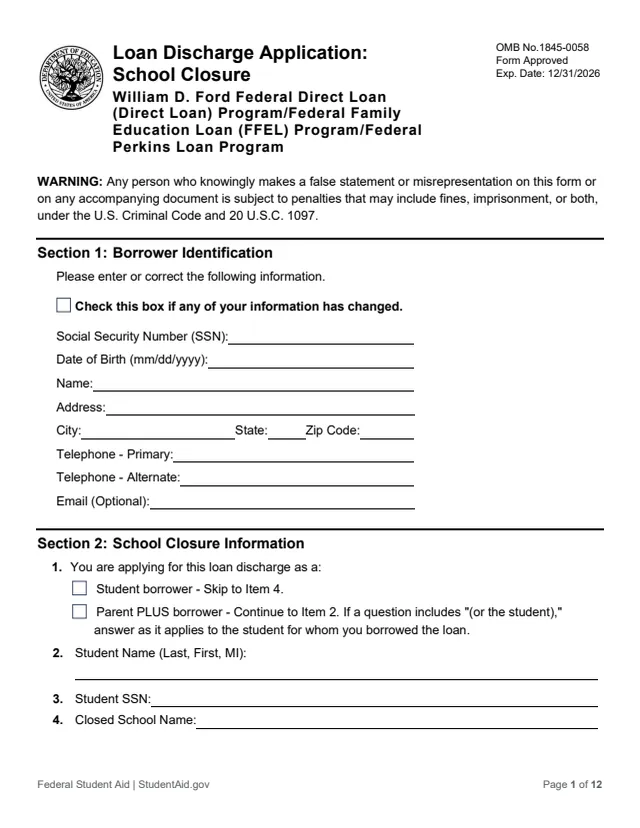
Closed School Discharge
55 fields, 12 pages
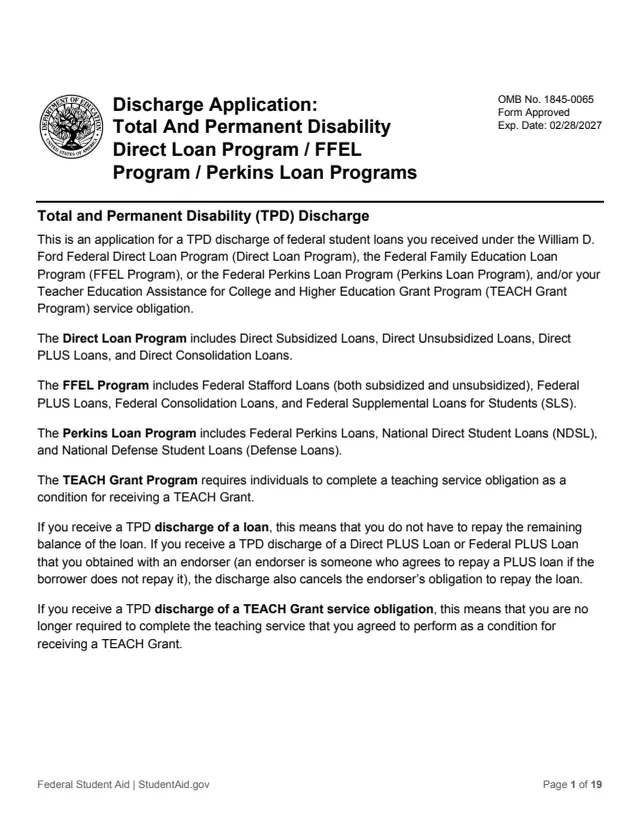
TPD Discharge
45 fields, 19 pages
PSLF
30 fields, 16 pages
General Forbearance
24 fields, 8 pages
IDR Plan Request
52 fields, 19 pages
The form is for borrowers who believe a school's misconduct may qualify them for a discharge of their federal student loans.
No tool matches that search.
The form says it depends on when each loan was taken out or consolidated: on or before June 30, 2017 under 34 C.F.R. 685.206(c), July 1, 2017 through June 30, 2020 under 34 C.F.R. 685.222(a), and on or after July 1, 2020 under 34 CFR 685.206(e). One application can be reviewed under more than one.
That is your choice in Section 7. The form says loans not in default go into forbearance, and defaulted loans into stopped collections, unless you ask otherwise. You can keep paying, for example during loan rehabilitation or while working toward Public Service Loan Forgiveness.
No. The form says a settlement agreement is not a favorable judgment for borrower defense, even if it was favorable to you, and that includes prior settlements with the Department.
The form says the timeline is lengthy and, depending on how many applications ED receives, a decision may take years. ED notifies you when the review is complete.
For loans covered by Section 5a, the form lists examples such as unemployment not caused by a recession, tuition well above what the school said, or no job in a field where the school guaranteed one. It excludes emotional distress, simply having loan debt, and choosing not to work.
Yes. The form covers misconduct by the school your child attended if you are a parent PLUS borrower. Section 2 asks for the student's name and Social Security number.
Yes. ED recommends submitting online at StudentAid.gov/borrower-defense. You can also mail the paper form to the address in Section 9.