Heading and due date
The form names 18 U.S.C. § 2519 and says the summary, the individual wiretap reports for calendar year 2025 and supplemental reports for prior years are to be received by the Administrative Office no later than March 31, 2026.
WT 1
Annual Prosecutor Summary of Wiretap Reports
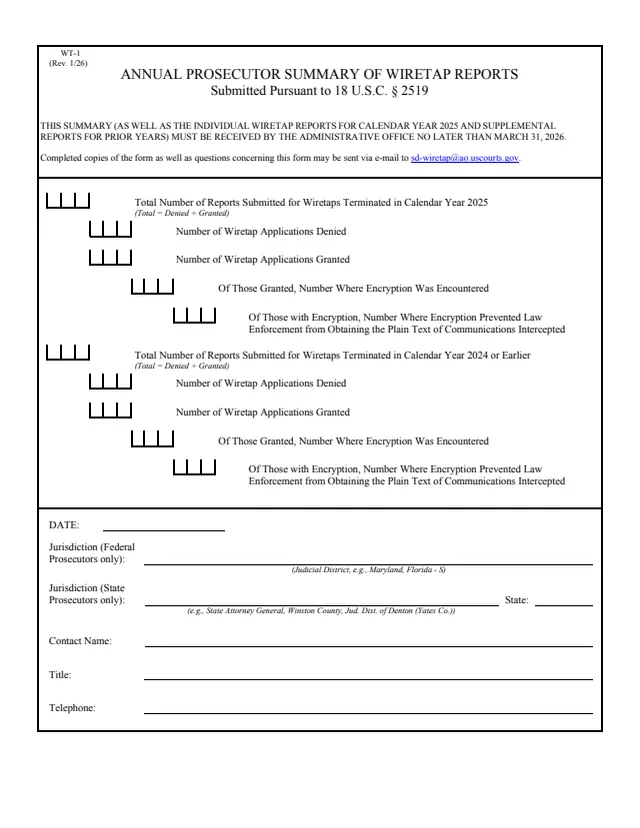
WT 1, Annual Prosecutor Summary of Wiretap Reports, is a one-page form submitted to the Administrative Office of the United States Courts under 18 U.S.C. § 2519. The U.S. Courts list it under Other Forms. It is not a form members of the public file: the guidance on the U.S. Courts page says it is completed by the prosecutor to summarize the number of interceptions being reported for the year, including information required by the Congress on the number of wiretaps where encryption was encountered.
The form counts the WT-2 reports a prosecutor submits, denied and granted, in two groups: wiretaps terminated in calendar year 2025, and wiretaps terminated in 2024 or earlier. It ends with the date, the jurisdiction and a contact person. The printed form is marked Rev. 1/26, and the U.S. Courts page lists it as effective on July 13, 2020.
This page explains the form in plain words and is not legal advice. The office completing it can fill it out free in the browser on this page and download the result without an account.
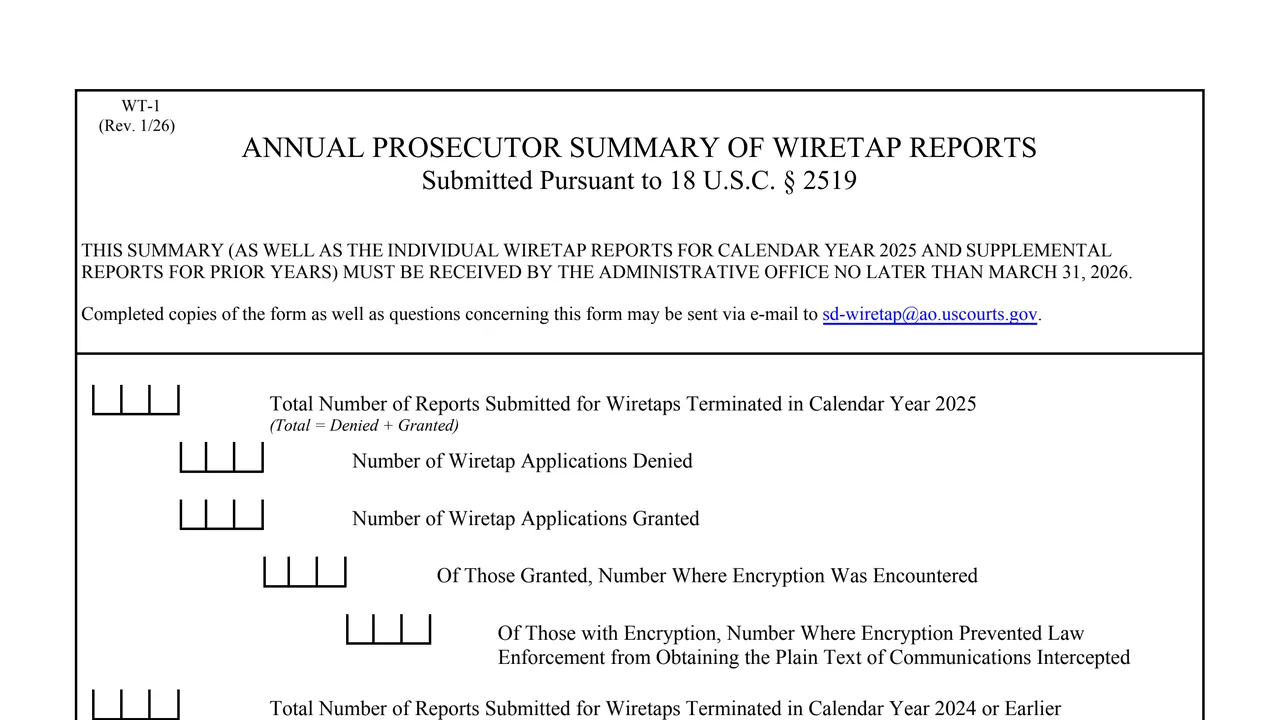
The form names 18 U.S.C. § 2519 and says the summary, the individual wiretap reports for calendar year 2025 and supplemental reports for prior years are to be received by the Administrative Office no later than March 31, 2026.
The total number of reports submitted, which the form says equals denied plus granted, then the number of applications denied and the number granted.
The same counts for wiretaps terminated in earlier years. The guidance says this group is for wiretaps being reported this year for the first time.
In each group, of those granted, the number where encryption was encountered, and of those, the number where encryption prevented law enforcement from obtaining the plain text of communications intercepted.
The date the form was completed and the jurisdiction, on one line for federal prosecutors and another for state prosecutors.
The contact name, title and telephone number of the person to contact with questions about the form.
The guidance says the prosecutor completes WT 1 when all of the reports for individual wiretaps for the year have been compiled and prepared for submission.
The guidance says the total is the number of WT-2 reports being submitted and equals the denied plus the granted applications.
Of the granted reports, enter how many encountered encryption of any kind, then how many of those had encryption that prevented law enforcement from obtaining the plain text.
The guidance says to enter the date the form was completed and the name of the jurisdiction authorized in the application or order, on the federal or state line.
Enter the name, title and telephone number of the person to be contacted for questions about the form.
The guidance says the completed form is to be emailed to [email protected]. The form has Print, Save As and Submit buttons.
You get the real form, filled in a browser tab, with nothing standing between you and the finished PDF.
The form says completed copies and questions may be sent by email to [email protected].
The form says it is to be received by the Administrative Office no later than March 31, 2026. The guidance says the form is to be received by March 31st of the year following the termination of the wiretap.
The guidance says that for federal cases, federal law enforcement agencies are required to submit the completed WT-1 Form to the Office of Enforcement Operations of the U.S. Department of Justice.
The form and its page do not print a fee.
The form names the individual wiretap reports and supplemental reports for prior years. The U.S. Courts publishes these as WT 2A, WT 2B and WT 3.
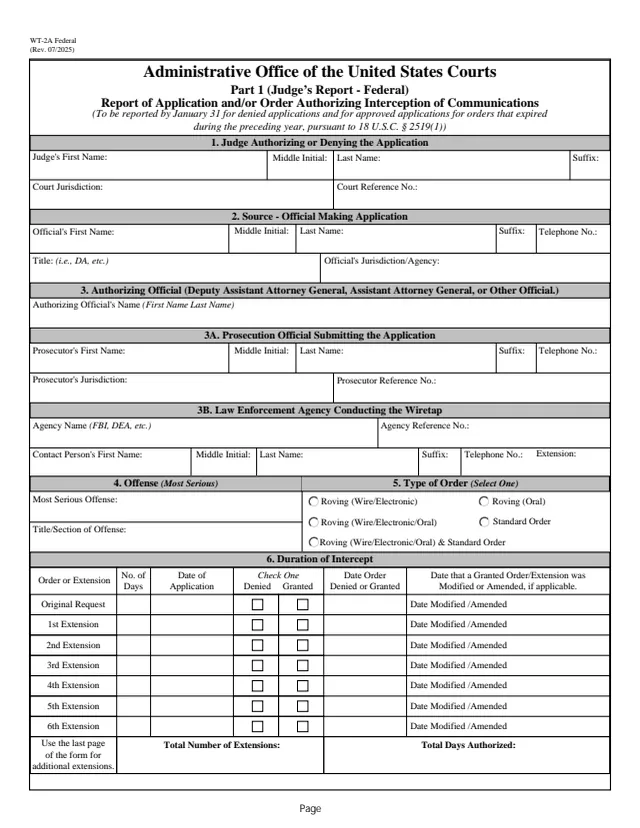
WT 2A
365 fields, 5 pages
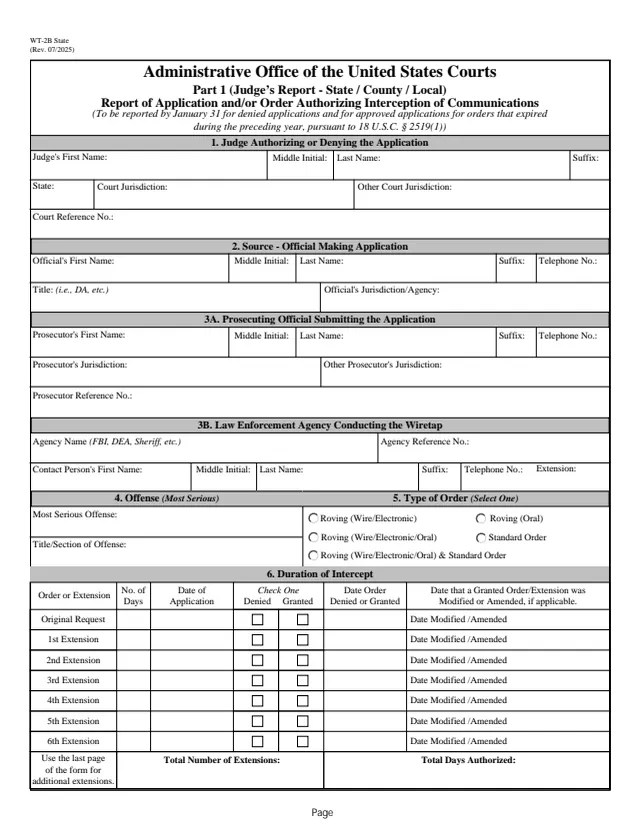
WT 2B
369 fields, 5 pages
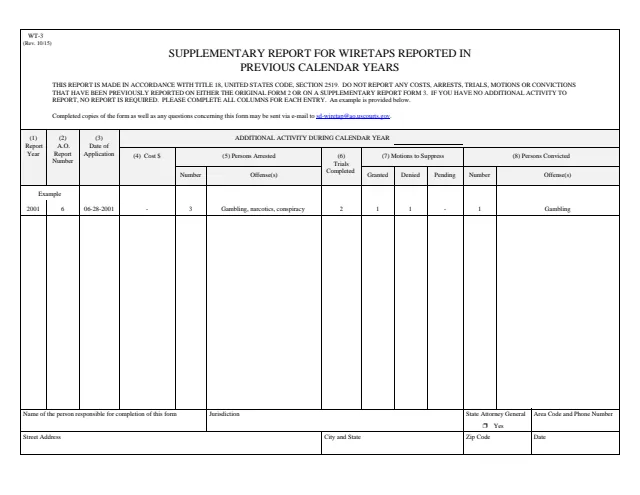
WT 3
181 fields, 1 page
WT 1 is a reporting form for prosecutors, not a form for the public. The form and its guidance name these offices.
No tool matches that search.
The guidance on the U.S. Courts page says the form is completed by the prosecutor to summarize the number of interceptions being reported for the year. It is not a form for members of the public.
The form says the summary, the individual wiretap reports for calendar year 2025 and supplemental reports for prior years are to be received by the Administrative Office no later than March 31, 2026.
The form says completed copies may be sent by email to [email protected]. For federal cases, the guidance says federal law enforcement agencies submit it to the Office of Enforcement Operations of the U.S. Department of Justice.
The guidance says one group is for wiretaps terminated in the current year and the other for wiretaps terminated in earlier years but being reported this year for the first time.
For the granted applications in each group, it asks how many encountered encryption and how many of those had encryption that prevented law enforcement from obtaining the plain text of communications intercepted.
No. This page explains the form in plain words from the form and its guidance. Questions about the form may be sent to [email protected], as the form says.