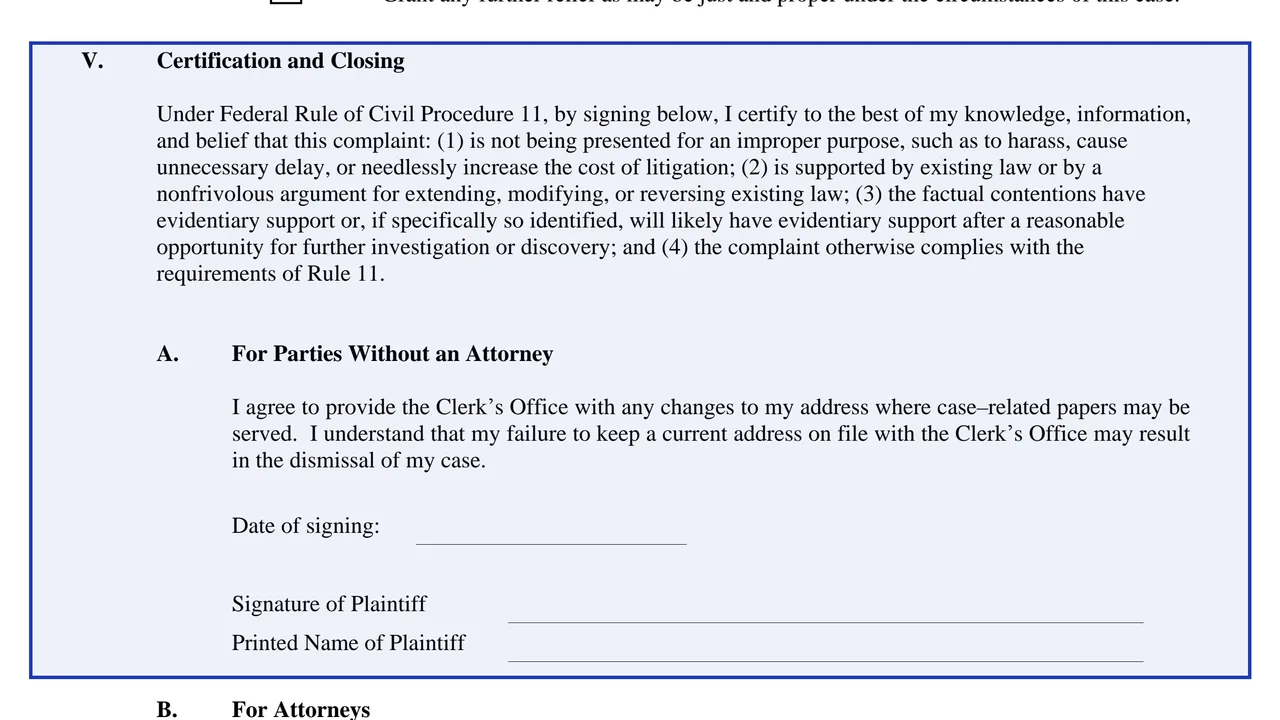
Caption and notice
The district and division, the plaintiffs' names, the current Commissioner as defendant with no address, and a case number left for the Clerk's Office. Page 1 has a notice on privacy, exhibits and the filing fee.
Pro Se 13
Complaint for Review of Social Security Decision
Pro Se 13, Complaint for Review of Social Security Decision, is a pleading form from the U.S. Courts for a case in a United States district court. The PDF titles it Complaint for Review of a Social Security Disability or Supplemental Security Income Decision. It is one of the Civil Pro Se Forms, which the U.S. Courts page says are limited to types of cases often filed in federal courts by people who represent themselves or who may not have much experience in federal courts.
The form describes the case as an action seeking court review of a decision of the Commissioner of the Social Security Administration. It asks for the plaintiff and the defendant (the current Commissioner), the claim type, when notice of the final decision was received, why the decision should be overturned, the relief requested, and a signed certification under Federal Rule of Civil Procedure 11.
The U.S. Courts offers it as a PDF and a Word file, effective on December 1, 2016. This page explains the form in plain words and is not legal advice. You can fill it out free in your browser on this page and download the result without an account.
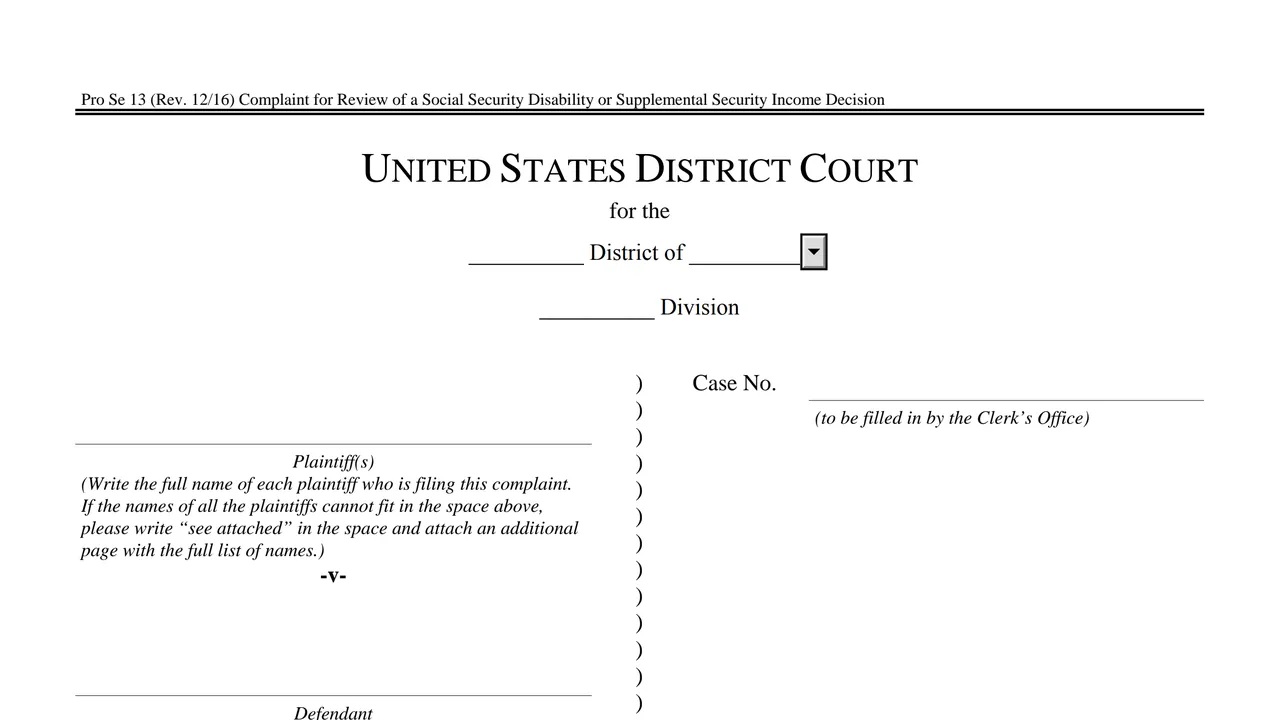
The district and division, the plaintiffs' names, the current Commissioner as defendant with no address, and a case number left for the Clerk's Office. Page 1 has a notice on privacy, exhibits and the filing fee.
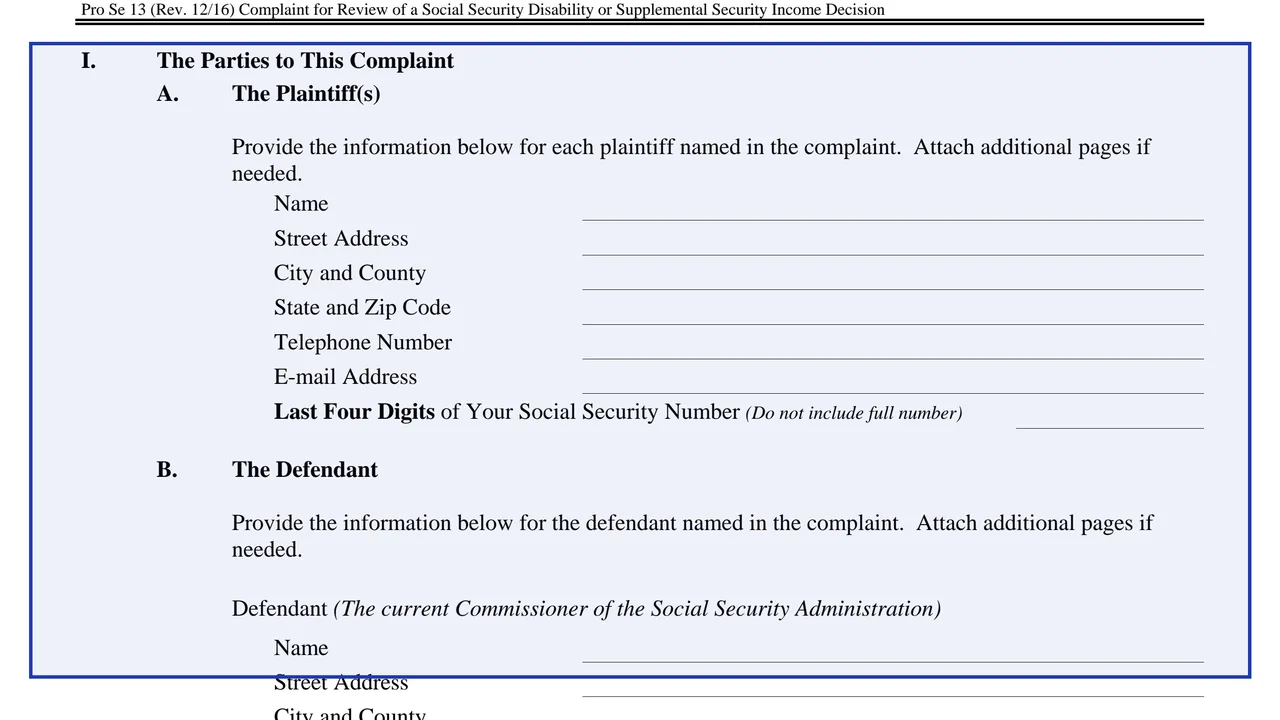
Name, address, phone, email and the last four digits of the Social Security number for each plaintiff, and the Commissioner's name with the regional General Counsel office address.
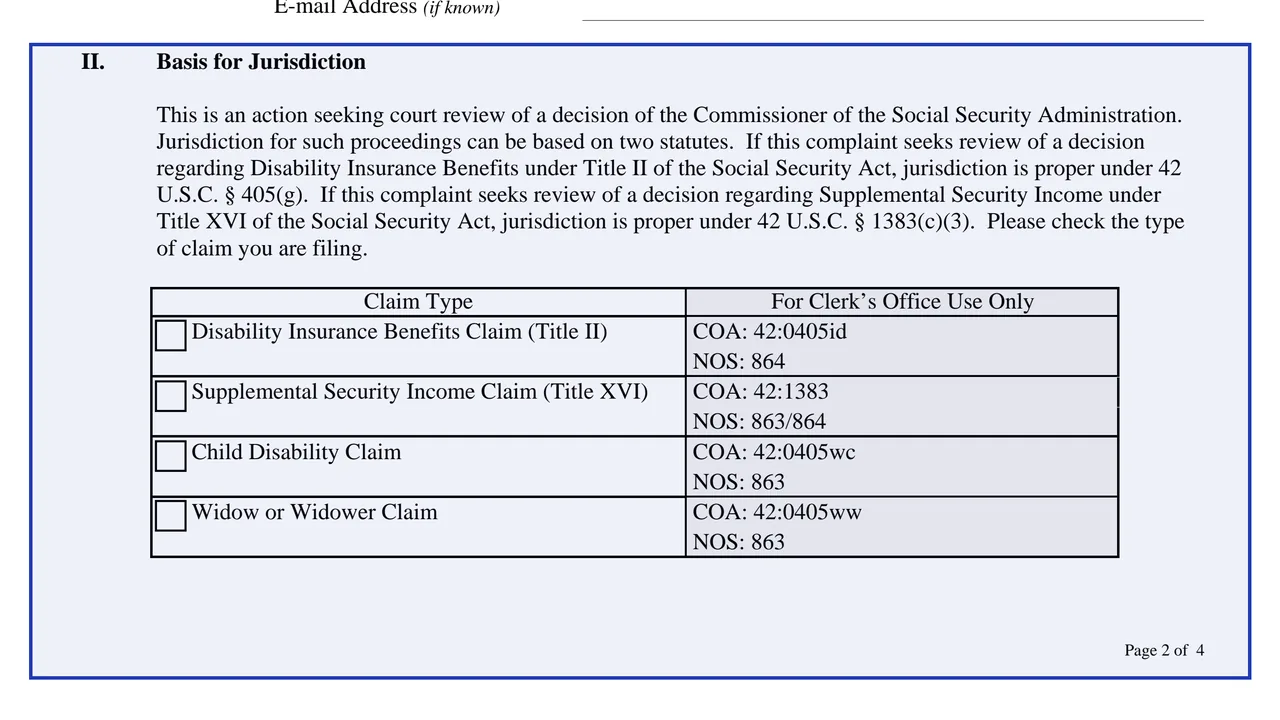
The form says review of a Title II Disability Insurance Benefits decision is under 42 U.S.C. § 405(g) and of a Title XVI Supplemental Security Income decision under 42 U.S.C. § 1383(c)(3). It asks for the claim type and the notice date.
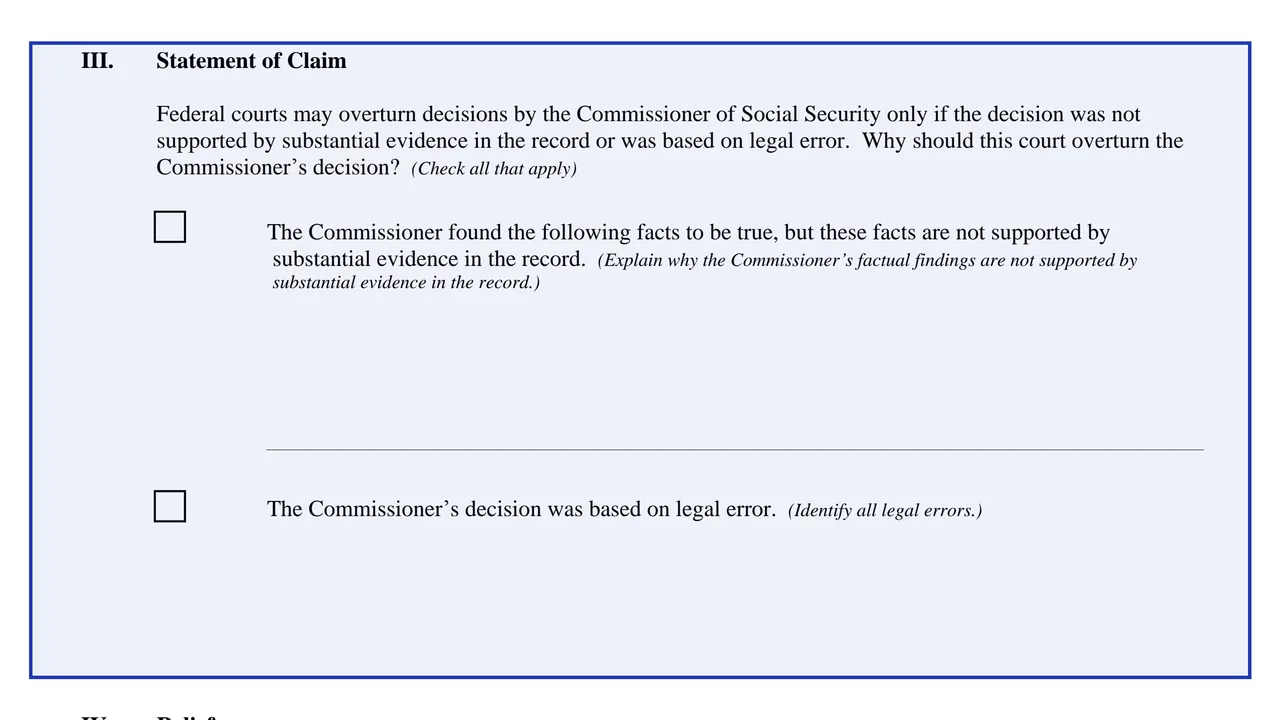
The form says federal courts may overturn a decision only if it was not supported by substantial evidence in the record or was based on legal error, and has a checkbox and space to explain each.
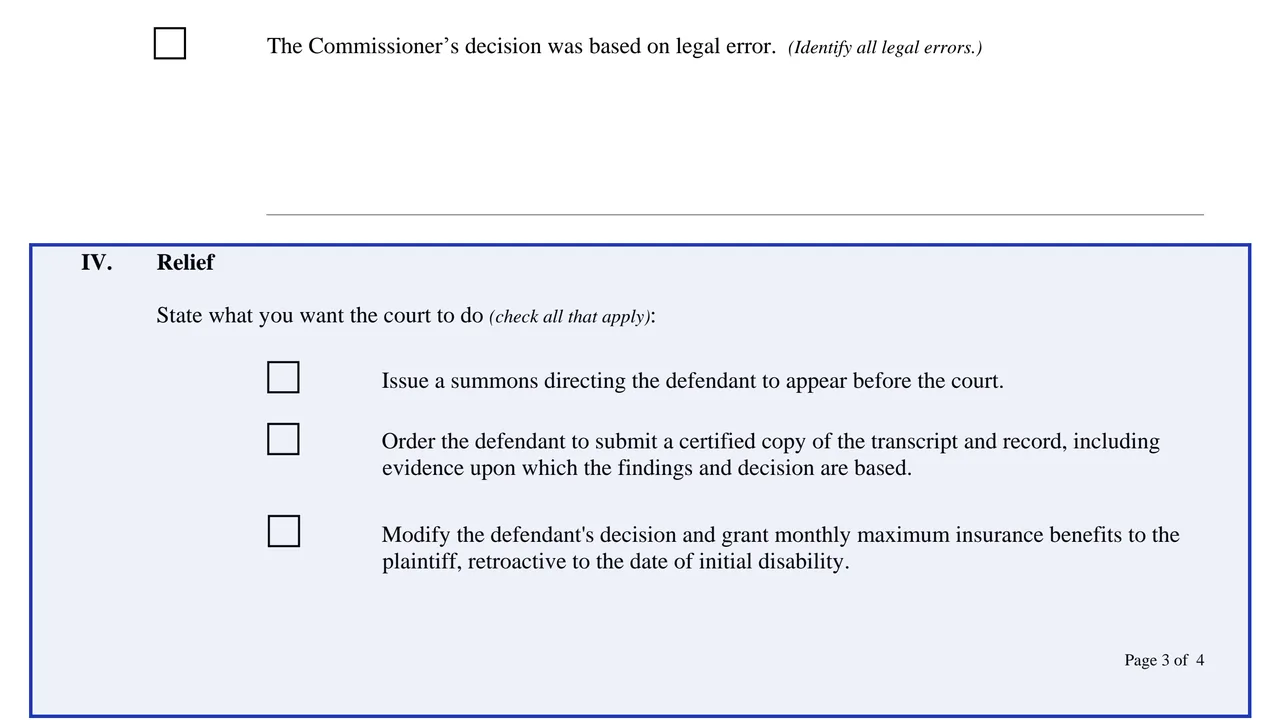
Checkboxes for a summons, an order for a certified copy of the transcript and record, modifying the decision to grant benefits retroactive to the date of initial disability, a remand for reconsideration, and further just relief.
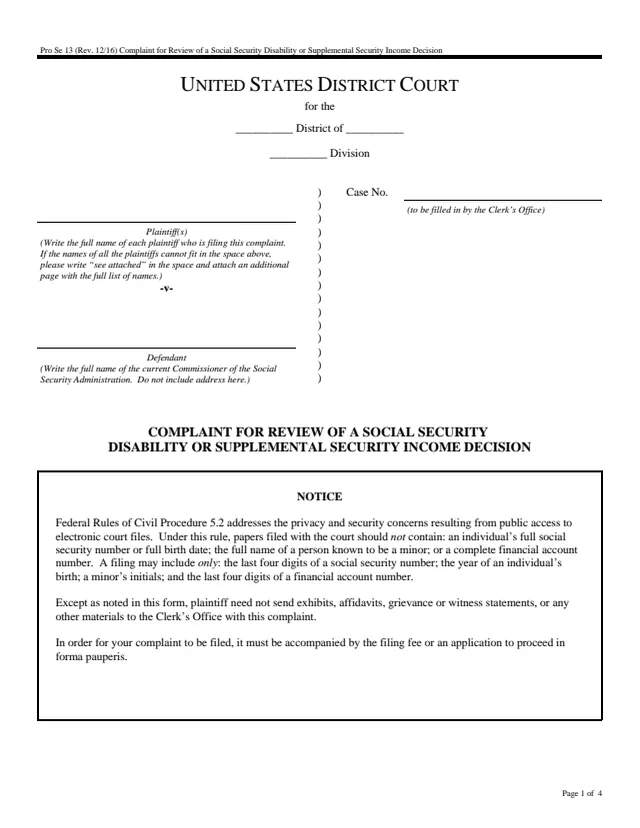
A certification under Federal Rule of Civil Procedure 11, then the date, signature and printed name of the plaintiff, or the attorney's details.
Page 1 cites Federal Rule of Civil Procedure 5.2: a filing may include only the last four digits of a Social Security number, the year of birth, a minor's initials and the last four digits of a financial account number.
The caption asks for the full name of the current Commissioner of the Social Security Administration as defendant, without an address. Section I.B then asks for the regional General Counsel office address.
Section II lists Disability Insurance Benefits (Title II), Supplemental Security Income (Title XVI), Child Disability and Widow or Widower claims. The codes beside them are for Clerk's Office use only.
The form asks when notice of the final decision was received, likely the date of the Appeals Council denial notice, and for copies of the final decision and that denial notice.
In Section III, check substantial evidence, legal error or both and explain each. In Section IV, check the relief asked for.
Sign under the Rule 11 certification and print your name. Parties without an attorney also agree to keep their address current with the Clerk's Office.
You get the real form, filled in a browser tab, with nothing standing between you and the finished PDF.
The form is captioned for a United States District Court, district and division. The page says to consult the rules and caselaw that govern in the court where the pleading is filed.
The form says an appeal from a decision of the Commissioner must be filed within 60 days of the date on which notice was received that the Commissioner's decision became final.
The form says that for the complaint to be filed, it must be accompanied by the filing fee or an application to proceed in forma pauperis. It does not print the fee amount.
The form asks for copies of the Commissioner's final decision and the Appeals Council denial notice. Except as noted in the form, it says the plaintiff need not send exhibits, affidavits or other materials with the complaint.
The page says that if you are not a lawyer and are suing or have been sued, it is best to have or consult a lawyer if possible.
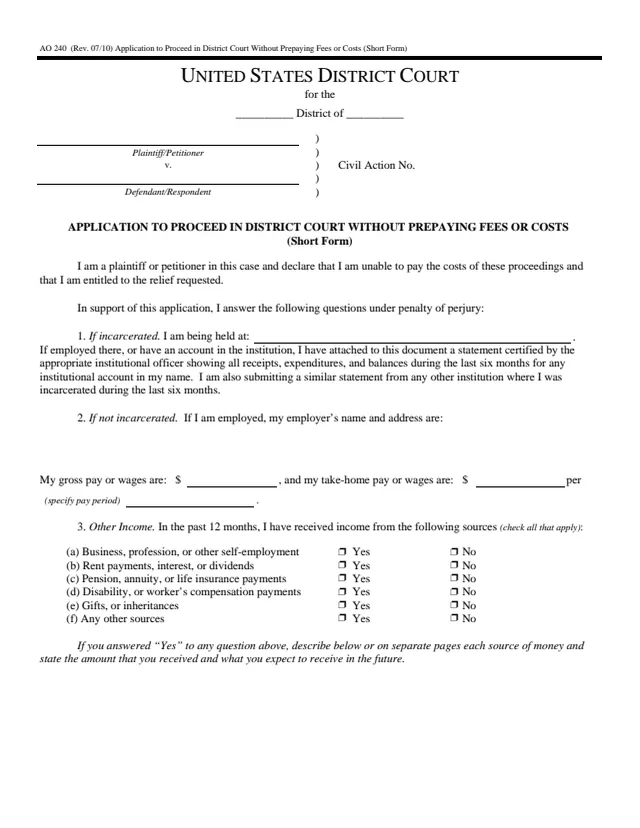
AO 240
28 fields, 2 pages
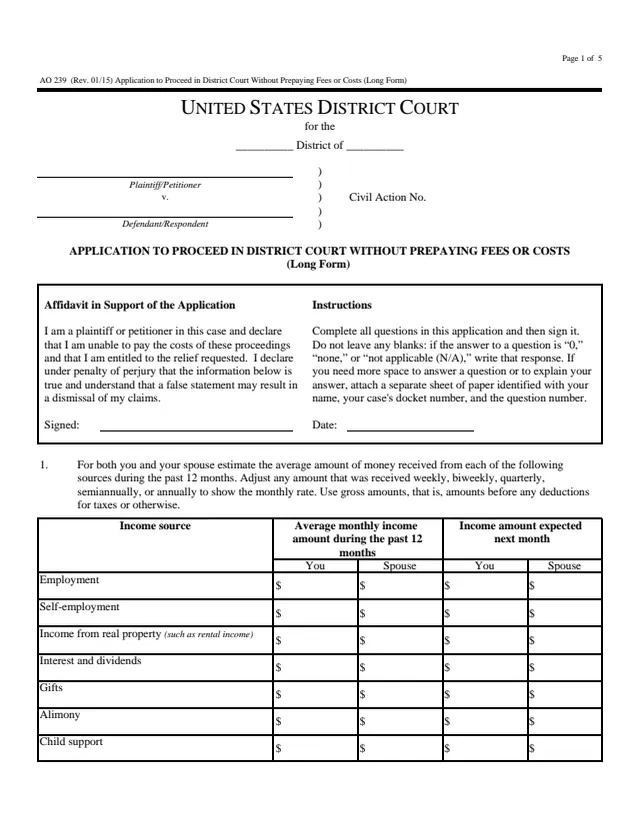
AO 239
191 fields, 5 pages
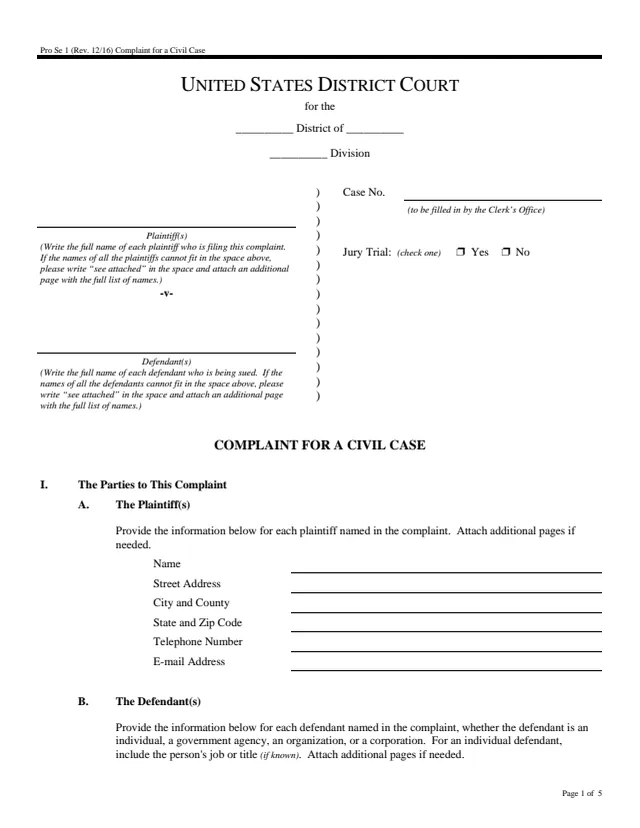
Pro Se 1
76 fields, 5 pages
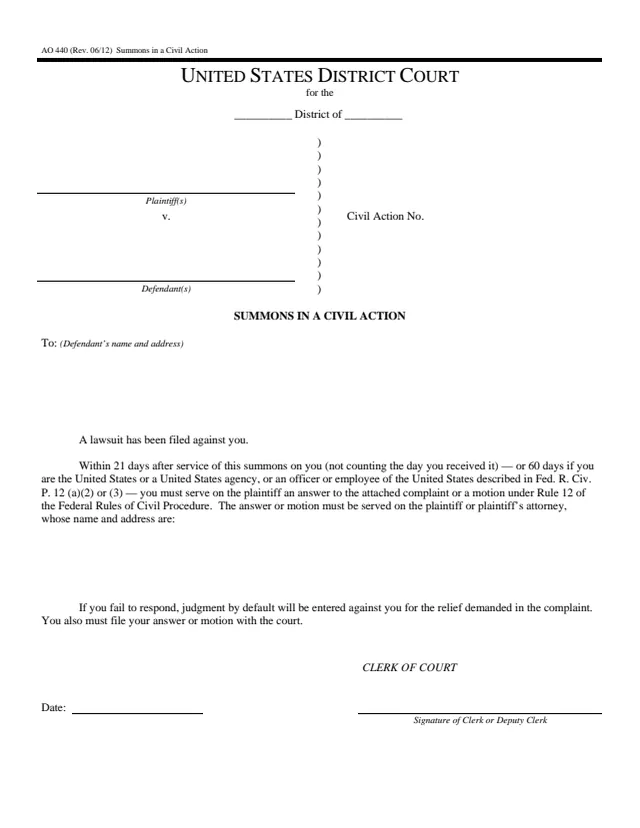
AO 440
34 fields, 2 pages
The page describes the Civil Pro Se Forms as examples for people who represent themselves or have little experience in federal courts, and says to use the form that fits your case. The form names these parties.
No tool matches that search.
No. The U.S. Courts page says no form provides legal advice or substitutes for having or consulting a lawyer, and that following a form does not guarantee a pleading is legally or factually correct or sufficient.
The form names the current Commissioner of the Social Security Administration. The caption asks for the Commissioner's full name without an address, and Section I.B asks for the Regional Office of the Social Security Administration General Counsel.
No. Section I.A asks only for the last four digits and says not to include the full number. The notice on page 1 cites Federal Rule of Civil Procedure 5.2.
Yes. It says an appeal from a decision of the Commissioner must be filed within 60 days of the date on which notice was received that the decision became final, likely the date of the Appeals Council denial notice.
A copy of the Commissioner's final decision and a copy of the notice from the Social Security Appeals Council that the appeal was denied.
The form marks the COA and NOS codes beside each claim type as For Clerk's Office Use Only. The plaintiff checks the claim type.
No amount is printed. The form says the complaint must be accompanied by the filing fee or an application to proceed in forma pauperis for it to be filed.