Caption
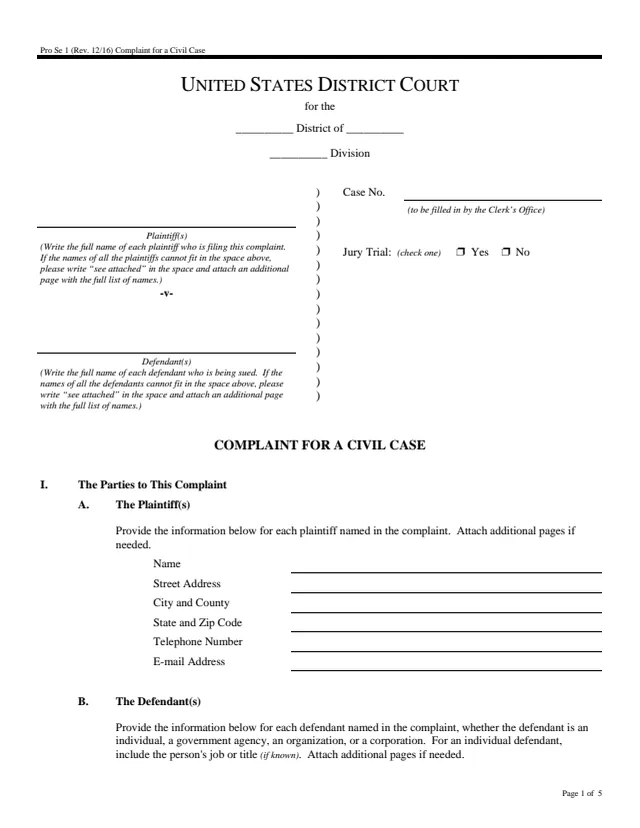
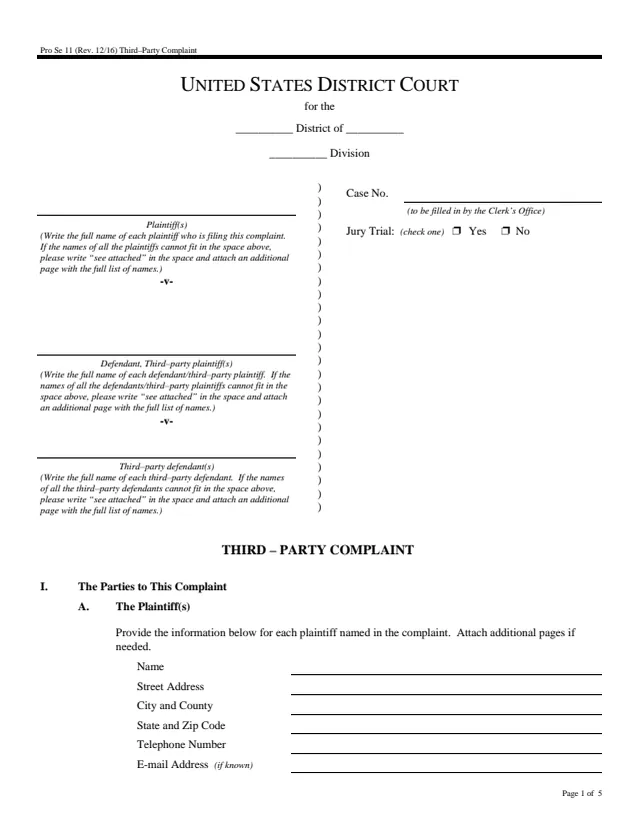
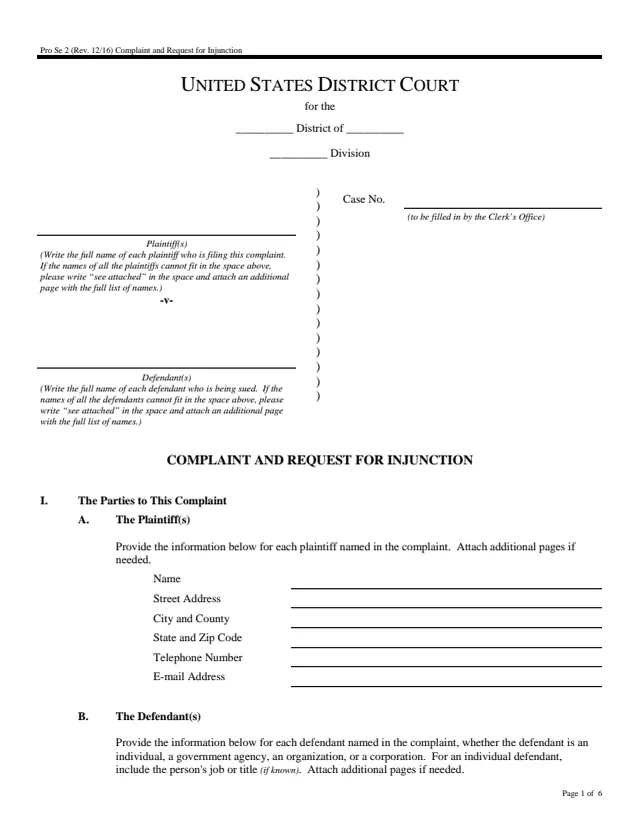
The district and division, the full names of the plaintiffs and the defendants, and a case number left for the Clerk's Office. Names that do not fit go on an attached page, with "see attached" written in the space.
Pro Se 12
Complaint for Interpleader and Declaratory Relief
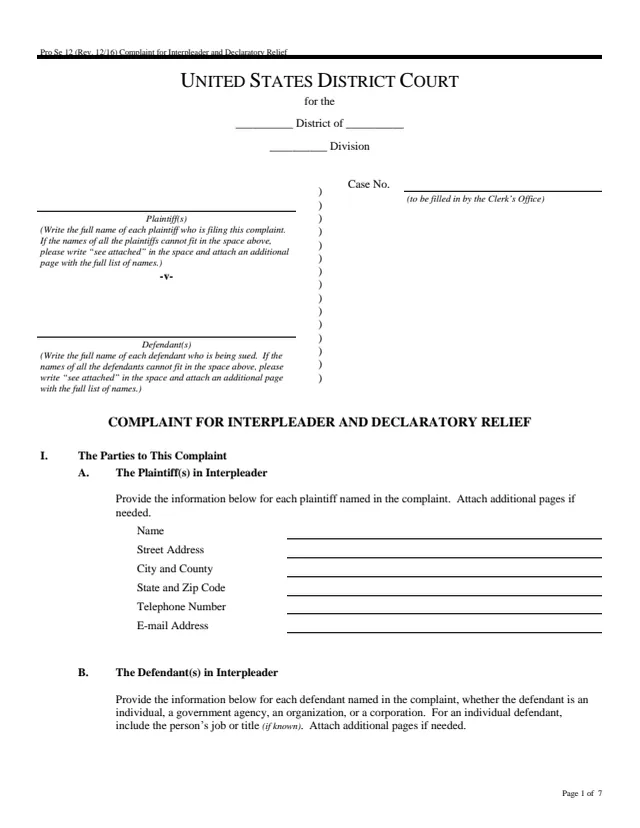
Pro Se 12, Complaint for Interpleader and Declaratory Relief, is a pleading form from the U.S. Courts for a case in a United States district court. It is one of the Civil Pro Se Forms, which the U.S. Courts page says are limited to types of cases often filed in federal courts by people who represent themselves or who may not have much experience in federal courts.
The form asks the plaintiff to describe property in their possession that each defendant claims. It covers the parties, which of two types of interpleader action is brought (under Federal Rule of Civil Procedure 22 or under 28 U.S.C. § 1335), jurisdiction and venue, whether the property was deposited with the court or a bond given, the relief requested, and a signed certification under Federal Rule of Civil Procedure 11.
The U.S. Courts offers it as a PDF and a Word file, effective on December 1, 2016. This page explains the form in plain words and is not legal advice. You can fill it out free in your browser on this page and download the result without an account.
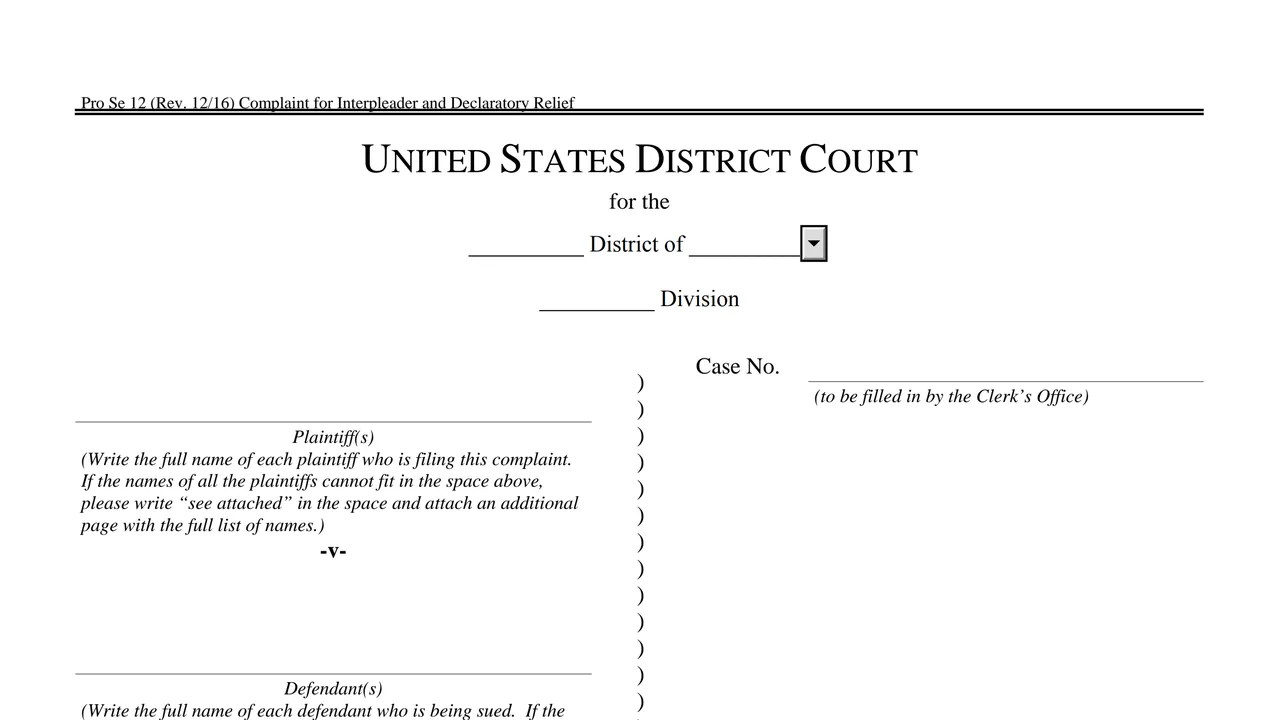
The district and division, the full names of the plaintiffs and the defendants, and a case number left for the Clerk's Office. Names that do not fit go on an attached page, with "see attached" written in the space.
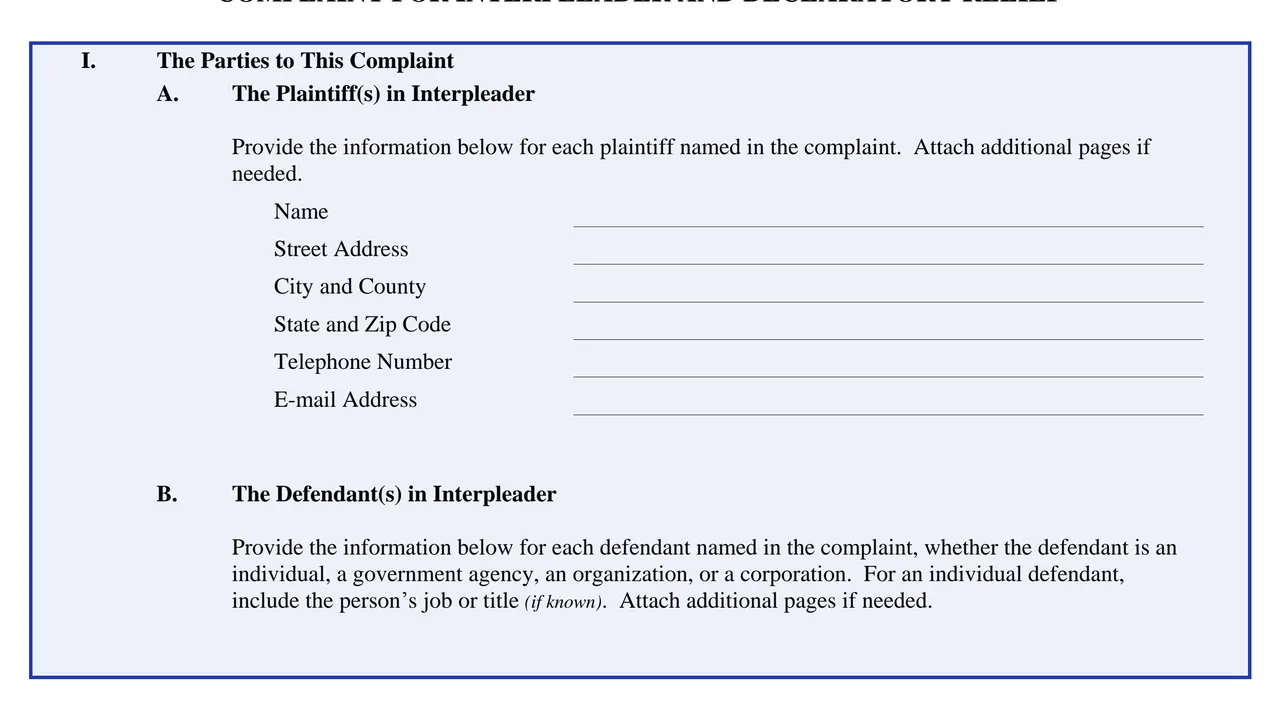
Name, address, phone and email for each plaintiff in interpleader, and for up to four defendants in interpleader, with an individual's job or title if known.
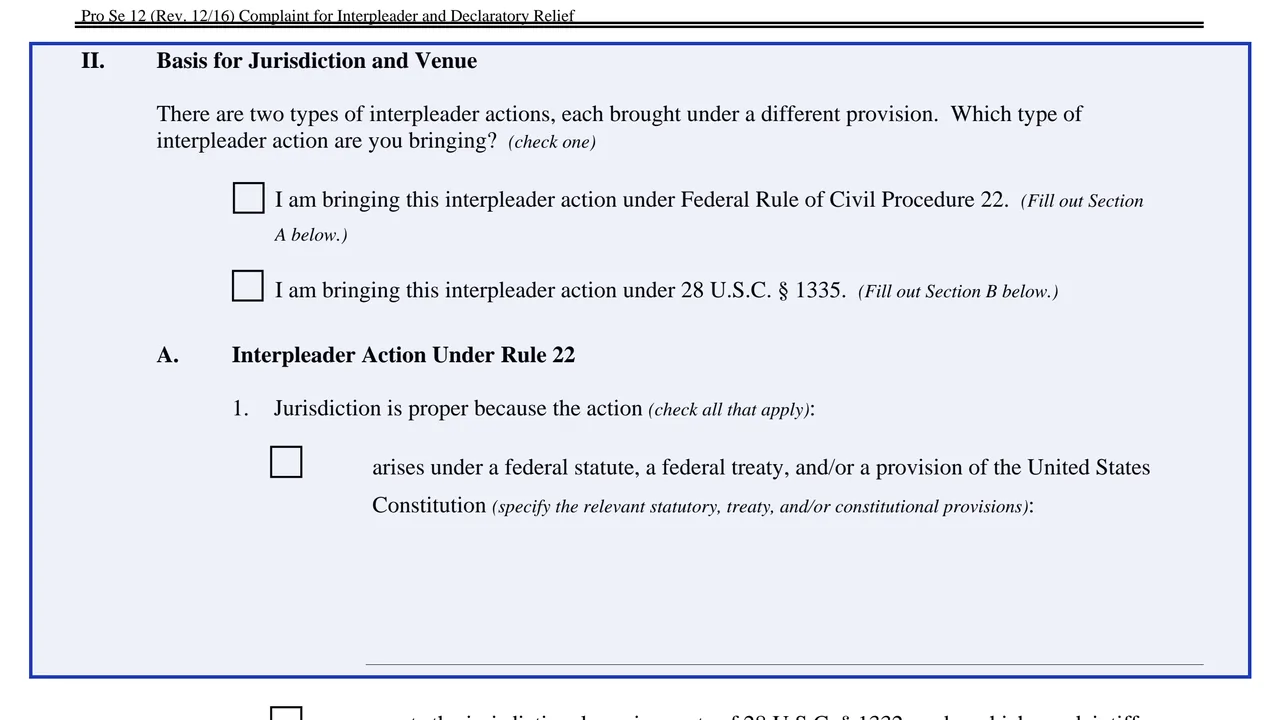
A choice between an action under Federal Rule of Civil Procedure 22 (Section A) and one under 28 U.S.C. § 1335 (Section B). Each asks for the parties' citizenship and why venue is proper, under 28 U.S.C. § 1391 or § 1397.
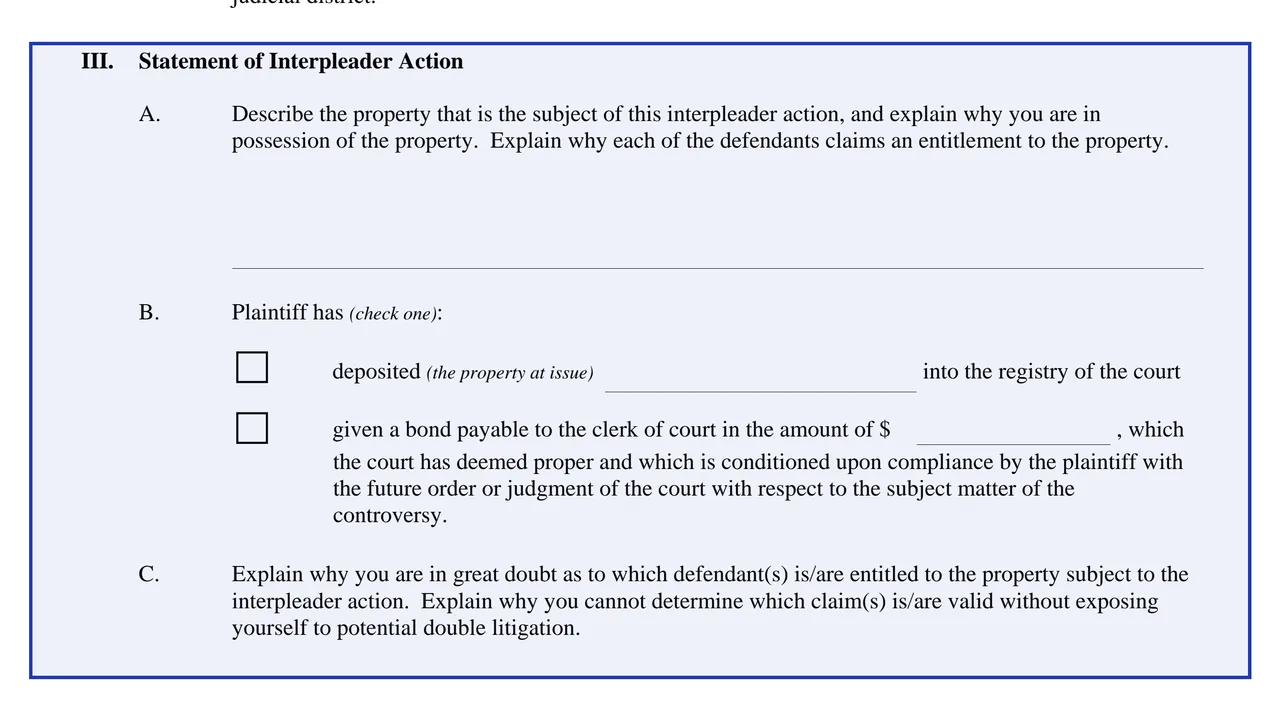
The property and why you hold it, why each defendant claims it, whether it was deposited into the registry of the court or a bond given to the clerk of court, and why you are in great doubt about who is entitled to it.
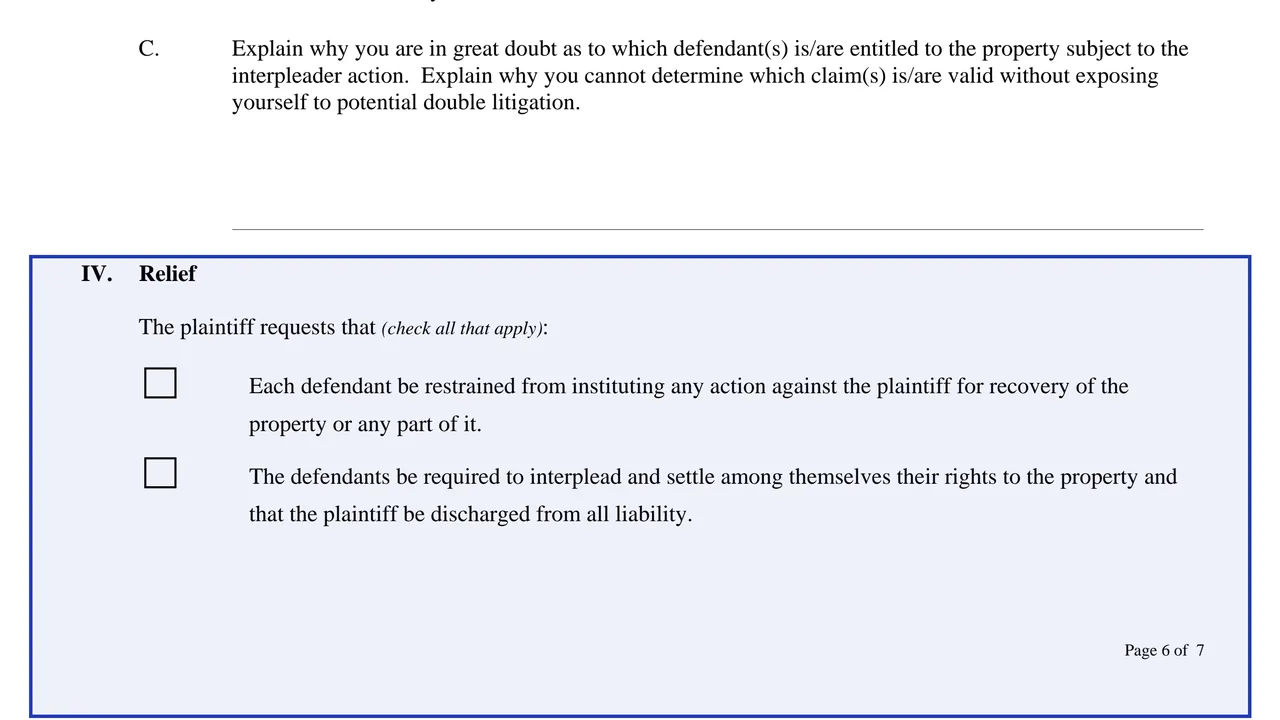
Checkboxes for restraining each defendant from suing the plaintiff over the property, requiring the defendants to interplead and discharging the plaintiff from liability, costs and reasonable attorney's fees, and further just relief.
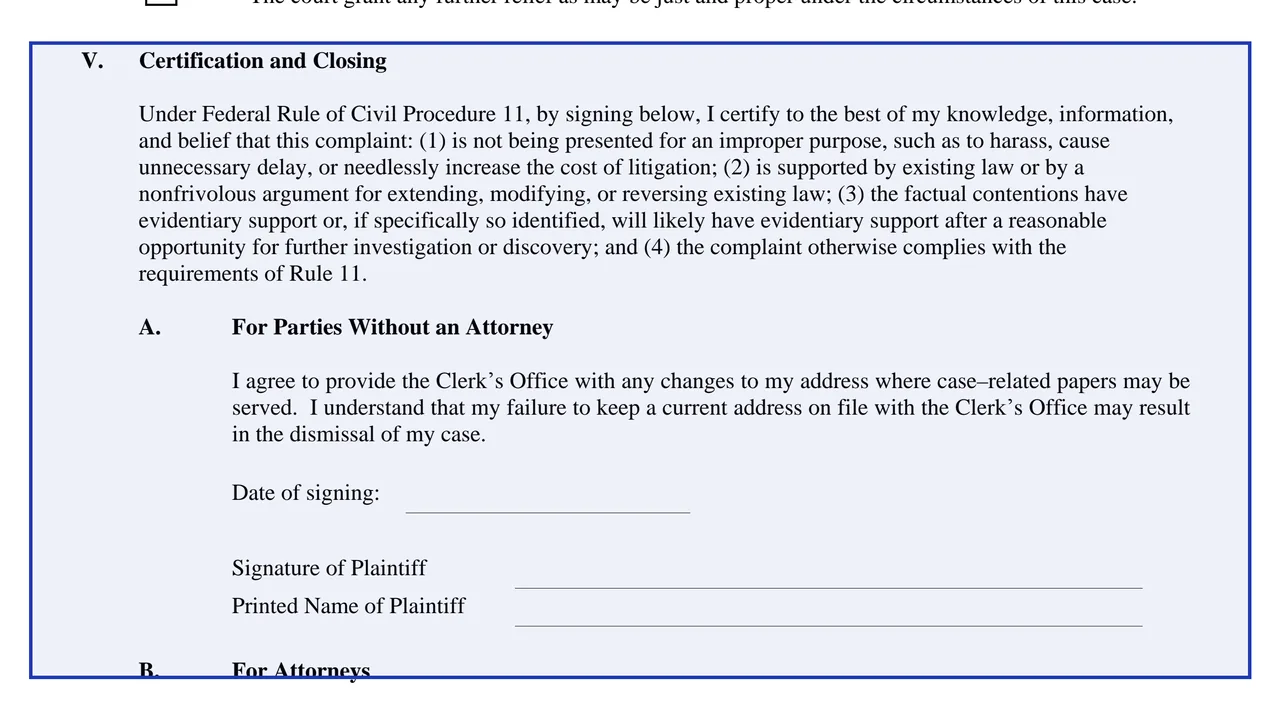
A certification under Federal Rule of Civil Procedure 11, then the date, signature and printed name of the plaintiff, or the attorney's details.
The U.S. Courts page says no form provides legal advice, a court may require more or less than a form asks, and to consult the rules and caselaw that govern in the court where you file.
Enter the district, division and the full names of the parties, leave the case number for the Clerk's Office, and complete Section I for each plaintiff and defendant.
Section II asks you to check one: an action under Rule 22 (fill out Section A) or under 28 U.S.C. § 1335 (fill out Section B). Only the matching section is filled out.
Section III asks what the property is, why you hold it and why each defendant claims it, and whether it was deposited into the registry of the court or a bond was given to the clerk of court.
The page cites Federal Rule of Civil Procedure 5.2: a filing may show only the last four digits of a Social Security, taxpayer or financial account number, the year of birth, and a minor's initials.
Check the relief asked for in Section IV, then sign under the Rule 11 certification and print your name. Parties without an attorney also agree to keep their address current with the Clerk's Office.
You get the real form, filled in a browser tab, with nothing standing between you and the finished PDF.
The form is captioned for a United States District Court, district and division. The page says to consult the rules and caselaw that govern in the court where the pleading is filed.
For a Rule 22 action based on 28 U.S.C. § 1332, the form says the amount at stake must exceed $75,000. For a § 1335 action, it says at least two defendants must be citizens of different States and the property must be worth at least $500.
Section III.B has two choices: the property was deposited into the registry of the court, or a bond payable to the clerk of court was given in an amount the court deemed proper.
The form and its U.S. Courts page do not print a filing fee.
The page says the forms give no guidance on when pleadings, claims or defenses have to be raised or who has to be sued, and that some have to be raised within a certain period of time.
The page says that if you are not a lawyer and are suing or have been sued, it is best to have or consult a lawyer if possible.
The page describes the Civil Pro Se Forms as examples for people who represent themselves or have little experience in federal courts, and says to use the form that fits your case. The form names these parties.
No tool matches that search.
No. The U.S. Courts page says no form provides legal advice or substitutes for having or consulting a lawyer, and that following a form does not guarantee a pleading is legally or factually correct or sufficient.
Section II lists an action under Federal Rule of Civil Procedure 22 and one under 28 U.S.C. § 1335, and asks you to check one and fill out the matching Section A or B. This page cannot say which one fits a case.
For a Rule 22 action that relies on 28 U.S.C. § 1332, the form says the amount at stake must exceed $75,000, not counting interest and costs of court. For a § 1335 action, it says the property in controversy must be worth at least $500.
Restraining each defendant from suing the plaintiff over the property, requiring the defendants to interplead and settle their rights with the plaintiff discharged from liability, costs and reasonable attorney's fees, and any further relief that is just and proper.
The form says the case number is filled in by the Clerk's Office.
The page cites Federal Rule of Civil Procedure 5.2: filings should not contain anyone's full Social Security number or full birth date, the name of a person known to be a minor, or a complete financial account number.
No. The page says the forms give no guidance on timing, that some pleadings, claims or defenses have to be raised within a certain period of time, and that the Federal Rules of Civil Procedure are available free at www.uscourts.gov.