Caption and warnings
Debtor 1, Debtor 2 (spouse, if filing), the bankruptcy court district and the case number, then notes on redaction, supporting documents and the penalty for a fraudulent claim.
B 410
Proof Of Claim
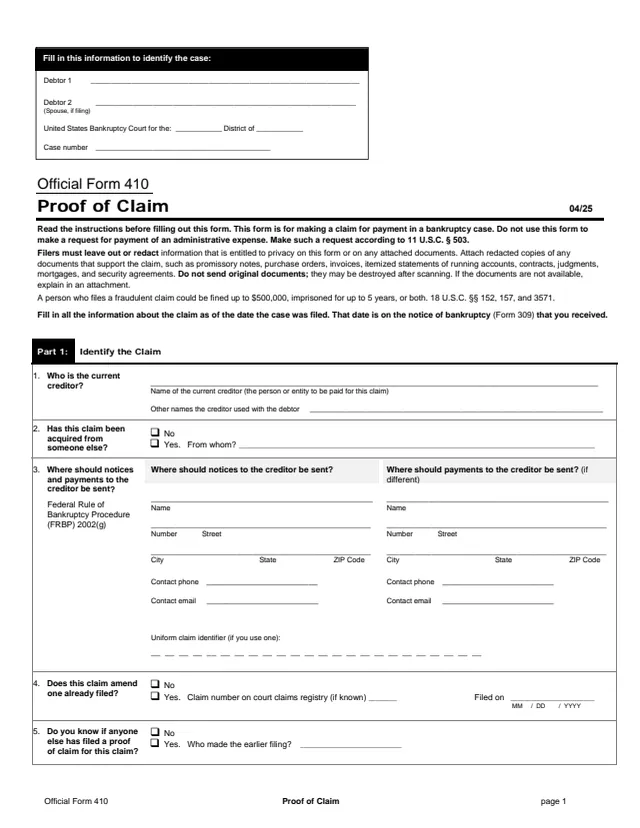
Form B 410, printed as Official Form 410, Proof of Claim, is the Official Bankruptcy Form the form describes as being for making a claim for payment in a bankruptcy case. The current version is dated 04/25. The U.S. Courts page lists it under Bankruptcy Forms, effective on December 1, 2024 and updated on April 1, 2025, says it is derived from Official Form 10, and says Official Bankruptcy Forms are approved by the Judicial Conference and must be used under Bankruptcy Rule 9009. The committee note says Form 410 applies in all cases.
The 3-page form identifies the claim and the creditor, gives the amount and basis of the claim as of the date the case was filed, asks whether it is secured, based on a lease, subject to setoff or entitled to priority, and ends with a signature under penalty of perjury. The form says not to use it for a request for payment of an administrative expense, which is made according to 11 U.S.C. § 503.
This page explains the form in plain words and is not legal advice. The instructions suggest considering the advice of an attorney. You can fill it out free in your browser on this page and download the result without an account.
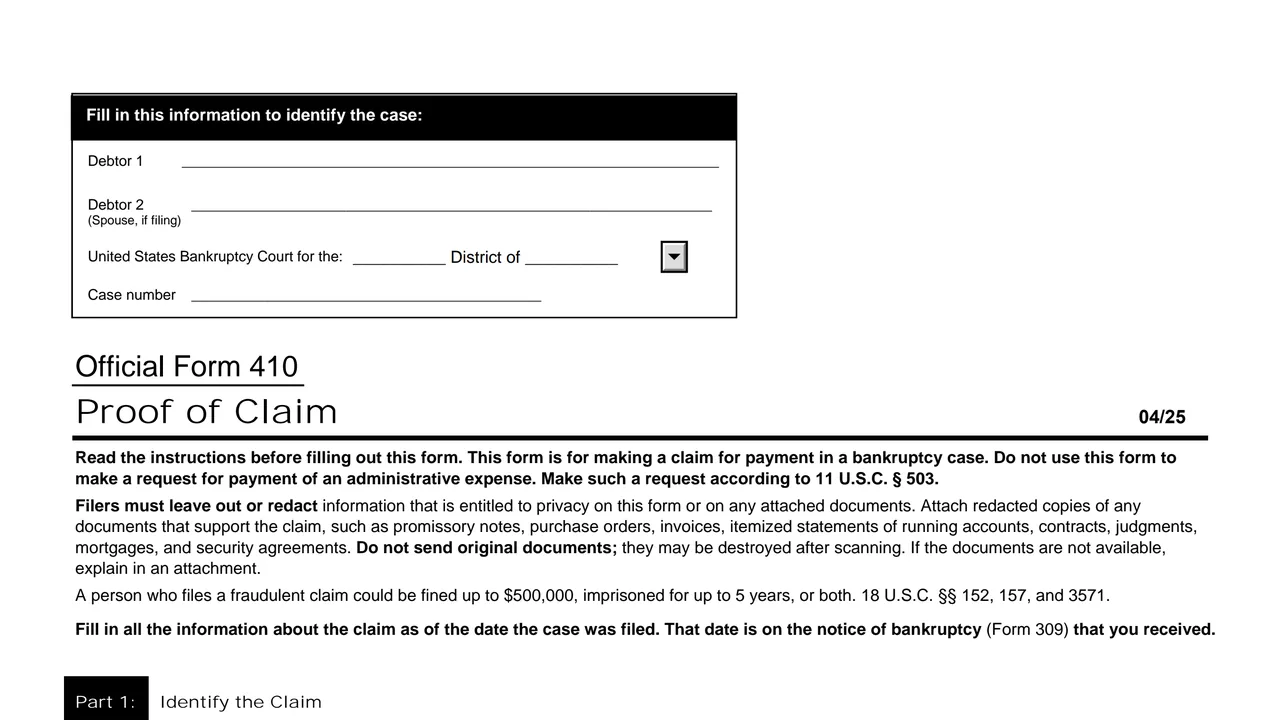
Debtor 1, Debtor 2 (spouse, if filing), the bankruptcy court district and the case number, then notes on redaction, supporting documents and the penalty for a fraudulent claim.
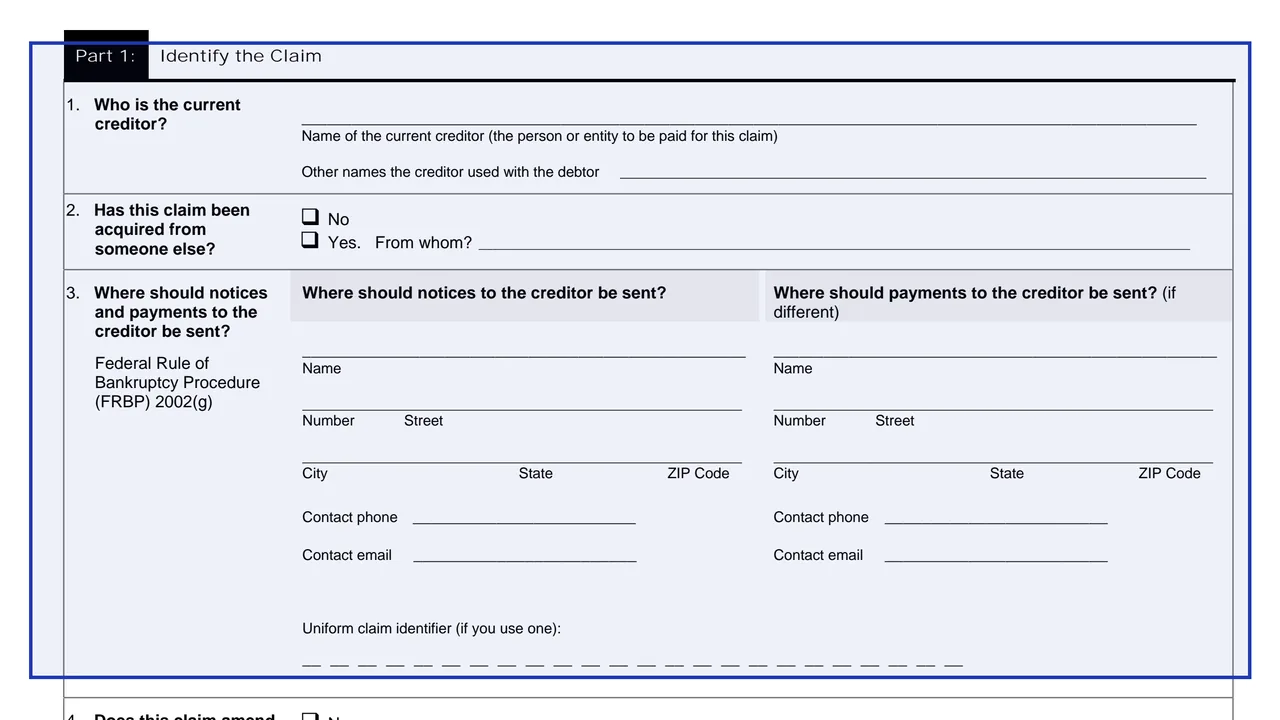
Lines 1 to 5: the current creditor, whether the claim was acquired, where notices and payments go (FRBP 2002(g)), an optional uniform claim identifier, whether it amends an earlier claim, and whether anyone else filed for it.
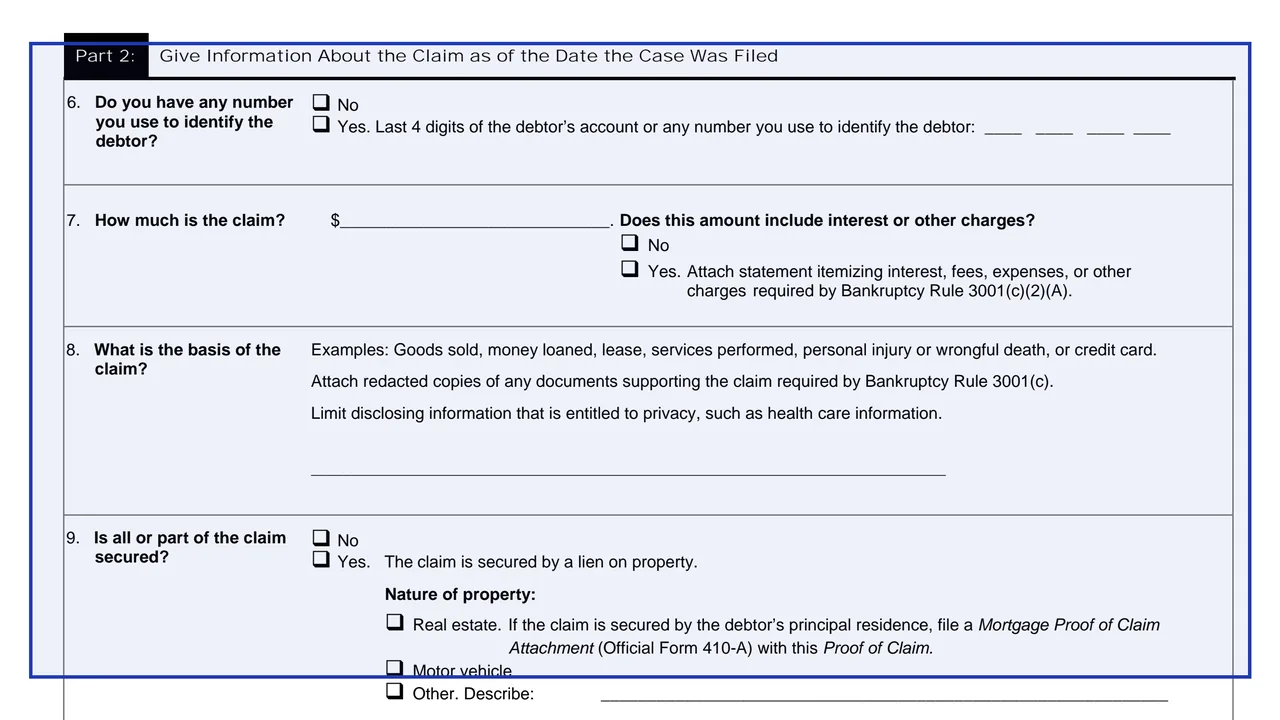
Lines 6 to 8: the last 4 digits of any number used to identify the debtor, the claim amount and whether it includes interest or other charges, and the basis, such as goods sold, money loaned, lease or credit card.
For a secured claim: the property, basis for perfection, value, secured and unsecured amounts, amount to cure any default and the annual interest rate, fixed or variable. Then lease and right of setoff questions.
Priority under 11 U.S.C. § 507(a): domestic support obligations, deposits up to $3,800*, wages up to $17,150* earned within 180 days, taxes or penalties, employee benefit plan contributions, or another subsection.
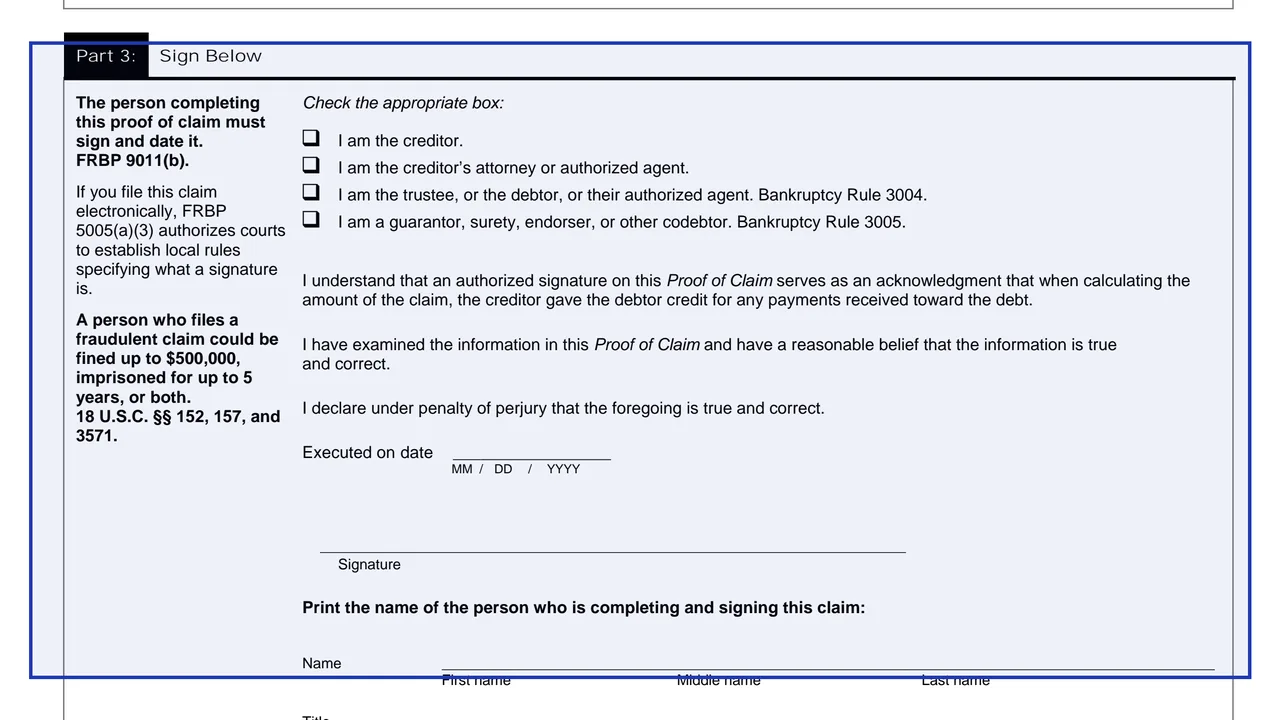
The signer's role, an acknowledgment that the creditor credited the debtor for payments received, a declaration under penalty of perjury, the date, signature, name, title, company, address, phone and email.
The form says to fill in all the information about the claim as of the date the case was filed, and that date is on the notice of bankruptcy (Form 309).
The instructions say to use the debtor's name and case number as shown in the bankruptcy notice received.
The form asks for redacted copies of supporting documents, such as promissory notes, invoices, contracts, judgments, mortgages and security agreements, and says not to send originals because they may be destroyed after scanning. If they are not available, explain in an attachment.
Citing Bankruptcy Rule 9037, the instructions say to show only the last 4 digits of any Social Security, tax identification or financial account number, only the year of a birth date, and a minor child's initials with a parent's or guardian's name and address.
Line 9 says that if the claim is secured by the debtor's principal residence, a Mortgage Proof of Claim Attachment (Official Form 410-A) is filed with the Proof of Claim.
Part 3 says the person completing the proof of claim signs and dates it, citing FRBP 9011(b). For electronic filing, it says FRBP 5005(a)(3) authorizes courts to set local rules on what a signature is.
You get the real form, filled in a browser tab, with nothing standing between you and the finished PDF.
The instructions say a proof of claim is filed in the district where the case is pending.
The form and its instructions do not print a fee.
The instructions say that to receive confirmation the claim has been filed, either enclose a stamped self-addressed envelope and a copy of the form, or view the filed form in the court's PACER system (www.pacer.psc.uscourts.gov).
The form says a person who files a fraudulent claim could be fined up to $500,000, imprisoned for up to 5 years, or both, citing 18 U.S.C. §§ 152, 157, and 3571.
The instructions say some entities offer to buy claims for less than face value, that they do not represent the bankruptcy court, the trustee or the debtor, that a creditor has no obligation to sell, and that any transfer is subject to Bankruptcy Rule 3001(e).
The asterisked line 12 amounts are, the form says, subject to adjustment on 4/01/28 and every 3 years after that for cases begun on or after the date of adjustment.
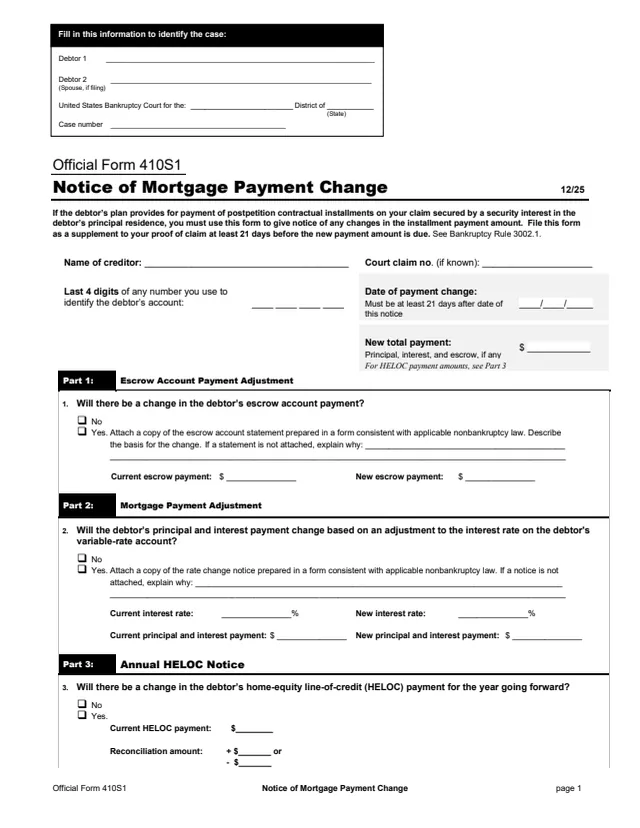
B 410S-1
60 fields, 2 pages
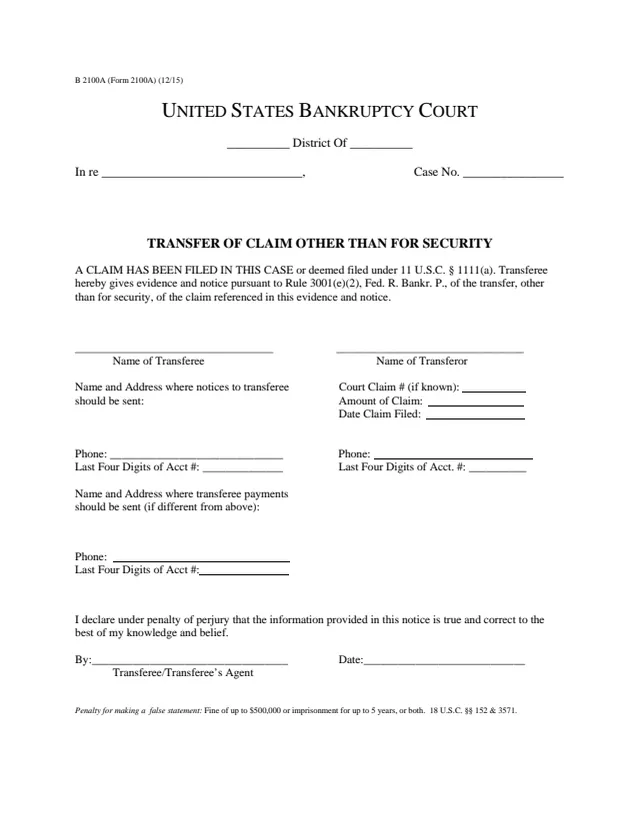
B 2100A
21 fields, 1 page
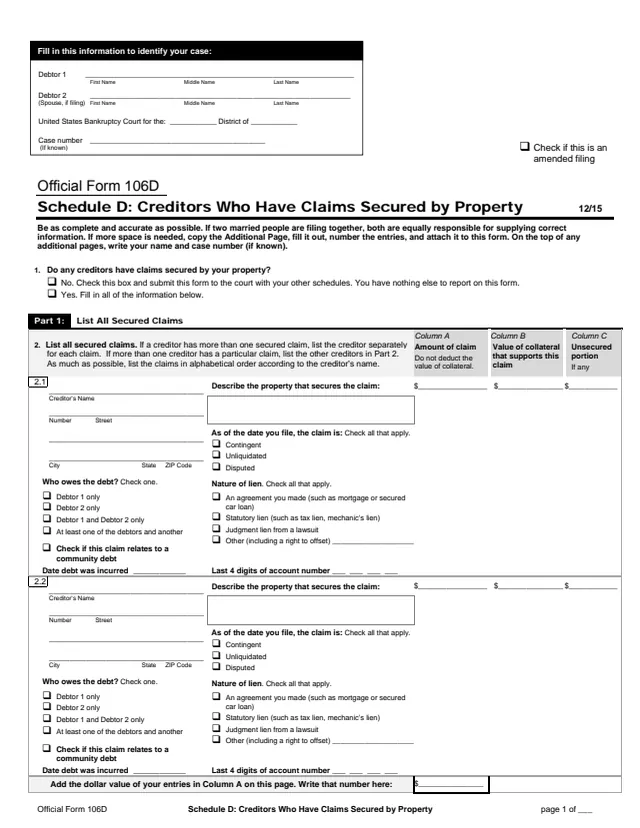
B 106D
186 fields, 3 pages
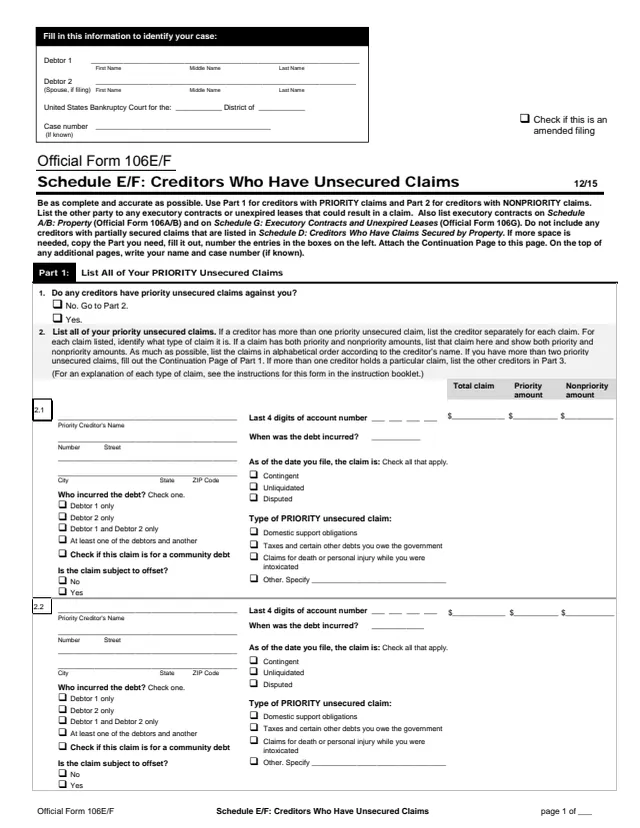
B 106E/F
323 fields, 6 pages
Part 3 lists who may complete and sign a proof of claim, and the person completing it checks one box.
No tool matches that search.
Part 3 has boxes for the creditor, the creditor's attorney or authorized agent, the trustee or the debtor or their authorized agent (Bankruptcy Rule 3004), and a guarantor, surety, endorser or other codebtor (Bankruptcy Rule 3005).
No. The form asks for redacted copies and says not to send original documents because they may be destroyed after scanning. If the documents are not available, the form says to explain in an attachment.
The instructions say the form and attachments show only the last 4 digits of any Social Security, individual tax identification or financial account number, only a minor's initials, and only the year of any person's date of birth, and that confidential health care information is left out or redacted.
The form says to fill in all the information as of the date the case was filed, and that the date is on the notice of bankruptcy (Form 309).
No. The form says not to use it for a request for payment of an administrative expense, and to make such a request according to 11 U.S.C. § 503.
The instructions say to enclose a stamped self-addressed envelope and a copy of the form, or to view the filed form in the court's PACER system.
A 2025 staff notation on the U.S. Courts page says line 12 was adjusted effective April 1, 2025, as part of the tri-annual dollar adjustments required by 11 U.S.C. § 104.
No. It explains what the form asks in plain words. It does not say whether a claim is valid, secured or entitled to priority.