Page 1 header
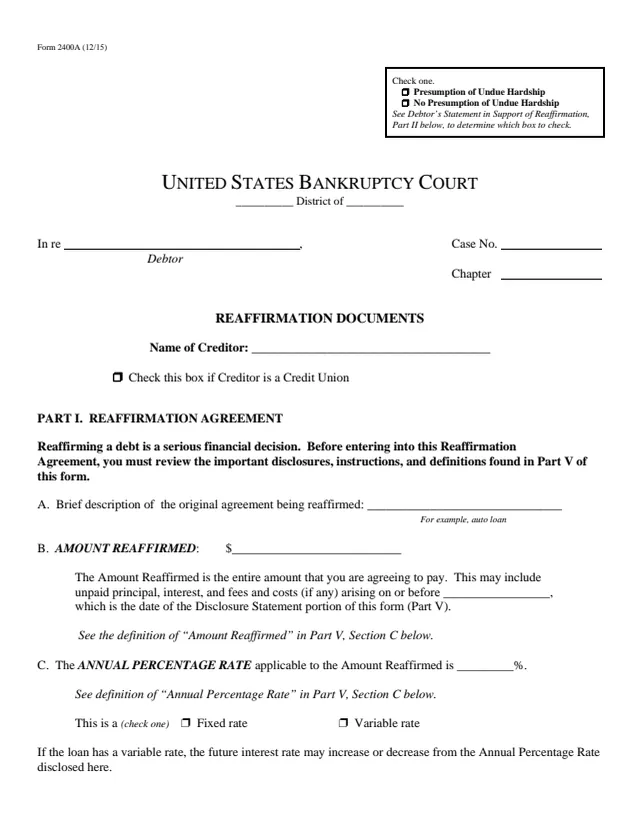
A choice between Presumption of Undue Hardship and No Presumption of Undue Hardship, then the district, debtor, case number, chapter, name of creditor and a credit union box.
B 2400A
Reaffirmation Documents
Form B 2400A, Reaffirmation Documents, is a Director's Bankruptcy Form from the U.S. Courts. The instructions say it includes the Reaffirmation Agreement, disclosures and other documents a debtor uses to reaffirm a debt, which means staying legally obligated to pay a debt that would otherwise be discharged in bankruptcy. The form is dated 12/15, and the U.S. Courts page lists it as effective on December 1, 2015, and says it is derived from Form 240A.
The instructions say reaffirming a debt is voluntary and debtors are not required to reaffirm any debt. They also say this Director's form is optional, is not used with a separate attached Reaffirmation Agreement, and does not replace the Reaffirmation Cover Sheet required by Fed. R. Bankr. P. 4008(a). The page says the use of Director's Forms may be required by local court rules or general orders.
This page explains the form in plain words and is not legal advice. You can fill it out free in your browser on this page and download the result without an account.
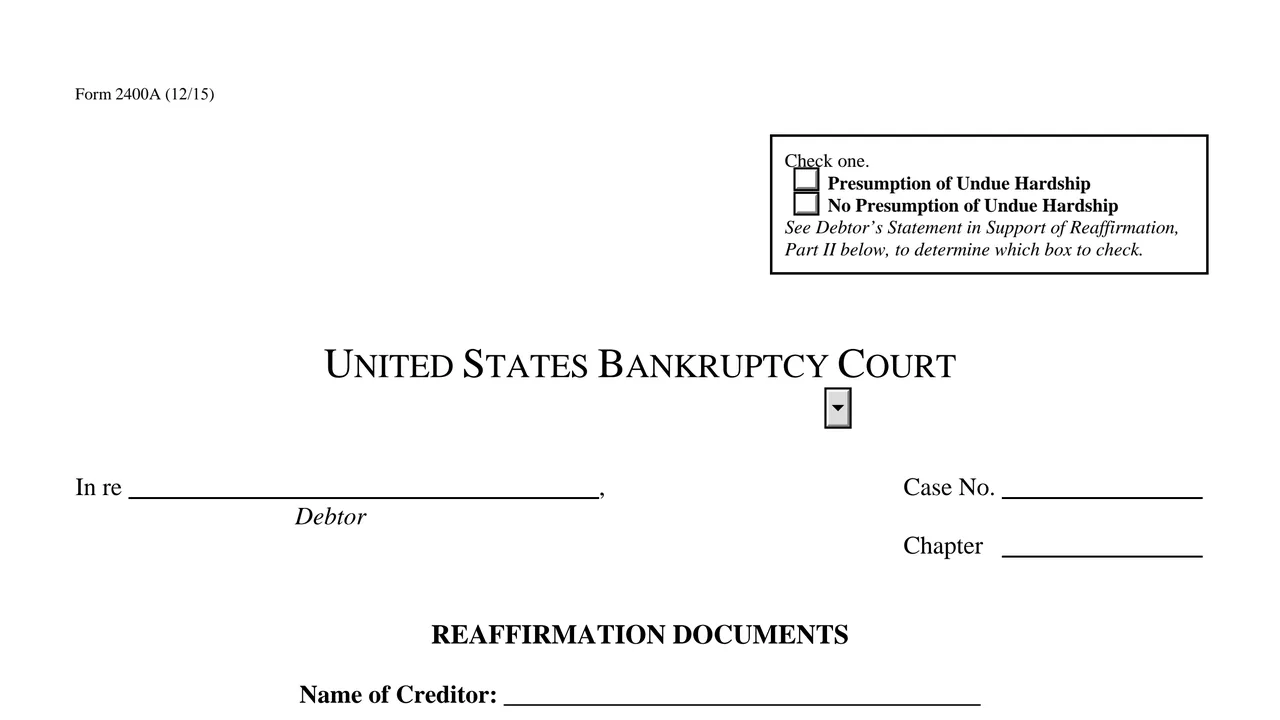
A choice between Presumption of Undue Hardship and No Presumption of Undue Hardship, then the district, debtor, case number, chapter, name of creditor and a credit union box.
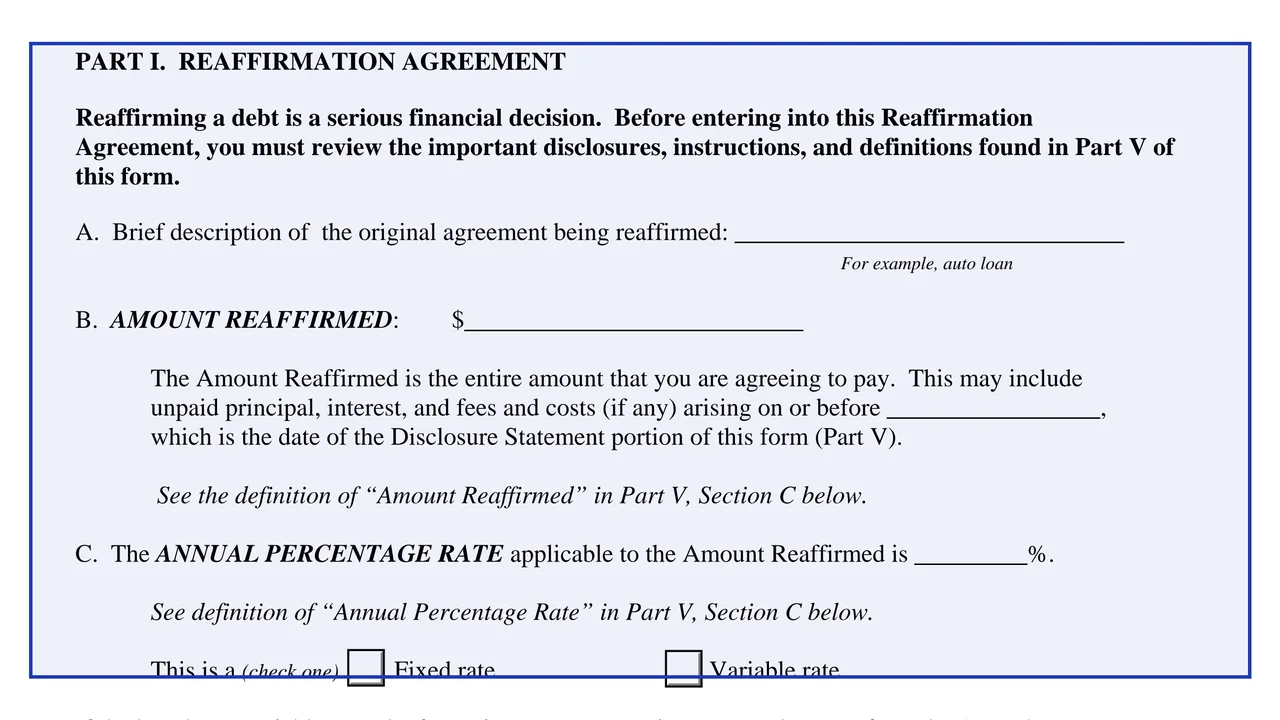
The original agreement, the Amount Reaffirmed, the Annual Percentage Rate and whether it is fixed or variable, repayment terms, collateral and its current market value, purchase price or original loan, changed terms and any future credit.
Whether an attorney represented the debtor and whether the creditor is a credit union, then monthly income and expenses, the amount available for this debt, the required payment and why the agreement will not impose an undue hardship.
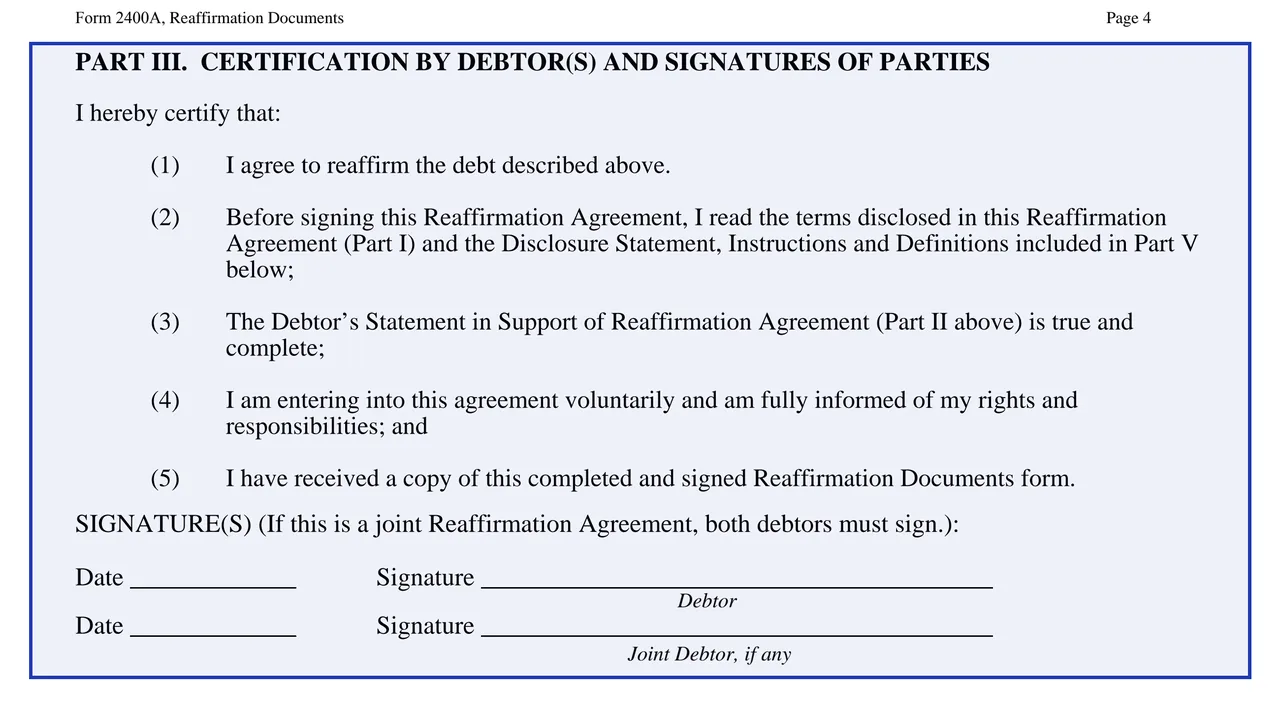
The debtor certifies five points, including agreeing to reaffirm, reading Parts I and V, entering the agreement voluntarily and receiving a copy of the signed form. The creditor then accepts the terms.
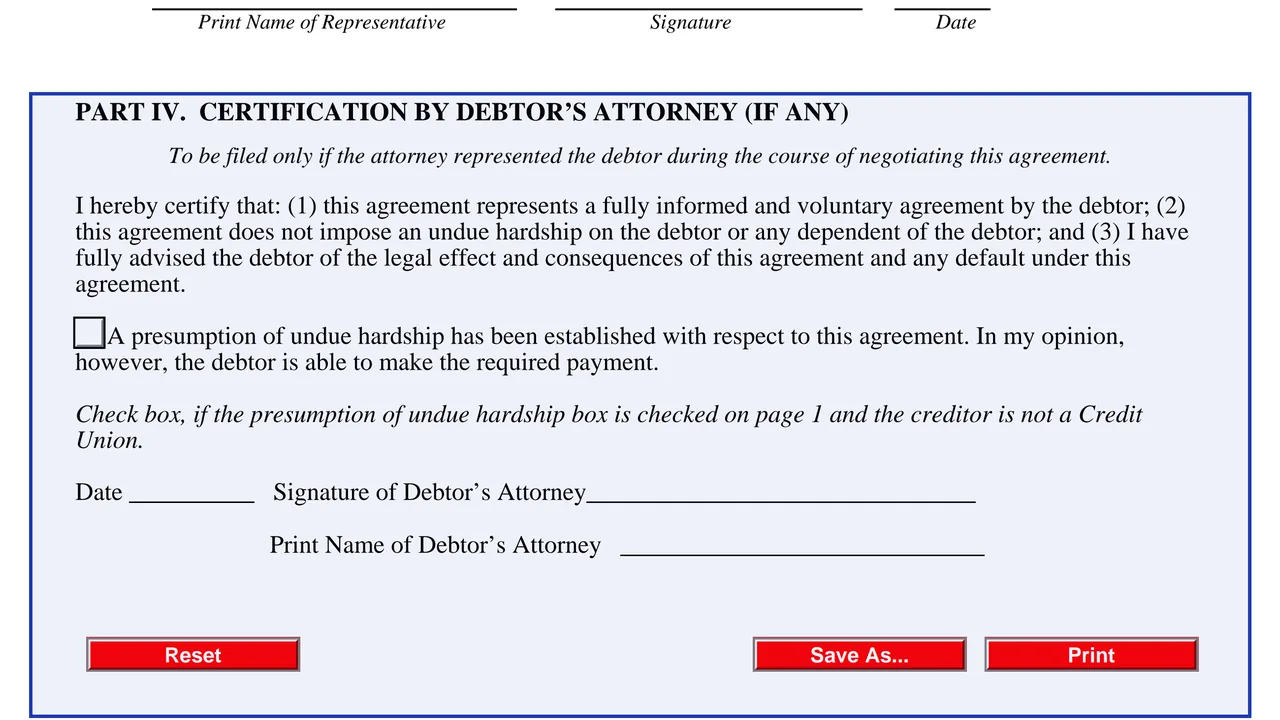
Filed only if an attorney represented the debtor in negotiating, with a box for when a presumption of undue hardship is established but, in the attorney's opinion, the debtor is able to make the payment.
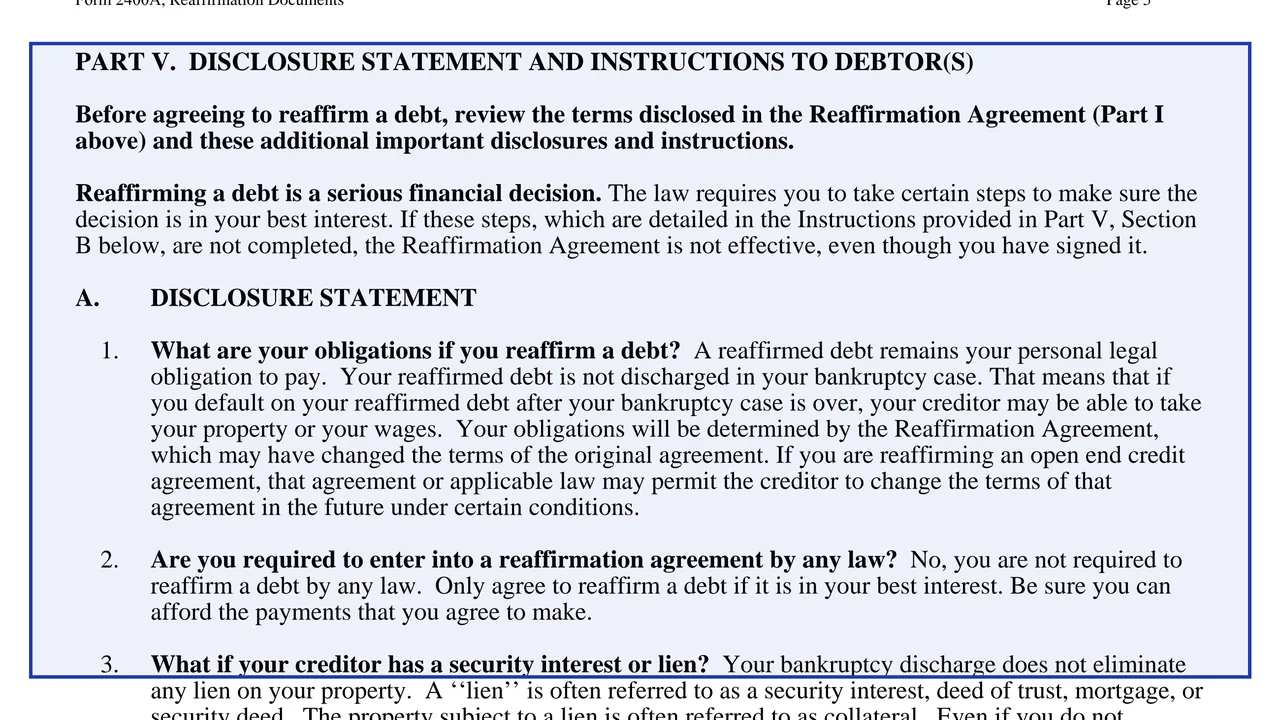
Explains what reaffirming means, liens, timing, cancellation and when the agreement takes effect, gives filing instructions, and defines Amount Reaffirmed, Annual Percentage Rate and Credit Union.
Part I says to review the disclosures, instructions and definitions in Part V before entering into the agreement, and calls reaffirming a debt a serious financial decision.
The instructions say to describe the original agreement, enter the total debt reaffirmed and the date the disclosure was prepared, the Annual Percentage Rate and the repayment terms. All blanks are filled in, with one of two boxes checked.
If the debtor had no attorney or the creditor is not a credit union, C.1 and C.2 compare present income and expenses. The instructions say not to use figures from the bankruptcy schedules unless they are identical to the present ones.
Part II says that if the monthly payment on line d is greater than the amount available on line c, the Presumption of Undue Hardship box on page 1 is checked; otherwise, No Presumption of Undue Hardship.
Each reaffirming debtor signs and dates Part III, the creditor's representative signs and dates the acceptance, and an attorney who negotiated for the debtor signs Part IV.
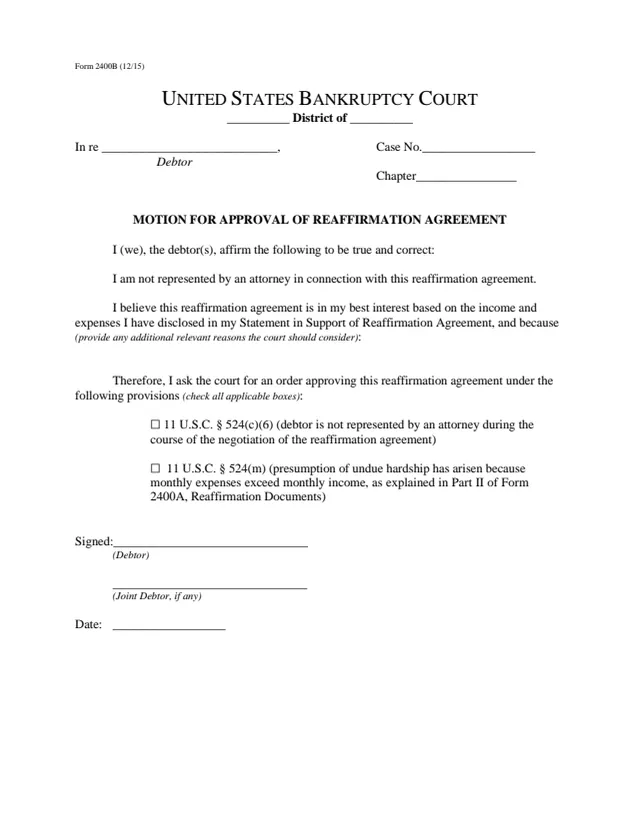
Part V says the debtor or the creditor files the original packet with a completed Reaffirmation Agreement Cover Sheet, Official Form 427. A debtor without an attorney also files a motion for court approval unless the real property exception applies.
You get the real form, filled in a browser tab, with nothing standing between you and the finished PDF.
Part V says a reaffirmation agreement is entered into before the discharge, and the signed agreement is filed no later than 60 days after the first date set for the meeting of creditors. It says the court may extend the time, even after the 60-day period has ended.
Part V says the agreement may be rescinded at any time before the court enters the discharge, or during the 60-day period that begins when it is filed, whichever occurs later, by notifying the creditor.
With an attorney, Part V says the agreement takes effect when filed, unless it is presumed an undue hardship and the creditor is not a credit union, in which case the court reviews it and may set a hearing. Without an attorney, it takes effect only once the court approves it.
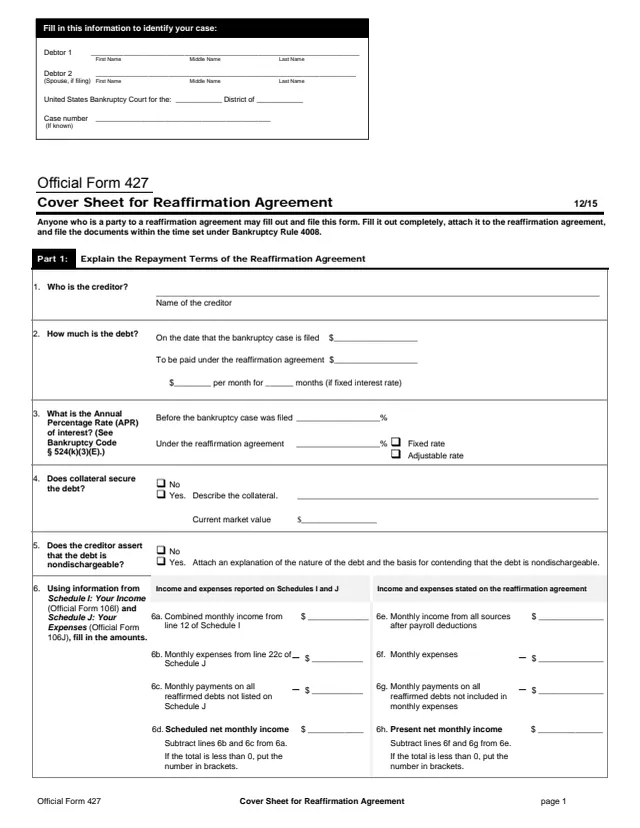
Part V names the Reaffirmation Agreement Cover Sheet, Official Form 427. The instructions say this form does not replace the cover sheet required by Fed. R. Bankr. P. 4008(a).
The form, its instructions and its U.S. Courts page do not print a fee.
The form is completed and signed by the debtor and the creditor, with a certification by the debtor's attorney when one negotiated the agreement.
No tool matches that search.
No. Part V says no law requires reaffirming a debt, and the instructions say reaffirming is voluntary. Part V also says to agree only if it is in the debtor's best interest and the payments are affordable.
Part V says a reaffirmed debt remains a personal legal obligation and is not discharged, and that after a default the creditor may be able to take property or wages.
Part V says the discharge does not eliminate any lien on property, and the creditor may still have a right under the lien to take the collateral on default. It adds that exempt or abandoned personal property may be redeemed with a single payment equal to its current value.
Part V says no later than 60 days after the first date set for the meeting of creditors, and that the court may extend the time, even after the 60-day period has ended.
Part V says it may be rescinded before the court enters the discharge, or within 60 days after it is filed, whichever is later, by notifying the creditor, even if the court has approved it.
Part V says that without an attorney, the agreement is not effective unless the court approves it after a motion and a hearing, except for a consumer debt secured by a lien on real property such as a home.
No. The instructions say not to use this form with a separate attached Reaffirmation Agreement. For that, they say parties may draft their own documents, use Director's Form 2400A/B ALT, or use other forms authorized by local courts.