Part 1: Chapter
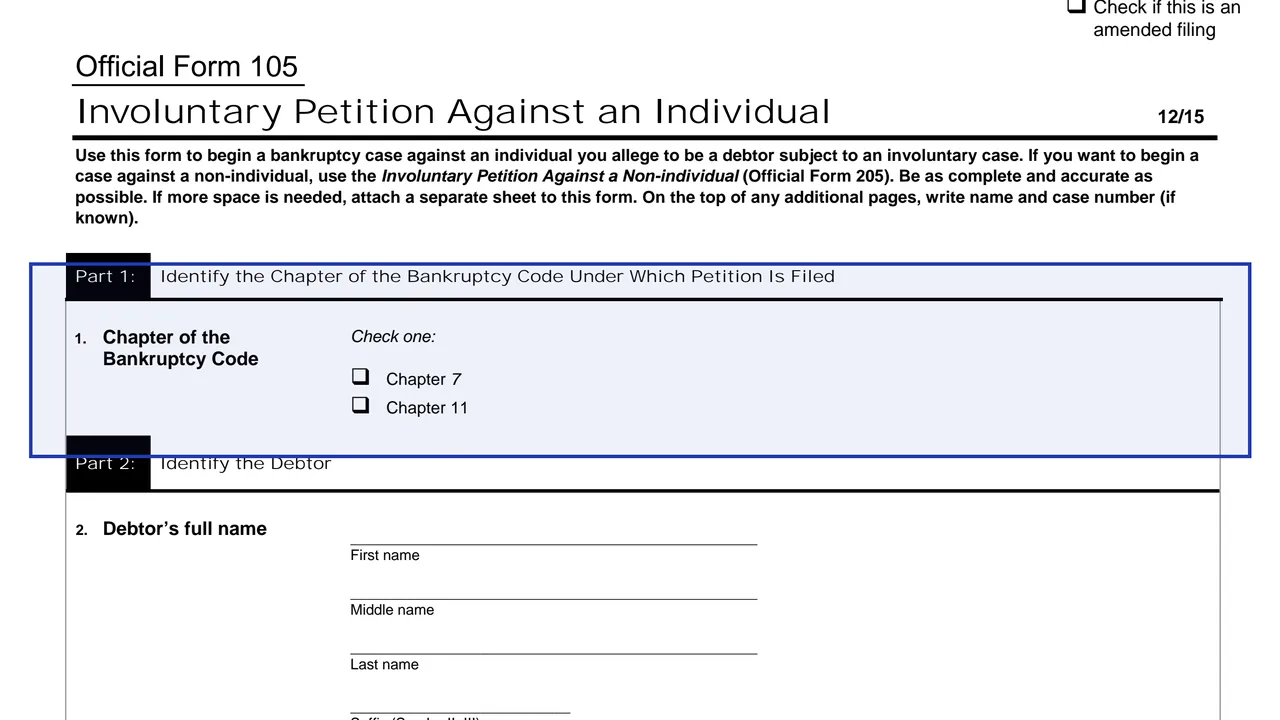
Line 1 asks for the chapter of the Bankruptcy Code under which the petition is filed: Chapter 7 or Chapter 11.
B 105
Involuntary Petition Against an Individual
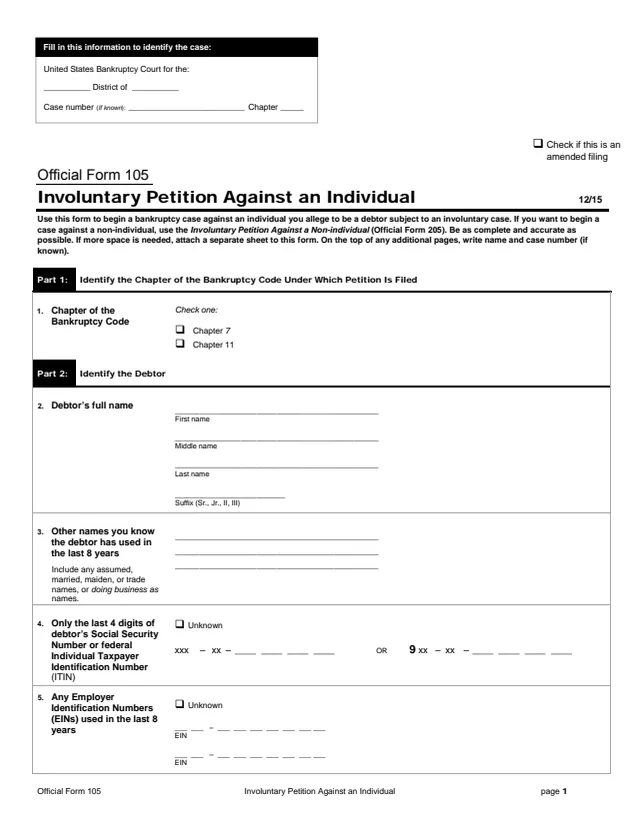
Form B 105, printed as Official Form 105, is the Involuntary Petition Against an Individual. It is an Official Bankruptcy Form from the U.S. Courts, listed under Individual Debtors and effective on December 1, 2015. The U.S. Courts page says it is derived from Official Form 5, and that Official Bankruptcy Forms are approved by the Judicial Conference and must be used under Bankruptcy Rule 9009.
The form says to use it to begin a bankruptcy case against an individual you allege to be a debtor subject to an involuntary case, and to use the Involuntary Petition Against a Non-individual (Official Form 205) for a case against a non-individual. It is filled out and signed by the petitioners or their representatives and their attorneys. The 5-page form names the chapter (Chapter 7 or Chapter 11), identifies the debtor, states the venue, the allegations and each petitioner's claim, and requests an order for relief.
This page explains the form in plain words and is not legal advice. You can fill it out free in your browser on this page and download the result without an account.
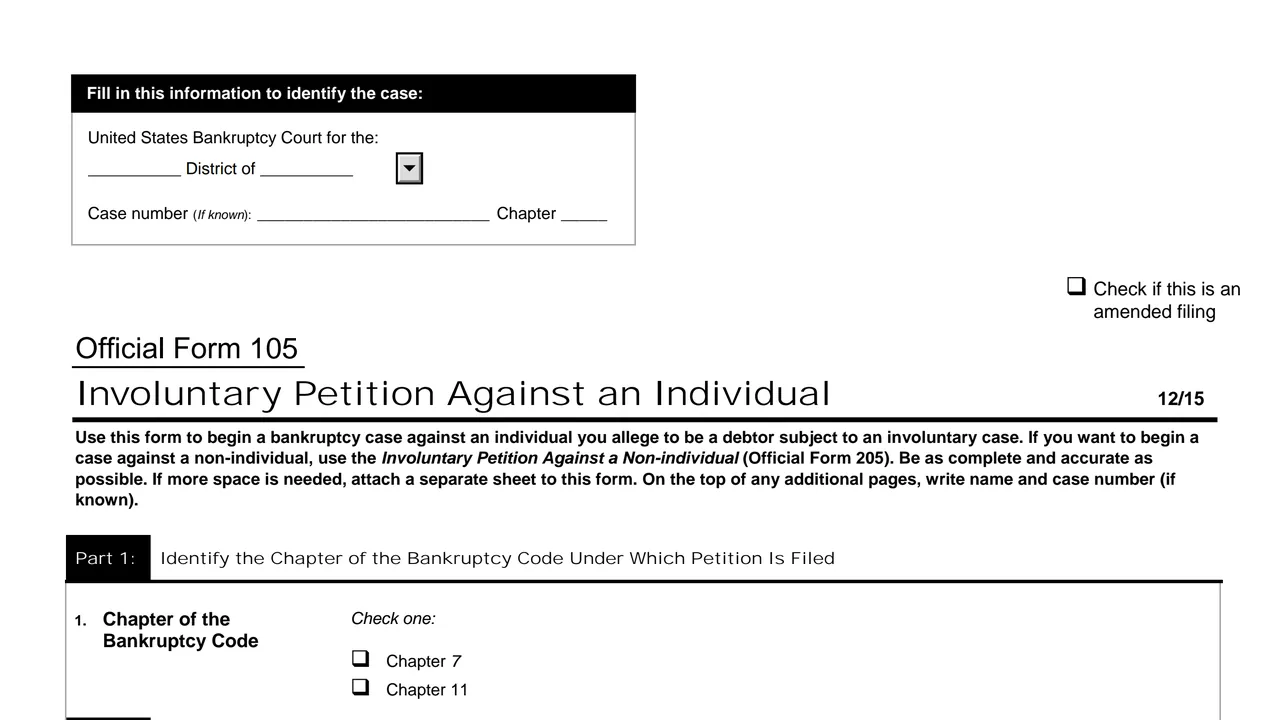
Line 1 asks for the chapter of the Bankruptcy Code under which the petition is filed: Chapter 7 or Chapter 11.
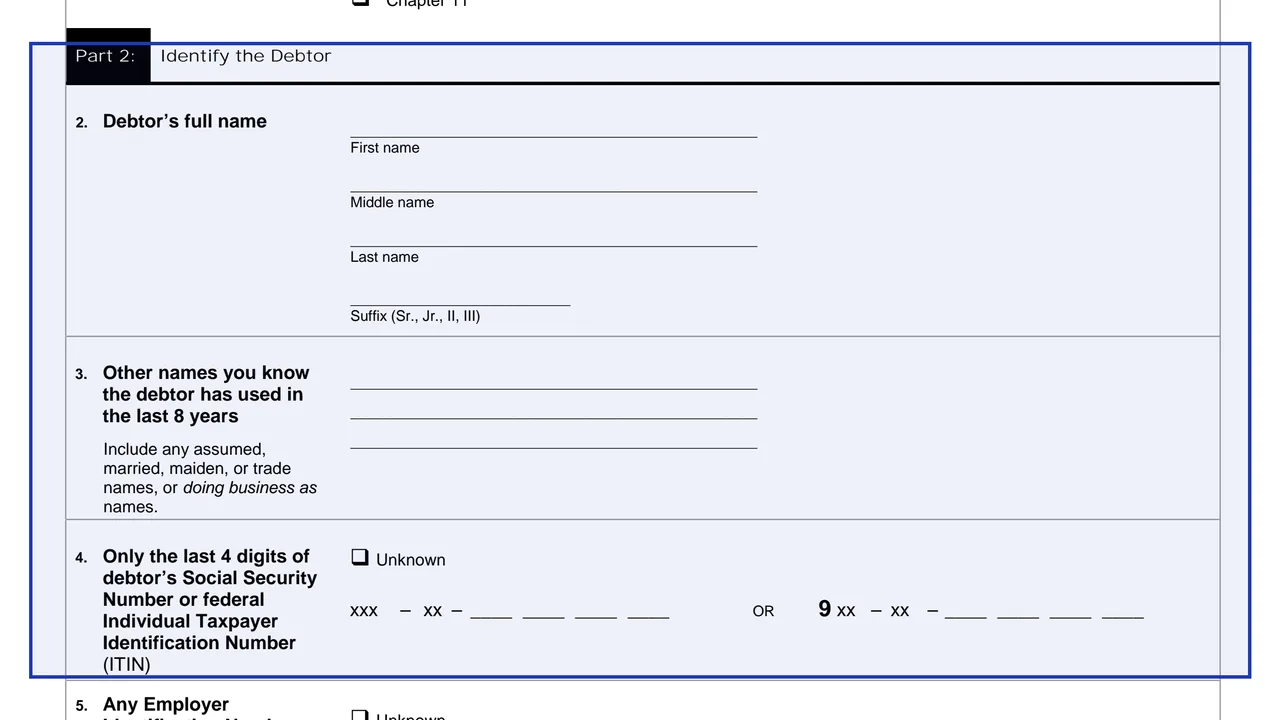
Lines 2 to 9: the debtor's full name, other names used in the last 8 years, only the last 4 digits of the Social Security number or ITIN, any EINs, addresses, type of business, type of debt, and cases pending by or against a partner, spouse or affiliate.
Line 10 gives the reason for filing in this court, such as the debtor having resided, had the principal place of business, or had principal assets in the district longer than in any other district over the last 180 days, or another reason (28 U.S.C. § 1408).
Line 11 has two boxes, at least one checked: the debtor is generally not paying debts as they become due, unless they are the subject of a bona fide dispute as to liability or amount, or a custodian, as the form describes it, was appointed or took possession within 120 days before filing.
Line 12 asks whether any claim against the debtor was transferred by or to a petitioner. Line 13 lists each petitioner's claim, with a total.
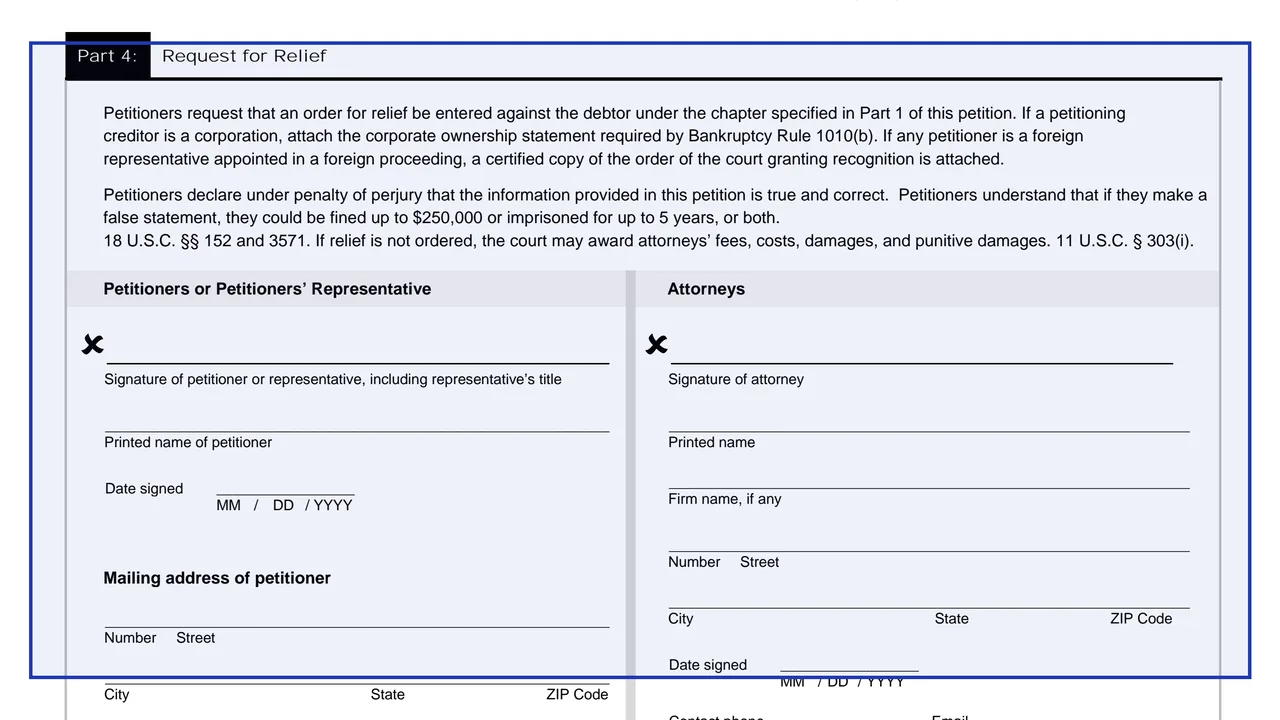
Petitioners request an order for relief under the chapter in Part 1 and declare under penalty of perjury that the information is true and correct, followed by signature blocks for petitioners and attorneys.
Fill in the district, the case number if known and the chapter, check the box if this is an amended filing, and choose Chapter 7 or Chapter 11 on line 1.
Give the debtor's names, addresses, county and business details. For the Social Security number or ITIN, the form has room only for the last 4 digits, or a box for Unknown.
Check one reason for venue on line 10. On line 11, the form says at least one box must be checked.
If a claim was transferred by or to a petitioner, the form says to attach all documents that evidence the transfer and any statements required under Bankruptcy Rule 1003(a). Then list each petitioner's claim on line 13.
With more than 3 petitioners, the form says to attach sheets with the penalty of perjury statement, each petitioner's or representative's signature, the attorney's signature, and the same details in the format of the form.
Each petitioner or representative signs and dates Part 4, and each attorney signs too. Extra pages carry a name and case number, if known, at the top.
You get the real form, filled in a browser tab, with nothing standing between you and the finished PDF.
With the United States Bankruptcy Court for the district named at the top of page 1. Line 10 gives the reason for filing in that court (see 28 U.S.C. § 1408).
The form does not print a filing fee.
Part 4 says petitioners who make a false statement could be fined up to $250,000 or imprisoned for up to 5 years, or both (18 U.S.C. §§ 152 and 3571).
Part 4 says that if relief is not ordered, the court may award attorneys' fees, costs, damages, and punitive damages (11 U.S.C. § 303(i)).
The form names the corporate ownership statement under Bankruptcy Rule 1010(b) for a corporate petitioner, a certified copy of a recognition order for a foreign representative, and transfer documents under Bankruptcy Rule 1003(a).
The petitioners fill out and sign the form, with their representatives and attorneys. The debtor is the individual the case is filed against.
No tool matches that search.
The petitioners. The form says to use it to begin a bankruptcy case against an individual you allege to be a debtor subject to an involuntary case. Each petitioner or representative signs Part 4, which also has signature blocks for attorneys.
Line 1 offers two choices: Chapter 7 or Chapter 11.
The form says that to begin a case against a non-individual, the Involuntary Petition Against a Non-individual (Official Form 205) is used instead.
No. Line 4 asks only for the last 4 digits of the debtor's Social Security number or ITIN, with a box for Unknown. The committee note says petitioning creditors give only the last four digits in conformity with Rule 9037.
Part 4 says petitioners who make a false statement could be fined up to $250,000 or imprisoned for up to 5 years, or both, citing 18 U.S.C. §§ 152 and 3571.
The form says to attach additional sheets with the statement under penalty of perjury, each petitioner's (or representative's) signature, the signature of the petitioner's attorney, and the claim, representative and attorney details in the format of the form.
No. This page explains the form in plain words and is not legal advice. It does not say whether anyone is eligible to file the petition or whether a debtor is subject to an involuntary case.