Section A: certification type and date
Initial, revised and recertification dates. The instructions say a revised or recertified CMN always gives the initial date as well.
CMS-484
CERTIFICATE OF MEDICAL NECESSITY - Oxygen DME 484.5
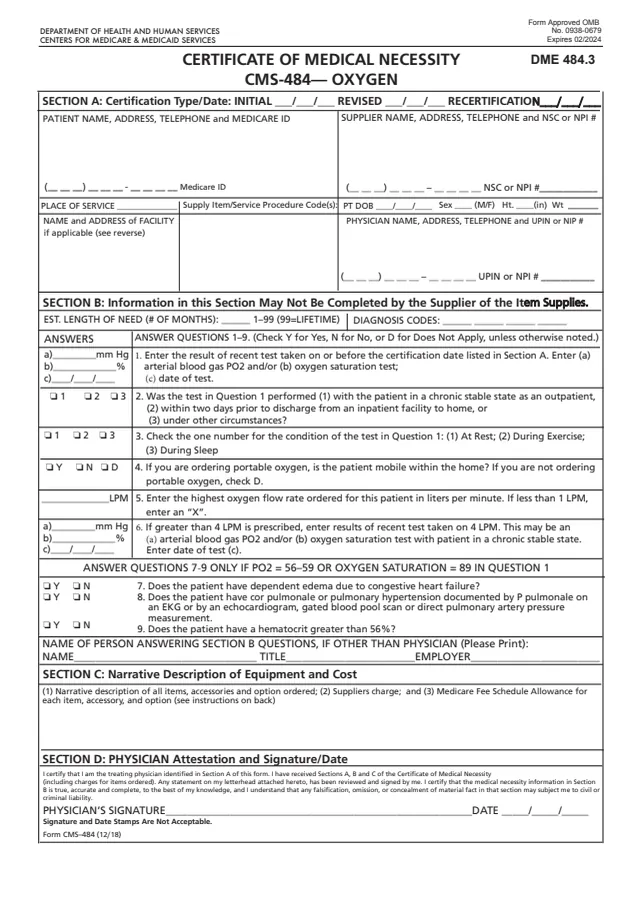
Form CMS-484 is the Certificate of Medical Necessity (CMN) for oxygen from the Centers for Medicare & Medicaid Services (CMS), part of the U.S. Department of Health and Human Services. The form is printed as DME 484.3. Its instructions say the question section gathers clinical information to help Medicare determine the medical necessity for the items being ordered, and the CMS page notes the form is to be used starting January 1, 2007.
The form has four sections. Section A identifies the patient, supplier, place of service, procedure codes and physician, and may be completed by the supplier. Section B covers the estimated length of need, diagnosis codes and nine questions on oxygen test results, test conditions and flow rate, and may not be completed by the supplier. Section C describes the equipment and its cost, and Section D is the physician's attestation and signature.
The form says signature and date stamps are not acceptable. You can fill it out free in your browser on this page and download the result without an account.
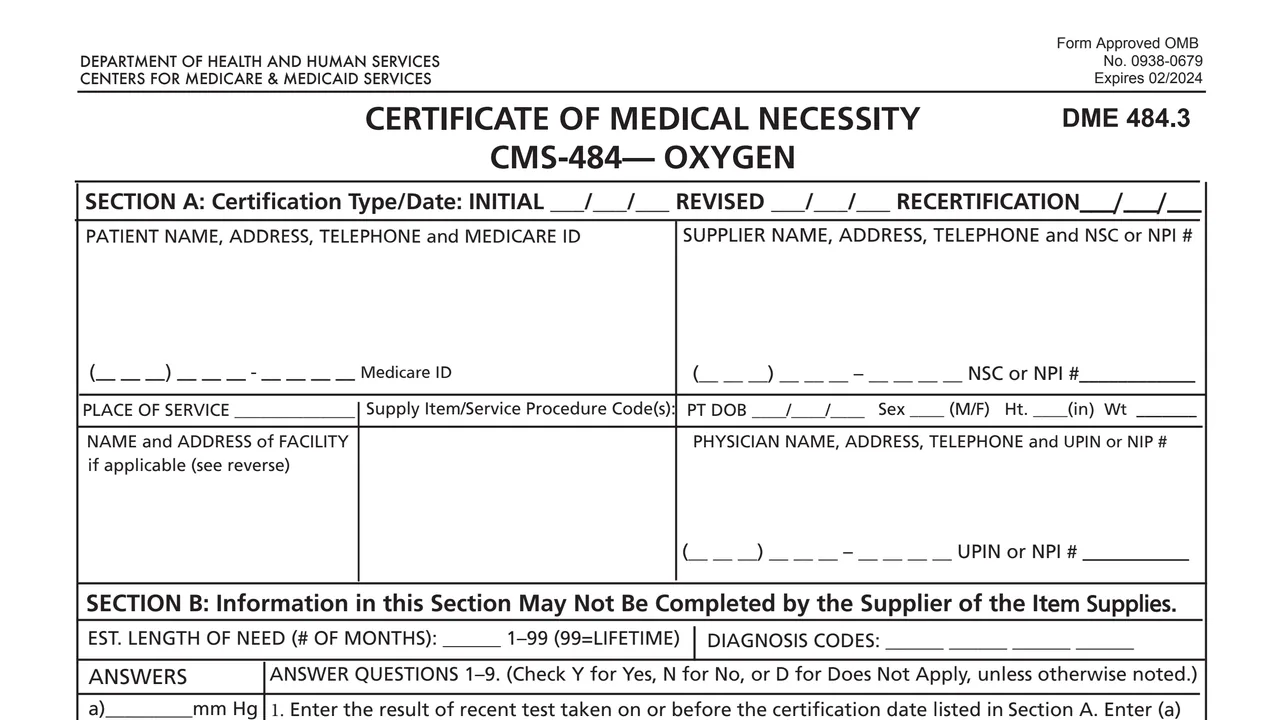
Initial, revised and recertification dates. The instructions say a revised or recertified CMN always gives the initial date as well.
Patient and supplier details, place of service, facility name and address if applicable, supply item or service procedure codes, the patient's date of birth, sex, height and weight, and the physician's name, address, phone and UPIN or NPI.
Estimated length of need in months from 1 to 99, where 99 means lifetime, and diagnosis codes. The instructions ask for the primary code first, up to 4 codes.
A recent arterial blood gas PO2 and/or oxygen saturation result and its date, where and under what condition the test was done, whether the patient is mobile within the home if portable oxygen is ordered, the highest flow rate in liters per minute, and a test on 4 LPM if more than 4 LPM is prescribed.
Answered only if PO2 is 56 to 59 or oxygen saturation is 89 in question 1: dependent edema due to congestive heart failure, documented cor pulmonale or pulmonary hypertension, and a hematocrit greater than 56%.
Section C: a narrative description of all items, accessories and options ordered, the supplier's charge and the Medicare fee schedule allowance for each. Section D: the physician attestation, signature and date.
Enter the certification dates, patient and supplier details, place of service, procedure codes and physician information. The instructions say to use the qualifier XX before a 10-digit NPI.
Describe the items, options, accessories, supplies and drugs ordered, with the supplier's charge and the Medicare fee schedule allowance for each, where applicable.
Enter the length of need and diagnosis codes, then answer the questions, checking Y for yes, N for no or D for does not apply. The form says to enter an X for a flow rate below 1 LPM.
The physician reviews Sections A, B and C, then signs and dates Section D. The form says signature and date stamps are not acceptable.
You get the real form, filled in a browser tab, with nothing standing between you and the finished PDF.
The form does not print a submission address. The CMS address in the Paperwork Reduction Act notice is for comments on the form, and the form says not to submit claims to it. It points to medicare.gov for information on claim filing.
The instructions say a revised certification is completed when the physician changes the order based on the patient's changing clinical needs, and that the initial date is always given along with the revised or recertification date.
Only the physician signs, in Section D. The form says signature and date stamps are not acceptable.
Section D says any falsification, omission or concealment of material fact in Section B may subject the physician to civil or criminal liability.
The instructions say to use XX before a 10-digit NPI, 1C before a legacy NSC number and 1G before a 6-digit UPIN.
The form estimates an average of 12 minutes per response, including reviewing the instructions and gathering the data. It shows OMB No. 0938-0679.
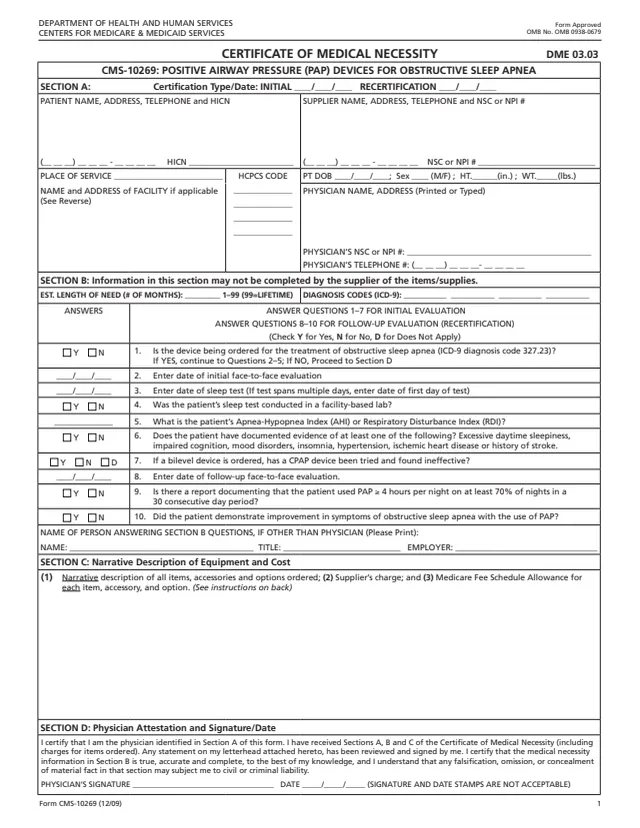
CMS-10269
89 fields, 2 pages
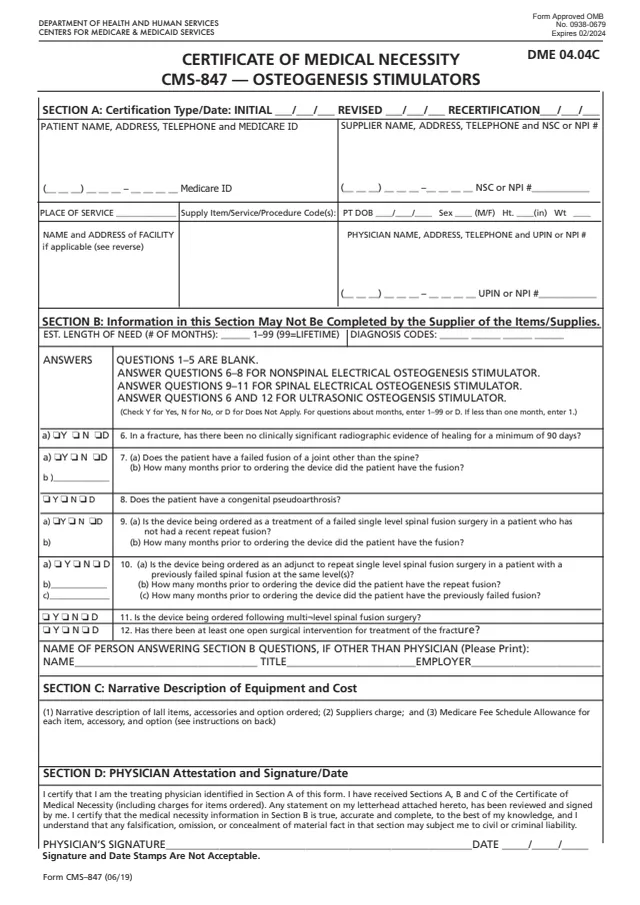
CMS-847
53 fields, 2 pages
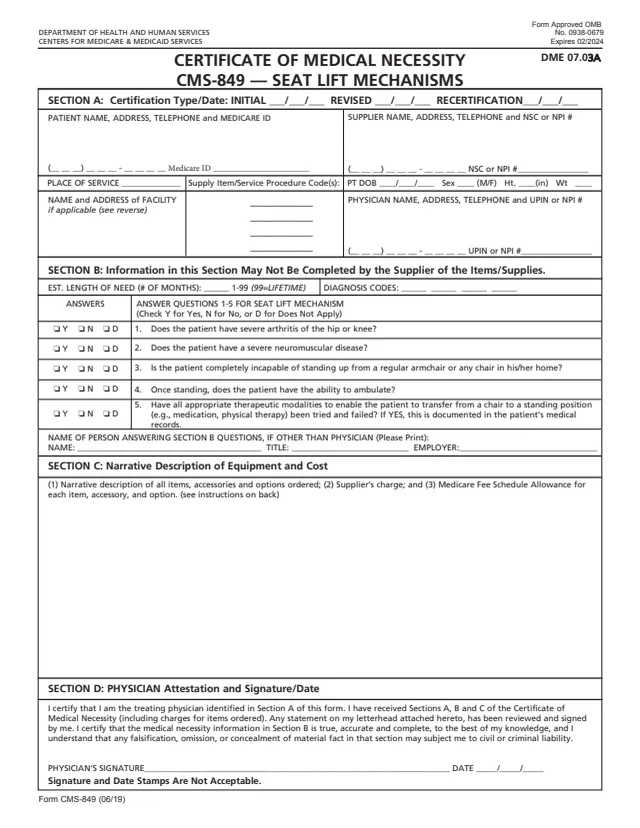
CMS-849
32 fields, 2 pages
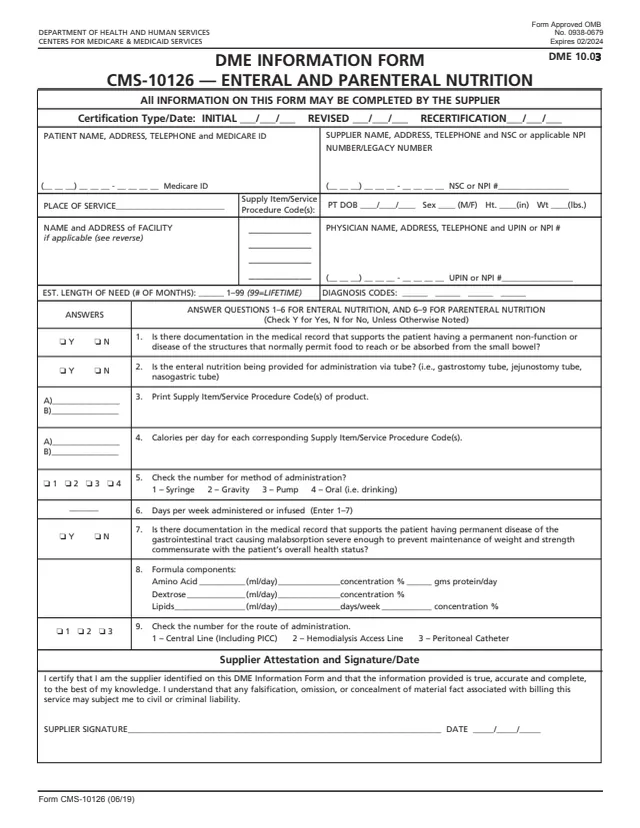
CMS-10126
96 fields, 2 pages
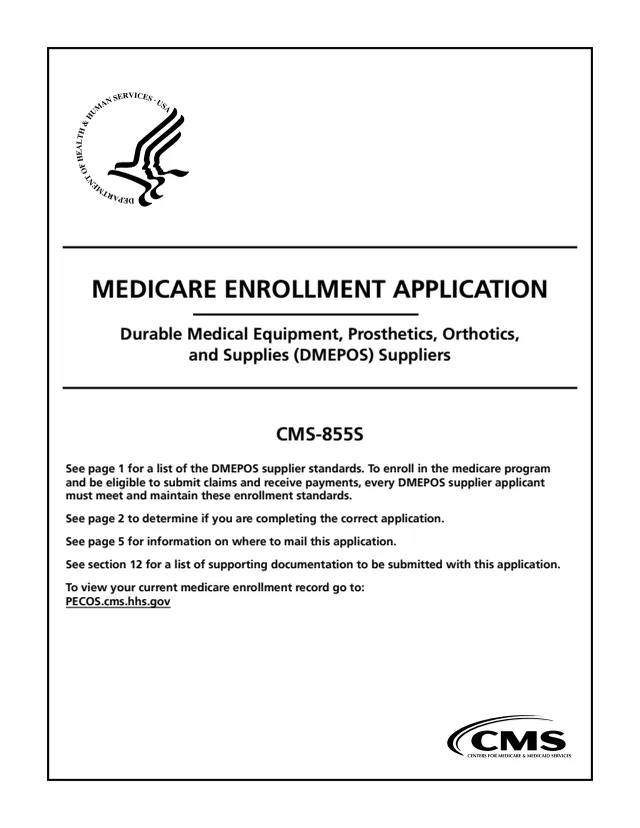
CMS-855S
1,031 fields, 39 pages
The form splits the work between the supplier and the physician, section by section.
No tool matches that search.
The form splits it: the supplier may complete Section A and completes Section C, Section B may not be completed by the supplier, and the physician completes and signs Section D.
No. The form says Section B may not be completed by the supplier. A non-physician clinician or physician employee may complete it, but it is reviewed and the CMN signed by the treating practitioner.
The form says to answer questions 7 to 9 only if the PO2 is 56 to 59 or the oxygen saturation is 89 in question 1.
Question 5 asks for the highest oxygen flow rate ordered in liters per minute, and says to enter an X if it is less than 1 LPM.
The form says 99 means lifetime. The instructions say to enter 99 if the patient will need the item for the rest of their life.
No. The form says signature and date stamps are not acceptable.
No. The form says not to submit claims to the CMS address in its Paperwork Reduction Act notice, and points to medicare.gov for information on claim filing.