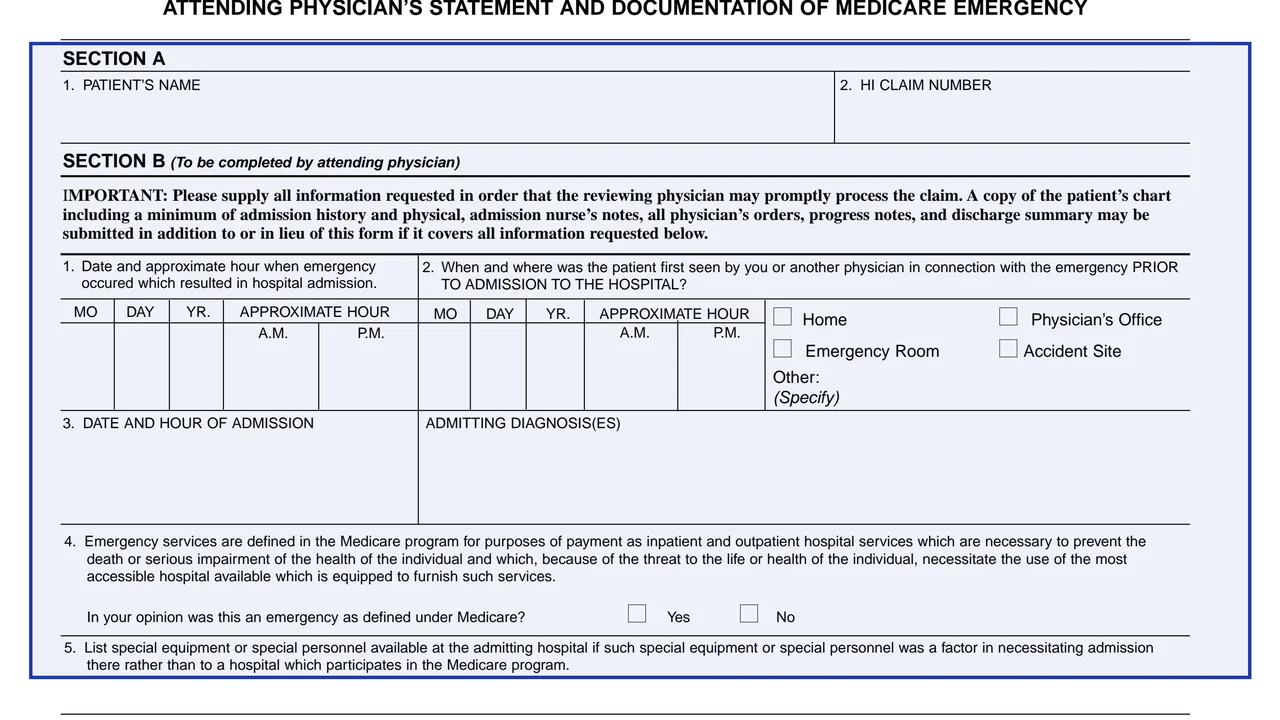
Section A: patient
The patient's name and HI claim number.
CMS-1771
ATTENDING PHYSICIANS STATEMENT AND DOCUMENTATION FOR MEDICARE EMERGENCY
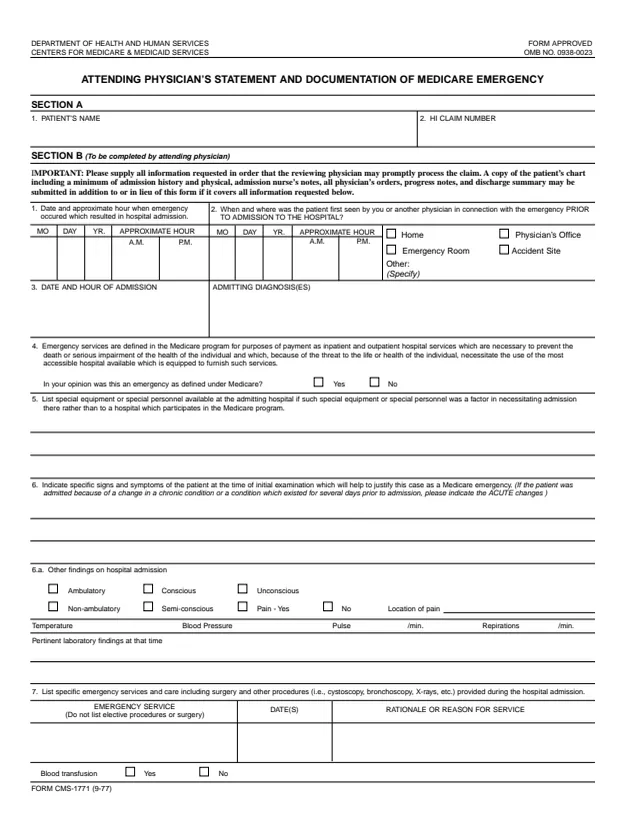
Form CMS-1771 is the Attending Physician's Statement and Documentation of Medicare Emergency from the Centers for Medicare & Medicaid Services (CMS), part of the U.S. Department of Health and Human Services. Section A identifies the patient by name and HI claim number. Section B is marked to be completed by the attending physician, and the form says the information is requested so that the reviewing physician may promptly process the claim.
Section B asks when the emergency occurred, where the patient was first seen, the admission date and diagnoses, whether the physician considers it an emergency as defined under Medicare, the signs, symptoms and findings at admission, the emergency services given, and the earliest date a transfer to a participating hospital or a discharge was permissible from a medical standpoint. Item 4 prints the Medicare definition of emergency services.
The form says a copy of the patient's chart may be submitted in addition to or in place of the form if it covers all the information requested. You can fill it out free in your browser on this page and download the result without an account.
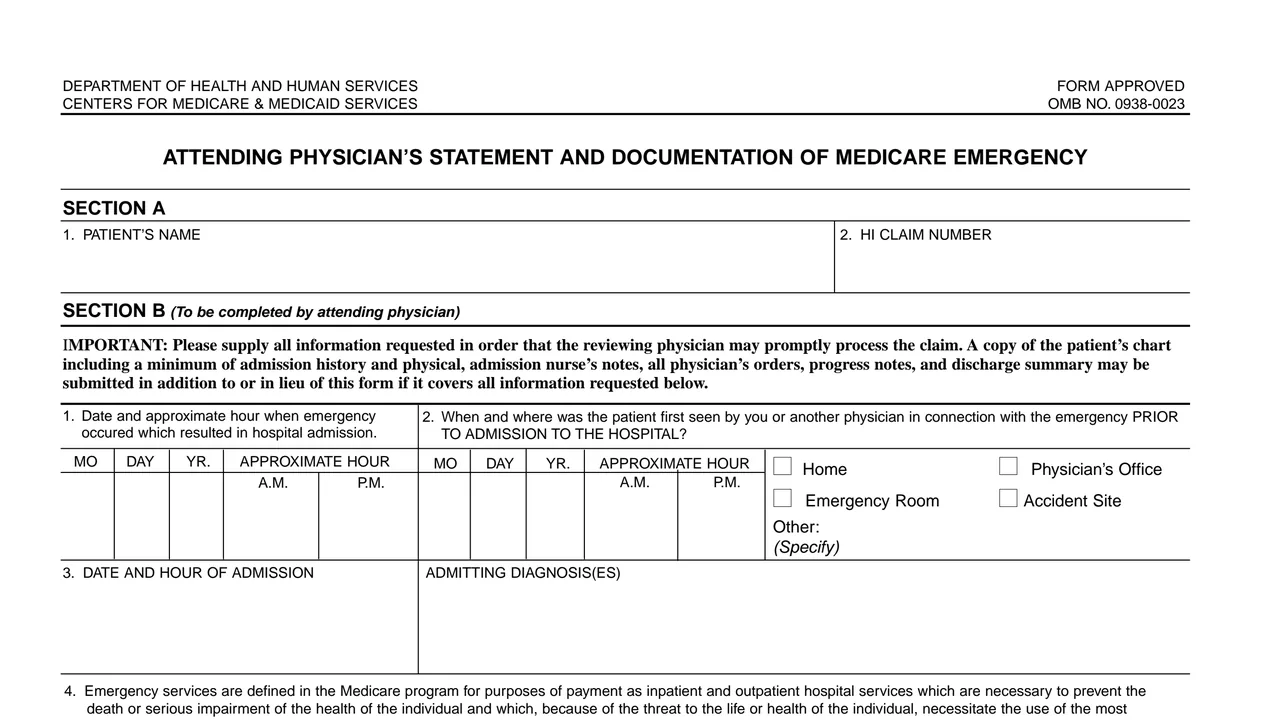
The patient's name and HI claim number.
Date and approximate hour of the emergency, when and where the patient was first seen before admission (home, physician's office, emergency room, accident site or other), and the date and hour of admission with the admitting diagnoses.
The Medicare definition of emergency services, a yes or no question on whether the physician considers this an emergency as defined under Medicare, and any special equipment or personnel at the admitting hospital that was a factor in the admission there.
Signs and symptoms at the initial examination, with the acute changes for a chronic condition, plus checkboxes for ambulatory, conscious and pain status, temperature, blood pressure, pulse, respirations and pertinent laboratory findings.
Emergency services with their dates and reasons, a blood transfusion yes or no, findings that kept the patient an emergency case for the whole period claimed, and the earliest date transfer or discharge was permissible.
Discharge diagnoses related to the alleged emergency, other contributing conditions, any additional information, and the physician's signature, date, M.D. or D.O. box, address and phone number.
Enter the patient's name and HI claim number.
Complete items 1 to 3 with dates, approximate hours, where the patient was first seen and the admitting diagnoses.
Item 4 prints the Medicare definition and asks for a yes or no. Item 5 lists special equipment or personnel if they were a factor in the admission.
Complete items 6 to 8. The form says not to list elective procedures or surgery in item 7.
Item 9 asks for the earliest date it was permissible to transfer or discharge the patient. Items 10 and 10a ask for discharge diagnoses related to the alleged emergency and other contributing conditions.
Item 11 has room for additional information or an attachment. The physician then signs, dates, checks M.D. or D.O., and adds an address and phone number.
You get the real form, filled in a browser tab, with nothing standing between you and the finished PDF.
The form and the CMS page do not print a mailing address. The CMS address in the Paperwork Reduction Act notice is given for comments on the time estimate or suggestions for improving the form.
The form says a copy of the patient's chart may be submitted in addition to or in place of the form if it covers all the information requested.
The form shows OMB No. 0938-0023 and prints FORM CMS-1771 (9-77). The CMS page lists a revision date of 1977-09-01 and an O.M.B. expiration date of 2026-01-31.
The form estimates an average of 15 minutes per response, including reviewing instructions and gathering the data.
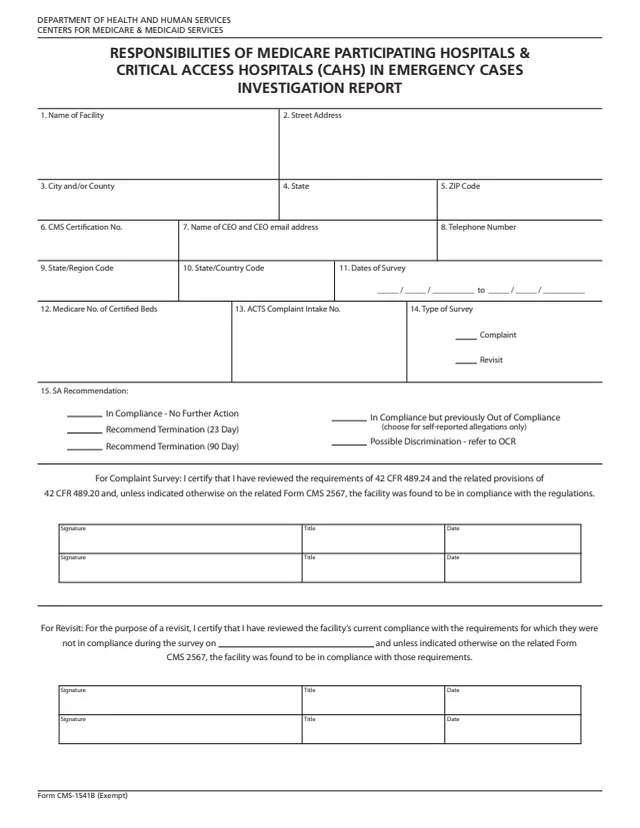
CMS-1541B
38 fields, 1 page
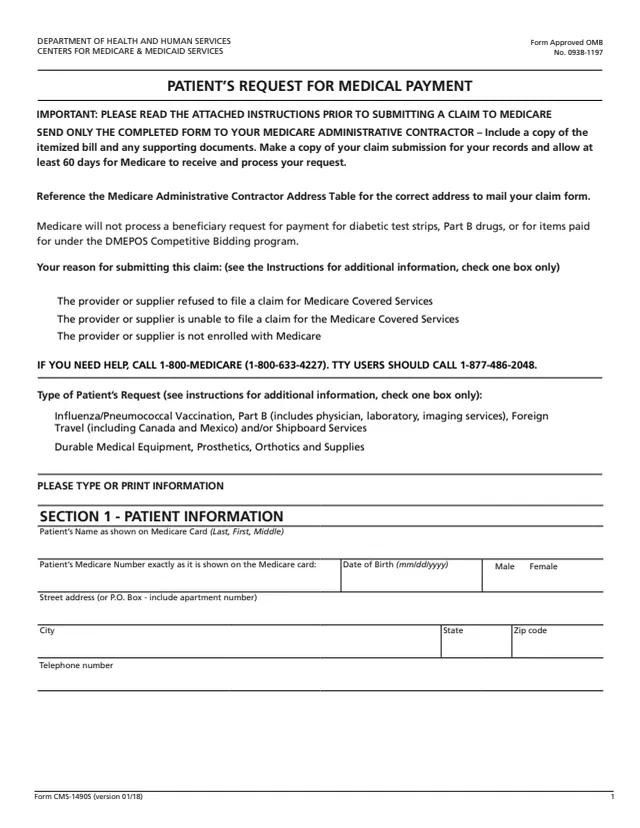
CMS-1490S
49 fields, 18 pages
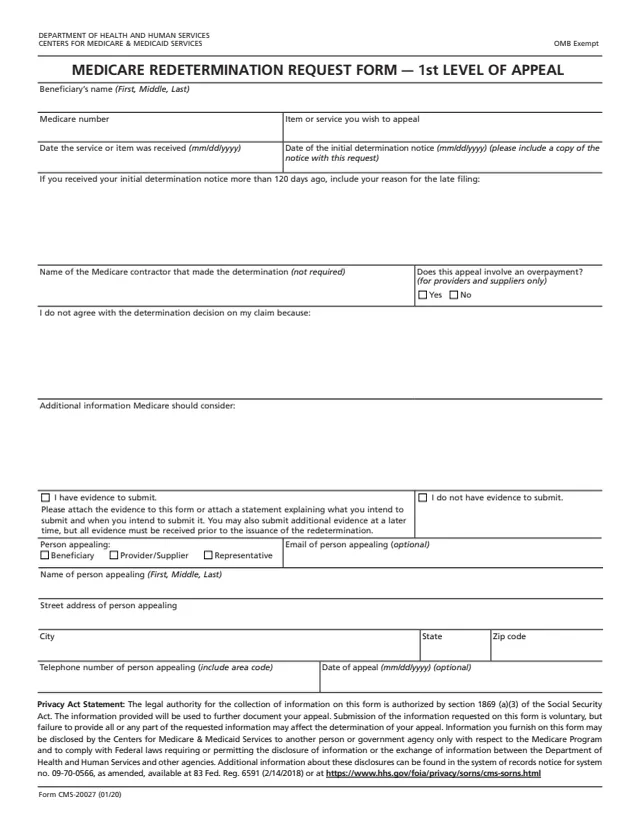
CMS-20027
20 fields, 1 page
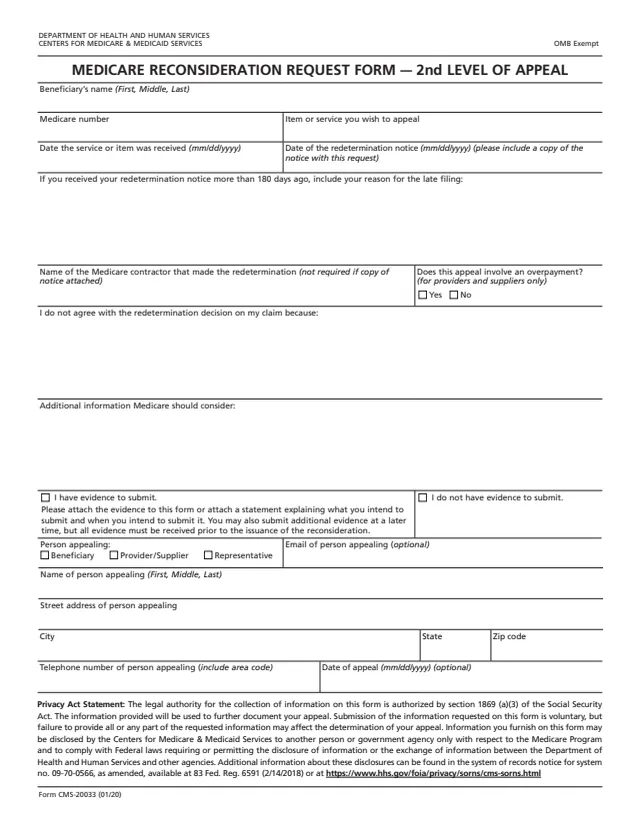
CMS-20033
20 fields, 1 page
The form names the attending physician as the person who completes Section B.
No tool matches that search.
Section B is marked to be completed by the attending physician. Section A identifies the patient by name and HI claim number.
Item 4 says emergency services are defined in the Medicare program, for purposes of payment, as inpatient and outpatient hospital services necessary to prevent the death or serious impairment of the health of the individual, which, because of the threat to the life or health of the individual, necessitate the use of the most accessible hospital available that is equipped to furnish such services.
The form says a copy of the chart, including at least the admission history and physical, admission nurse's notes, all physician's orders, progress notes and discharge summary, may be submitted in addition to or in lieu of the form if it covers all the information requested.
Item 7 lists emergency services and care provided during the admission. The form says not to list elective procedures or surgery there.
The earliest date on which it was permissible, from a medical standpoint, to transfer the patient to a participating hospital or extended care facility, or to discharge the patient.
The Paperwork Reduction Act notice estimates an average of 15 minutes per response.