Part I: Short-term
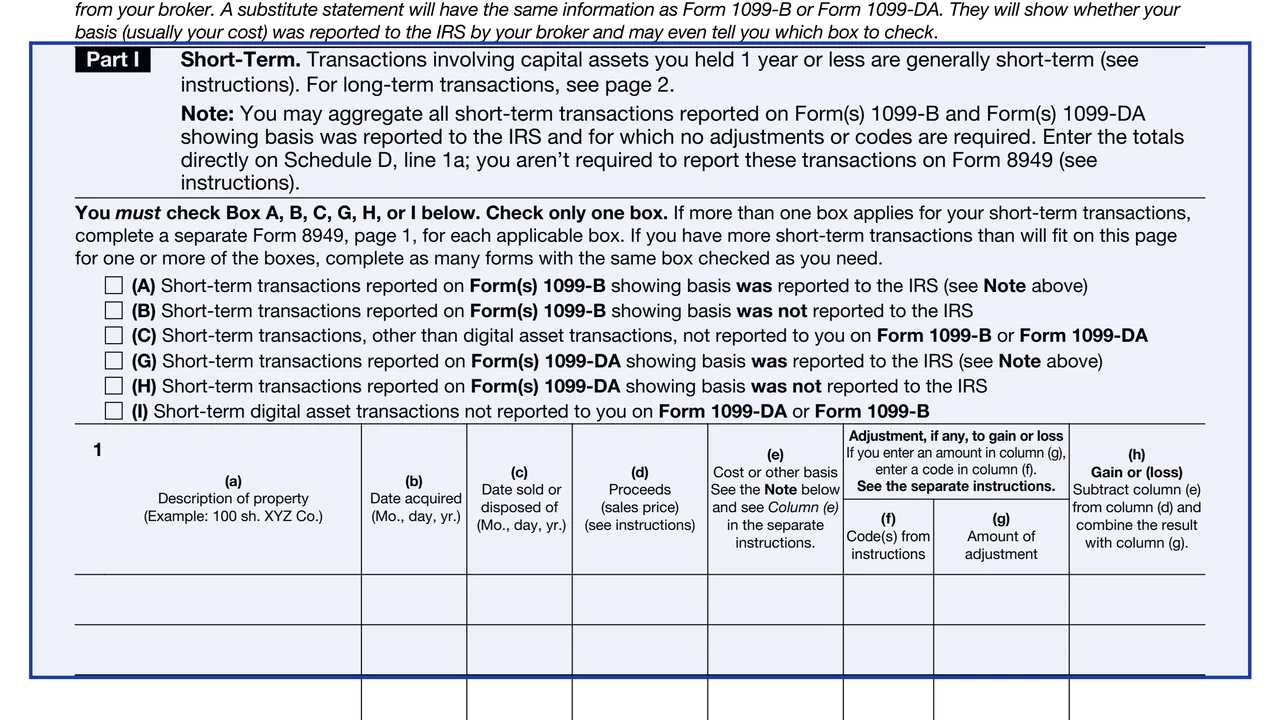
Transactions involving assets you held 1 year or less, generally. You check one box, A, B, C, G, H or I, and complete a separate page for each box that applies.
8949
Sales and Other Dispositions of Capital Assets
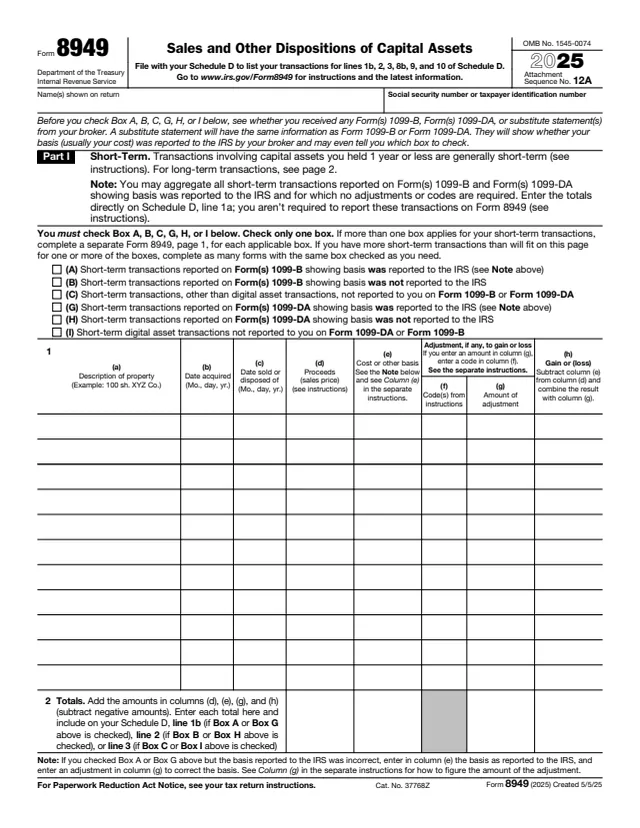
Form 8949 is the detailed list behind Schedule D. Each row is one sale or exchange of a capital asset: what it was, when you got it and sold it, what you received, what it cost you, and the gain or loss.
The instructions say it lets you and the IRS reconcile amounts reported to you on Form 1099-B, Form 1099-DA or Form 1099-S with the amounts you report on your return. Its totals then move to Schedule D, which figures your net gain or loss.
For 2025 the form adds boxes G to L for digital asset transactions.
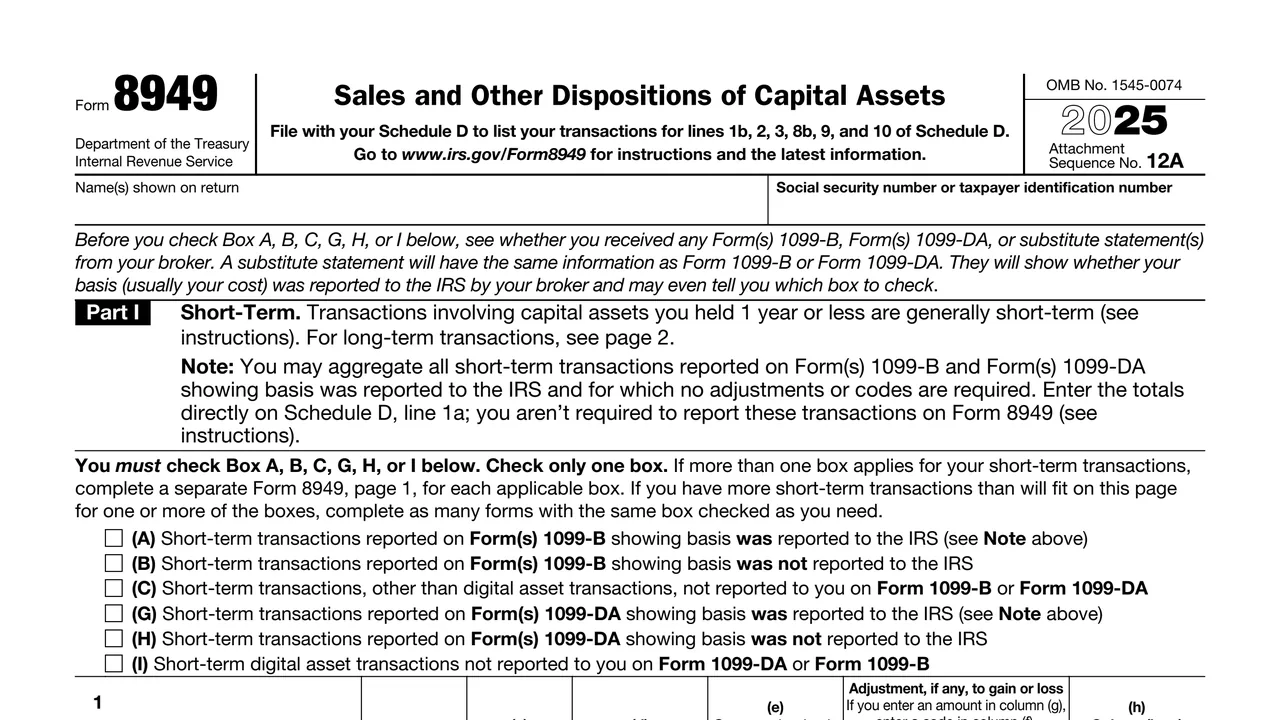
Transactions involving assets you held 1 year or less, generally. You check one box, A, B, C, G, H or I, and complete a separate page for each box that applies.
A and B cover Form 1099-B sales with basis reported or not reported to the IRS, and C covers other sales not reported on a 1099-B or 1099-DA. G, H and I are the same three cases for digital assets.
Description of property, date acquired, date sold, proceeds, cost or other basis, adjustment codes in column (f), the adjustment amount in column (g) and the gain or loss in column (h).
Add columns (d), (e), (g) and (h). The totals go on Schedule D line 1b, 2 or 3, depending on the box you checked.
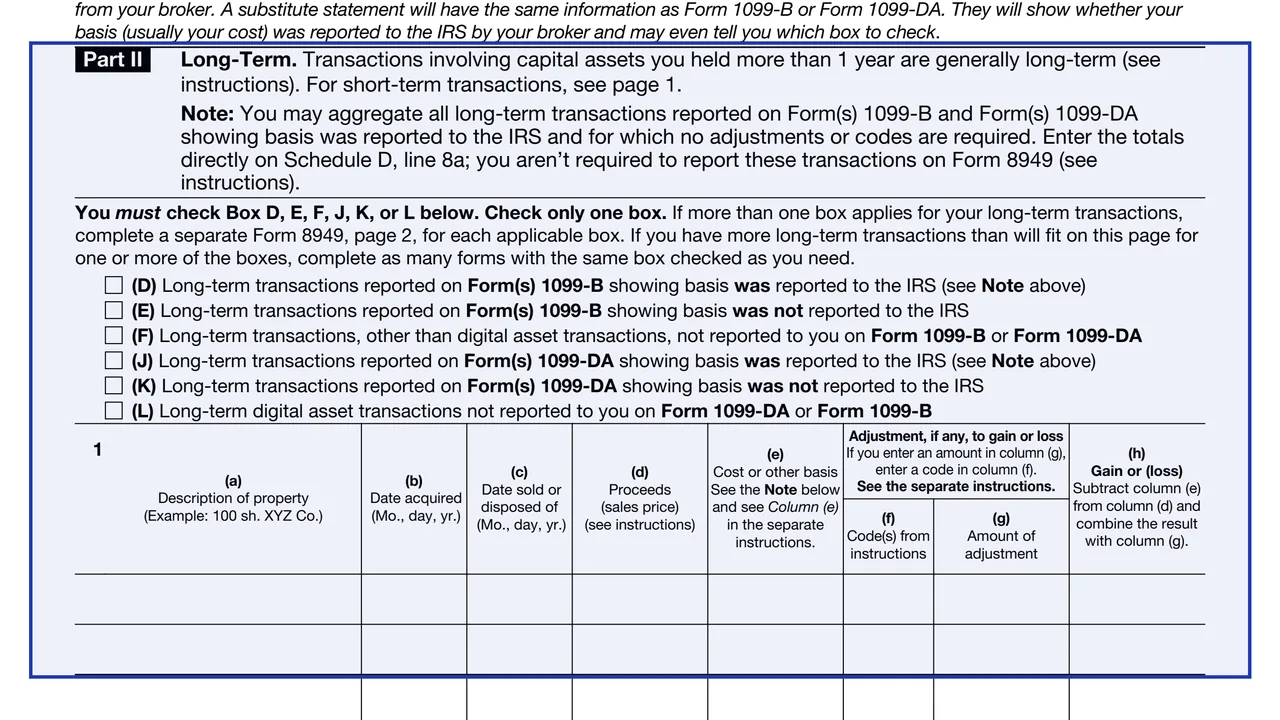
The same layout for assets held more than 1 year, generally, with boxes D, E, F, J, K and L. The totals go on Schedule D line 8b, 9 or 10.
The form says to see whether you received Forms 1099-B, 1099-DA or substitute statements before you choose a box. They show whether your basis was reported to the IRS and may tell you which box to check.
Exception 1 lets you report totals directly on Schedule D line 1a or 8a when basis was reported to the IRS and no adjustments are needed.
Check only one box on each page. Use a separate page for each box that applies, and as many pages with the same box as you need.
Fill columns (a) to (e) from your records and statements, then figure the gain or loss in column (h).
If you enter an amount in column (g), enter a code in column (f). For example, code W marks a nondeductible loss from a wash sale.
The line 2 totals go on the Schedule D line that matches your box. You can fill this form free on this page.
You get the real form, filled in a browser tab, with nothing standing between you and the finished PDF.
The instructions say to file Form 8949 with the Schedule D for the return you are filing, so it is due with that return.
Attach it with Schedule D when you mail your return, or let tax software transmit it when you e-file.
The IRS form is free.
Keep broker statements and records of the dates and cost of each asset you sold.
Exception 2 lets you report transactions on an attached statement with the same information as Parts I and II, instead of on the form's rows.
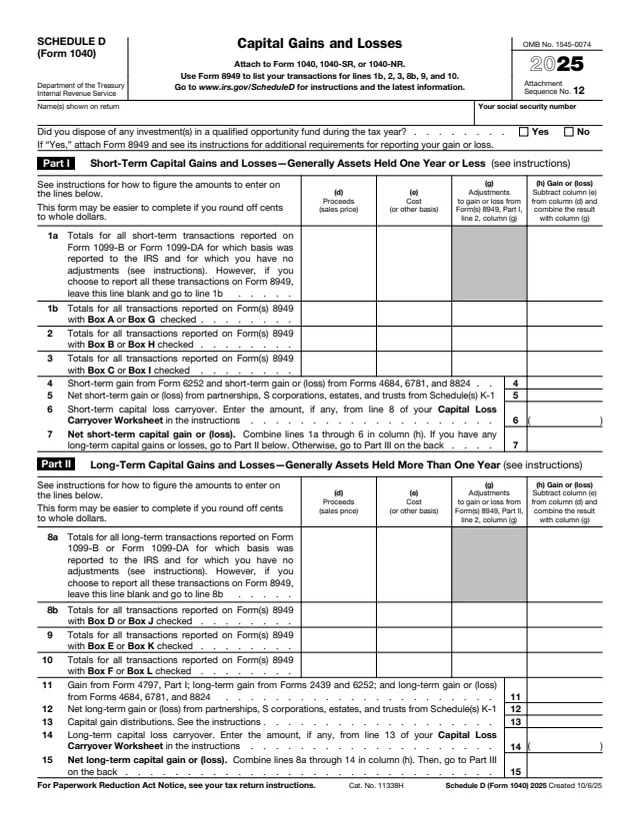
1040
55 fields, 2 pages
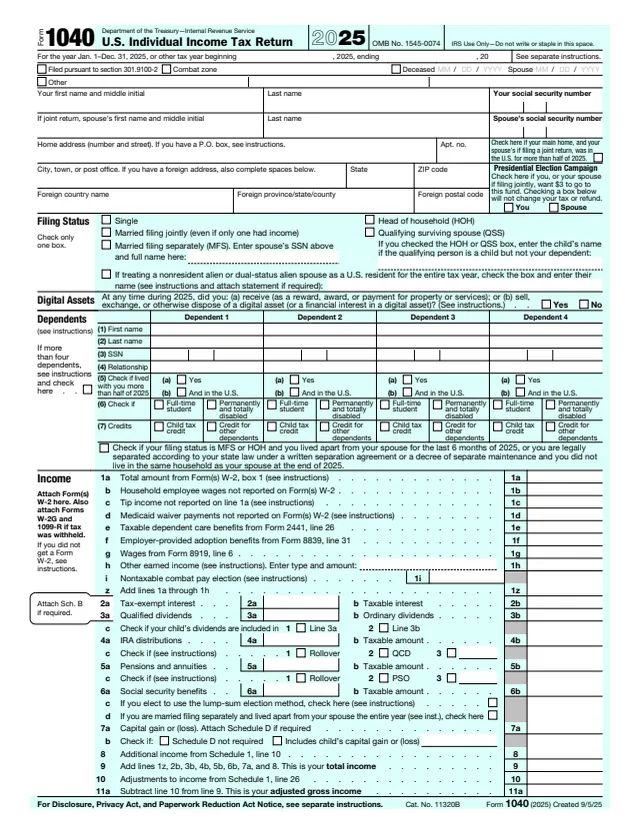
1040
199 fields, 2 pages
1099-K
207 fields, 6 pages
1099-S
65 fields, 4 pages
1099-DIV
140 fields, 6 pages
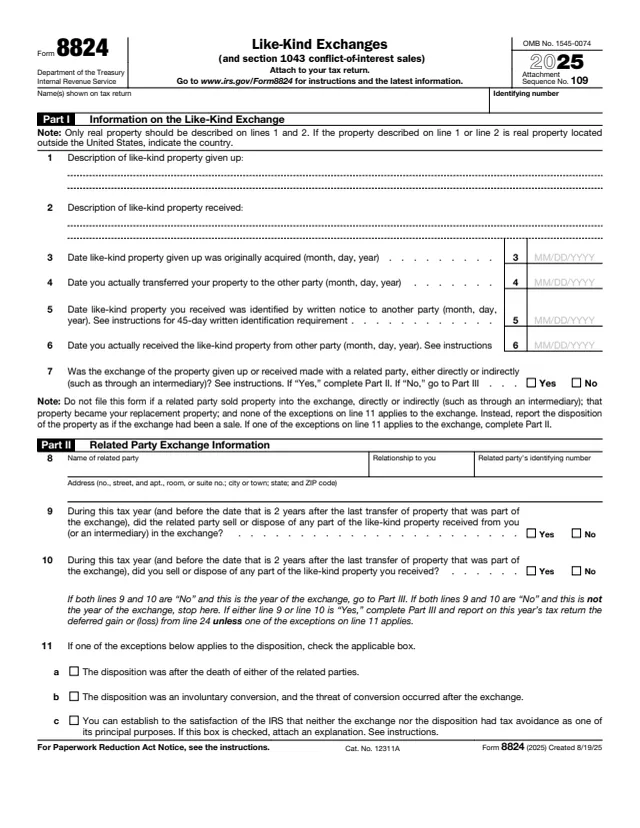
8824
63 fields, 2 pages
No tool matches that search.
Not always. Exception 1 lets you report totals directly on Schedule D line 1a or 8a when your Form 1099-B or 1099-DA shows basis reported to the IRS and no adjustments are needed.
Yes, under Exception 2, if the statement contains all the same information as Parts I and II in a similar format. The instructions say not to enter "Available upon request" and summary totals in place of the details.
Boxes G, H or I for short-term and J, K or L for long-term. The instructions say not to use box C or F for digital asset transactions.
It marks a nondeductible loss from a wash sale.
The instructions say short-term is generally a holding period of 1 year or less, and long-term is generally more than 1 year.