Part I: Coverage and contributions, lines 1 to 8
Line 1 asks for self-only or family HDHP coverage. Line 2 holds your own contributions, and lines 3 to 8 figure your limit after Archer MSA contributions and any additional amount for age 55 or older.
8889
Health Savings Accounts (HSAs)
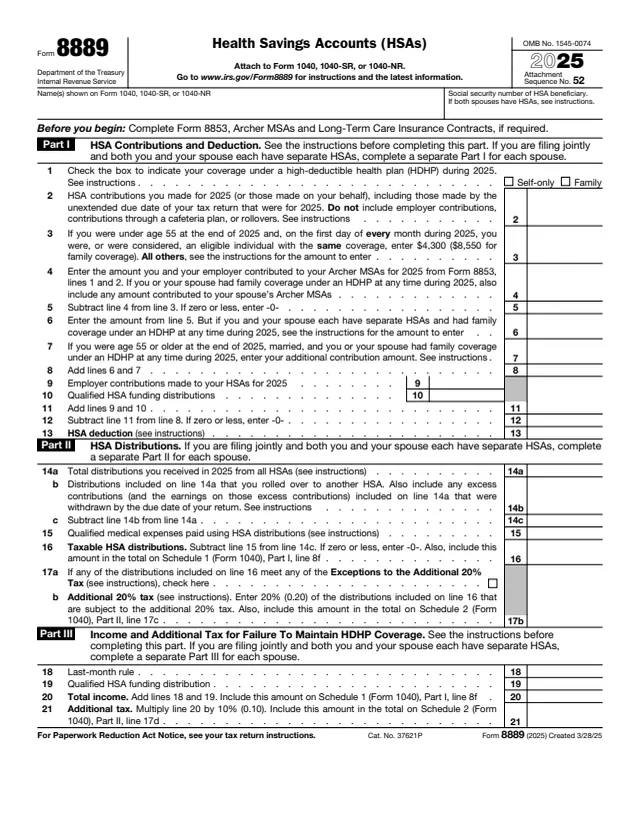
Form 8889 is the IRS form for health savings accounts (HSAs). The IRS page says it is used to report HSA contributions, including those made on your behalf and by an employer, figure your HSA deduction, report distributions from HSAs, and figure income and additional tax if you fail to stay an eligible individual.
The instructions define an eligible individual as someone covered under a high deductible health plan (HDHP) with no other health coverage except certain disregarded coverage, who isn't enrolled in Medicare and isn't another person's dependent. For 2025, they give an HDHP minimum annual deductible of $1,650 for self-only coverage and $3,300 for family coverage.
For 2025, line 3 uses $4,300 for self-only coverage or $8,550 for family coverage, and the instructions add $1,000 for people age 55 or older at the end of the year. The form is attached to Form 1040, 1040-SR or 1040-NR.
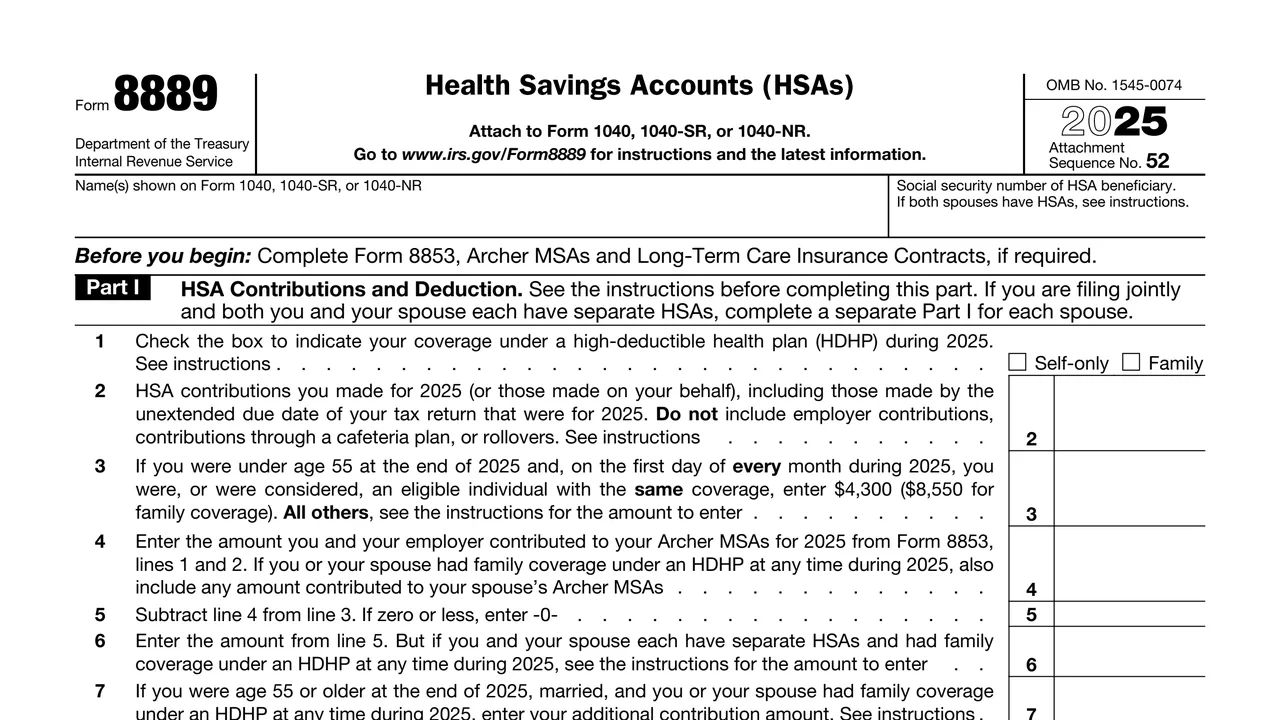
Line 1 asks for self-only or family HDHP coverage. Line 2 holds your own contributions, and lines 3 to 8 figure your limit after Archer MSA contributions and any additional amount for age 55 or older.
Employer contributions on line 9 and qualified HSA funding distributions on line 10 reduce the limit. Line 13 is your HSA deduction, which goes on Schedule 1 (Form 1040), Part II, line 13.
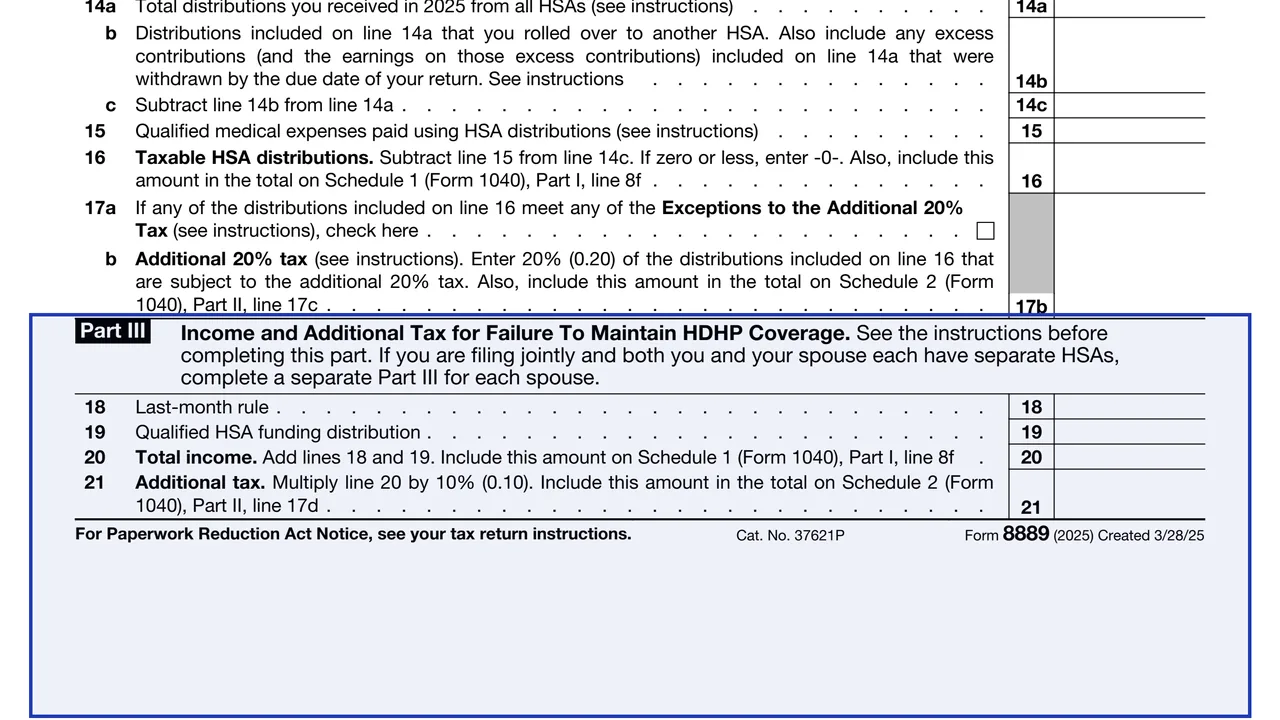
Total distributions from Form 1099-SA, less rollovers and withdrawn excess contributions, less qualified medical expenses. Line 16 is the taxable amount for Schedule 1 (Form 1040), line 8f.
Line 17a is checked if an exception applies. Line 17b is 20% of taxable distributions without an exception and goes on Schedule 2 (Form 1040), Part II, line 17c.
Income from the last-month rule on line 18 and from a qualified HSA funding distribution on line 19. Line 21 is a 10% additional tax for Schedule 2 (Form 1040), Part II, line 17d.
The form says to complete Form 8853, Archer MSAs and Long-Term Care Insurance Contracts, first if required, because line 4 takes Archer MSA contributions from it.
Check self-only or family. The instructions say that with family coverage on the first day of the last month of the tax year, December 1 for most people, you check the family box.
Line 2 takes contributions for 2025 made through April 15, 2026, without employer or cafeteria plan amounts. Line 3 uses $4,300 or $8,550, or the Line 3 Limitation Chart and Worksheet.
The instructions say employer contributions, including payroll contributions through a cafeteria plan, should be shown on Form W-2, box 12, code W, and go on line 9.
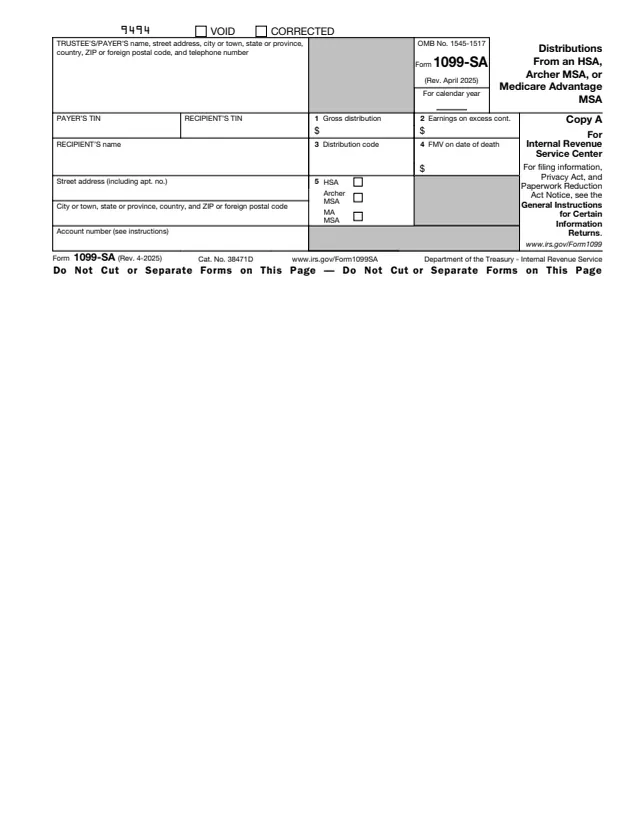
Enter the Form 1099-SA box 1 total on line 14a, then the qualified medical expenses paid with HSA distributions on line 15.
Line 13 goes to Schedule 1 (Form 1040), line 13, lines 16 and 20 to Schedule 1, line 8f, and lines 17b and 21 to Schedule 2. You can fill this form free on this page.
You get the real form, filled in a browser tab, with nothing standing between you and the finished PDF.
Form 8889 is attached to Form 1040, 1040-SR or 1040-NR and is due with it. The instructions say 2025 contributions can be made through April 15, 2026.
Attach it to your return. If married filing jointly and both spouses have HSAs, the instructions say to complete a separate Form 8889 for each spouse.
The IRS form is free.
The instructions say Code section 4973 imposes a 6% tax on excess contributions to an HSA, figured on Form 5329. Excess withdrawn with its earnings by the due date, including extensions, is treated as not contributed.
The instructions say a rollover is generally completed within 60 days, and an HSA can receive only one rollover contribution in a 1-year period. A direct trustee-to-trustee transfer isn't a rollover.
1099-SA
33 fields, 3 pages
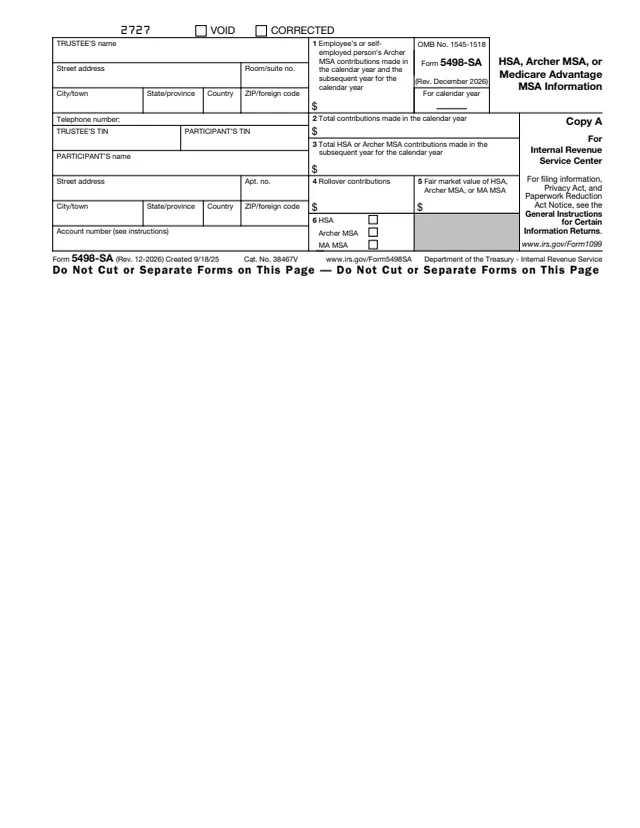
5498-SA
57 fields, 3 pages
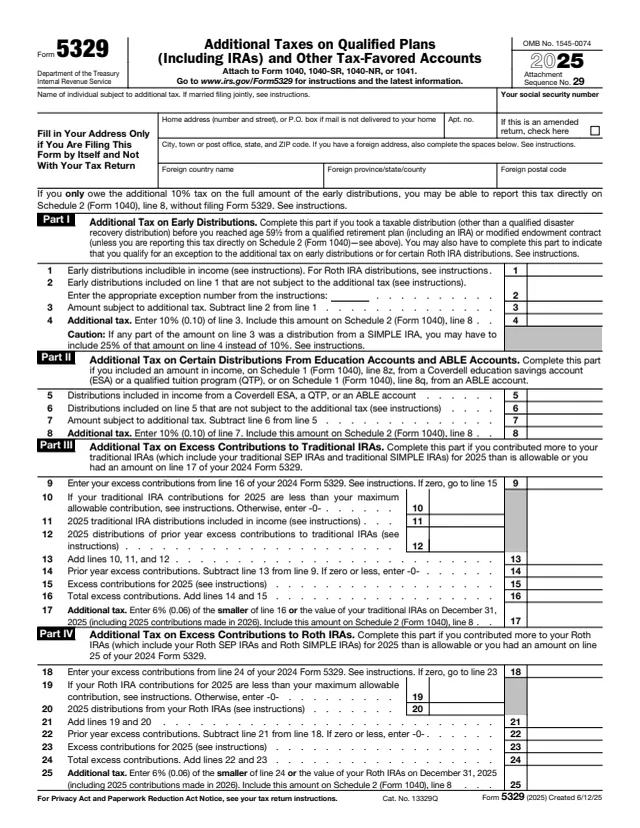
5329
75 fields, 3 pages
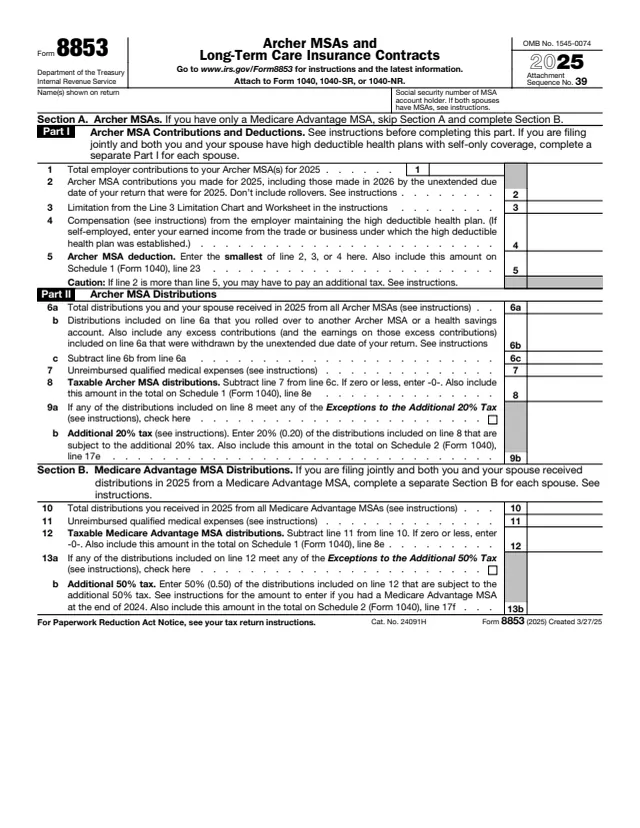
8853
38 fields, 2 pages
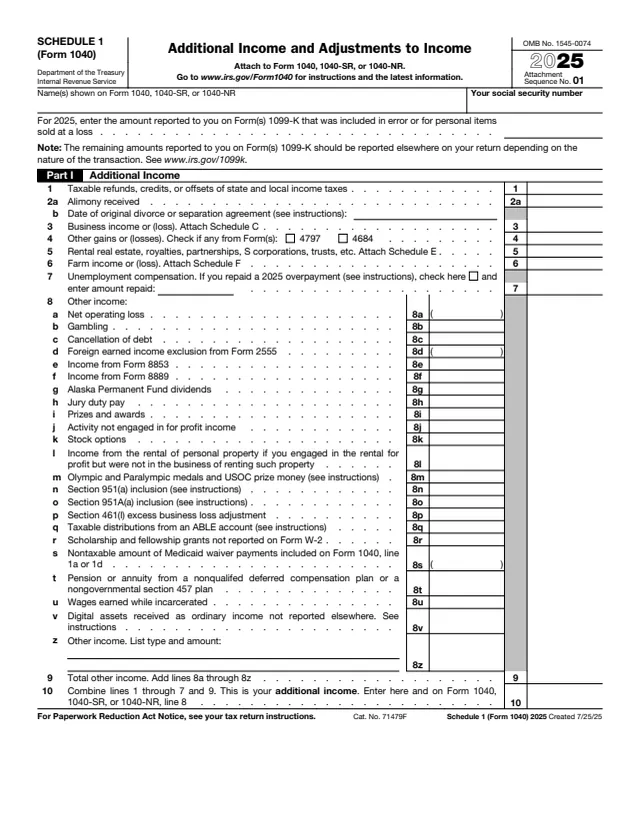
1040
73 fields, 2 pages
W-2
568 fields, 11 pages
No tool matches that search.
The instructions give $4,300 for self-only HDHP coverage and $8,550 for family coverage, plus $1,000 if you were age 55 or older at the end of 2025. Employer contributions, Archer MSA contributions and qualified HSA funding distributions reduce the limit.
Yes. The instructions say Form 8889 is filed if you, your employer or someone else made contributions to your HSA.
The instructions say distributions used only for qualified medical expenses of the account beneficiary, spouse or dependents are excludable. Any part not used that way is included in income and generally faces an additional 20% tax.
The instructions say it doesn't apply to distributions made after the account beneficiary dies, becomes disabled or turns age 65.
The instructions say that if you are an eligible individual on the first day of the last month of the tax year, December 1 for most people, you may be treated as eligible for the whole year. A testing period then follows, and failing it is reported in Part III.
The instructions say contributions can't be deducted for any month in which you were enrolled in Medicare.