Header
Name, address, quarter ending date and employer identification number, with boxes for a final return and an address change.
720
Quarterly Federal Excise Tax Return
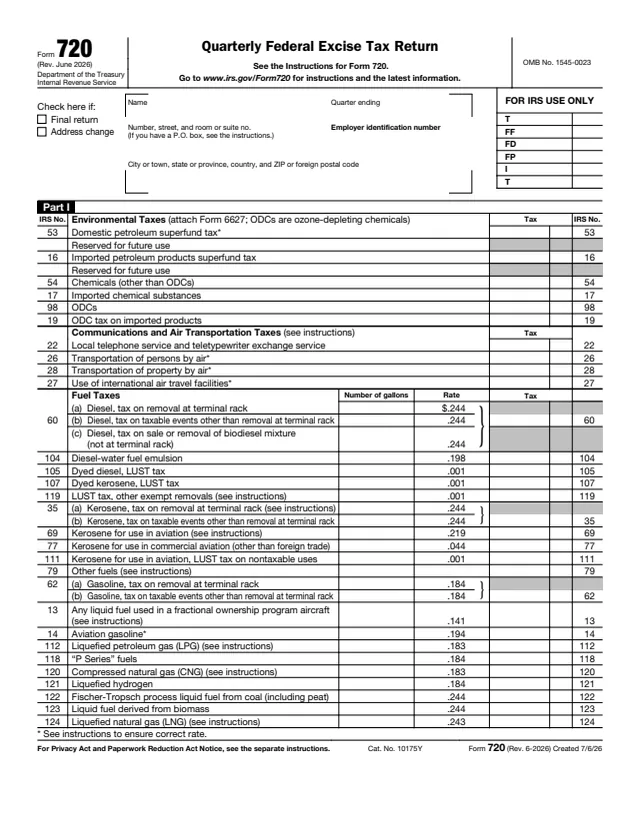
Form 720, Quarterly Federal Excise Tax Return, is the return used to report liability by IRS No. and pay the federal excise taxes listed on the form. The taxes cover environmental taxes, communications and air transportation, fuel, the retail tax on trucks and trailers, ship passengers, foreign insurance policies, coal and tires, and Part II items such as the patient-centered outcomes research (PCOR) fee, sport fishing equipment, indoor tanning services and the excise tax on repurchase of corporate stock.
The return is filed for each calendar quarter by the person or business that is liable for, or responsible for collecting, those taxes. Schedule C lets a filer that reports a liability in Part I or II claim certain credits. The instructions say adjustments to earlier quarters go on Form 720-X, not on Form 720.
This page covers the Rev. June 2026 form, which also carries Schedules A, T and C and the Form 720-V payment voucher. You can fill out the PDF free in your browser on this page and download it without an account.
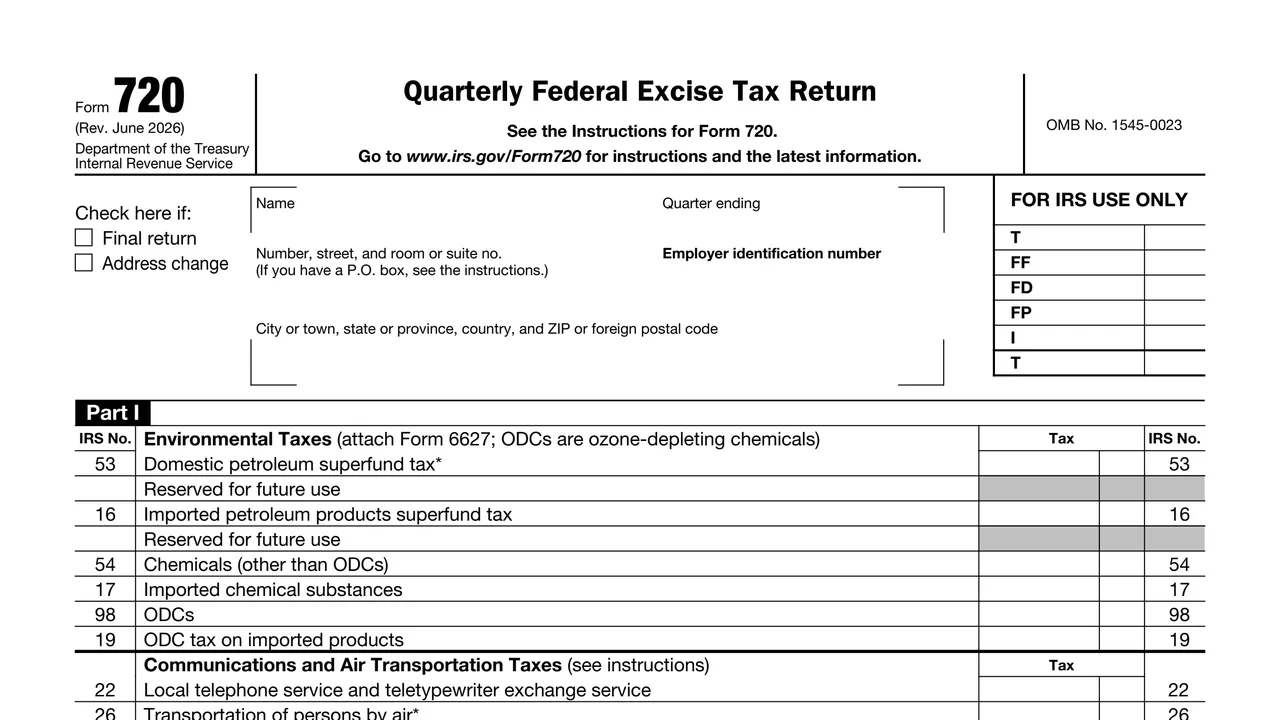
Name, address, quarter ending date and employer identification number, with boxes for a final return and an address change.
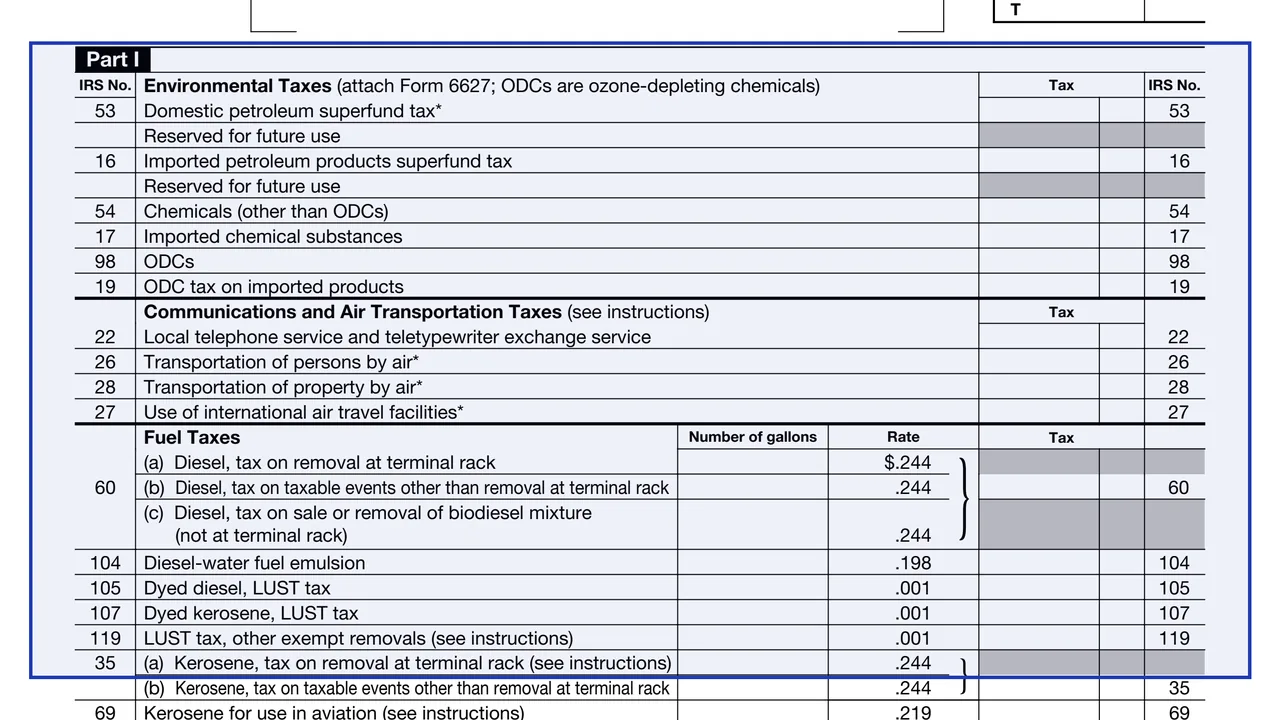
Environmental taxes, communications and air transportation taxes, fuel taxes with gallons and rates, the retail tax, ship passenger tax, other excise taxes, foreign insurance taxes and manufacturers taxes. Line 1 is the total.
The PCOR fee, sport fishing equipment, bows and arrow shafts, indoor tanning services, inland waterways fuel use, floor stocks tax on ozone-depleting chemicals, repurchase of corporate stock and sales of designated drugs. Line 2 is the total.
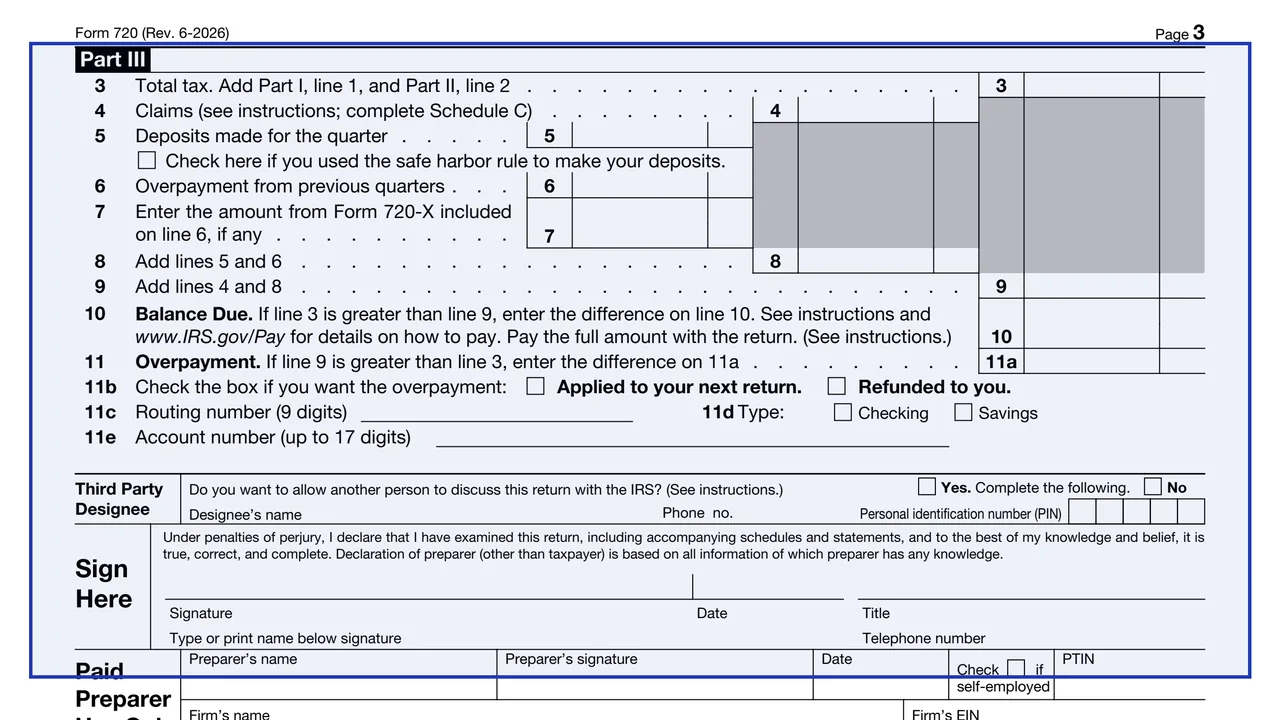
Lines 3 to 11 combine total tax, claims, deposits and earlier overpayments into a balance due or an overpayment, with direct deposit lines, the third party designee, signature and paid preparer sections.
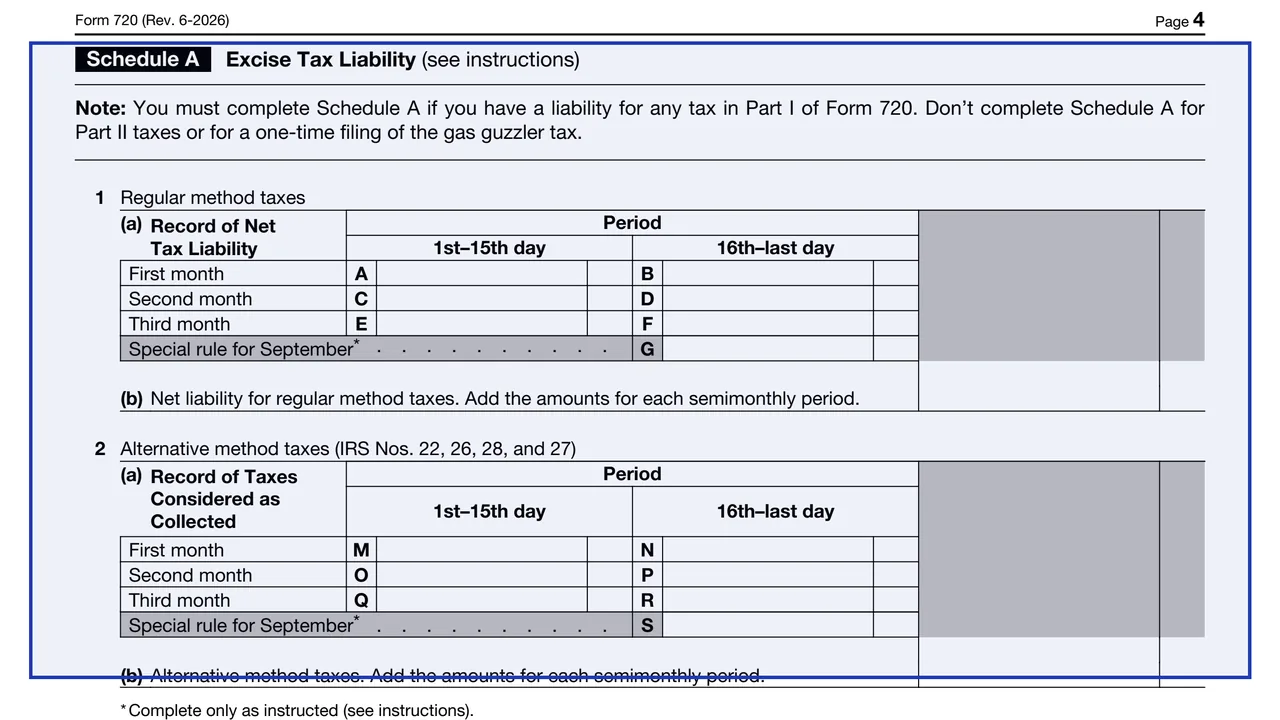
Schedule A records net tax liability for Part I taxes by semimonthly period, under the regular method or the alternative method. Schedule T reports gallons received or delivered in two-party exchanges within a terminal.
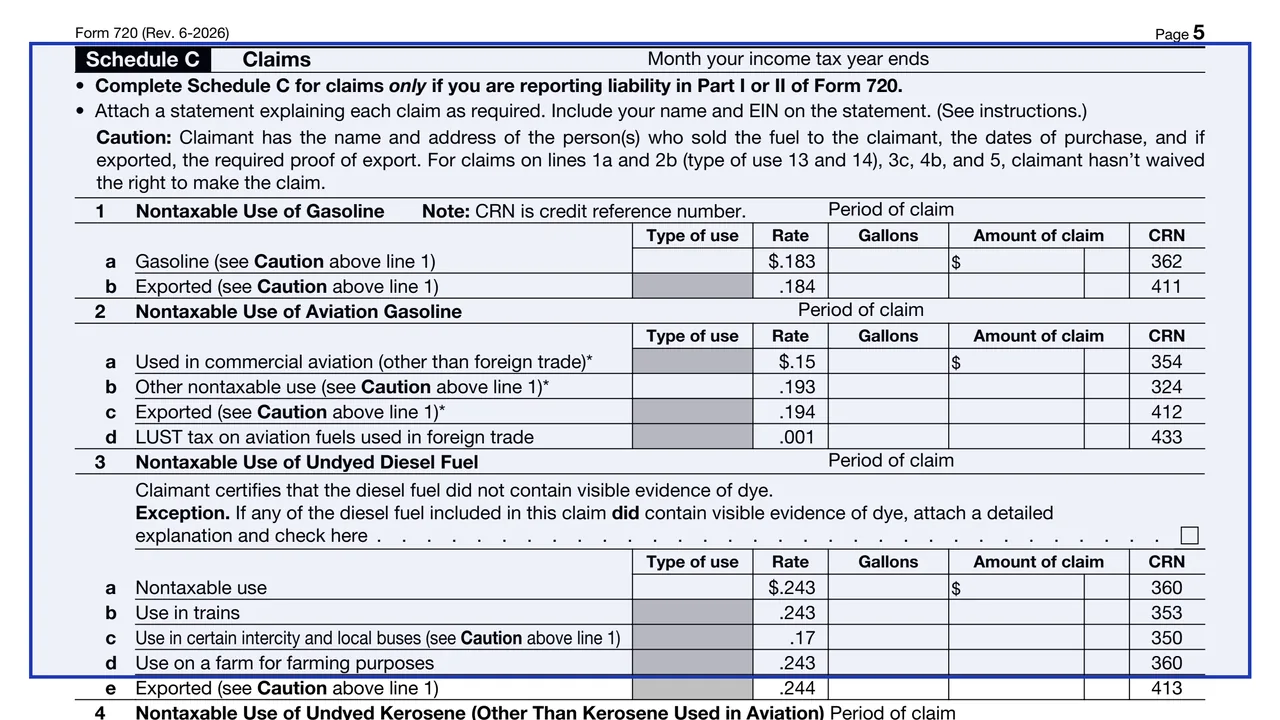
Schedule C lists claims by line with type of use, rate, gallons and a credit reference number (CRN). Form 720-V is the payment voucher sent with a check or money order.
Enter the name, address, EIN and the quarter ending date as month and year. Check the address change box if the address changed, and the final return box when no more Form 720 returns will be filed.
Enter the tax on the line for each IRS No. that applies, with gallons, tons, tires or other units where the line asks. The instructions say to enter a zero on the line for a tax normally reported but not owed this quarter. Attach Form 6627, Form 6197 or Form 7208 where the line says so.
The form says Schedule A is completed when there is a liability for any tax in Part I. Enter net liability for each semimonthly period in boxes A to G for the regular method or M to S for the alternative method. It is not completed for Part II taxes or a one-time gas guzzler filing.
For each claim, enter the month the income tax year ends, the period of claim, type of use, gallons and amount. Attach a statement explaining each claim with name and EIN. Line 15 total goes to Part III, line 4.
Add Parts I and II on line 3, then enter claims, deposits made for the quarter and earlier overpayments. If line 3 is more than line 9, the difference goes on line 10. The instructions say no payment is due if line 10 is under $1.00. An overpayment on line 11a is applied to the next return or refunded.
A person authorized by the entity signs and dates the return. A paid preparer who is not an employee of the filer also signs and enters a PTIN. The third party designee section names someone the IRS may discuss the return with.
You get the real form, filled in a browser tab, with nothing standing between you and the finished PDF.
The instructions list Department of the Treasury, Internal Revenue Service, Ogden, UT 84201-0009. Form 720 can also be filed electronically through a provider in the IRS e-file program for excise taxes.
Jan., Feb., Mar. by April 30; Apr., May, June by July 31; July, Aug., Sept. by October 31; Oct., Nov., Dec. by January 31. A due date on a Saturday, Sunday or legal holiday moves to the next business day.
The instructions say semimonthly deposits are generally required, by electronic funds transfer. No deposit is required when net Part I liability does not exceed $2,500 for the quarter, for a one-time gas guzzler filing, for the PCOR fee on a second-quarter return, and for Part II taxes other than the floor stocks tax.
Line 10 can be paid by IRS Direct Pay, EFTPS, check or money order, or EFW when filing electronically. Form 720-V goes with a check or money order payable to "United States Treasury" and is not filed when paying by Direct Pay, EFTPS or direct debit.
The instructions say to keep records supporting all claims and exemptions at least 4 years from the latest of the date the tax became due, the tax was paid or a claim was filed.
If communications, air transportation and indoor tanning services taxes are collected but not paid over, or willfully not collected, the instructions say this penalty may apply and equals the full amount of the unpaid tax.
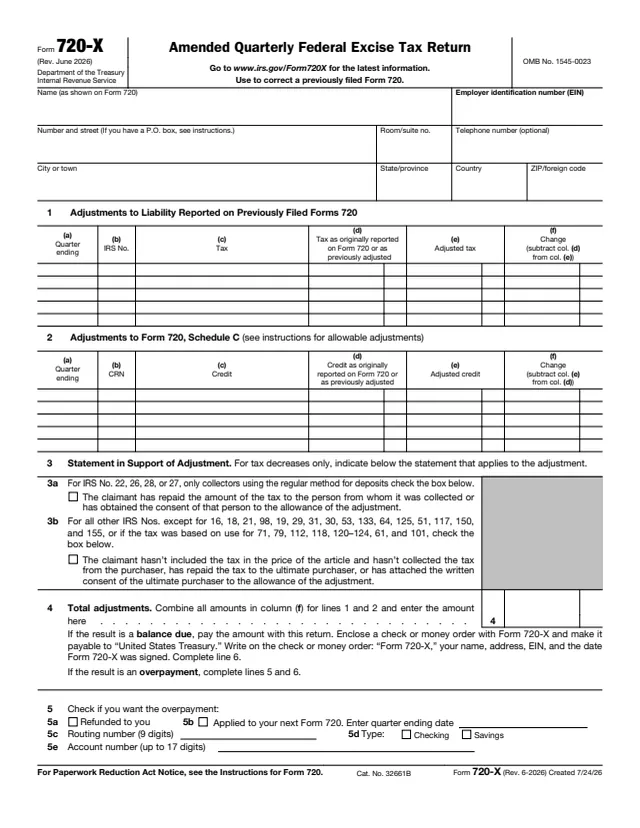
720-X
120 fields, 2 pages
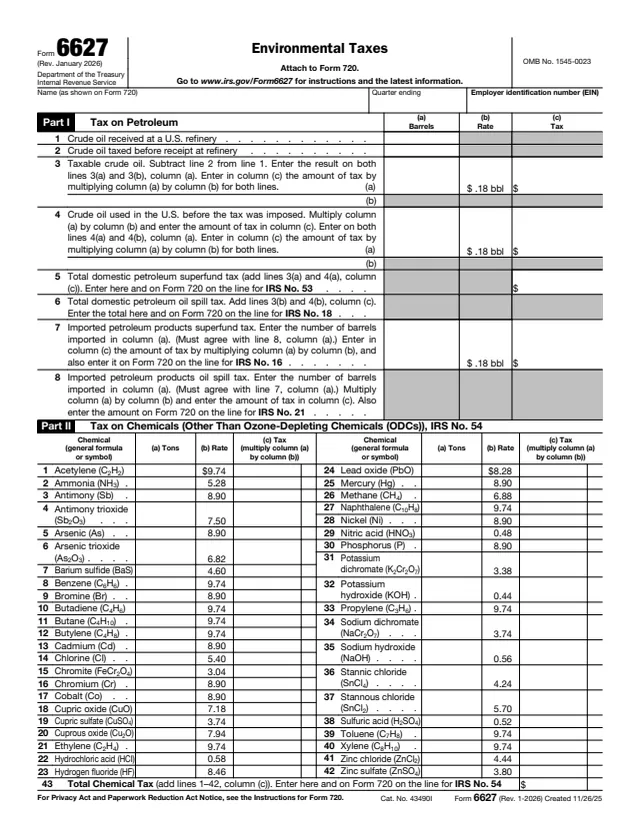
6627
282 fields, 2 pages
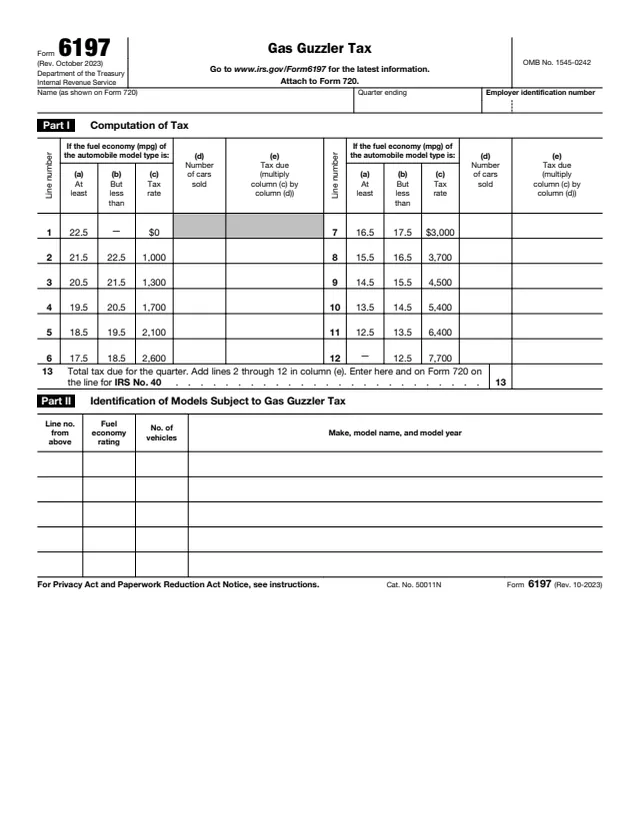
6197
85 fields, 2 pages
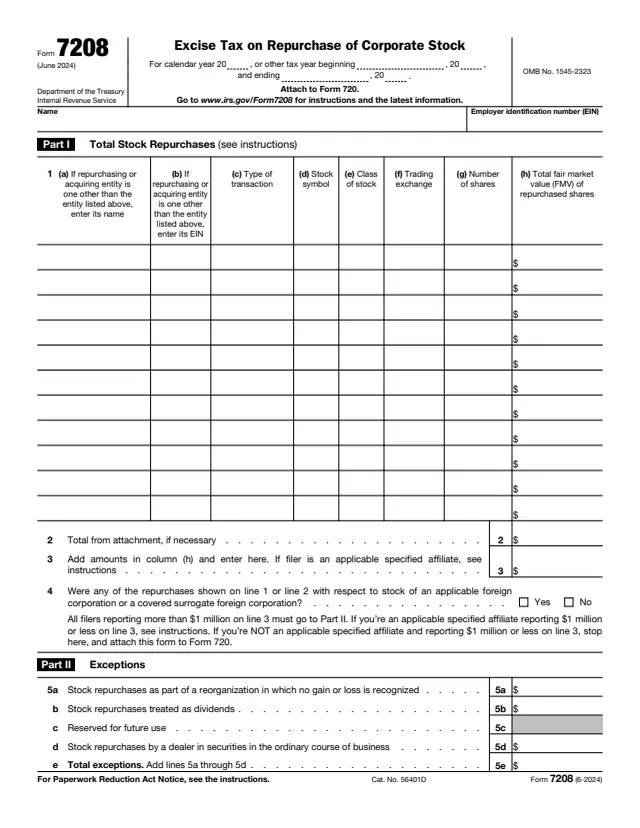
7208
229 fields, 2 pages
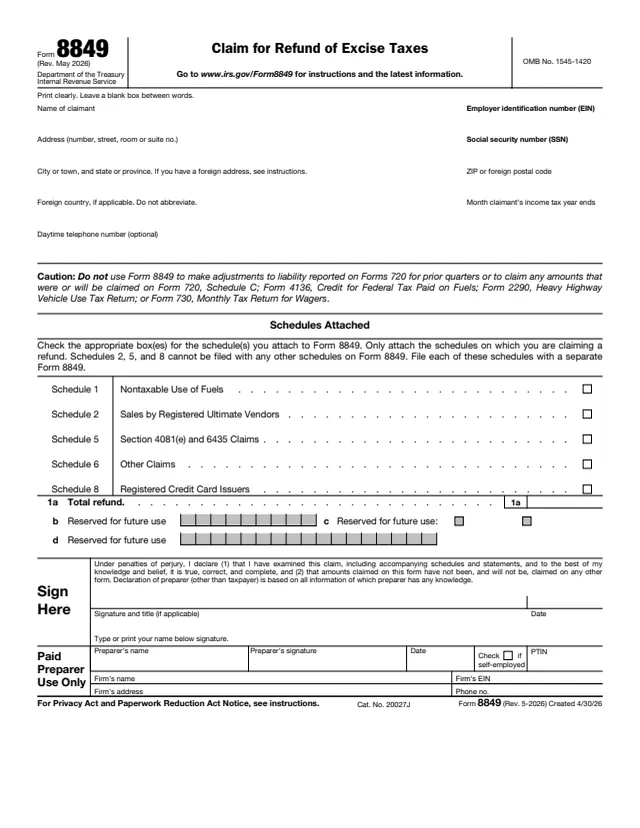
8849
27 fields, 4 pages
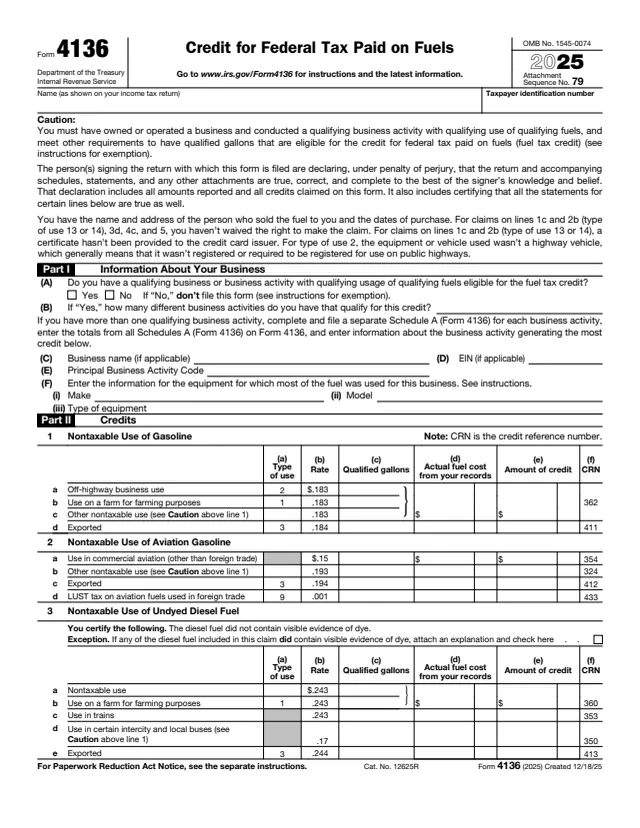
4136
485 fields, 4 pages
The instructions say Form 720 is filed by anyone liable for, or responsible for collecting, any of the federal excise taxes listed in Parts I and II. It is a business return in most cases, signed by a person authorized by the entity.
No tool matches that search.
The instructions say anyone liable for, or responsible for collecting, any federal excise tax listed in Parts I and II files it, for the current quarter or until a final return is filed after an earlier liability.
Quarterly: by April 30, July 31, October 31 and January 31 for the quarters ending in March, June, September and December. A weekend or legal holiday moves the date to the next business day.
The instructions give Department of the Treasury, Internal Revenue Service, Ogden, UT 84201-0009. It can also be e-filed through an electronic return originator, transmitter or intermediate service provider.
The instructions say to enter a zero on the lines for taxes normally reported, enter "None" on Part III, line 3, and sign and date the return.
Adjustments to liabilities reported for prior quarters go on Form 720-X, Amended Quarterly Federal Excise Tax Return. The instructions say not to enter adjustments on Form 720.
No. Form 720-V goes with a check or money order. The instructions say not to file it when the balance due is paid by IRS Direct Pay, EFTPS or direct debit.