Business details and equipment
Name and taxpayer identification number, business name, EIN and Principal Business Activity Code, then the make, model and type of the equipment for which most of the fuel was used for this business.
4136 Sch. A
Business Activity Report for Credit for Federal Tax Paid on Fuels
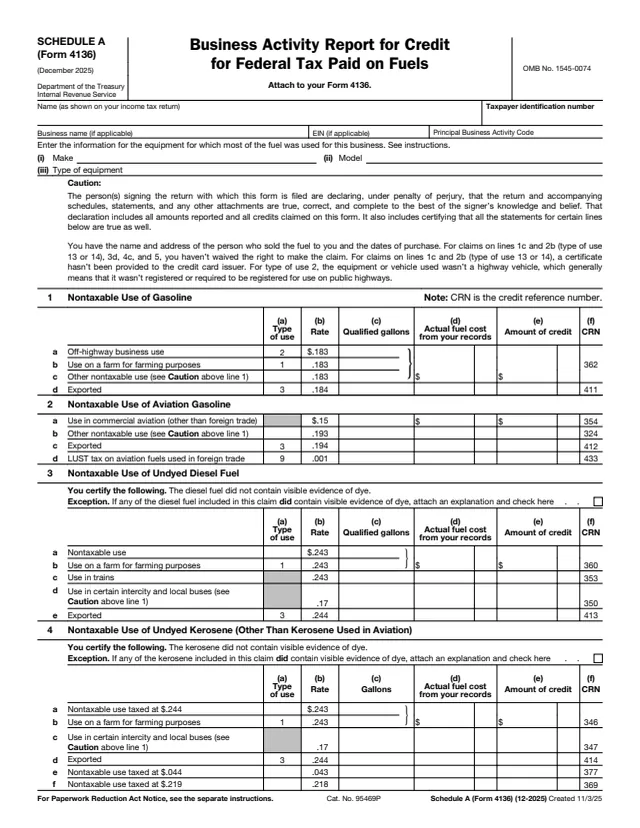
Schedule A (Form 4136), Business Activity Report for Credit for Federal Tax Paid on Fuels, is an attachment to Form 4136. The schedule says to attach it to your Form 4136. It reports, for one business or business activity, the fuel tax credit claims for nontaxable uses and sales of fuel, line by line, ending with the total income tax credit claimed on line 17.
The joint Instructions for Form 4136 and Schedule A say that if you have more than one qualifying business or business activity with qualifying usage of qualifying fuels, a separate Schedule A (Form 4136) is used for each one. The lines on the schedule are the same as on Form 4136, and the instructions refer to the Form 4136 line instructions for completing it.
This edition is dated December 2025. You can fill out Schedule A (Form 4136) free in your browser on this page and download it without an account.
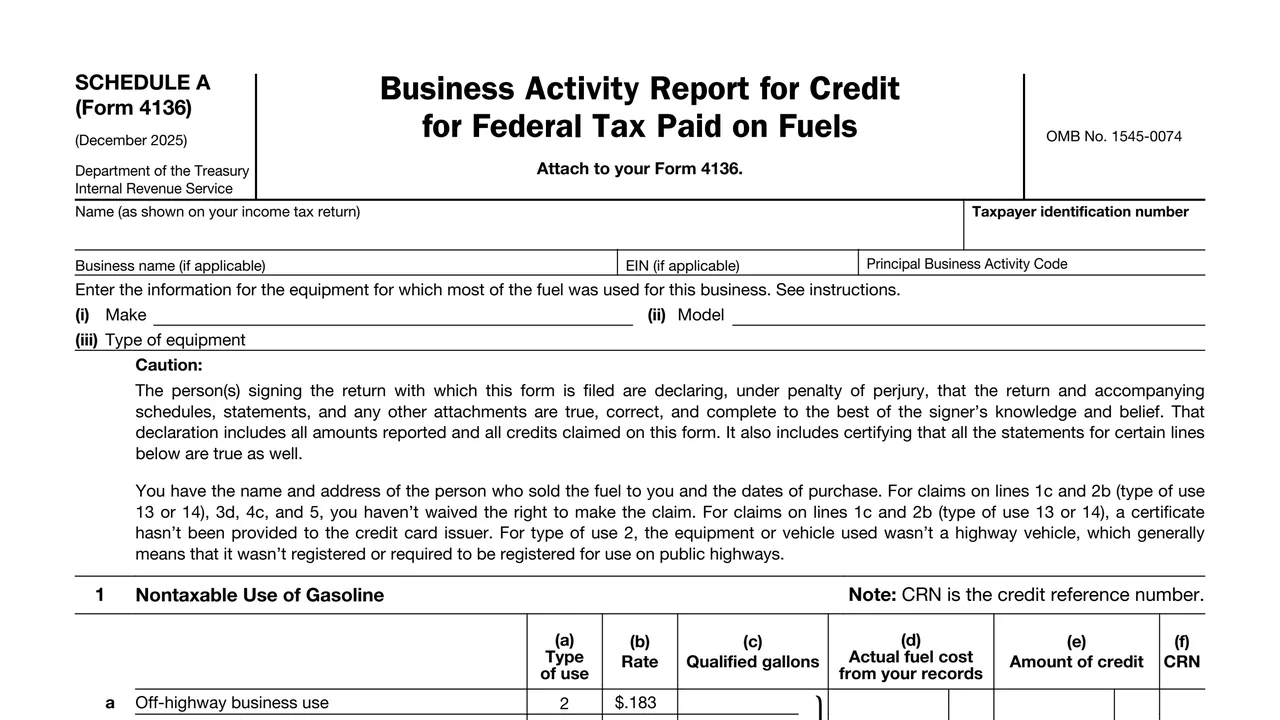
Name and taxpayer identification number, business name, EIN and Principal Business Activity Code, then the make, model and type of the equipment for which most of the fuel was used for this business.
A statement that the signers of the return declare under penalty of perjury that the schedule is true, correct and complete, including certifications about the seller's name and address, waivers and highway vehicles.
Nontaxable use of gasoline, aviation gasoline, undyed diesel fuel and undyed kerosene, and kerosene used in aviation. Each line has columns for type of use, rate, gallons, actual fuel cost, amount of credit and CRN.
Sales by registered ultimate vendors of undyed diesel fuel, undyed kerosene and kerosene for use in aviation, and claims by registered credit card issuers. Each has a space for the registration number.
Nontaxable use of alternative fuel, nontaxable use of a diesel-water fuel emulsion, diesel-water fuel emulsion blending, and exported dyed fuels and gasoline blendstocks. Lines 9, 10 and 12 are reserved for future use.
The total income tax credit claimed, which the schedule says to figure by adding lines 1 through 16, column (e).
Enter the name as shown on your income tax return, your TIN, and the business name and EIN if applicable. The instructions say to enter the EIN issued on Form SS-4, not an SSN, and the six-digit principal business activity code.
Enter the make, model and type of the equipment for which most of the fuel was used for this business.
For each claim, enter the type of use number from the Type of Use Table in the instructions, the gallons and the actual fuel cost from your records. The instructions say to generally multiply the rate by the number of gallons for the amount of credit.
For lines 6, 7, 8, 13 and 15, enter the registration number in the space provided. The schedule and instructions tie these claims to a Form 637 registration number.
Add lines 1 through 16, column (e), and enter the total on line 17. The instructions say to combine the totals from all Schedules A (Form 4136) on Form 4136, Part II.
You get the real form, filled in a browser tab, with nothing standing between you and the finished PDF.
The schedule says to attach it to your Form 4136. It is not filed on its own.
The instructions say to complete a separate Schedule A (Form 4136) for each EIN, combine the totals on Form 4136, Part II, and describe the business activity generating the most qualifying fuel usage on Form 4136, Part I, lines (C) through (F).
The instructions say records supporting any credits claimed are kept for at least 3 years from the date the return is due or filed, whichever is later. Exported fuel claims also need proof of exportation, such as an export bill of lading.
The instructions caution that falsely claiming the fuel tax credit will result in severe consequences, including civil and criminal penalties.
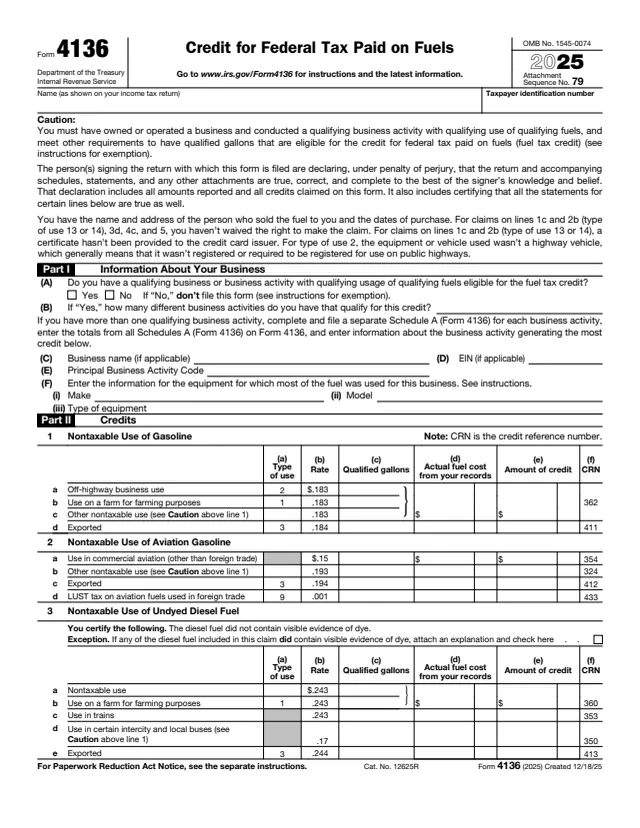
4136
485 fields, 4 pages
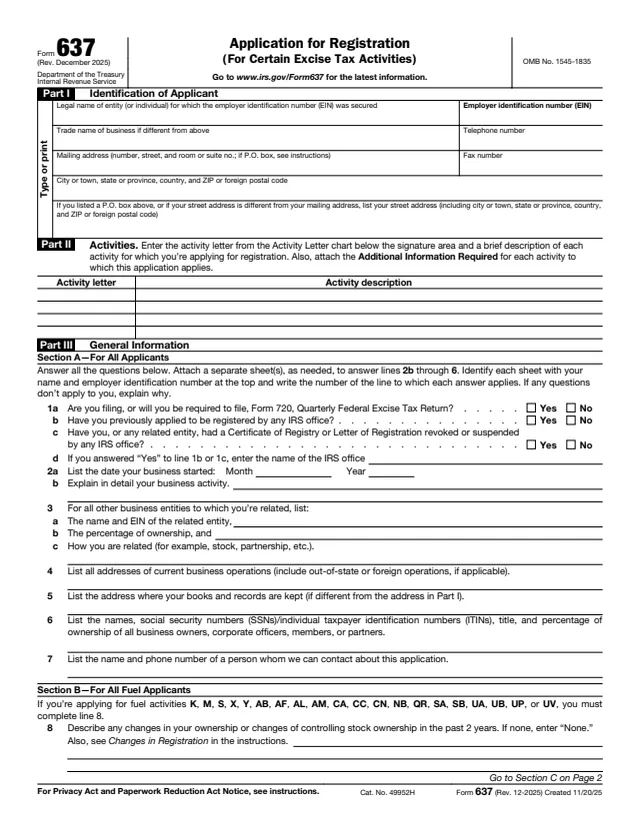
637
50 fields, 7 pages
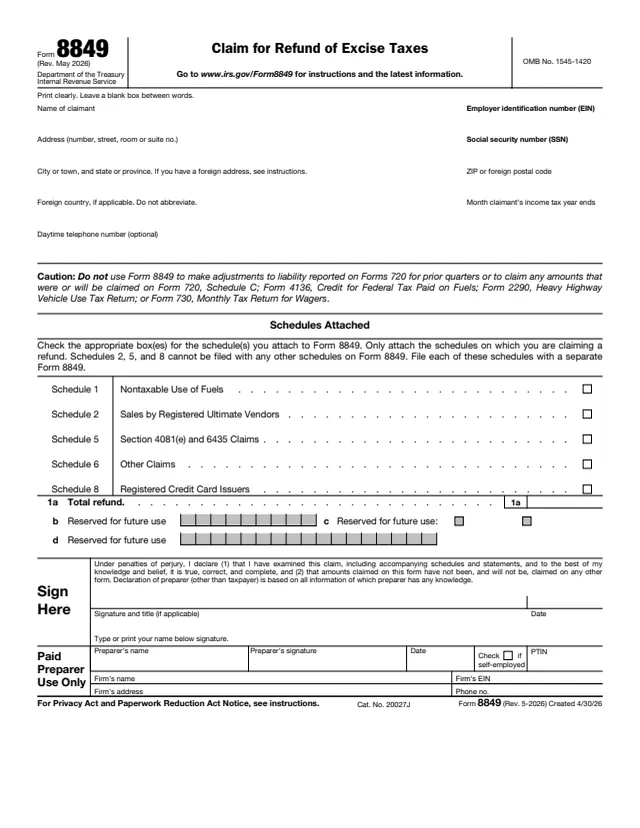
8849
27 fields, 4 pages
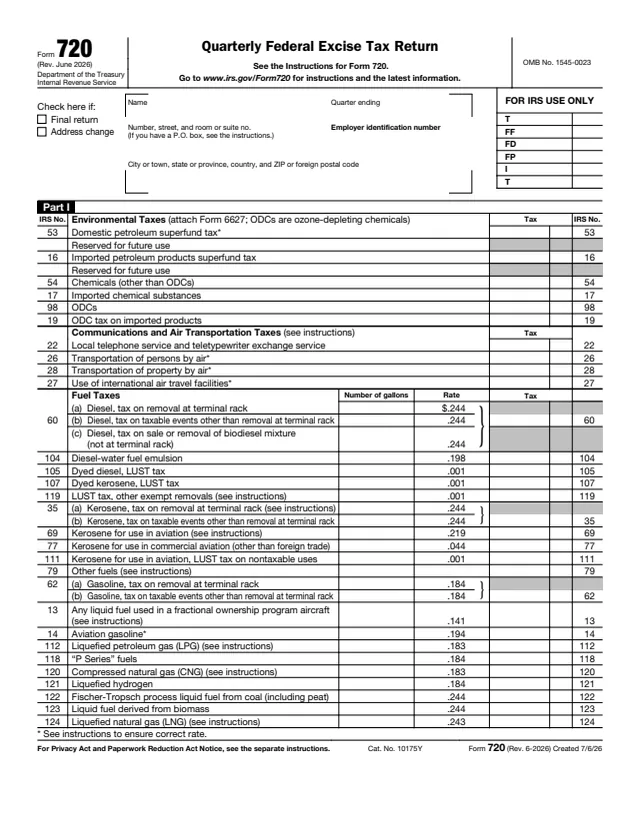
720
715 fields, 8 pages
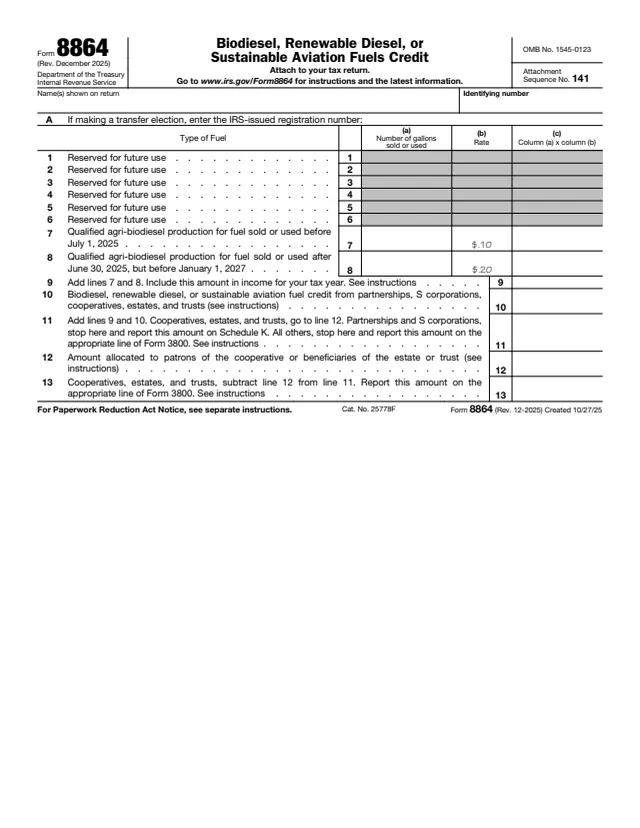
8864
32 fields, 1 page
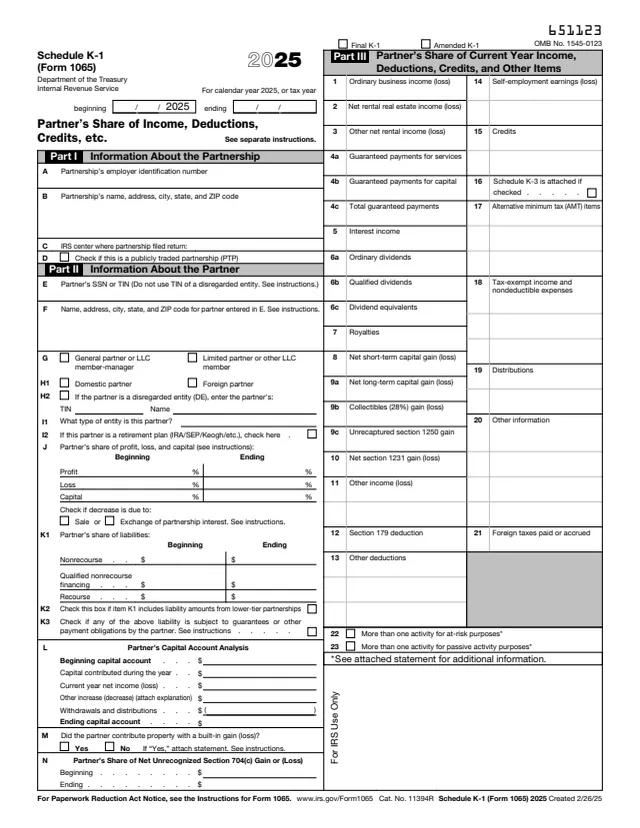
1065
111 fields, 1 page
The person or business that files Form 4136 completes this schedule and attaches it to that form. The instructions describe when separate schedules are used and who cannot file Form 4136.
No tool matches that search.
No. The schedule says to attach it to your Form 4136, and its totals are combined on Form 4136, Part II.
The instructions say to complete and file a separate Schedule A (Form 4136) for each EIN, then combine the totals from all of them on Form 4136.
The schedule says CRN is the credit reference number. Each claim line shows its CRN in column (f).
The actual fuel cost from your records. The instructions list column (d) as new for 2025 on Part II, lines 1 through 16.
The instructions say a taxpayer who uses gasoline in their vehicle for personal use, commuting to work, or driving for ride sharing services does not qualify for the fuel tax credit.