Header
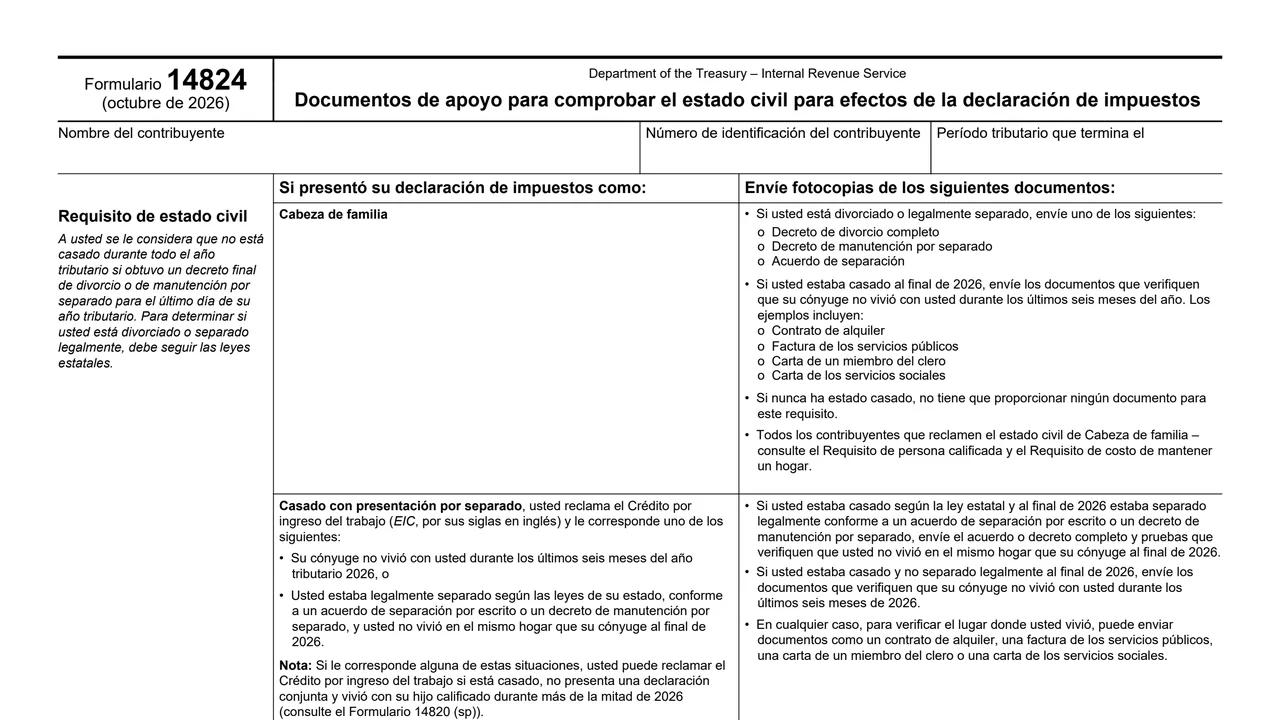
Spaces for the taxpayer name, taxpayer identification number and tax period ending ("Período tributario que termina el").
14824
Supporting Documents to Prove Filing Status (Spanish Version)
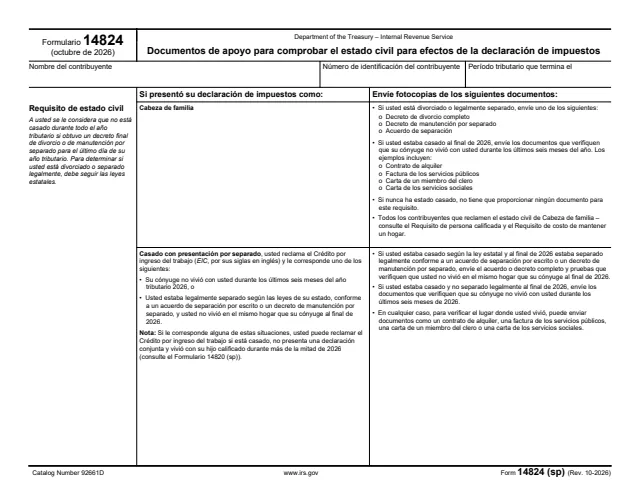
Form 14824 (sp) is the Spanish version of Form 14824, Supporting Documents to Prove Filing Status. Its Spanish title is "Documentos de apoyo para comprobar el estado civil para efectos de la declaración de impuestos." It is a two-page IRS table, written in Spanish, of the photocopies that support the filing status on a return. It covers two statuses: Head of Household ("Cabeza de familia"), and married filing separately ("Casado con presentación por separado") when the Earned Income Credit (EIC) is claimed.
The table is built on three tests: the filing status test, the qualifying person test for Head of Household and the cost of keeping up a home test for Head of Household. For each case it names the documents to send, such as a divorce decree, a rental contract, school or medical records, or rent receipts and utility bills.
The header prints the date in Spanish, "octubre de 2026", and the lists refer to tax year 2026. The top has spaces for the taxpayer name, taxpayer identification number and tax period ending. You can fill them out free in your browser on this page and download the result without an account.
Spaces for the taxpayer name, taxpayer identification number and tax period ending ("Período tributario que termina el").
If divorced or legally separated: the complete divorce decree, separate maintenance decree or separation agreement. If married at the end of 2026: documents showing the spouse did not live with the taxpayer in the last six months, such as a rental contract, utility bill, or letter from clergy or social services.
If legally separated: the complete agreement or decree and proof of not living in the same household at the end of 2026. If not legally separated: documents showing the spouse did not live with the taxpayer in the last six months of 2026.
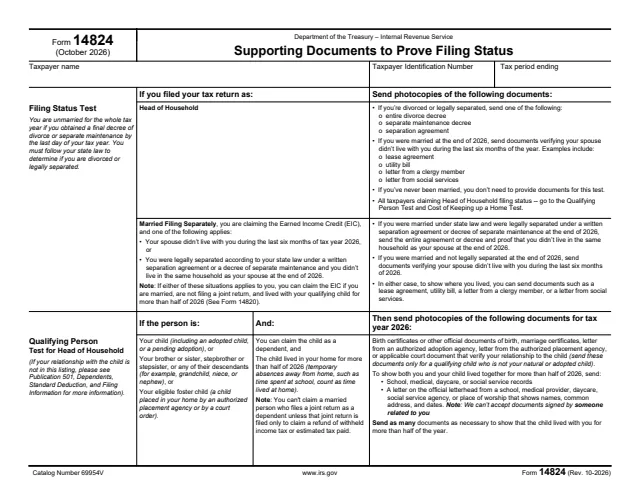
Covers a child, including an adopted child or pending adoption, a brother, sister, stepbrother or stepsister or their descendants, or an eligible foster child, who can be claimed as a dependent and lived in the home more than half of 2026.
School, medical, daycare or social services records, or a letter on official letterhead from a school, medical provider, social services agency or place of worship showing names, common addresses and dates.
For paying more than half the cost of keeping up the home in 2026: rent receipts, utility bills, grocery receipts, property tax bills, mortgage interest statement, upkeep and repair bills, property insurance statement and other household bills.
The tables are in Spanish. The items below give their English meaning.
Enter the taxpayer name, taxpayer identification number and tax period ending at the top.
Read the row for the status on the return: Cabeza de familia, or Casado con presentación por separado with the EIC. The form says state law decides whether a person is divorced or legally separated.
Photocopy the decree or agreement, or the papers that show where each spouse lived, such as a rental contract or a utility bill, as the row lists.
Add relationship papers only if the child is not a natural or adopted child, and records showing the child lived in the home more than half of 2026. The form says to send as many documents as needed.
For Head of Household, add copies of household bills such as rent receipts, utility bills, grocery receipts and the mortgage interest statement.
The form says the IRS cannot accept documents signed by a person related to the taxpayer.
You get the real form, filled in a browser tab, with nothing standing between you and the finished PDF.
The form prints no mailing address. It is an IRS list headed Department of the Treasury, Internal Revenue Service.
The form prints no deadline.
Each documents column says to send photocopies ("fotocopias").
This revision's lists refer to tax year 2026.
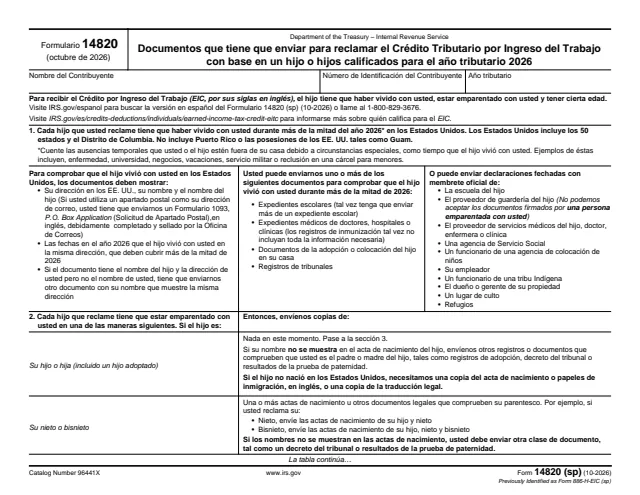
For a relationship not in the list, the form points to Publication 501, Dependents, Standard Deduction, and Filing Information, noting it is in English. For the EIC on a separate return it points to Form 14820 (sp).
14824
3 fields, 2 pages
14820
10 fields, 3 pages
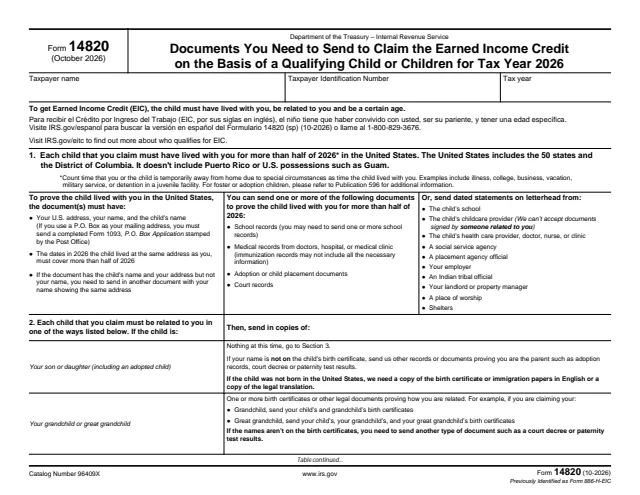
14820
8 fields, 2 pages
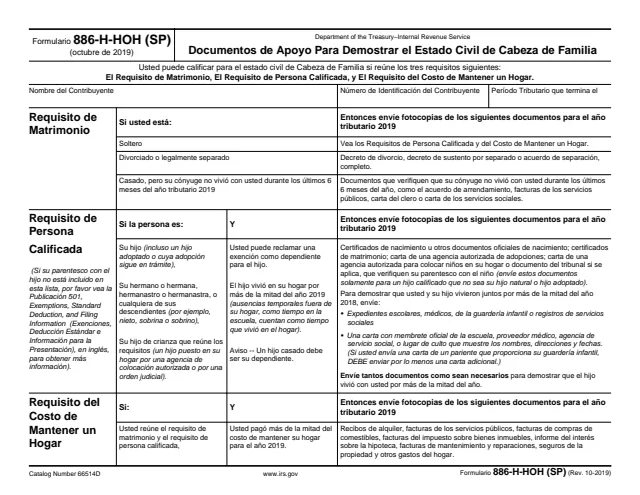
886-H-HOH
3 fields, 1 page
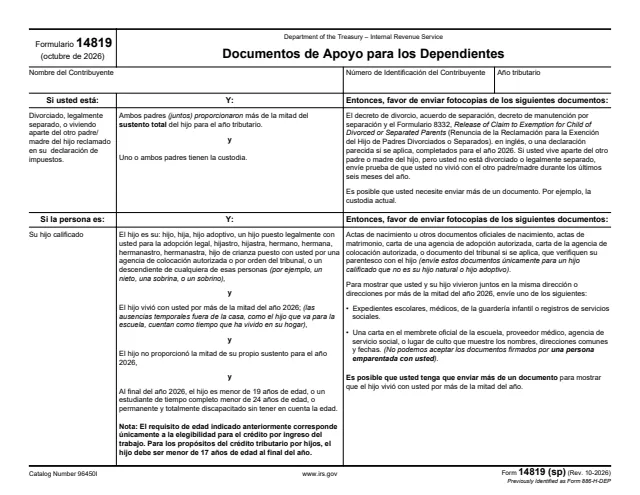
14819
3 fields, 2 pages
The form is a Spanish IRS list for the taxpayer whose return shows the filing status in question. The taxpayer fills in the header and sends photocopies of the documents that fit the case. The header names the Department of the Treasury, Internal Revenue Service.
No tool matches that search.
The title, header and tables are in Spanish. Only the footer with the form and catalog numbers is in English. The English edition is Form 14824.
Head of Household (Cabeza de familia), and married filing separately (Casado con presentación por separado) when the Earned Income Credit is claimed and one of the two listed situations applies.
The filing status test, the qualifying person test for Head of Household and the cost of keeping up a home test for Head of Household.
The form says no document is needed for the filing status test in that case. It says every Head of Household claim also goes through the qualifying person and cost of keeping up a home tests.
The form says a person is considered unmarried for the whole tax year if they obtained a final decree of divorce or separate maintenance by the last day of the tax year, following state law.
The form points to Publication 501, Dependents, Standard Deduction, and Filing Information, and notes that it is in English.