Header and opening lines
Taxpayer name, taxpayer identification number and tax year, the main rule, and pointers to IRS.gov/espanol, the number 1-800-829-3676 and an IRS.gov page on who qualifies for the EIC.
14820
Documents You Need to Send to Claim the Earned Income Credit on the Basis of a Qualifying Child or Children for Tax Year 2026 (Spanish Version)
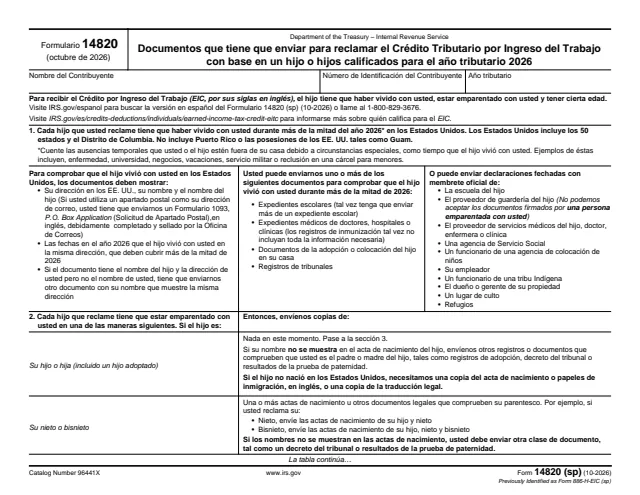
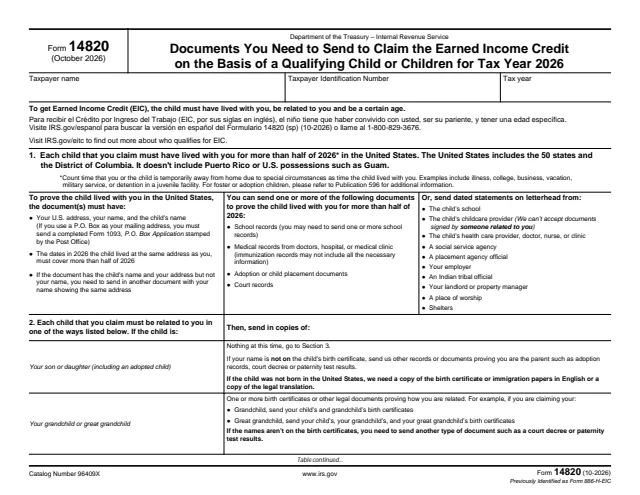
Form 14820 (sp) is the Spanish version of Form 14820, Documents You Need to Send to Claim the Earned Income Credit on the Basis of a Qualifying Child or Children for Tax Year 2026. The IRS PDF is written in Spanish for taxpayers who read Spanish and are backing up an Earned Income Credit (EIC) claim with a qualifying child. The English edition is Form 14820. This page describes the Spanish edition in English.
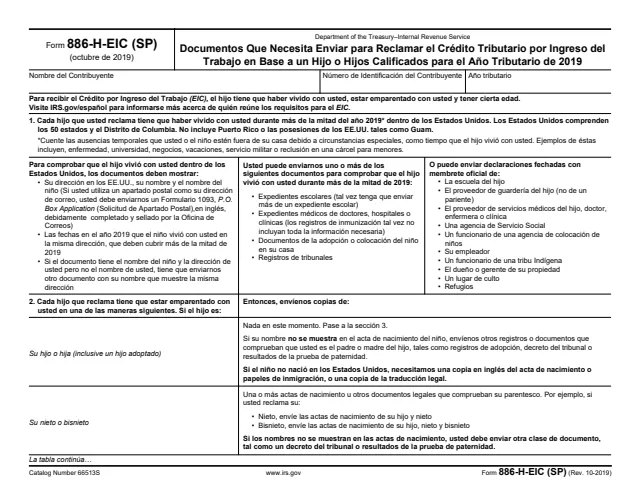
The form opens with its main rule: to get the EIC, the child has to have lived with the taxpayer, be related to the taxpayer and be a certain age. Three numbered sections list the documents to send for each test, and page 3 closes with a checklist of things to review before sending copies. The Spanish edition runs to three pages, and its footer says it was previously identified as Form 886-H-EIC (sp).
The top of page 1 has spaces for the taxpayer name, taxpayer identification number and tax year. You can fill in the header free in your browser on this page and download the form without an account.
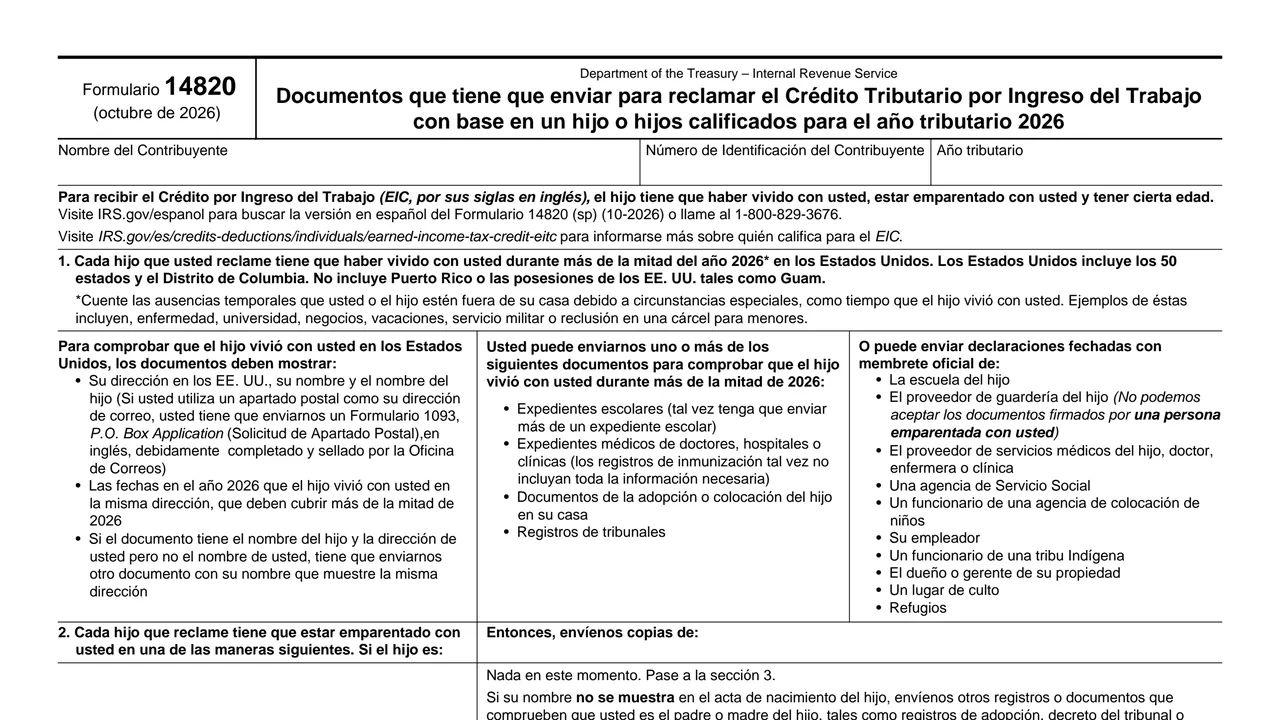
Taxpayer name, taxpayer identification number and tax year, the main rule, and pointers to IRS.gov/espanol, the number 1-800-829-3676 and an IRS.gov page on who qualifies for the EIC.
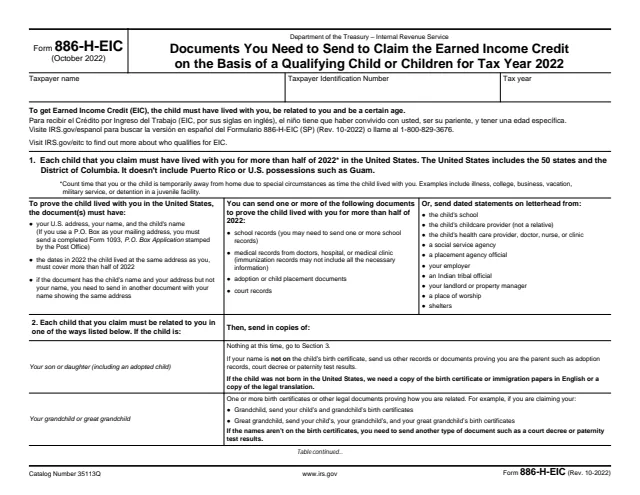
Each child claimed has to have lived with the taxpayer for more than half of 2026 in the United States, meaning the 50 states and the District of Columbia, not Puerto Rico or possessions such as Guam.
What the documents have to show, such as the U.S. address, both names and dates covering more than half of 2026, then the records accepted and who can write a dated statement on letterhead.
A table that pairs each relationship, from son or daughter to foster child, with the birth certificates, court papers or agency statements to send copies of.
Three rows: under 19 at the end of 2026, 19 but under 24 and a full-time student for any part of 5 calendar months, and any age if permanently and totally disabled during 2026.
The rule that all three tests have to be proved, then items to check before sending, such as documents for 2026 and a legal translation of anything not in English.
Enter the taxpayer name, taxpayer identification number and tax year at the top of page 1.
Gather records or dated letterhead statements showing the U.S. address, both names and dates in 2026. With a P.O. box as the mailing address, the form asks for a completed Form 1093, P.O. Box Application, stamped by the Post Office.
Find the relationship in section 2. For a son or daughter the form says nothing is needed at this time, unless the taxpayer's name is not on the birth certificate or the child was not born in the United States.
A child under 19 at the end of 2026 and younger than the taxpayer needs nothing at this time. A full-time student 19 to under 24 needs school records, and a disabled child needs a letter from a doctor, social services program or government agency.
Check that the documents prove all three tests and are for 2026. The form notes one record can prove more than one thing, such as a school record that shows the address and names the taxpayer as parent.
Send copies of the documents to the IRS. The checklist says a document that is not in English goes with a legally translated document.
You get the real form, filled in a browser tab, with nothing standing between you and the finished PDF.
The form asks the taxpayer to send copies of the documents to the IRS, in its words "envíenos" (send us). It prints no mailing address.
The form says that without the legal documents it asks for, the EIC can't be claimed with that child, though the taxpayer may still be able to claim the EIC without a qualifying child.
The form says the IRS can't accept documents signed by someone related to the taxpayer, for example a sister who cares for the child while the taxpayer works.
For a child not born in the United States, the form asks for the birth certificate or immigration papers in English, or a copy of the legal translation.
The checklist says the documents are for 2026, not the current year.
14820
8 fields, 2 pages
886-H-EIC
8 fields, 3 pages
886-H-EIC
8 fields, 2 pages
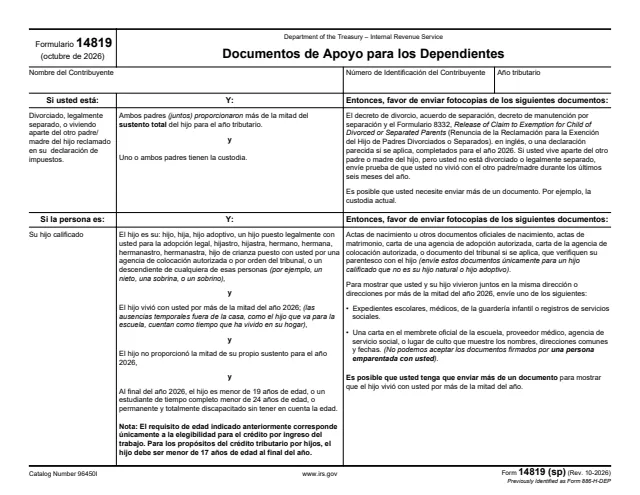
14819
3 fields, 2 pages
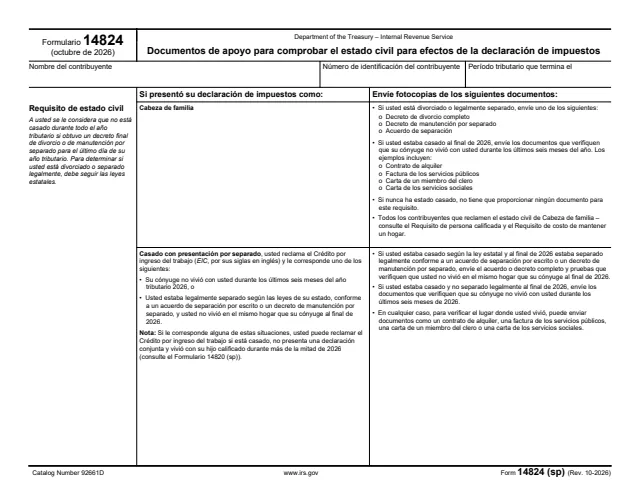
14824
3 fields, 2 pages
The form is addressed to a taxpayer who claims the EIC with a qualifying child. The taxpayer sends copies of the listed documents to the IRS, which the form calls "us."
No tool matches that search.
The PDF is in Spanish. The English edition of the same list is Form 14820, and this page describes the Spanish edition in English.
The IRS. The form asks the taxpayer to send copies "to us" and prints no mailing address.
That the child lived with the taxpayer in the United States for more than half of 2026, is related to the taxpayer, and meets the age rule.
The checklist says that if the documents are not in English, a legally translated document is sent as well.
The form says time away for special circumstances, such as illness, college, business, vacation, military service or detention in a juvenile facility, counts as time the child lived with the taxpayer.
The footer says Form 14820 (sp) was previously identified as Form 886-H-EIC (sp).