Phần I: site information
Office name, office address (street, city, state, postal code), site identification number (SIDN), office coordinator name, and the office contact's name and phone number.
14446
Virtual VITA/TCE Taxpayer Consent (Vietnamese Version)
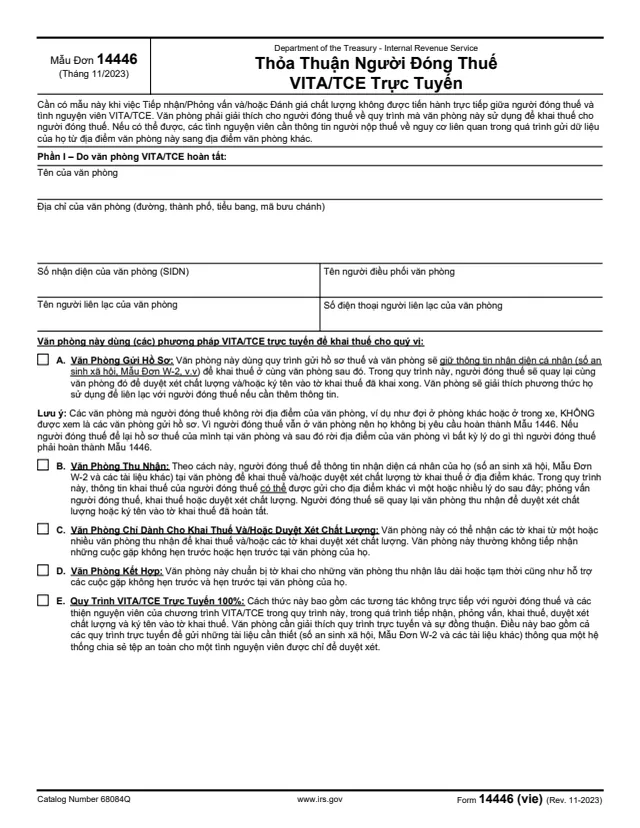
Form 14446 (vie) is the Vietnamese version of Form 14446, Virtual VITA/TCE Taxpayer Consent. The IRS lists it for taxpayers who read Vietnamese and get help at a Volunteer Income Tax Assistance (VITA) or Tax Counseling for the Elderly (TCE) site. The three pages are printed in Vietnamese under the title Thỏa Thuận Người Đóng Thuế VITA/TCE Trực Tuyến, and each footer reads Form 14446 (vie) (Rev. 11-2023). The English edition is Form 14446.
The Vietnamese text says the form is needed when intake/interview and/or quality review are not done in person between the taxpayer and the VITA/TCE volunteer. The site, called a văn phòng (office) in Parts I and II, completes those parts. The taxpayer reads Phần III (Part III), answers two Có (Yes) or Không (No) questions and signs, and on a joint return both spouses sign.
You can fill it out free in your browser on this page and download the result without an account.
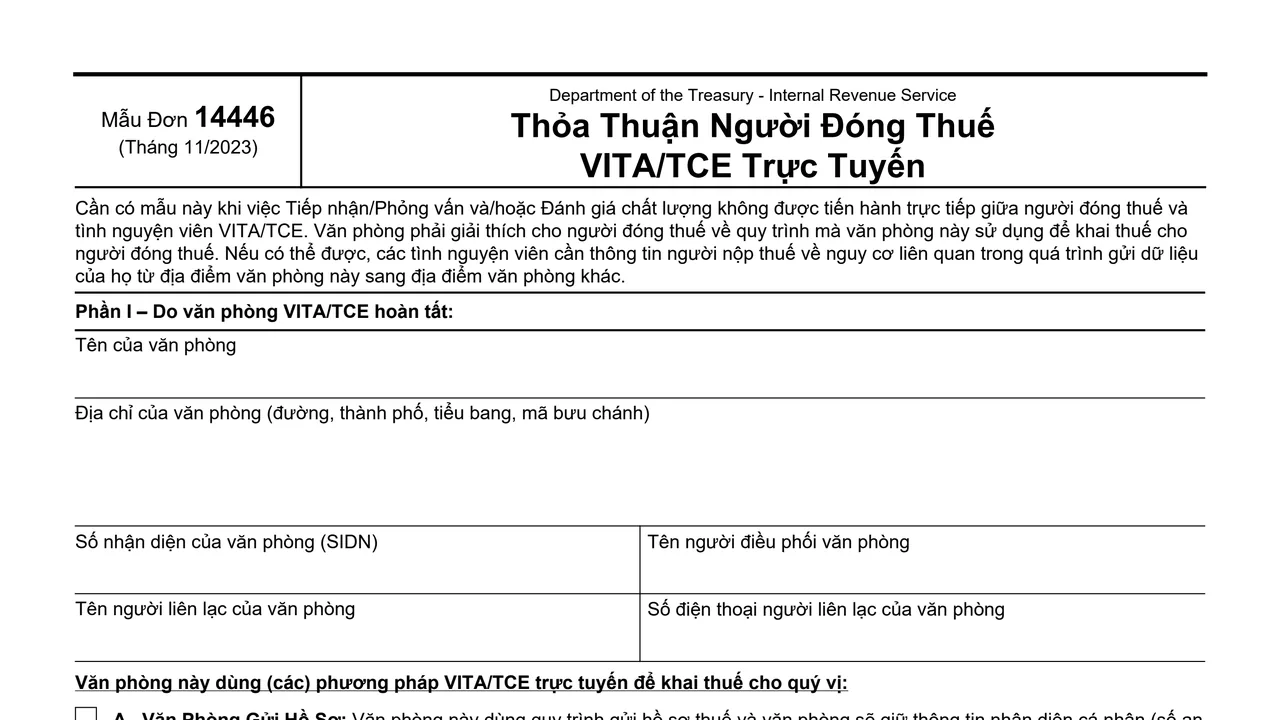
Office name, office address (street, city, state, postal code), site identification number (SIDN), office coordinator name, and the office contact's name and phone number.
Văn Phòng Gửi Hồ Sơ (drop off office), Văn Phòng Thu Nhận (intake office), a preparation and/or quality review only office, Văn Phòng Kết Hợp (combination office), and the 100% virtual VITA/TCE process.
Eleven numbered processes, each with a guide question in parentheses: scheduling, the consent agreement, intake, identity checks with photo ID and Social Security cards or ITIN letters, interview, preparation, contact, quality review, sharing, signing and e-filing.
The form says IRS staff choose free tax preparation sites at random for review, the site corrects any errors found, and not wanting a review does not affect the services provided.
Says that if non-IRS online systems are attacked without the site's knowledge, federal law may not be able to protect the return information from use or distribution. It also says the offices are run by IRS sponsored partners.
A Có or Không on using the office's virtual VITA/TCE process, then printed name, date of birth, date, phone, email and an electronic or a typed/printed signature, in columns for the taxpayer and the spouse.
The office enters its name, address, SIDN, coordinator and contact, then checks each virtual method, A to E, that it uses.
For each of the 11 processes, the office writes how it is handled remotely. Item 9 asks which channel, in person or online, is used to share the finished return.
Check Có (Yes) or Không (No) on letting IRS staff review the return for accuracy if they choose the site that prepares it.
Check Có or Không on using the office's virtual process, enter the printed name, date of birth, date, phone and email, then sign electronically or by typing or printing. HOẶC between the two signature lines means or.
On a joint return, the spouse fills in the second column with the same details and signs.
You get the real form, filled in a browser tab, with nothing standing between you and the finished PDF.
The Vietnamese text says page three of the form is kept at the office with all other required documents. No IRS mailing address is printed.
The disclosure says consent is in effect for the period the taxpayer names, or for one year from the date of signing when no period is stated.
The Vietnamese text says that if the taxpayer does not want to sign, the office cannot prepare the return under this process.
The form names the Treasury Inspector General for Tax Administration (TIGTA), by phone at 1-800-366-4484 or by email at [email protected].
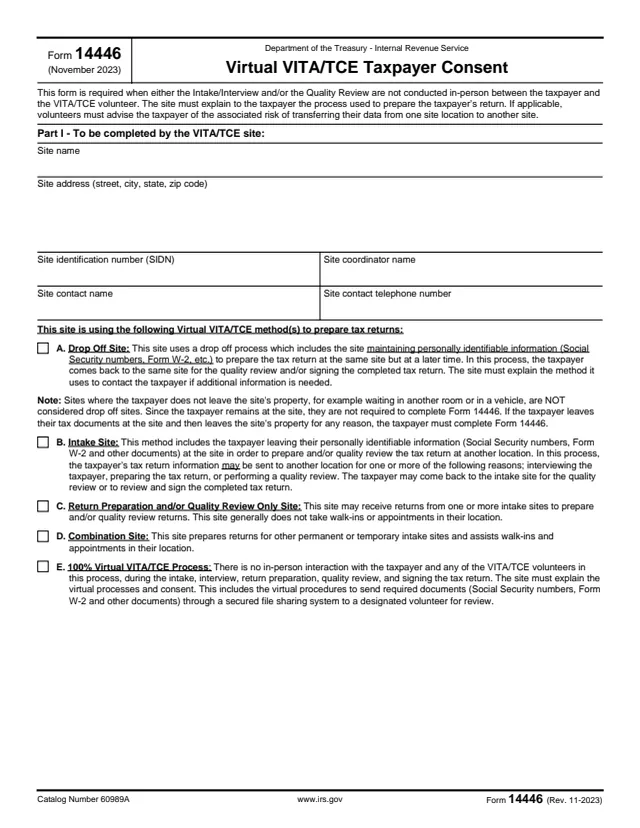
Form 14446 is the English edition. The Vietnamese footer carries the same Rev. 11-2023 date, and the header gives it in Vietnamese as Tháng 11/2023.
14446
41 fields, 3 pages
13614-C
297 fields, 6 pages
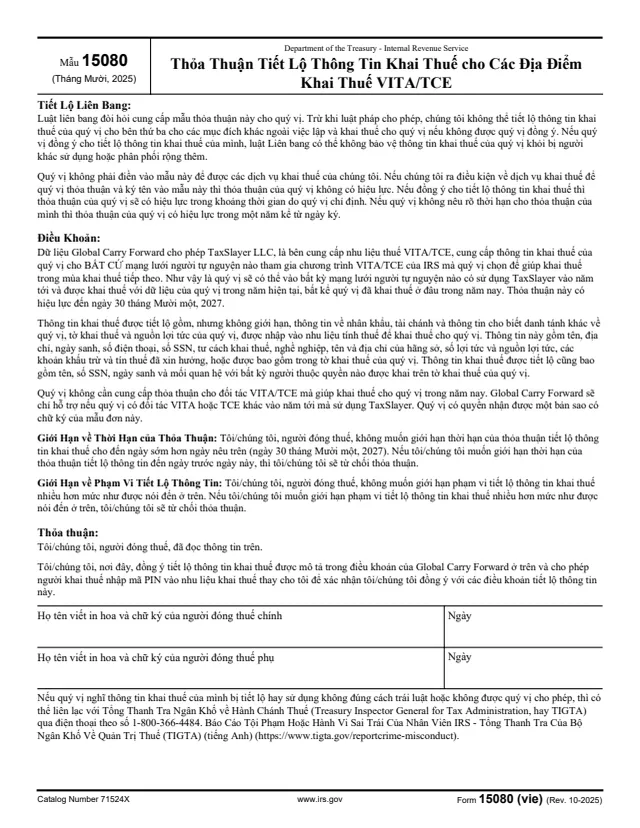
15080
5 fields, 1 page
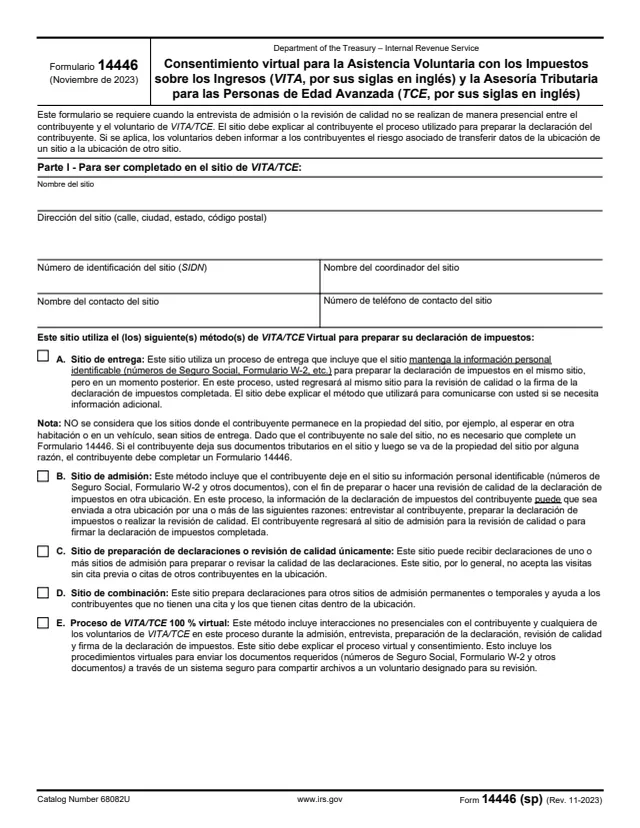
14446
41 fields, 3 pages
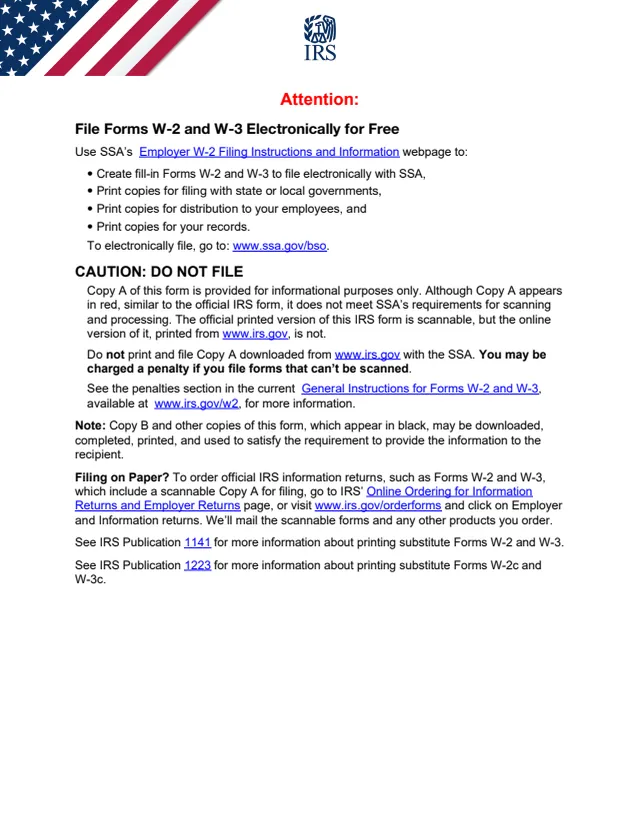
W-2
568 fields, 11 pages
The VITA/TCE site fills in Parts I and II. The taxpayer, and a spouse on a joint return, fill in Part III. The form says page three stays at the site.
No tool matches that search.
Vietnamese. It is the Vietnamese version of Form 14446, Virtual VITA/TCE Taxpayer Consent. Apart from the IRS header, the footers and acronyms such as SIDN and ITIN, the text is in Vietnamese.
The VITA/TCE site, which this edition calls an office. Phần I asks for office details and the virtual methods it uses. Phần II asks it to explain its 11 processes.
The form says page three is kept at the office with all other required documents. It prints no IRS address.
The form says that if the taxpayer does not want the return reviewed, it does not affect the services the site provides.
For the period the taxpayer names. If none is stated, the form says consent is in effect for one year from the date of signing.
Each page footer prints Form 14446 (vie) (Rev. 11-2023) and Catalog Number 68084Q.