Header and opportunity fund question
Name, employer identification number, and a yes or no question on whether the corporation disposed of any investment in a qualified opportunity fund during the tax year.
1120
Capital Gains and Losses
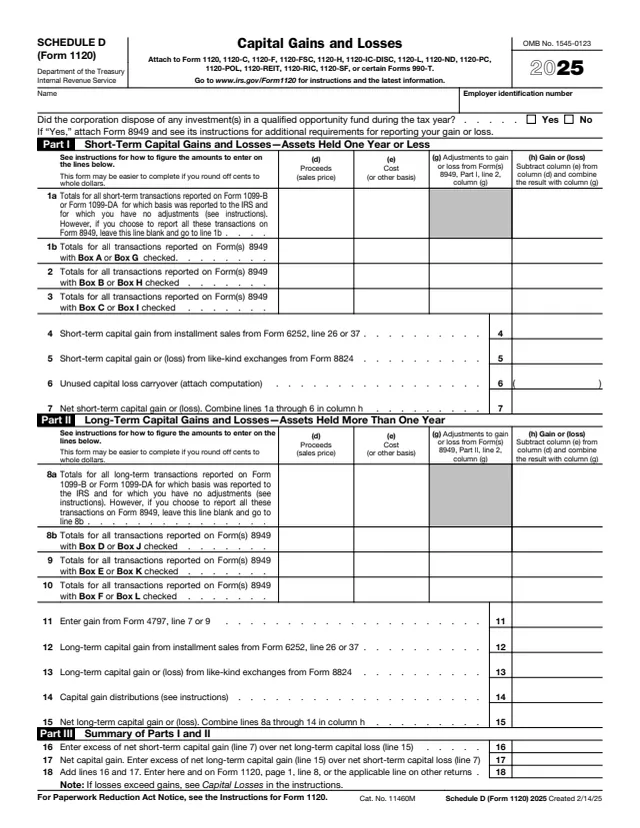
Schedule D (Form 1120), Capital Gains and Losses, is the schedule a corporation attaches to its income tax return to report capital gains and losses. The IRS page says it is used to figure the overall gain or loss from transactions reported on Form 8949, to report certain transactions the corporation does not have to report on Form 8949, and to report capital gain distributions not reported directly on Form 1120.
Part I covers short-term gains and losses on assets held one year or less, Part II covers long-term gains and losses on assets held more than one year, and Part III combines the two. The total on line 18 goes to Form 1120, page 1, line 8, or the applicable line on other returns. The schedule also asks whether the corporation disposed of any investment in a qualified opportunity fund during the tax year.
This page covers the 2025 schedule. The instructions say codes G through L were added on lines 1b, 2, 3, 8b, 9 and 10 to include digital asset transactions. You can fill out the PDF free in your browser on this page and download it without an account.
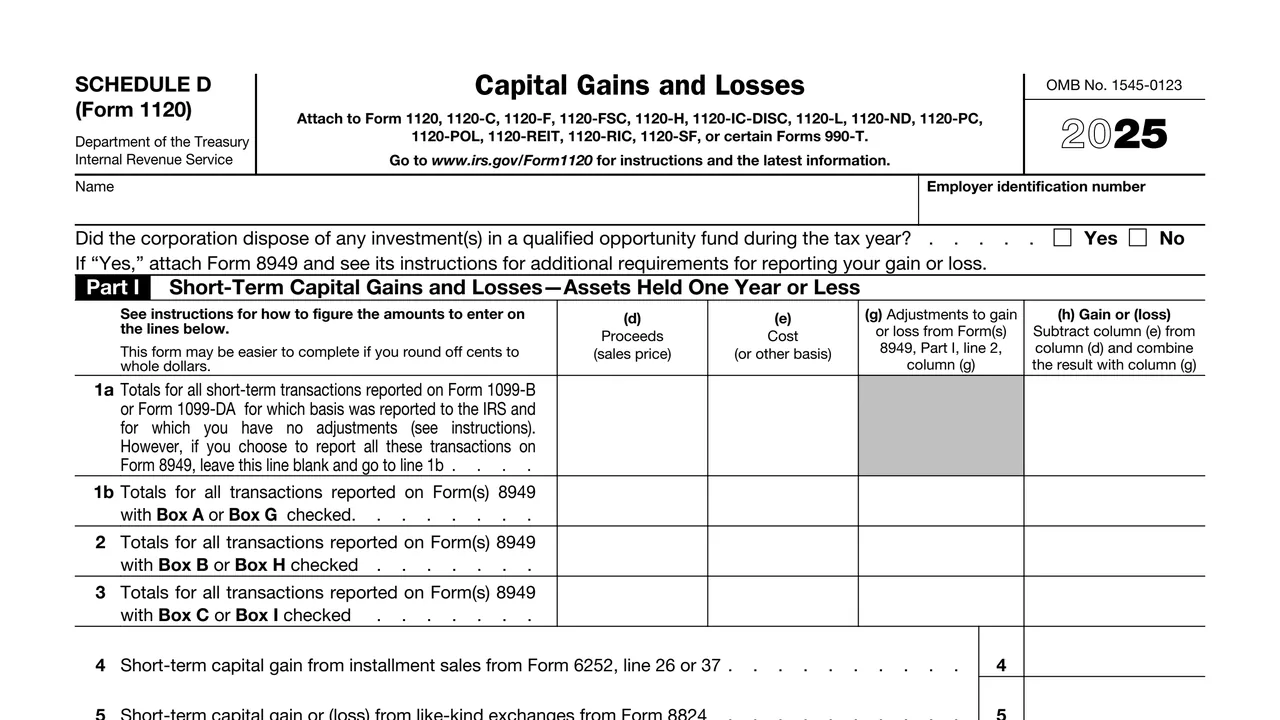
Name, employer identification number, and a yes or no question on whether the corporation disposed of any investment in a qualified opportunity fund during the tax year.
Short-term totals from Form 1099-B or Form 1099-DA, and from Forms 8949 with Box A or G, B or H, and C or I checked, in columns (d) proceeds, (e) cost, (g) adjustments and (h) gain or loss.
Short-term gain from installment sales (Form 6252), gain or loss from like-kind exchanges (Form 8824), unused capital loss carryover, and net short-term capital gain or loss.
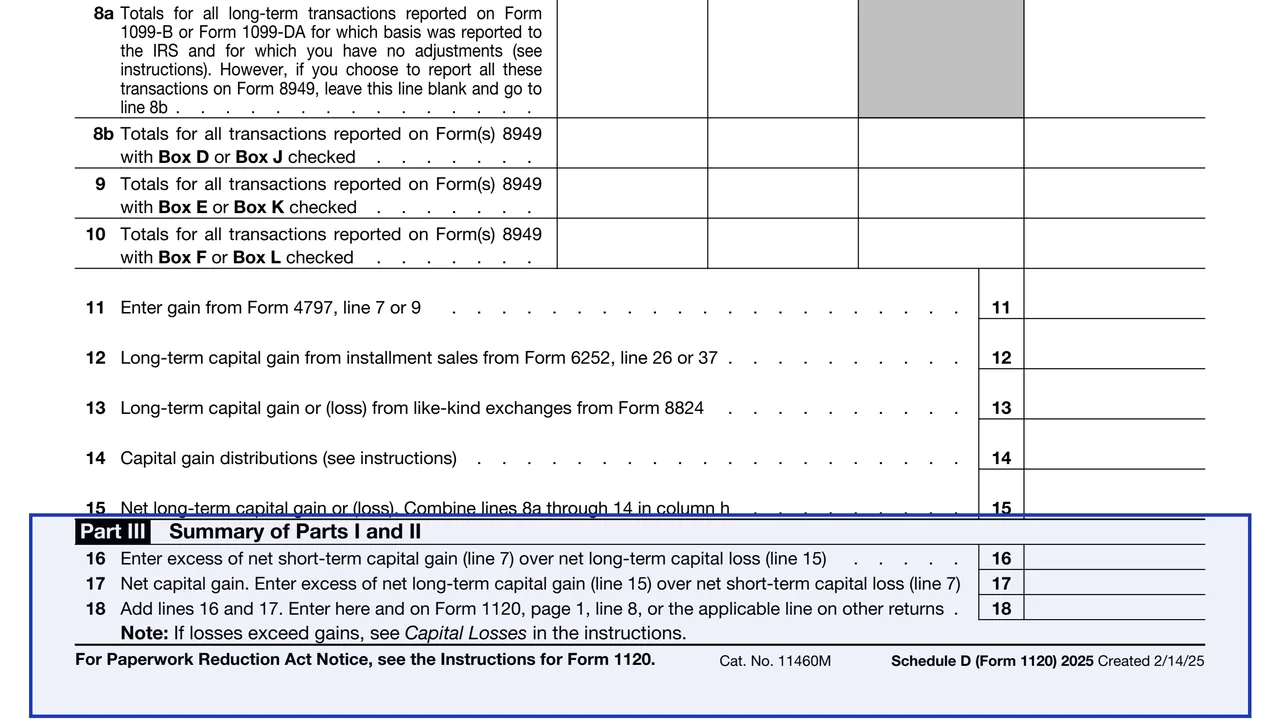
Long-term totals from Form 1099-B or Form 1099-DA, and from Forms 8949 with Box D or J, E or K, and F or L checked.
Gain from Form 4797, line 7 or 9, long-term installment and like-kind exchange amounts, capital gain distributions, and net long-term capital gain or loss.
Line 16 is net short-term gain over net long-term loss, line 17 is net capital gain, and line 18 adds them for Form 1120, page 1, line 8, or the applicable line on other returns.
Check Yes or No at the top. The form says that if the answer is Yes, attach Form 8949 and see its instructions for additional reporting requirements.
The instructions say these lines can hold totals for transactions on Form 1099-B or Form 1099-DA showing basis reported to the IRS, with no adjustments and the Ordinary and QOF boxes not checked. Those are then left off Form 8949.
Complete Form 8949 first, then enter its Part I totals on lines 1b, 2 and 3 and its Part II totals on lines 8b, 9 and 10 by the box checked.
Subtract column (e) from column (d), combine the result with column (g), and enter it in column (h). The instructions say to enter negative amounts in parentheses.
Line 6 holds any unused capital loss carryover, with a statement attached showing how it was computed. Line 14 holds the total capital gain distributions paid by a RIC or REIT during the year.
Complete lines 16 and 17, add them on line 18 and enter the total on Form 1120, page 1, line 8, or the applicable line on the other return. If losses exceed gains, the form points to Capital Losses in the instructions.
You get the real form, filled in a browser tab, with nothing standing between you and the finished PDF.
The schedule is attached to Form 1120, 1120-C, 1120-F, 1120-FSC, 1120-H, 1120-IC-DISC, 1120-L, 1120-ND, 1120-PC, 1120-POL, 1120-REIT, 1120-RIC, 1120-SF, or certain Forms 990-T.
The instructions say the holding period for short-term gains and losses is generally 1 year or less, and for long-term gains and losses generally more than 1 year.
The instructions say a corporation's capital losses are allowed in the current tax year only to the extent of capital gains, and a net capital loss is carried back 3 years and forward up to 5 years as a short-term capital loss.
The instructions point to Form 4797 for business property, Form 4684 for casualties and thefts, Form 6781 for section 1256 contracts and straddles, and Form 8997 for qualified opportunity fund investments.
The instructions say the corporation either rounds off all amounts on its return to whole dollars or uses cents for all amounts.
1120
481 fields, 6 pages
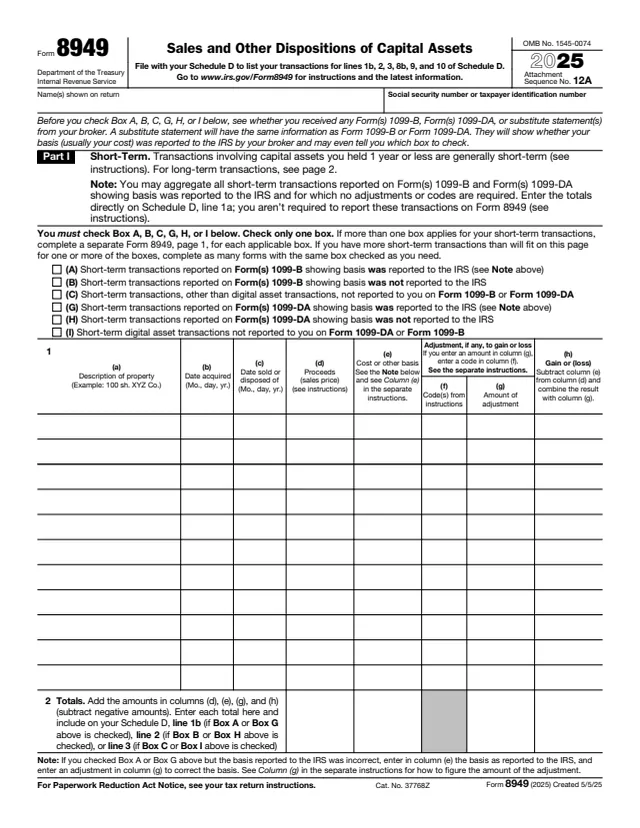
8949
202 fields, 2 pages
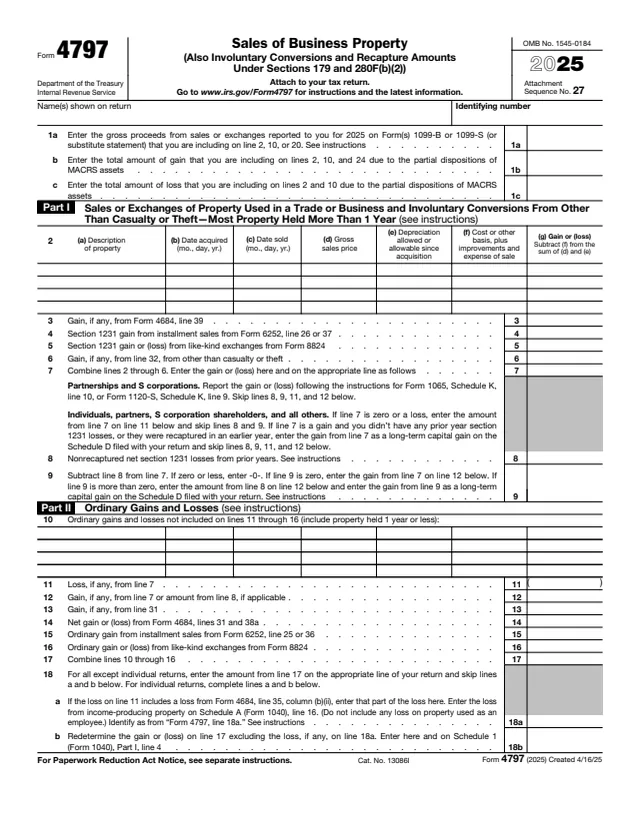
4797
182 fields, 2 pages
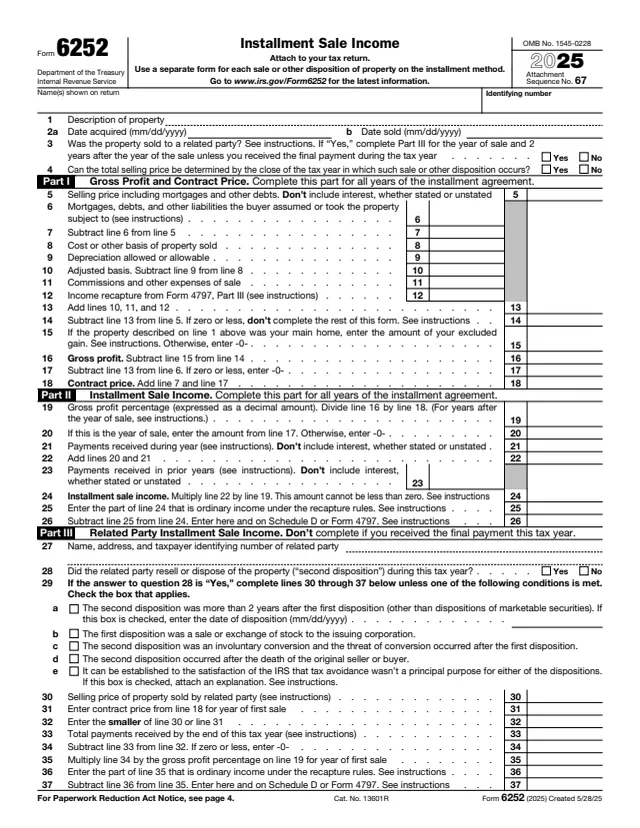
6252
49 fields, 4 pages
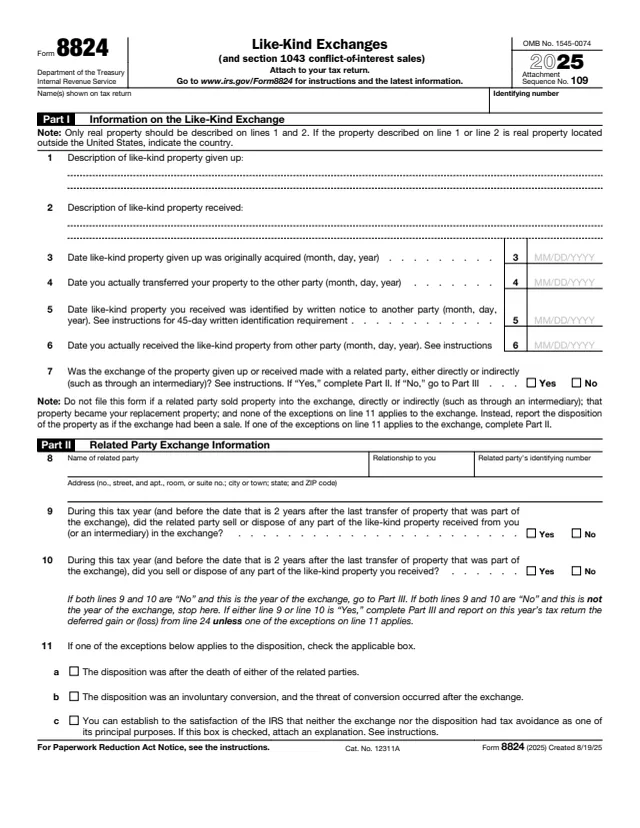
8824
63 fields, 2 pages
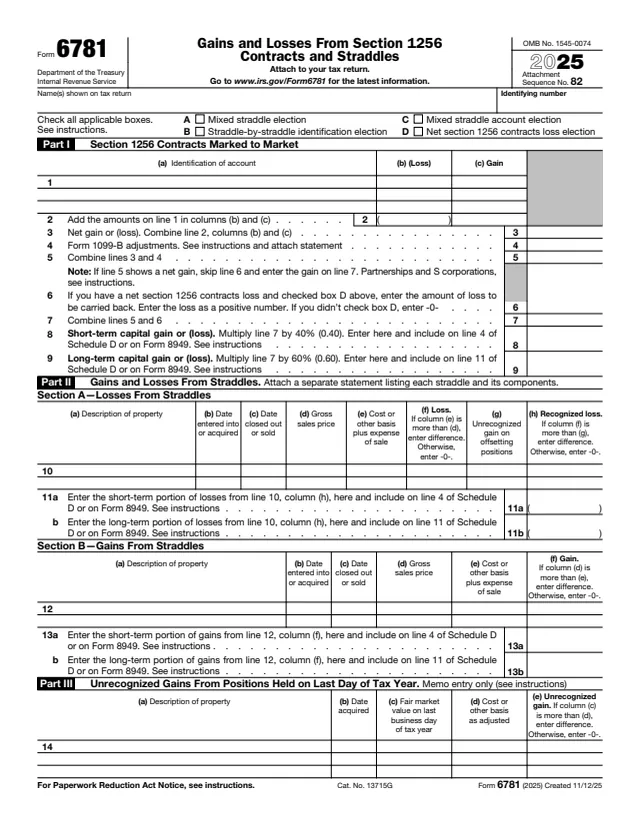
6781
71 fields, 4 pages
The instructions say the schedule is completed and attached to the corporation's return. It is sent to the IRS with that return.
No tool matches that search.
The form lists Form 1120, 1120-C, 1120-F, 1120-FSC, 1120-H, 1120-IC-DISC, 1120-L, 1120-ND, 1120-PC, 1120-POL, 1120-REIT, 1120-RIC, 1120-SF, and certain Forms 990-T.
No. The instructions say totals from Form 1099-B or Form 1099-DA can go straight on lines 1a and 8a when basis was reported to the IRS and no adjustments apply. Other transactions go on Form 8949 first.
The instructions say capital losses are allowed only to the extent of capital gains, and a net capital loss is carried back 3 years and forward up to 5 years as a short-term capital loss.
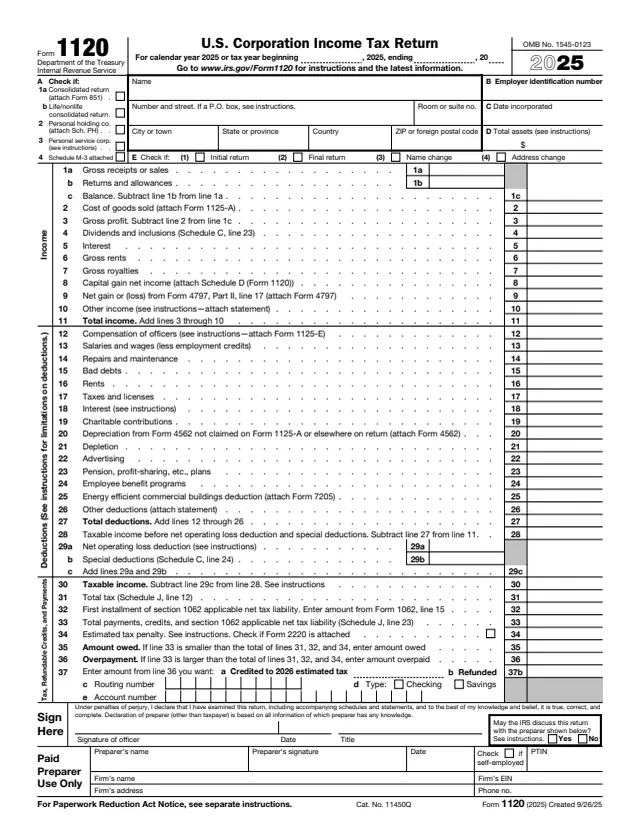
The form says to enter it on Form 1120, page 1, line 8, or the applicable line on other returns.
The instructions say codes G, H, I, J, K and L were added to lines 1b, 2, 3, 8b, 9 and 10 for digital asset transactions, and point to Form 1099-DA and Form 8949.
The instructions say the total capital gain distributions paid by a RIC or REIT during the year, regardless of how long the corporation owned the stock.