Lender and payer of record boxes
The recipient/lender's name, street address, room or suite, city, state or province, country, ZIP, telephone number and TIN, the payer of record's name, address and TIN, and an account number.
1098-VLI
Vehicle Loan Interest Statement
Form 1098-VLI, Vehicle Loan Interest Statement, is an information return. The IRS About page says to use it to report interest of $600 or more you received on a specified passenger vehicle loan (SPVL) during the calendar year in the course of your trade or business from an individual, decedent's estate, or non-grantor trust.
The lender, called the recipient/lender on the form, files Copy A with the IRS and gives Copy B to the borrower, called the payer of record. The form shows the interest received, the vehicle's year, make, model and VIN, the loan dates, the outstanding principal, any refund of overpaid interest and two checkboxes about the vehicle. Copy B carries a caution that the amount shown may not be fully deductible by the payer of record.
This page hosts the December 2026 revision. The instructions say to use it for calendar year 2026 and later years until a superseding revision is issued. The form says Copy A from this PDF is for information only because self-printed copies are not scannable. You can fill out Copy B free in your browser on this page and download it without an account.
The recipient/lender's name, street address, room or suite, city, state or province, country, ZIP, telephone number and TIN, the payer of record's name, address and TIN, and an account number.
Vehicle loan interest received by the lender from the payer of record during the calendar year.
The year, make, model and vehicle identification number (VIN) of the passenger vehicle.
The loan origination date, the loan acquisition date, the outstanding principal and any refund of overpaid interest.
Whether original use of the vehicle began with the payer of record, and whether final assembly of the vehicle occurred within the United States.
Enter the filer's name, address and telephone number. The instructions say to use this same name and address on Form 1096 when filing on paper.
Enter the vehicle loan interest received from the payer of record during the calendar year. The instructions say not to include prepaid interest outside the January 15 exception, or interest on any part of the loan that is not an SPVL.
Enter the vehicle's year, make and model, and the VIN of the vehicle the loan was made for. If the vehicle was replaced with a substitute due to an unforeseen intervening event, the instructions say to report the substitute's VIN.
Enter the date the SPVL was originated with the original lender. If the loan was acquired, enter the acquisition date in box 3b. Otherwise box 3b is left blank.
Enter the outstanding principal as of January 1, or as of the origination or acquisition date if that happened during the year. Box 5 holds the total refund or credit of overpaid SPVL interest from prior years.
Check box 6 if original use of the vehicle began with the payer of record, or if the payer became an obligor because a previous obligor died. Check box 7 if final assembly occurred within the United States, which the instructions say may be read from the VIN or the vehicle's label.
You get the real form, filled in a browser tab, with nothing standing between you and the finished PDF.
Copy A goes to the IRS and Copy B goes to the payer of record. The instructions say Copy B is fillable online at IRS.gov/Form1098VLI for furnishing statements.
The instructions say a separate Form 1098-VLI is filed for each SPVL and the $600 threshold applies separately to each one. A lender may choose to report interest under $600, and is then subject to the same rules.
The form says not to print and file Copy A of this PDF, because the IRS may impose a penalty for filing forms it can't scan. Official forms can be ordered at IRS.gov/EmployerForms.
The instructions say the e-file threshold is 10 information returns in the aggregate, and point to IRS.gov/IRIS for the Information Returns Intake System, an online portal for e-filing.
The form's cover note says the year of the revision date is the first year for which issuers use the form to report amounts. The instructions say to use this revision for calendar year 2026 and later years.
The instructions point to Pub. 1099, General Instructions for Certain Information Returns, for when and where to file, corrected returns, statements to recipients and penalties.
1096
55 fields, 3 pages
1099-INT
127 fields, 7 pages
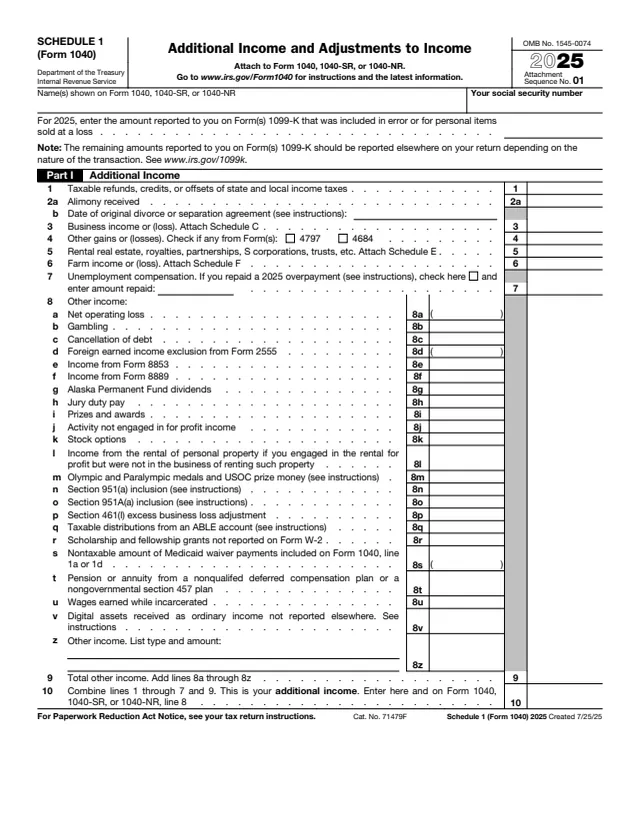
1040
73 fields, 2 pages
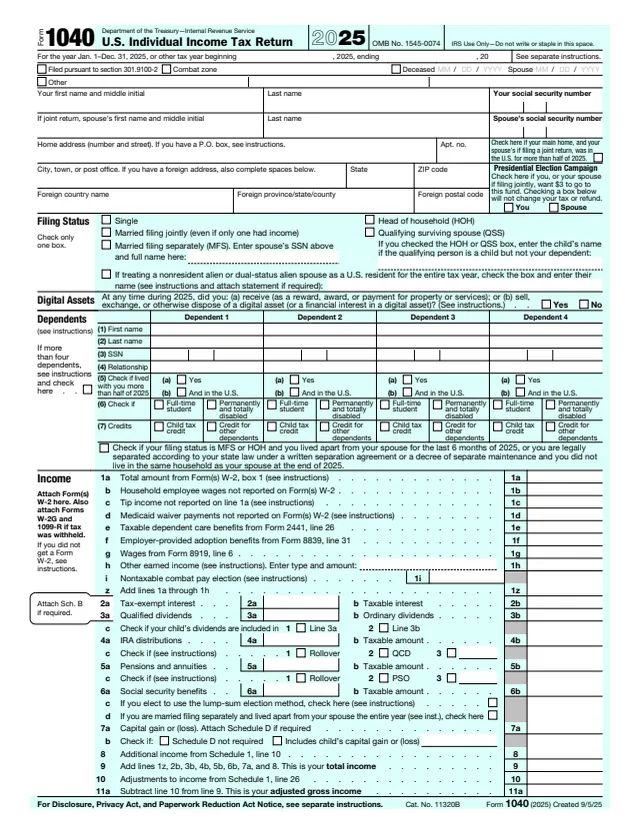
1040
199 fields, 2 pages
1098
41 fields, 4 pages
1098-E
43 fields, 4 pages
A person in a trade or business who receives the vehicle loan interest completes and files the form. The payer of record receives Copy B, which the form marks "keep for your records."
No tool matches that search.
The IRS About page says it is used to report interest of $600 or more received on a specified passenger vehicle loan in the course of a trade or business from an individual, decedent's estate or non-grantor trust.
The instructions define an SPVL as any indebtedness incurred after 2024 for the purchase of an applicable passenger vehicle for personal use that is secured by a first lien on that vehicle.
The instructions list a motor vehicle made mainly for public roads with at least 2 wheels, such as a car, minivan, van, sport utility vehicle, pickup truck or motorcycle, with a gross vehicle weight rating of less than 14,000 pounds, original use beginning with the payer of record and final assembly in the United States.
Copy B says the amount shown may not be fully deductible, and that limits based on the amount of interest paid, income and the passenger vehicle may apply. It points to the Instructions for Form 1040 rather than the lender for explanations.
Box 5 is a refund for overpayments of interest made in a prior year or years. The recipient instructions say not to deduct this amount, and that part or all of it may go on the Other income line of Schedule 1 (Form 1040) if it was deducted earlier.
The instructions say a form is not required for an SPVL with less than $600 of interest, even if an individual paid over $600 in total on several SPVLs. A lender may still choose to file one.