Sections 1 to 4: site and people
The VA medical center's station number, name and location, the VA principal investigator, the ACOS for Research and Development and the person completing the form.
10-0436
Application for an Off-Site Tissue Banking Waiver at a Non-Profit or Academic Institution
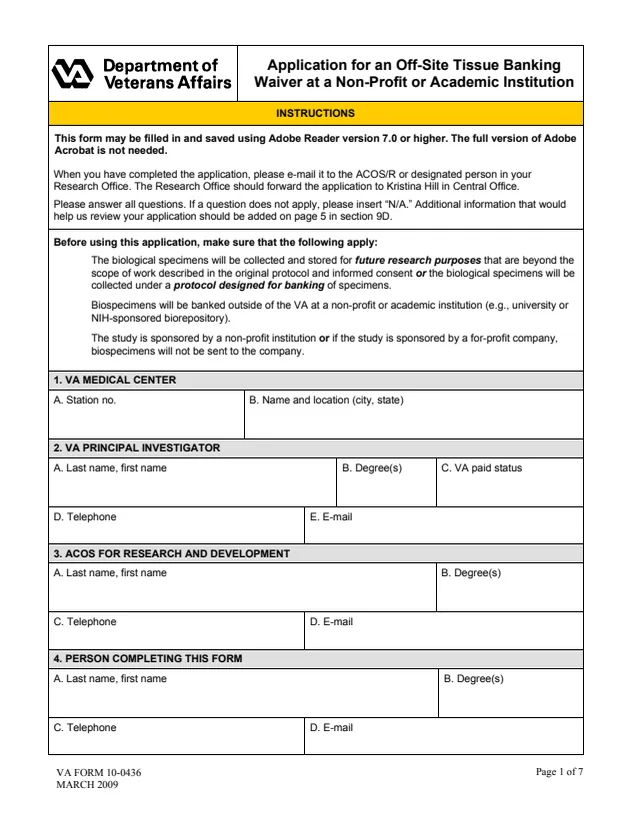
VA Form 10-0436 is the U.S. Department of Veterans Affairs Application for an Off-Site Tissue Banking Waiver at a Non-Profit or Academic Institution. It is a VA research form: a VA principal investigator's study team uses it to ask VA Central Office to approve banking biospecimens outside VA, for example at a university or NIH-sponsored biorepository, as the form puts it. VA's form page lists it under VHA.
The instructions say to use it only when the specimens will be stored for future research beyond the original protocol and consent, or collected under a banking protocol, when they will be banked at a non-profit or academic institution, and when a for-profit sponsor will not receive them. The PDF has seven pages: instructions, Sections 1 to 13 on the study, specimens, data and submission, and a page of definitions. You can fill out the PDF free in your browser on this page and download the result without an account.
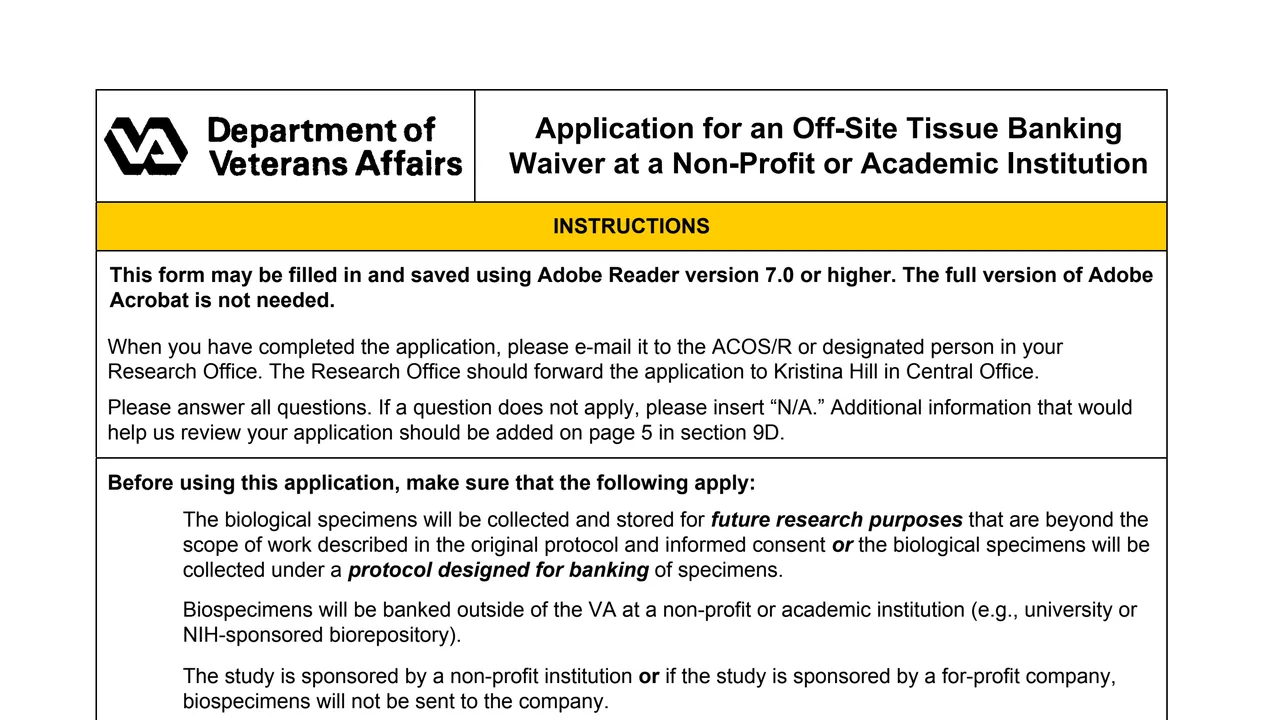
The VA medical center's station number, name and location, the VA principal investigator, the ACOS for Research and Development and the person completing the form.
Name, location and website of up to two tissue banks, then the study title, planned enrollment at the site, sponsor, grant number, start and end dates, other participating centers and whether IRB and R&D Committee approval depend on the waiver.
Types of specimens and how long they will be banked, whether the consent covers future research, how specimens are secured, the code used to label them and who holds and secures the key to the code.
Whether any data, including clinical and demographic data, x-rays and scans, will be sent or stored outside VA, whether it is de-identified, and how data that is not de-identified will be transferred.
The reason for using a non-VA repository, what happens to specimens when the bank closes or a subject withdraws, comments, the required documentation list, the Research Office contact and the PI certification.
The list of 18 HIPAA identifiers and the form's definition of de-identified data, which for VA research purposes meets the criteria of both HIPAA and the Common Rule.
The instructions list three conditions to confirm before using it: future research use or a banking protocol, a non-profit or academic bank, and no specimens sent to a for-profit sponsor.
The form asks for an answer to all questions, with N/A where a question does not apply. Extra information that would help the review goes in Section 9D.
Section 10 lists the research protocol, the informed consent form and separate HIPAA authorization, the bank's policies or the Tissue Bank Operations Form, and the IRB and R&D Committee approval letters.
The principal investigator types their name in Section 12 to verify the application was reviewed for accuracy and completeness.
Email the application and the Section 10 documents to the Research Office, which forwards it to Central Office. The form says electronic applications are preferred.
You get the real form, filled in a browser tab, with nothing standing between you and the finished PDF.
The instructions say to email the completed application to the ACOS/R or designated person in the Research Office.
Department of Veterans Affairs, Biomedical Laboratory R&D Service (121E), 810 Vermont Avenue, NW, Washington, DC 20420.
Section 13 lists the email [email protected], phone 202-443-5675 and fax 202-495-6181, and says electronic applications (via e-mail) are preferred.
The PDF footer reads MARCH 2009 on each of its seven pages.
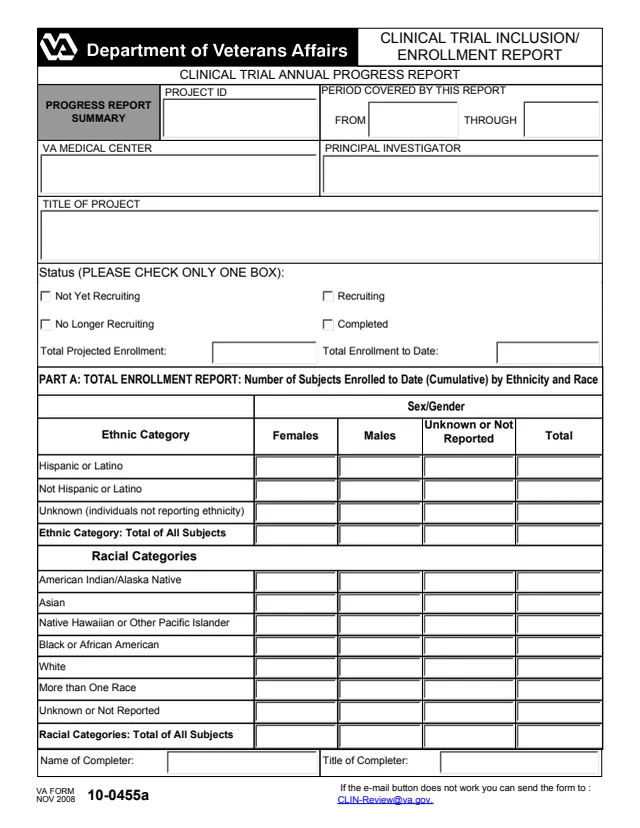
10-0455a
63 fields, 1 page
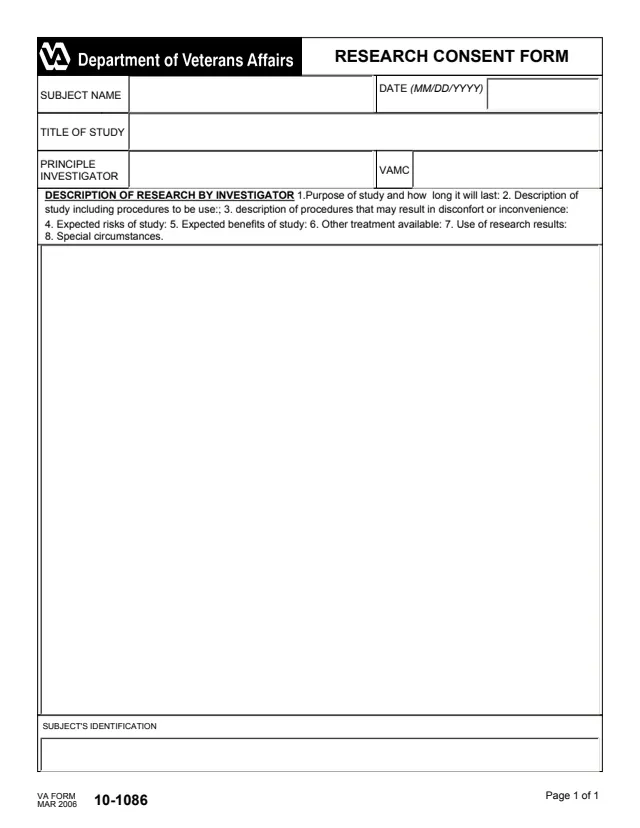
10-1086
7 fields, 1 page
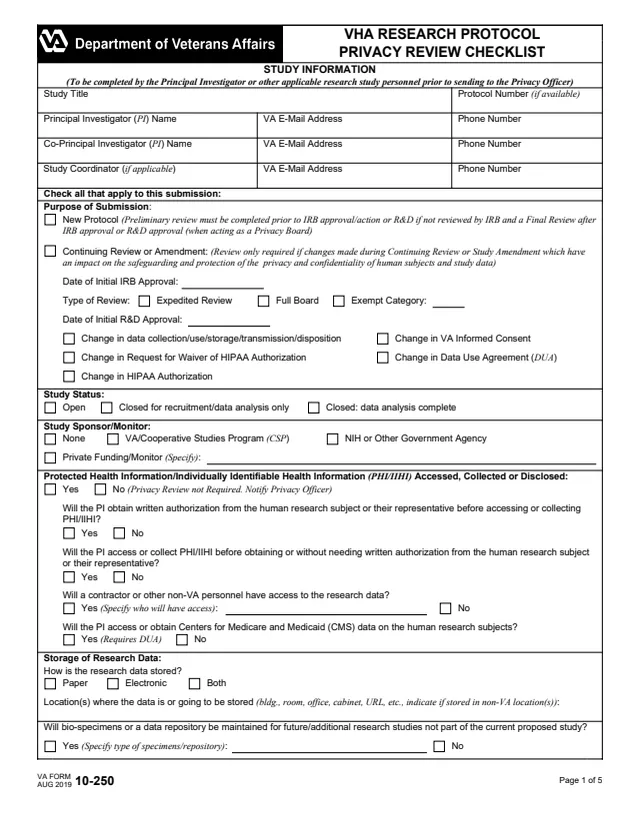
10-250
94 fields, 5 pages
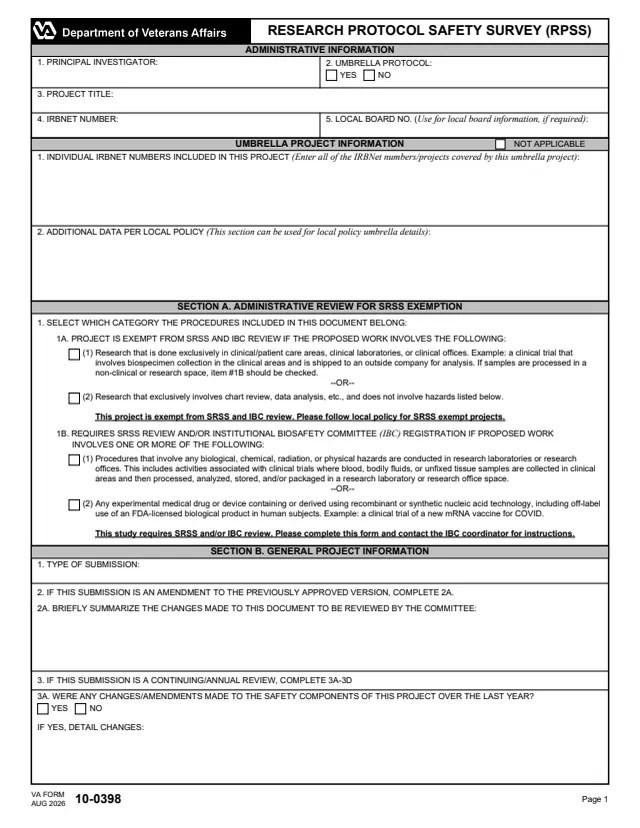
10-0398
627 fields, 12 pages
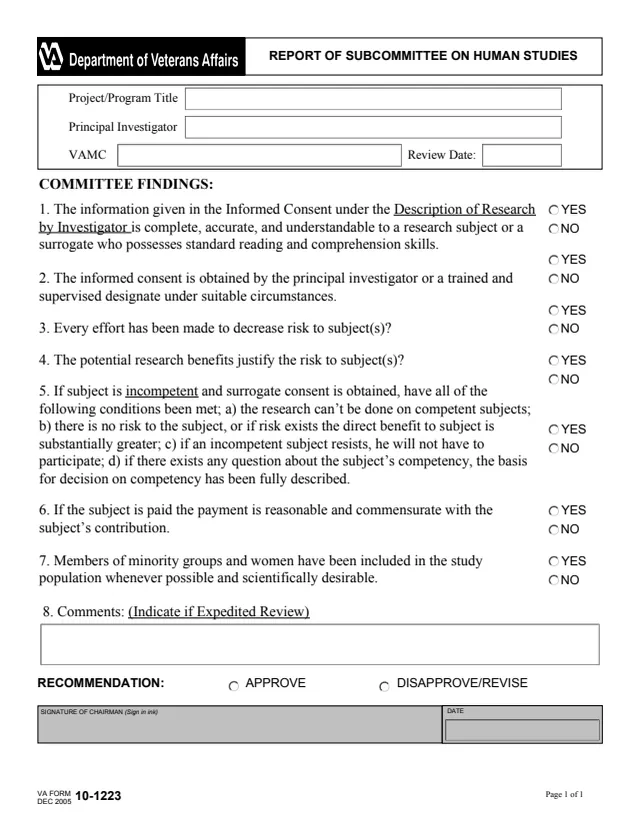
10-1223
22 fields, 1 page
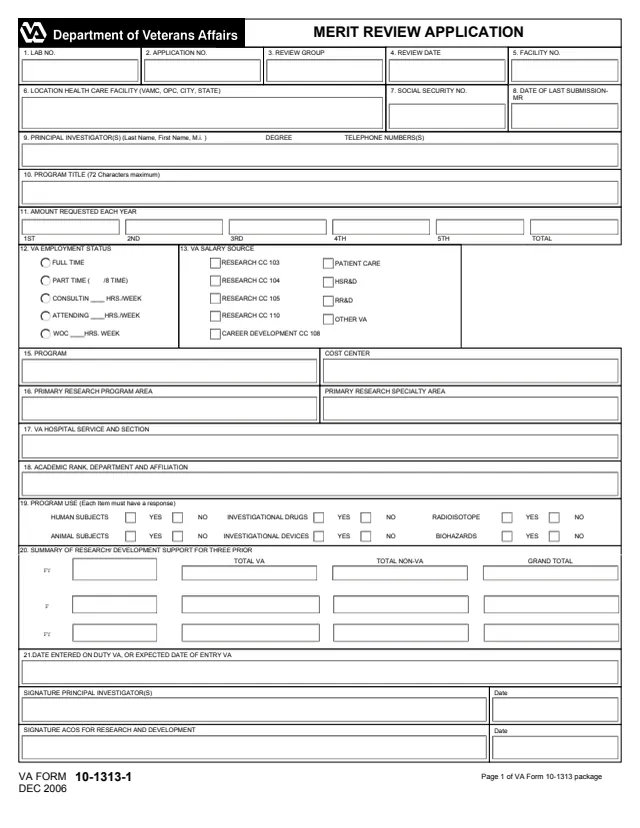
10-1313-1
65 fields, 1 page
The form names the people and offices involved. It is filled in about a study, not by the study's subjects.
No tool matches that search.
The study team of a VA principal investigator. The instructions say to email it to the ACOS/R or designated person in the Research Office, which forwards it to Central Office.
The instructions say it is for specimens kept for future research beyond the original protocol and consent, or collected under a banking protocol, banked outside VA at a non-profit or academic institution, with no specimens sent to a for-profit sponsor.
No. Section 6 says only one application should be submitted for all participating VA Medical Centers.
Section 10 says that if IRB and R&D Committee approval are contingent upon the waiver, those letters may be sent after ORD has approved the application.
The form says the specimens are labeled with a code that does not contain the subject's name, initials, SSN or anything derived from the 18 HIPAA identifiers listed in Section 14.
Section 14 says that for VA research purposes, data are de-identified only if they meet the criteria of both HIPAA, with all 18 identifiers removed, and the Common Rule. Coded data are not de-identified if the recipient has the key.