Part I: Personal information
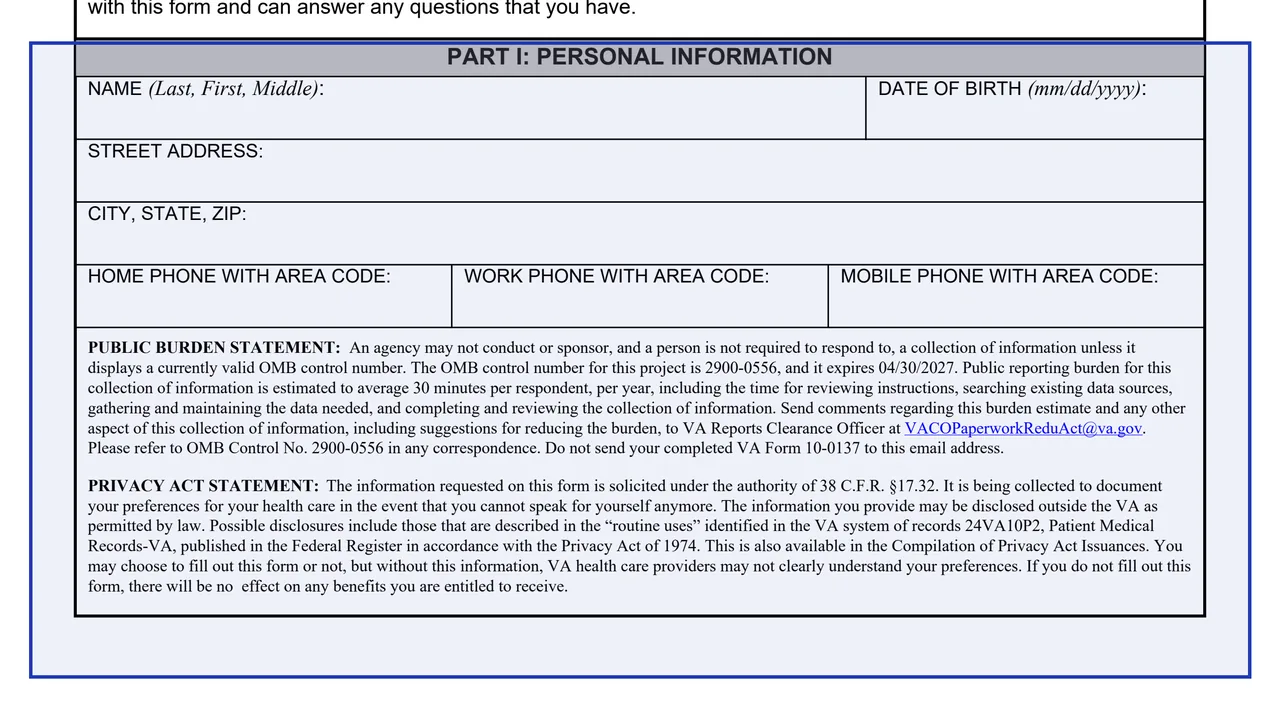
Name, date of birth, street address, city, state and ZIP, and home, work and mobile phone numbers. The name and date of birth repeat at the top of every page.
10-0137
VA Advance Directive: Durable Power of Attorney for Health Care and Living Will
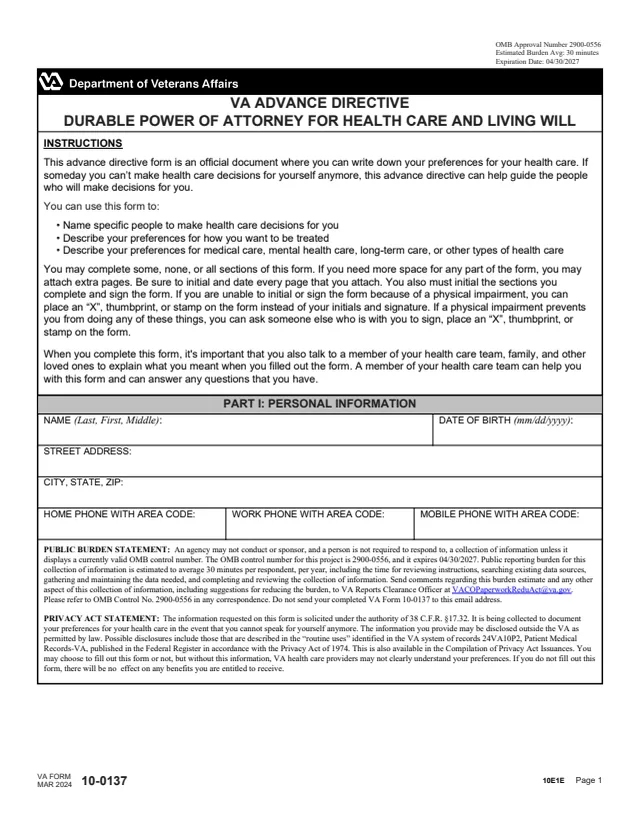
VA Form 10-0137 is the U.S. Department of Veterans Affairs advance directive, titled VA Advance Directive: Durable Power of Attorney for Health Care and Living Will. VA's form page says to use it to give specific people permission to make health care decisions for you, and to let VA health care providers know your wishes for medical, mental health, long-term, and other types of care.
The form calls itself an official document where you can write down your preferences for your health care. It says that if someday you can't make health care decisions for yourself anymore, it can help guide the people who will make decisions for you, and that you may complete some, none, or all of its sections.
The PDF has six pages: Part I for personal information, Part II for the Durable Power of Attorney for Health Care, Part III for the Living Will, Part IV for your signature and two witnesses, and an optional Part V for a notary public. VA's page lists VA Form 10-0137A, What You Should Know About Advance Directives, as a related form. You can fill out the PDF free in your browser on this page and download the result without an account.
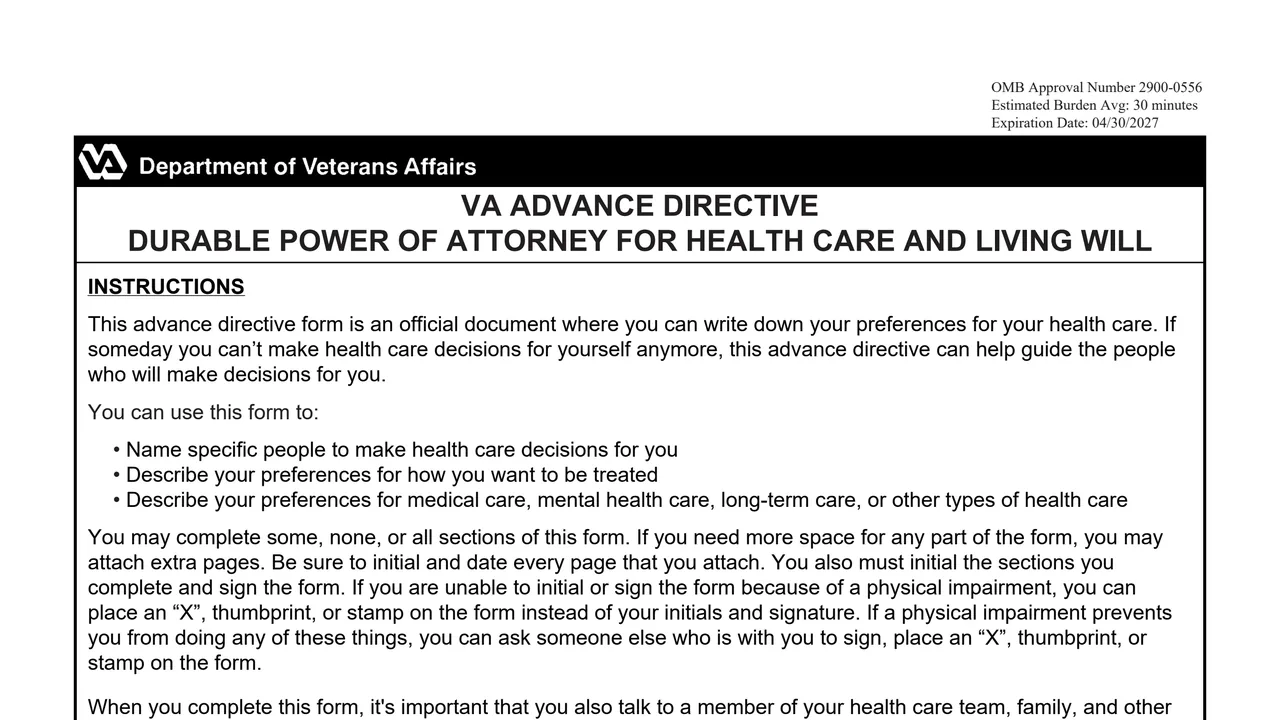
Name, date of birth, street address, city, state and ZIP, and home, work and mobile phone numbers. The name and date of birth repeat at the top of every page.
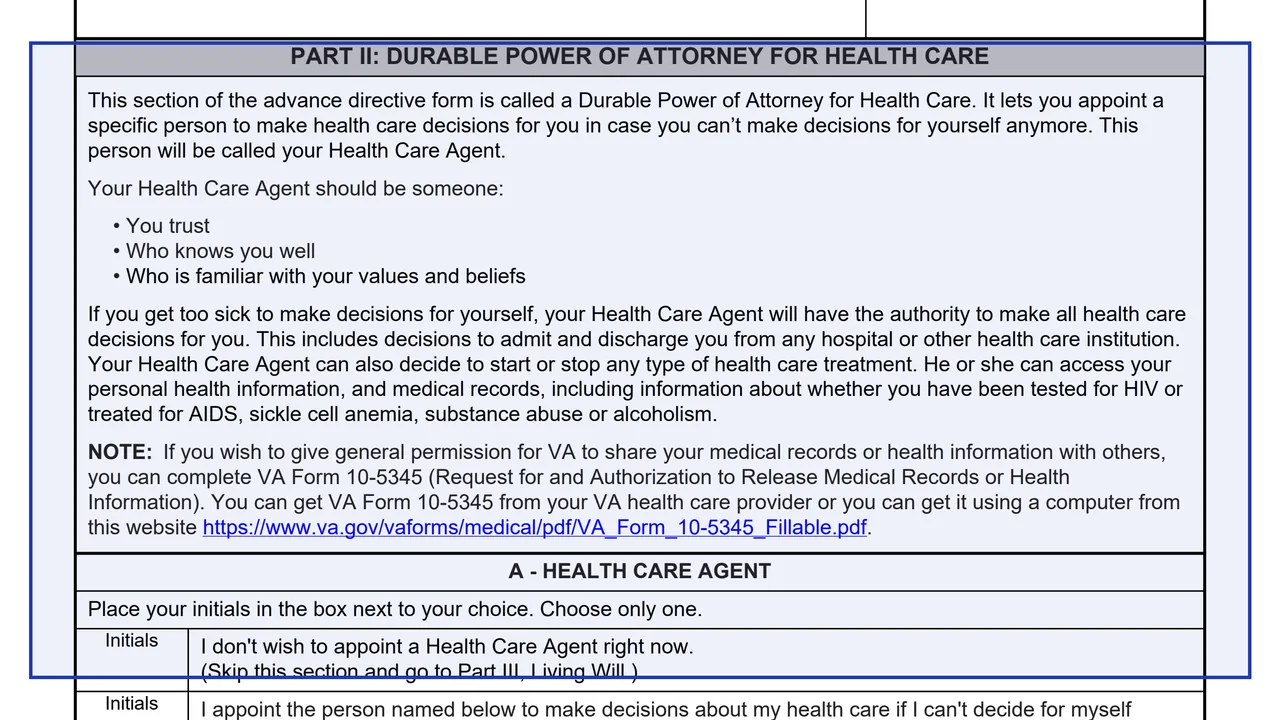
Section A has two choices, initial only one: not appointing a Health Care Agent right now, or appointing a named person with their relationship, address and phone numbers. Section B names an alternate Health Care Agent.
For six situations plus an Other line, you initial Yes, I'm not sure, or No about life-sustaining treatments. The form gives CPR, a breathing machine, kidney dialysis and a feeding tube as examples.
Optional mental health preferences, optional additional preferences such as social, cultural or faith-based ones, and a choice of whether the Living Will serves as a general guide or is followed strictly.
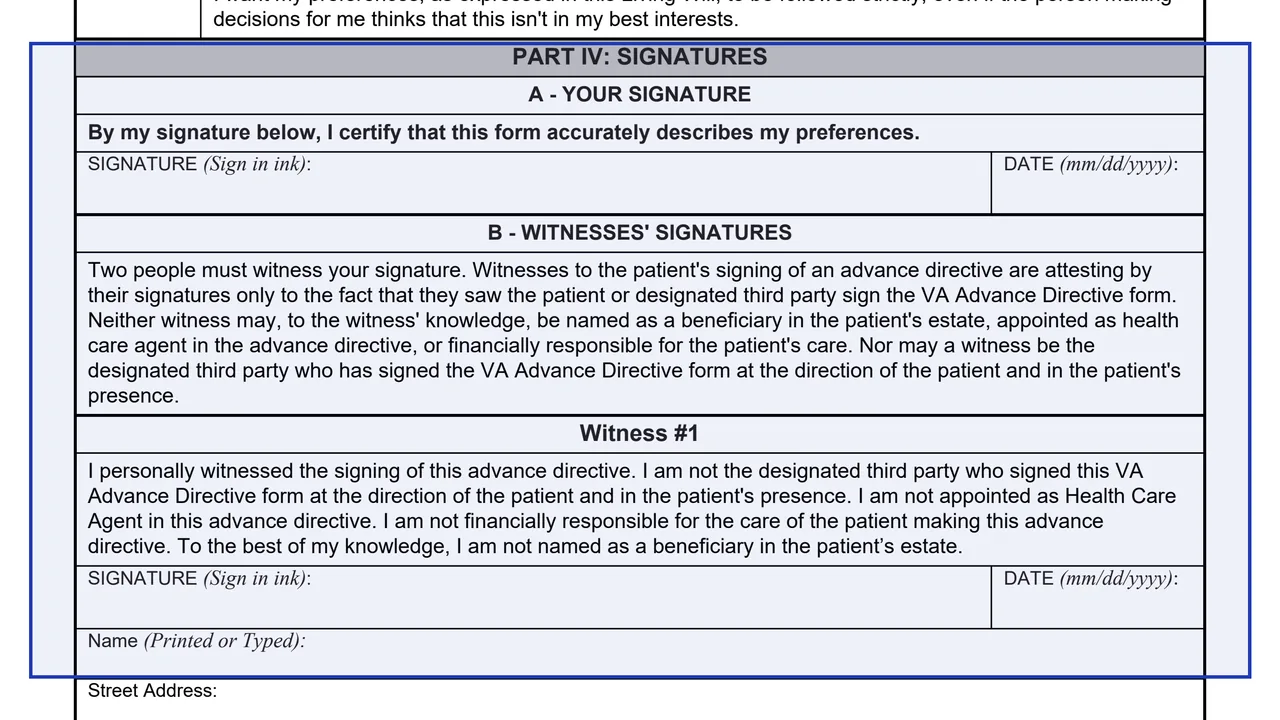
Your signature in ink and the date, certifying that the form accurately describes your preferences, then each witness's signature, date, printed name and address.
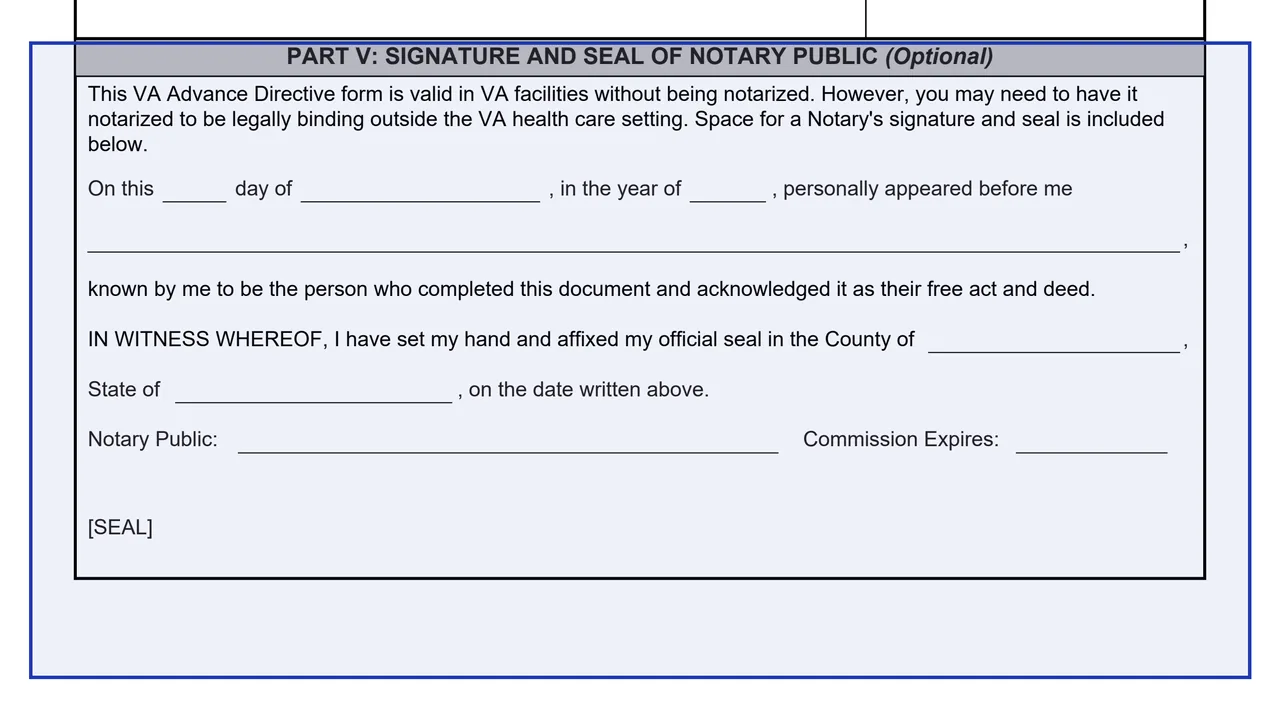
Space for a notary's acknowledgment with the day, the county and state, the notary's signature, the commission expiration date and the seal.
Enter your personal information on page 1, then your name and date of birth at the top of each later page.
Initial one box in Part II section A. The form says to skip to Part III if you don't wish to appoint an agent right now, and to use section B only for a second person.
Initial one box for each statement you answer in Part III. The form says you may attach extra pages for more space, and to initial and date every page you attach.
Sign and date Part IV A in ink. Each witness signs in ink, dates and prints their name and address in Part IV B.
The form says it's important to also talk to a member of your health care team, family and other loved ones to explain what you meant when you filled it out.
Part V is optional. The form says a notary may be needed for it to be legally binding outside the VA health care setting.
You get the real form, filled in a browser tab, with nothing standing between you and the finished PDF.
VA Form 10-0137 and its page print no mailing address. VA's page says the form is used to let VA health care providers know your wishes for care.
The form says a member of your health care team can help you with this form and can answer any questions that you have.
For general permission for VA to share medical records or health information with others, the form points to VA Form 10-5345, Request for and Authorization to Release Medical Records or Health Information.
The MAR 2024 edition carries OMB Approval Number 2900-0556, which expires 04/30/2027, and an estimated burden of 30 minutes.
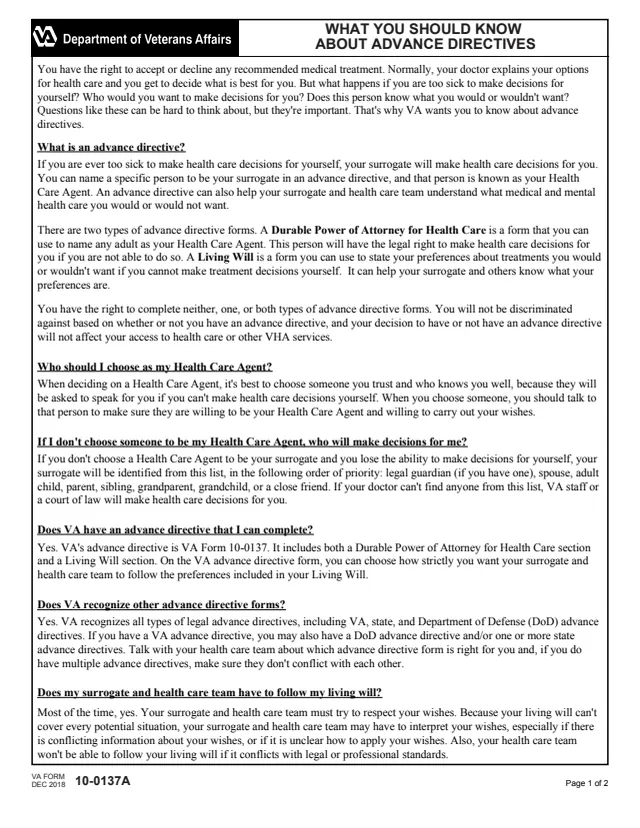
10-0137A
1 field, 2 pages
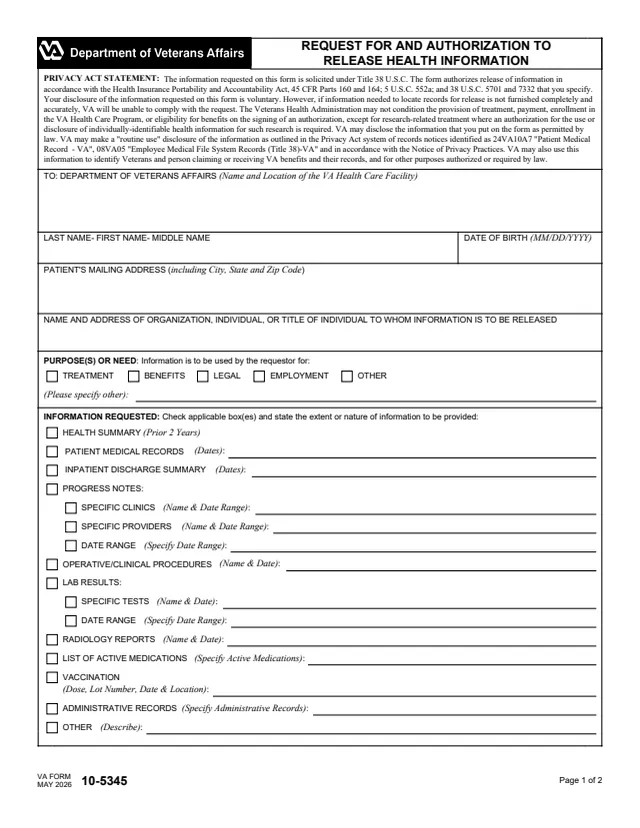
10-5345
61 fields, 2 pages
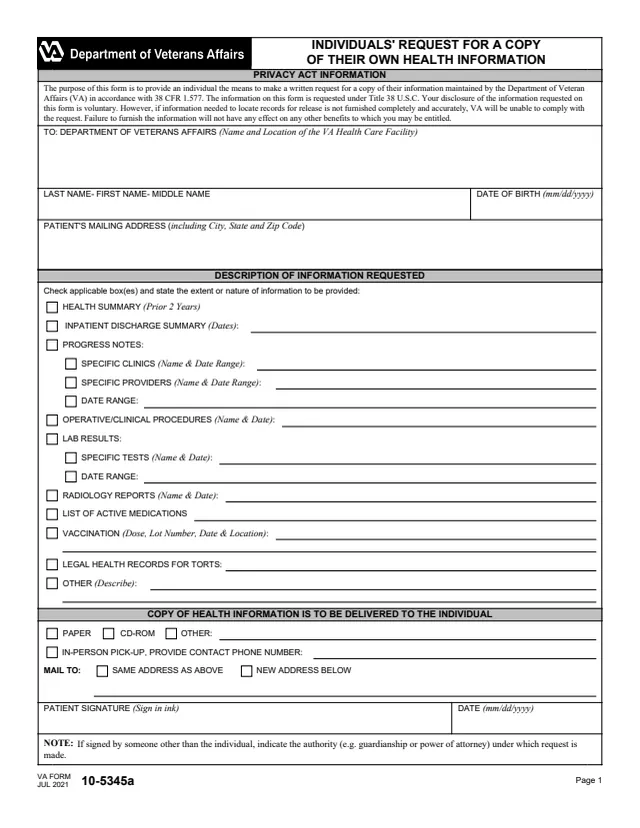
10-5345a
43 fields, 1 page
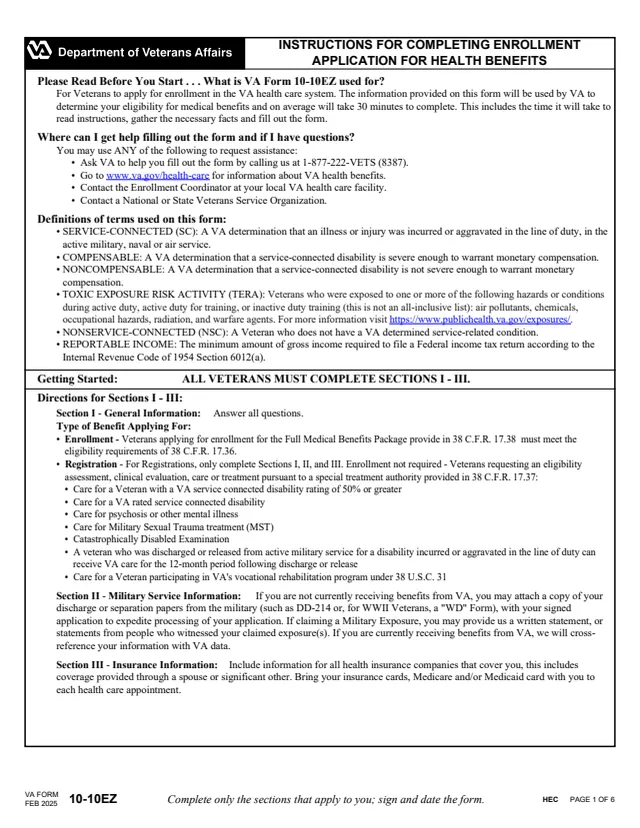
10-10EZ
122 fields, 6 pages
The form names everyone who takes part in completing it.
No tool matches that search.
VA's page says to use it to give specific people permission to make health care decisions for you, and to let VA health care providers know your wishes for medical, mental health, long-term, and other types of care.
The form says you may complete some, none, or all sections of it. It also asks you to initial the sections you complete and to sign the form.
The form says it is valid in VA facilities without being notarized. It also says you may need to have it notarized to be legally binding outside the VA health care setting, and gives an optional Part V for that.
The form says neither witness may, to the witness' knowledge, be named as a beneficiary in the patient's estate, be appointed as health care agent in the advance directive, or be financially responsible for the patient's care. A witness also can't be the person who signed at the patient's direction.
The form says you can place an X, a thumbprint or a stamp instead of your initials and signature. If you can't do any of those, you can ask someone else who is with you to do it for you.
The form says the agent has the authority to make all health care decisions if you get too sick to decide, including admission to and discharge from a hospital, starting or stopping any treatment, and access to your health information and medical records.