Part 1: Basis of filing
Whether you filed Form I-600A or are making a combination filing, whether the petition is for one child, birth siblings or other multiple children, and any change in marital status since filing.
I-600
Petition to Classify Orphan as an Immediate Relative
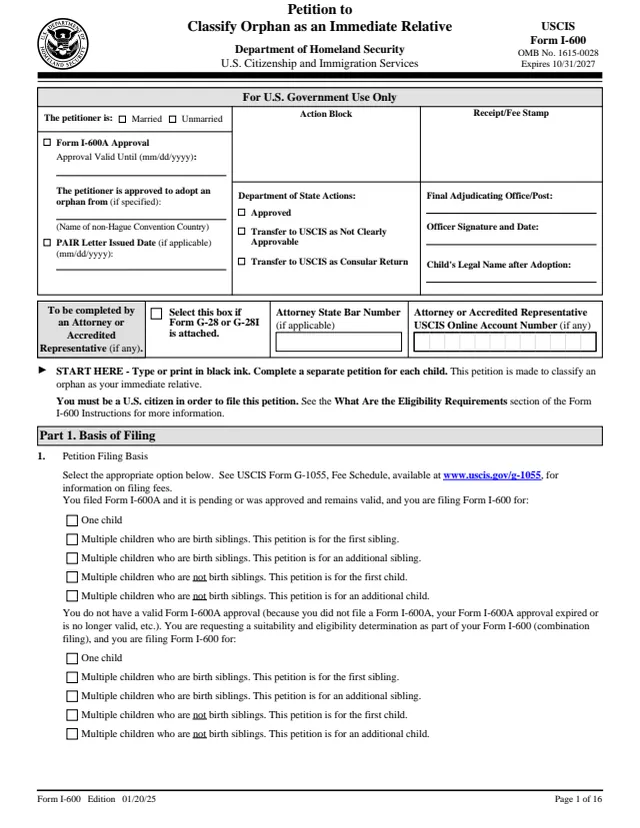
Form I-600, Petition to Classify Orphan as an Immediate Relative, is the form a U.S. citizen uses to ask USCIS to classify an orphan as an immediate relative. The USCIS page says the U.S. citizen adoptive parent or legal custodian files it to finalize the immigration process of a child who is not habitually resident in a Hague Convention country.
The instructions say USCIS uses it to decide whether a child who has been or will be adopted by a U.S. citizen (and spouse, if married) can be classified as an orphan for an immediate relative immigrant visa. The child has to qualify as an orphan under INA section 101(b)(1)(F), and the petition is filed before the child's 16th birthday, or before the 18th birthday in some sibling cases.
A petitioner who already filed Form I-600A for advance processing files Form I-600 once a child is identified. Without a valid Form I-600A approval, the instructions describe a combination filing, where USCIS decides suitability to adopt and the child's eligibility at the same time. The form is 16 pages long.
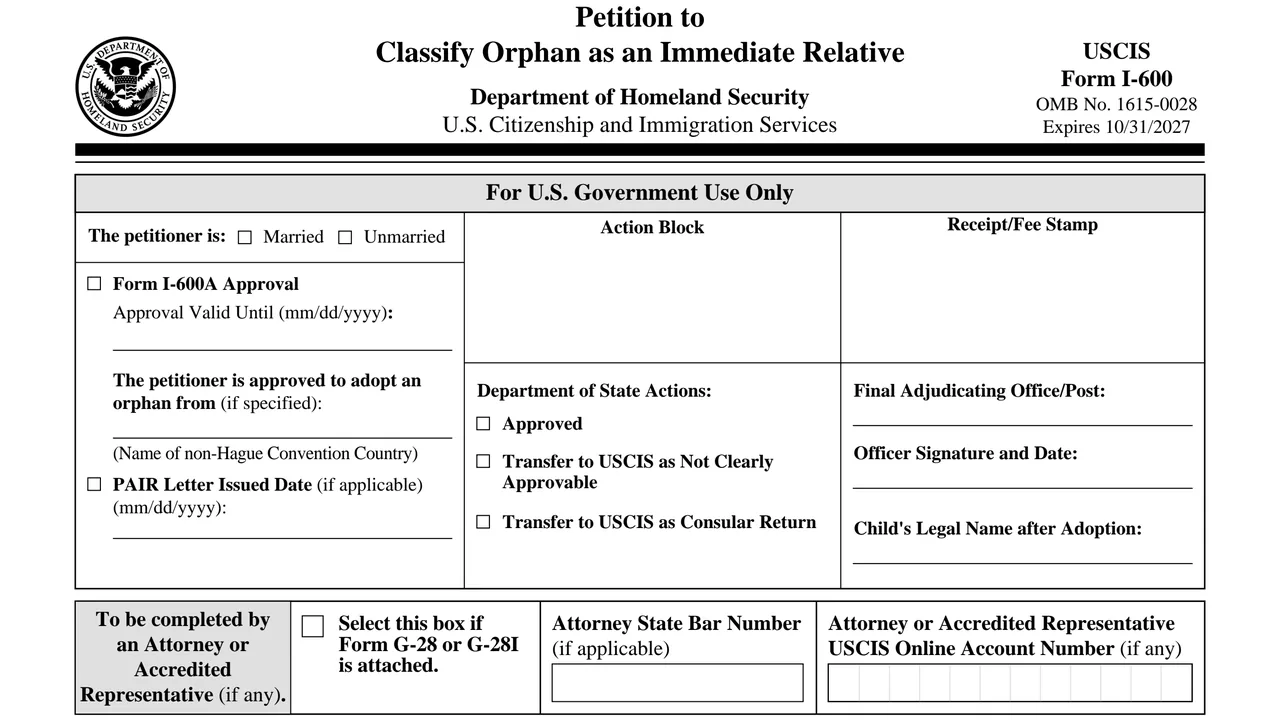
Whether you filed Form I-600A or are making a combination filing, whether the petition is for one child, birth siblings or other multiple children, and any change in marital status since filing.
Name, addresses, how you got U.S. citizenship, marital history, your spouse's details, adults and children in the household, earlier adoption history, and questions on criminal history and child welfare investigations.
Name at birth and current name, birth details, why the child is an orphan, whether the child was adopted abroad and seen in person before or during the adoption, and the pre-adoption requirements of the state where the child will live.
Where your home study was submitted, your primary adoption service provider, a table of all fees, expenses and in-kind payments made or expected, and whether anything was given to induce the child's release.
Whether the child is exempt from an Affidavit of Support (Form I-864 or I-864EZ) or one will go to the State Department, and any disability accommodation request.
The petitioner's and spouse's certifications, duty of disclosure and signatures, the interpreter and preparer sections, and additional information space.
Select whether you have a pending or approved and valid Form I-600A or are asking for a suitability and eligibility decision as part of this petition, then the option for one child or multiple children.
The instructions say to select only one of Items 1.a. to 1.e. and attach the matching Form I-600A approval or receipt notice, or the home study itself. If a state authority sends it to USCIS directly, wait to file until it is ready.
The table covers all fees, expenses, in-kind contributions and other compensation paid by you, your spouse or anyone on your behalf as of the date you sign, plus those you expect to pay.
Part 6 has two exemptions, 40 qualifying quarters of work or automatic citizenship under INA section 320, or Item 2, which means Form I-864 or I-864EZ goes with the visa application to the State Department.
Supplement 1 for each adult member of the household, Supplement 2 if you consent to USCIS sharing case details with your adoption service provider or others, and Supplement 3 to request action after approval.
The petitioner signs Part 8 and a married petitioner's spouse signs Part 9. A stamped or typewritten name is not accepted. This page lets you fill the form online free, then print it for signature.
You get the real form, filled in a browser tab, with nothing standing between you and the finished PDF.
The USCIS page says to see the Form I-600 filing instructions for where to file, and the instructions point to uscis.gov/i-600 for the most current information.
The fee for Form I-600 and its supplements is on the USCIS Fee Schedule page, and the instructions point to Form G-1055. Fees can change, so check it on the day you file.
Proof of your U.S. citizenship and of your marriage if married (unless already sent with Form I-600A), proof of the child's age and identity, death certificates of the parents if they apply, the adoption or custody decree with a certified translation, evidence the child is an orphan, and proof of state pre-adoption compliance.
A home study with original signatures goes with Form I-600 if it was not already sent with Form I-600A. The instructions say it cannot be more than six months old when submitted, and one not conducted by an accredited agency or a public authority is reviewed and approved by an accredited agency first.
The instructions say you, your spouse and adult household members have an ongoing duty to disclose arrests, criminal history and child abuse or neglect history, even if expunged or sealed, and that USCIS will deny the petition for concealing such facts.
The USCIS page says it rejects the form if the petitioner's family name, U.S. mailing address, petitioner's signature or spouse's signature is missing, or if all 16 pages are not submitted.
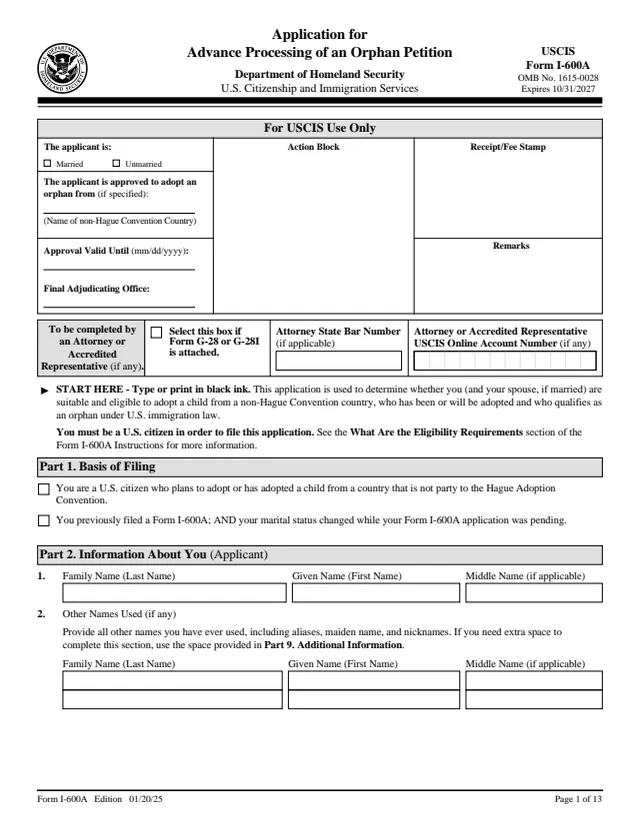
I-600A
308 fields, 13 pages
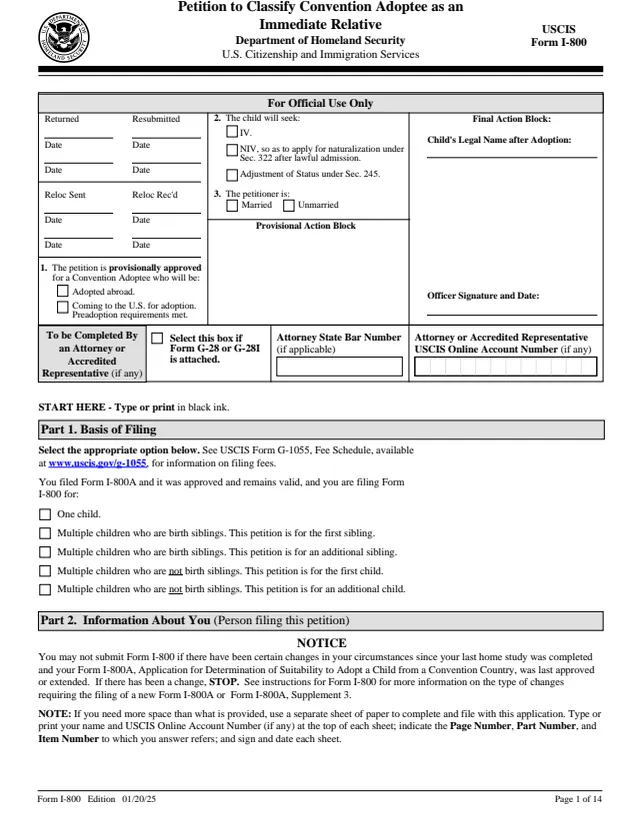
I-800
331 fields, 14 pages
I-800A
290 fields, 12 pages
I-130
450 fields, 12 pages
I-864
219 fields, 12 pages
I-864EZ
142 fields, 8 pages
No tool matches that search.
Form I-600 is for a child who is not habitually resident in a Hague Convention country. The instructions say a Hague Convention adoption generally goes through Form I-800A and Form I-800 instead.
Yes, as a combination filing. The instructions say you file Form I-600 for a specific child with the Form I-600A supporting documents, and USCIS decides your suitability and the child's eligibility together.
The instructions say to file before the child's 16th birthday. A birth sibling of a child adopted by the same parents may be filed for before the 18th birthday.
No. The instructions say the spouse does not need to be a U.S. citizen, but a spouse living in the United States needs proof of lawful status there.
The instructions describe Form I-604, Determination on Child for Adoption, as an internal orphan determination an officer completes in every orphan case before a final decision. It is an internal document.
USCIS fees change, so this page does not list one. The I-600 page points to the USCIS Fee Schedule for the form and its supplements, and the instructions point to Form G-1055.