Part 1: The employer
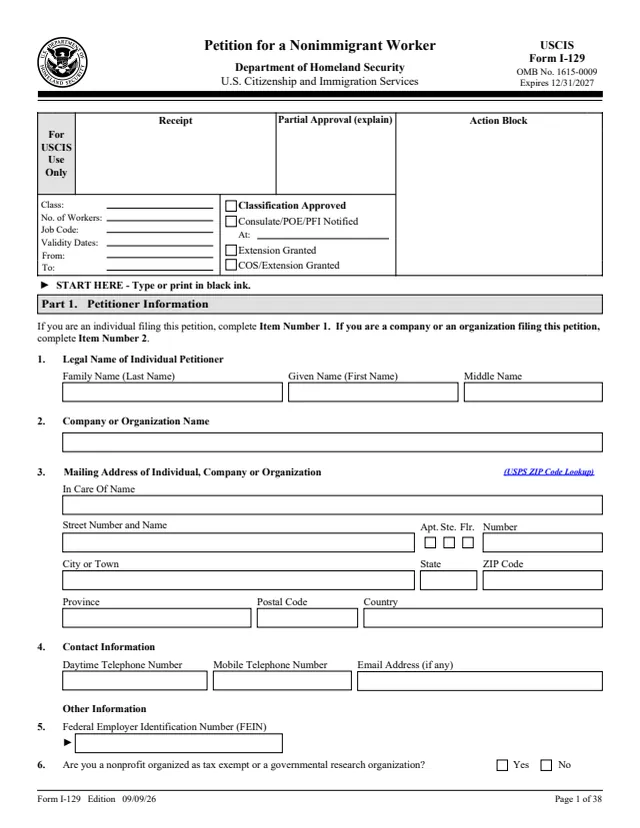
Legal name, mailing and physical address, phone, email and website, and whether the petitioner employs more than 50 people in the United States with more than half in H-1B, L-1A or L-1B status.
I-129S
Nonimmigrant Petition Based on Blanket L Petition
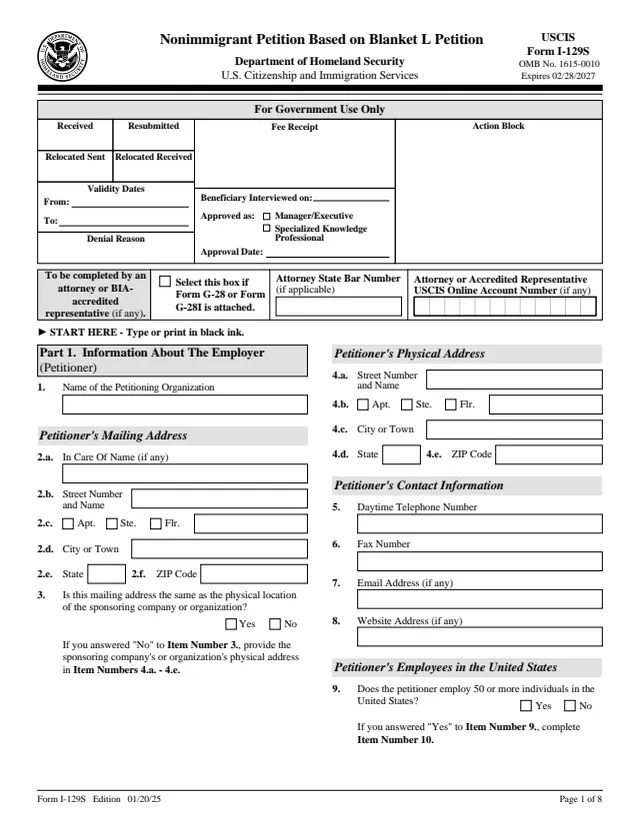
Form I-129S, Nonimmigrant Petition Based on Blanket L Petition, is how an employer (the petitioner) classifies an employee (the beneficiary) as an L-1 nonimmigrant intracompany transferee under an approved blanket L petition. USCIS lists three roles: executives, managers and specialized knowledge professionals.
The instructions say a petitioner with an approved blanket L-1 petition may file it for a beneficiary outside the United States. For a beneficiary already in the United States, a change of status or extension of stay is requested with Form I-129, Petition for a Nonimmigrant Worker, filed together with Form I-129S.
Where the form goes depends on where the employee is. USCIS says an employee who needs a visa presents it to a U.S. consular officer, and a Canadian citizen may present it to U.S. Customs and Border Protection (CBP) at certain ports of entry and pre-flight inspection locations.
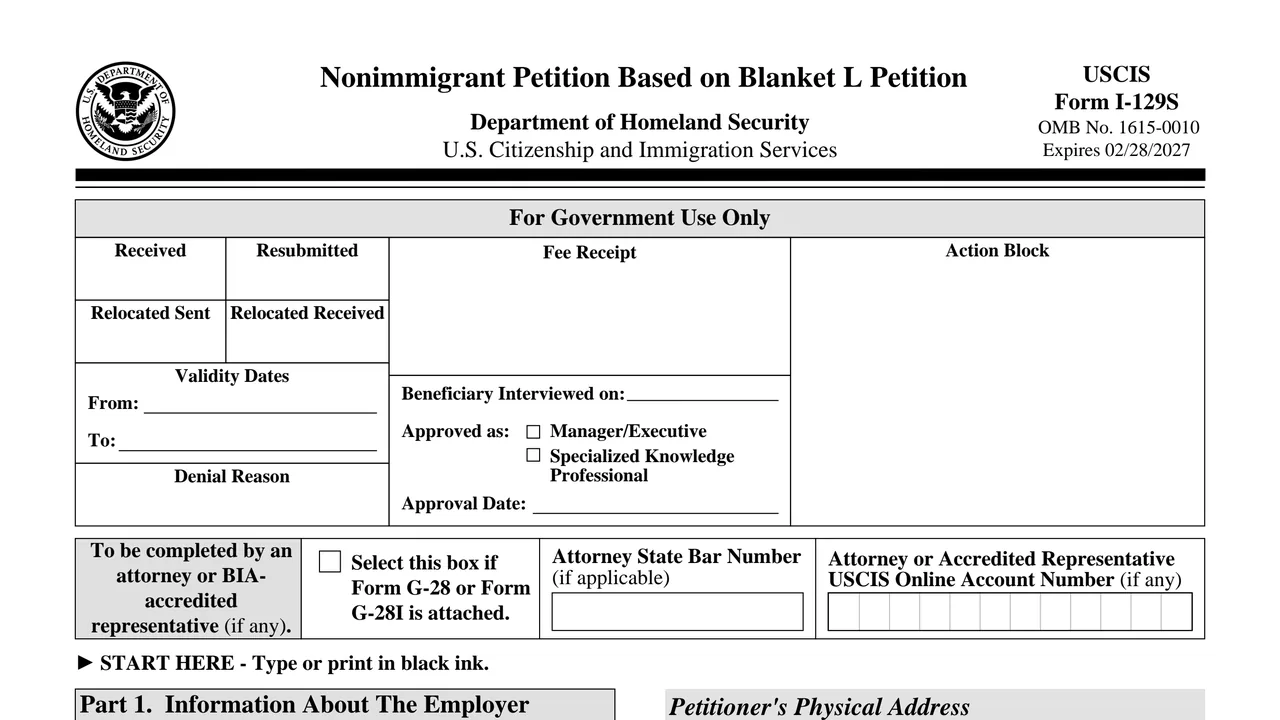
Legal name, mailing and physical address, phone, email and website, and whether the petitioner employs more than 50 people in the United States with more than half in H-1B, L-1A or L-1B status.
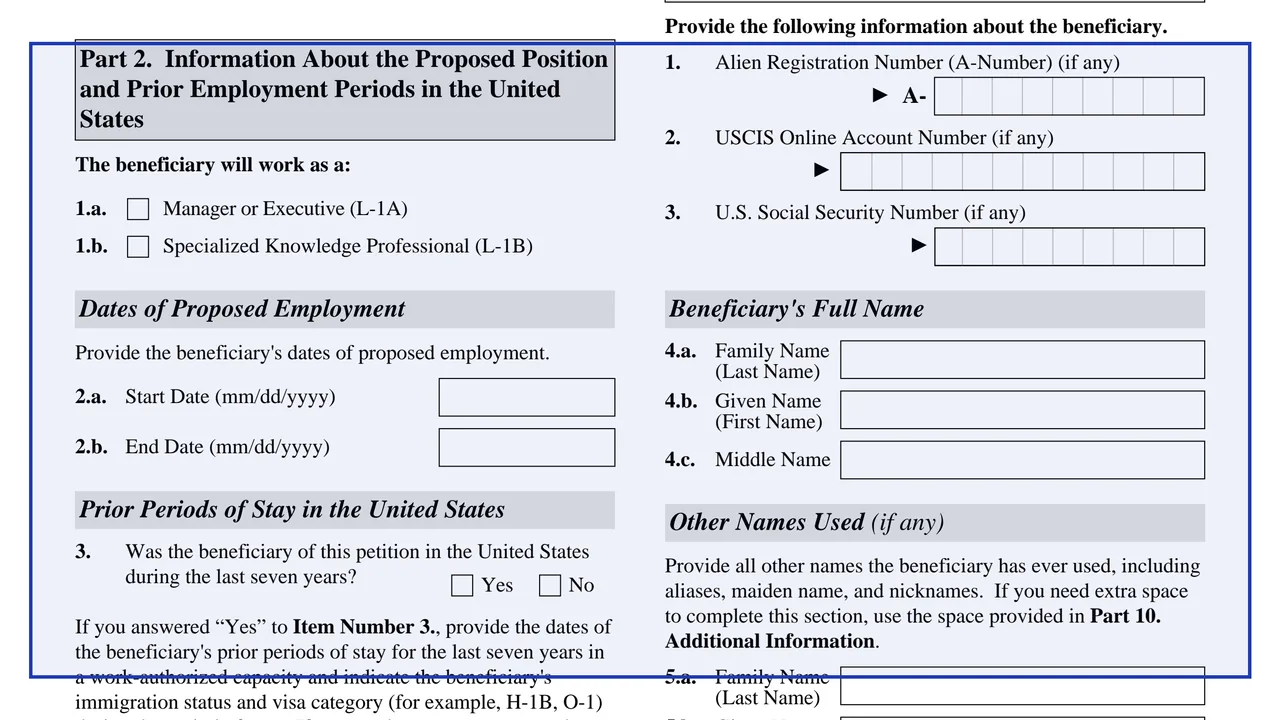
Whether the job is L-1A or L-1B, the proposed dates of employment, and any work-authorized stays in the United States during the last seven years.
A-Number, USCIS online account number and Social Security number if any, full and other names, foreign mailing and physical addresses, date and place of birth, and citizenship.
The blanket L petition receipt number, whether Form I-129 is filed with it, the work address, wages and weekly hours, job title and duties, and offsite placement questions for L-1B workers.
The qualifying foreign position, the foreign employer's name and address, and the job titles, dates, duties, yearly wages and weekly hours for the one continuous year out of three years.
The certification on releasing controlled technology or technical data, the petitioner's signature, the interpreter and preparer sections, and additional information space.
The USCIS page lists edition 01/20/25. The instructions say to type or print in black ink, write N/A where a question does not apply and None where the answer is zero.
Part 4, Item 1 takes the receipt number of the approved blanket L petition this petition is based on, and Item 2 records whether Form I-129 is filed with it.
Select L-1A or L-1B, give the dates, title, duties and daily time on them. For an L-1B worker placed mainly offsite, the instructions ask who supervises the work and why it is not labor for hire.
The instructions ask for the foreign job titles, dates, duties, wages and hours covering one continuous year out of three years in an executive, managerial or specialized knowledge capacity.
The instructions say the petitioner reviews the EAR and ITAR and indicates whether a U.S. Government license is needed to release controlled technology or technical data to the employee.
The instructions say a stamped or typewritten name is not accepted, and a photocopy, fax or scan of the original handwritten signature is valid. This page lets you fill the form online free, then print it to sign.
You get the real form, filled in a browser tab, with nothing standing between you and the finished PDF.
USCIS says the employee presents it to a consular officer or, for a Canadian citizen, to CBP. For an employee in the United States, the instructions say it is filed with Form I-129 at the USCIS service center that approved the blanket L petition.
USCIS lists online filing through a USCIS online account, and its Forms Available to File Online page says when a petitioner or accredited representative can file Form I-129S online.
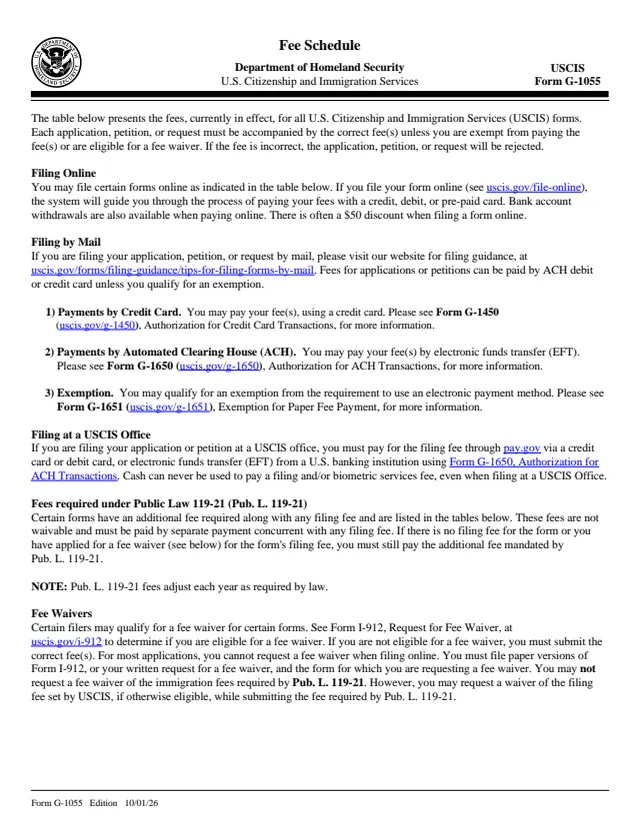
USCIS fees change, so this page does not list one. The USCIS page points to its Fee Schedule page and the instructions point to Form G-1055.
The instructions list a copy of the approval notice for the blanket L petition and a letter from the foreign qualifying employer with the employee's dates of employment, job duties, qualifications and salary, showing one continuous year out of three years.
USCIS says the employee carries a Form I-797 approval notice or a copy of the approved Form I-129S with a valid passport and any visa needed. It also says evidence of petition approval is not a visa.
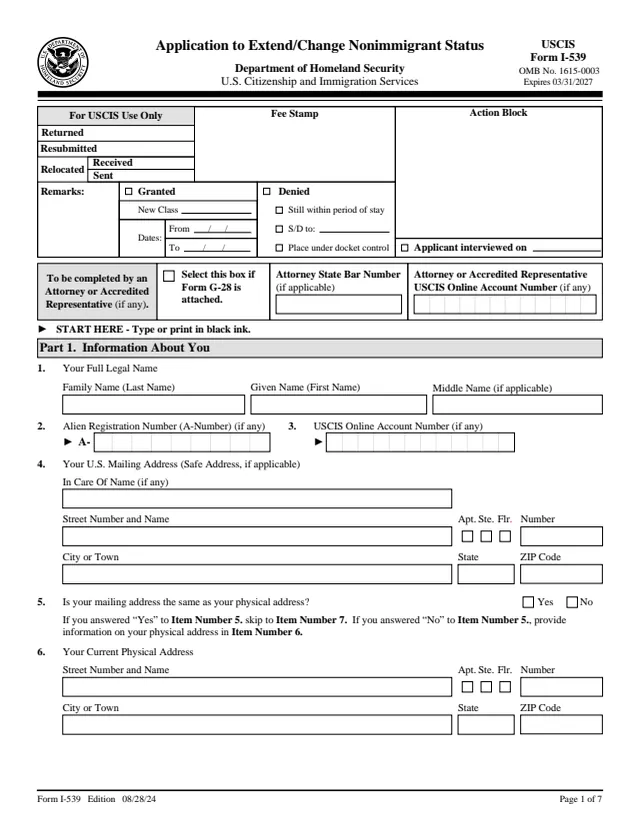
USCIS says the Form I-94 date shows the approved period of admission. If it ends before the petition's validity, the page lists an extension with Form I-129, another benefit, or departure, and Form I-539 for family members.
No tool matches that search.
No. USCIS says evidence of petition approval is not a visa, and the employee needs the right nonimmigrant visa, if one is required, before applying for admission.
USCIS lists online filing through a USCIS online account. Its Forms Available to File Online page says when a petitioner or accredited representative can file it online.
For both, the USCIS page says Form I-129 is filed with Form I-129S, the 01/20/25 edition only.
The instructions list a copy of the blanket L petition approval notice and a letter from the foreign qualifying employer describing the employee's employment, duties, qualifications and salary.
The instructions say the EAR and ITAR treat releasing controlled technology or technical data to a foreign person in the United States as an export, so the petitioner states in Part 6 whether a license is needed.
USCIS fees change, so this page does not list one. The USCIS page points to its Fee Schedule, and the instructions point to Form G-1055.