Front notice
Why the form was given, how unemployment insurance works for federal workers, and where to file a claim. The form says eligibility cannot be determined until after a claim is filed.
SF8
Notice to Federal Employee About Unemployment Insurance
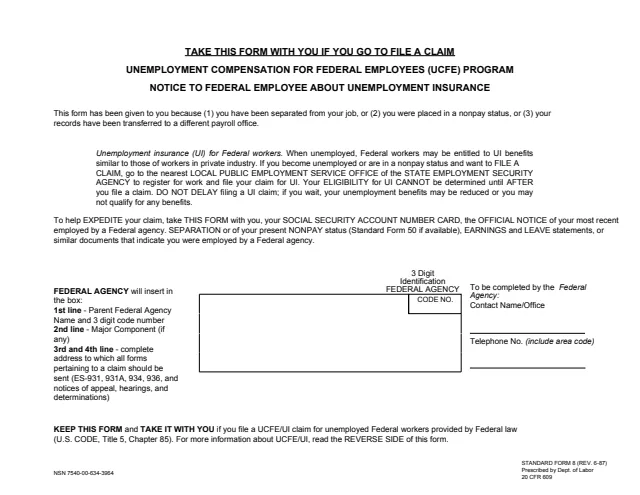
Standard Form 8 (SF 8), Notice to Federal Employee About Unemployment Insurance, is prescribed by the U.S. Department of Labor under 20 CFR 609. GSA hosts a copy in its forms library. The edition printed on the form is REV. 6-87, and it concerns the Unemployment Compensation for Federal Employees (UCFE) program.
The form says it has been given to the employee because they have been separated from their job, were placed in a nonpay status, or their records have been transferred to a different payroll office. The federal agency fills in a box with its name, 3 digit code, address for claim forms and a contact, and the employee keeps the form to take along if they file a UCFE/UI claim.
The back gives general information on who pays benefits, the conditions State laws set, appeal rights and penalties. The form says these statements do not have the effect of law, regulation, or ruling. You can fill it out free in your browser on this page and download the result without an account.
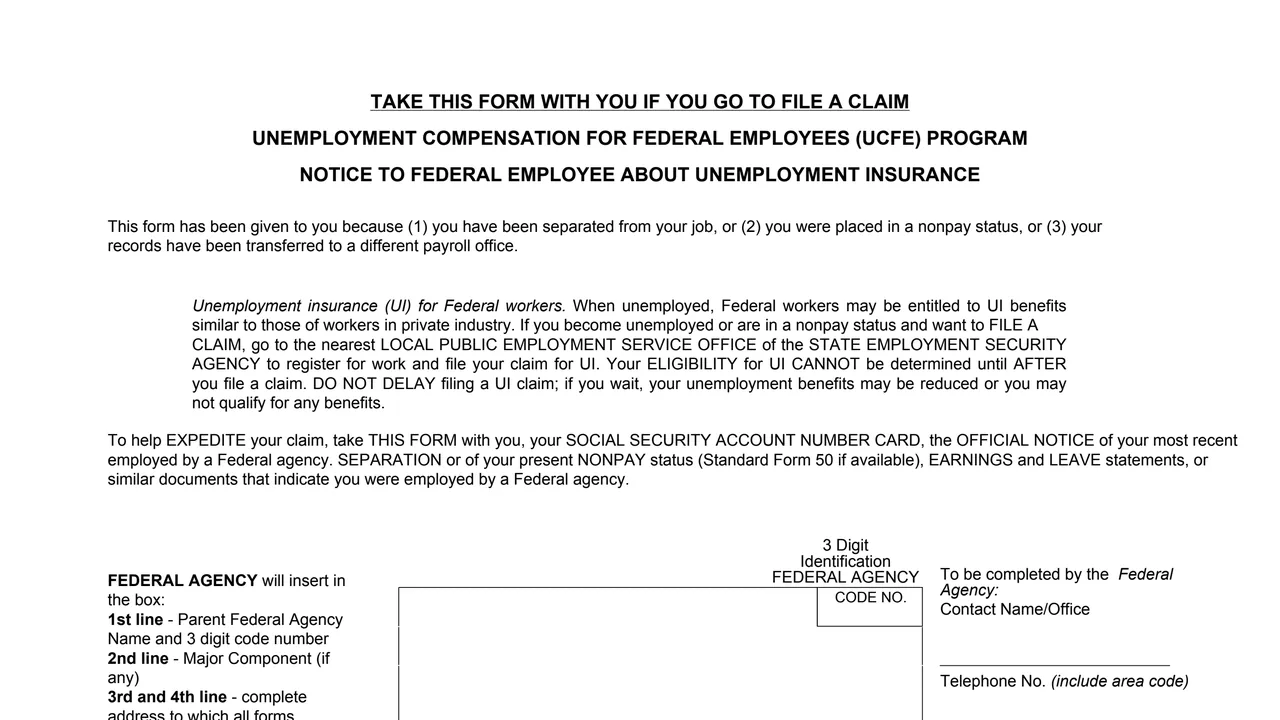
Why the form was given, how unemployment insurance works for federal workers, and where to file a claim. The form says eligibility cannot be determined until after a claim is filed.
The form lists this form, the Social Security account number card, the official notice of separation or nonpay status (Standard Form 50 if available), and earnings and leave statements or similar documents.
Agency name and 3 digit code, major component, the address for forms ES-931, 931A, 934, 936 and notices of appeal, hearings and determinations, plus a contact name or office and telephone number.
A State employment security agency under its UI law, generally under the law of the State of the last Official Duty Station shown on the final SF-50. Benefits come from U.S. Government funds.
The conditions the form says all State UI laws set, reasons State laws deny benefits, the right of appeal under State law, and penalties for a false claim.
The federal agency fills in its name, code, address for claim forms and contact details, then gives the form to the employee.
The form says to keep it and take it along if you file a UCFE/UI claim for unemployed federal workers.
Bring the documents the form lists, such as the Social Security card, the SF 50 notice if available, and earnings and leave statements.
The form says to go to the nearest local public employment service office of the State employment security agency to register for work and file a claim, and not to delay filing.
The form says to notify the local UI claim office of a mistake as soon as it is discovered, and to notify the local office in writing to stop benefits after becoming reemployed.
You get the real form, filled in a browser tab, with nothing standing between you and the finished PDF.
At the nearest local public employment service office of the State employment security agency. SF 8 itself is kept by the employee, not filed.
To the address the federal agency enters in its box, which the form says receives all forms pertaining to a claim.
The form says the employee is not eligible until returning to the United States, including the District of Columbia, Puerto Rico, and Virgin Islands, and benefit rights then follow the State of residence.
The form says UCFE/UI for unemployed federal workers is paid from U.S. Government funds and no deductions were taken from pay to finance these benefits.
The form cites U.S. Code, Title 5, Chapter 85 and 20 CFR 609, says it is prescribed by Dept. of Labor, and prints NSN 7540-00-634-3964.
A federal agency completes the box on the front and gives the form to the employee. The employee keeps it.
No tool matches that search.
The form says it is prescribed by the Dept. of Labor and cites 20 CFR 609. GSA hosts a copy in its forms library.
The form says it is given because the employee was separated from their job, placed in a nonpay status, or had their records transferred to a different payroll office.
No. The form says eligibility for UI cannot be determined until after a claim is filed, and that a State employment security agency pays eligible claimants.
The form lists this form, the Social Security account number card, the official notice of separation or nonpay status (Standard Form 50 if available), and earnings and leave statements or similar documents.
The form says yes: if a determination denies benefits, there is a right to appeal as provided in the applicable State law.
It says that anyone collecting UCFE/UI benefits who becomes reemployed is responsible for notifying the local office in writing to stop the payments, and that failing to do so may result in a penalty.