SF518

Blood or Blood Component Transfusion

Agency
GSA
Revision
Rev. 9/1992
Fillable fields
78
Pages
2
Official source
GSA form page
Checked
October 20, 2026
Fill SF518 online
Page 1 of form SF518

Standard Form 518 (SF 518): Blood or Blood Component Transfusion

Standard Form 518 (SF 518), Blood or Blood Component Transfusion, is a medical record printed as STANDARD FORM 518 (REV. 9-92). Its footer says Prescribed by GSA/ICMR, FIRMR (41 CFR) 201-9.202-1, and GSA hosts a copy in its forms library.

The front has three sections. Section I, Requisition, records the component requested, the type of request, the requesting physician, the diagnosis and a signed statement that a blood specimen was collected and its label verified. Section II, Pre-Transfusion Testing, records the unit, donor and recipient ABO and Rh, the antibody screen and crossmatch, and a previous record check. Section III, Record of Transfusion, records who inspected and issued the blood, two verifiers, vital signs before and after, the amount given and any reaction.

The back holds instructions for non self-explanatory items. You can fill it out free in your browser on this page and download the result without an account.
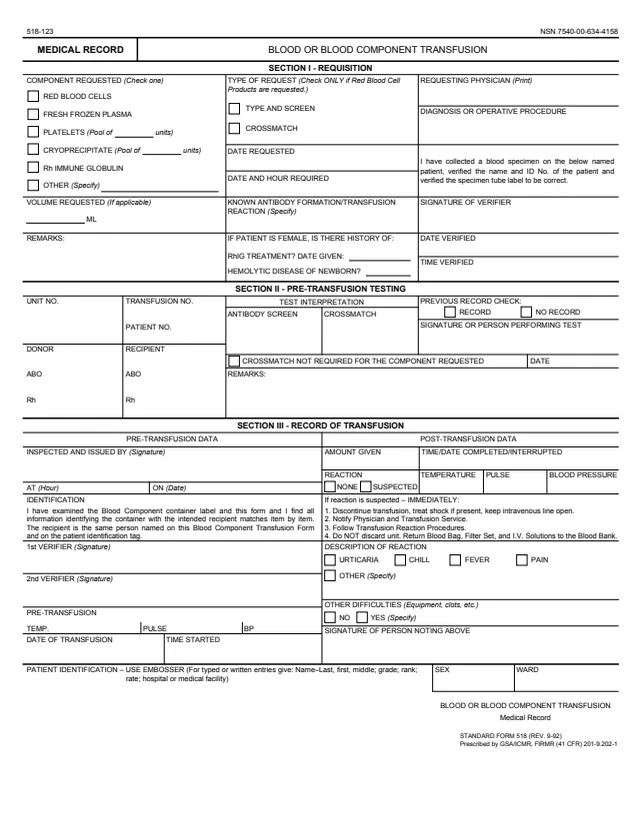
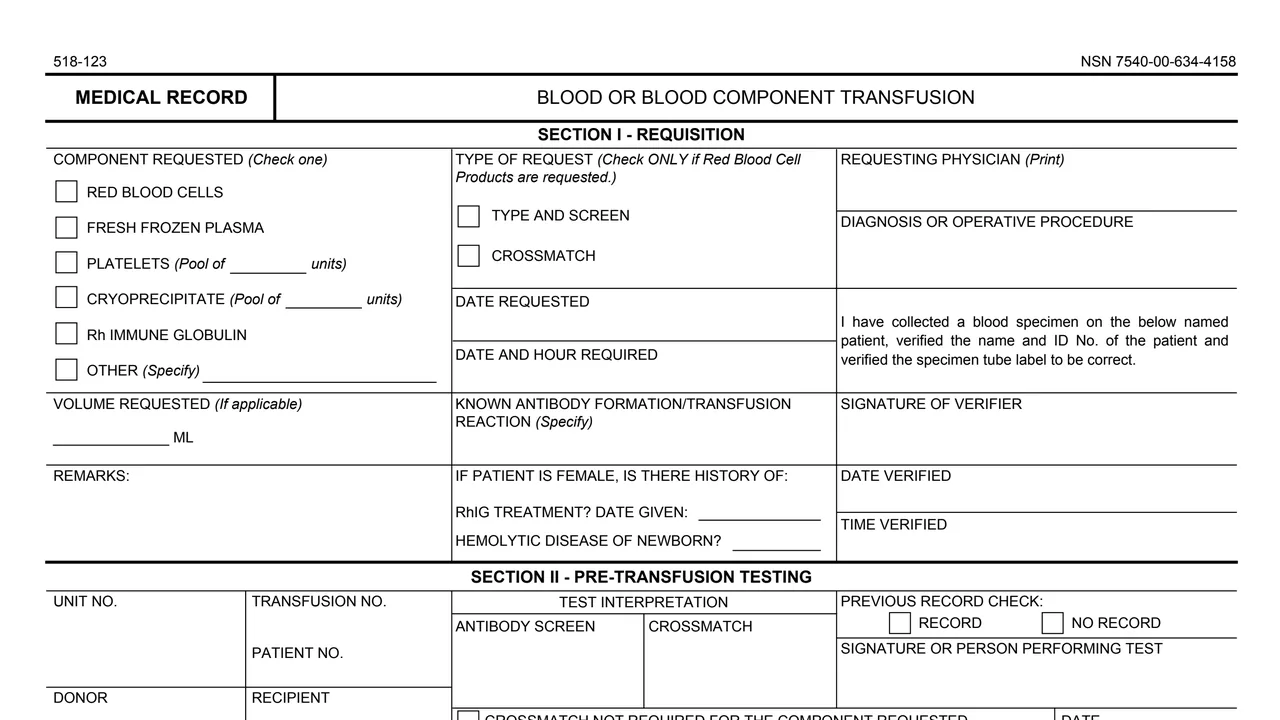
Top of page 1 of Standard Form 518 (SF 518): Blood or Blood Component Transfusion, as printed by GSA

What's on SF 518

Section I: requisition

Component requested (check one): red blood cells, fresh frozen plasma, platelets, cryoprecipitate, Rh immune globulin or other. Also type of request, volume in ML, dates, known antibody formation, history for a female patient and remarks.

Section I: specimen verification

The requesting physician, the diagnosis or operative procedure, and the verifier's statement about the blood specimen, with signature, date verified and time verified.

Section II: pre-transfusion testing

Unit no., transfusion no., patient no., donor and recipient ABO and Rh, test interpretation for antibody screen and crossmatch, previous record check, a crossmatch not required box, signature, date and remarks.

Section III: pre-transfusion data

Inspected and issued by (signature) at an hour and on a date, the identification statement, 1st and 2nd verifiers, pre-transfusion temperature, pulse and BP, date of transfusion and time started.

Section III: post-transfusion data

Amount given, time and date completed or interrupted, reaction none or suspected, temperature, pulse, blood pressure, description of reaction, other difficulties and the signature of the person noting them.

Patient identification

A row marked USE EMBOSSER. For typed or written entries: name (last, first, middle), grade, rank, rate and hospital or medical facility, with sex and ward.

The front has three numbered sections and a patient identification row. The back has instructions.

How to complete SF 518

  1. 1

    Request the component

    Check one component. The instructions say Other (Specify) lists any whole blood or blood product not on the menu, and the volume is used only when different from the standard amount. Type of request is checked only for red blood cell products.

  2. 2

    Check the medical records

    For known antibody formation or transfusion reaction, and for the history questions about a female patient, the instructions say to check medical records and annotate N/A if appropriate.

  3. 3

    Record the test results

    List the transfusion or patient number based on local procedures. The instructions say to use NEG or POS for the antibody screen and COMPAT or INCOMPAT for the crossmatch, and to compare current tests with prior records.

  4. 4

    Inspect and issue the blood

    The issuing laboratory person signs, not prints, the Inspected and Issued by line, with the hour and date of actual issue, and secures the form to the blood bag before issuing the blood.

  5. 5

    Verify identification

    Two verifiers sign the statement that the container label and the form match item by item and that the recipient is the person named on the form and on the patient identification tag.

  6. 6

    Record post-transfusion data

    The transfusionist enters the amount given in ml as a visual approximation and checks any reaction or difficulty. The instructions say to describe other reactions or difficulties on a separate sheet and attach it to SF 518.

These steps follow the instructions for non self-explanatory items on the back of the form.

Why fill Form SF518 on indox

You get the real form, filled in a browser tab, with nothing standing between you and the finished PDF.

  • Fill the form right in your browser, no software to install
  • Free to fill and free to download, with no account
  • The official blank straight from the GSA, not a copy someone retyped
  • Works on a phone, tablet or computer

Where it goes and what the form says

Where it goes

The PDF prints no filing address. It is labeled Medical Record. The instructions say the issuing laboratory person secures the form to the blood bag by string, rubberband, or tie knotted to the tag and the blood container before issuing the blood.

If a reaction is suspected

The form lists, IMMEDIATELY: 1. Discontinue transfusion, treat shock if present, keep intravenous line open. 2. Notify Physician and Transfusion Service. 3. Follow Transfusion Reaction Procedures. 4. Do NOT discard unit, and return the blood bag, filter set and I.V. solutions to the Blood Bank.

Blood that is not used

The instructions say the blood must not be abnormal in color or appearance or expired, and if any of these conditions exist the blood will not be used for transfusion.

Ordering paper copies

GSA's page says U.S. Government departments, agencies and offices can order this form at www.gsaglobalsupply.gsa.gov or www.gsaadvantage.gov with a government purchase card or AAC (Activity Address Code), and that government contractors need their department, agency or office to sponsor the request.

Prescribing note

The footer says Prescribed by GSA/ICMR, FIRMR (41 CFR) 201-9.202-1.

Who completes SF 518?

  • The requesting physician

    Section I has a REQUESTING PHYSICIAN (Print) box and a DIAGNOSIS OR OPERATIVE PROCEDURE box.

  • The person collecting the specimen

    A verifier signs a statement that they collected a blood specimen on the named patient, verified the patient's name and ID No. and verified the specimen tube label, with the date and time verified.

  • The person performing the test

    Section II has a signature line for the person performing the test, with a date.

  • The issuing laboratory person

    The instructions say the Inspected and Issued by statement is completed by the issuing laboratory person after inspecting the blood immediately before issue from the laboratory.

  • Two verifiers

    A 1st VERIFIER and a 2nd VERIFIER sign below the identification statement that the container label and the form match item by item.

  • The transfusionist

    The instructions say the Post-Transfusion Data is completed by the transfusionist, and a signature line follows for the person noting it.

Each section has its own signature lines. The instructions on the back name who completes some of them.

Official sources and the blank

Do it all with indox

View all 94 tools

Questions about Form SF518

Who issues SF 518?

The footer says Prescribed by GSA/ICMR, FIRMR (41 CFR) 201-9.202-1. GSA hosts a copy in its forms library, printed as STANDARD FORM 518 (REV. 9-92).

When is the type of request checked?

The form says to check Type and Screen or Crossmatch only if red blood cell products are requested.

When is the volume requested filled in?

The instructions say to use it only when different from the standard amount, for example an exchange transfusion of 50 ml.

What notations does SF 518 use for test results?

The instructions say to use NEG or POS in the antibody screen block and COMPAT or INCOMPAT in the crossmatch block.

Who signs the Inspected and Issued by line?

The issuing laboratory person. The instructions say the line holds their signature, as opposed to their name, and that the hour and date are as of actual issue.

What does SF 518 say to do if a reaction is suspected?

It lists four immediate actions: discontinue the transfusion, treat shock if present and keep the intravenous line open, notify the physician and transfusion service, follow transfusion reaction procedures, and return the unit and its materials to the Blood Bank without discarding it.