Header and blocks 1 and 2: category and addresses
Category I or II, Report Control Number, date, the originating office and originator, and the PQDR Screening Point with its contact.
SF368
Product Quality Deficiency Report
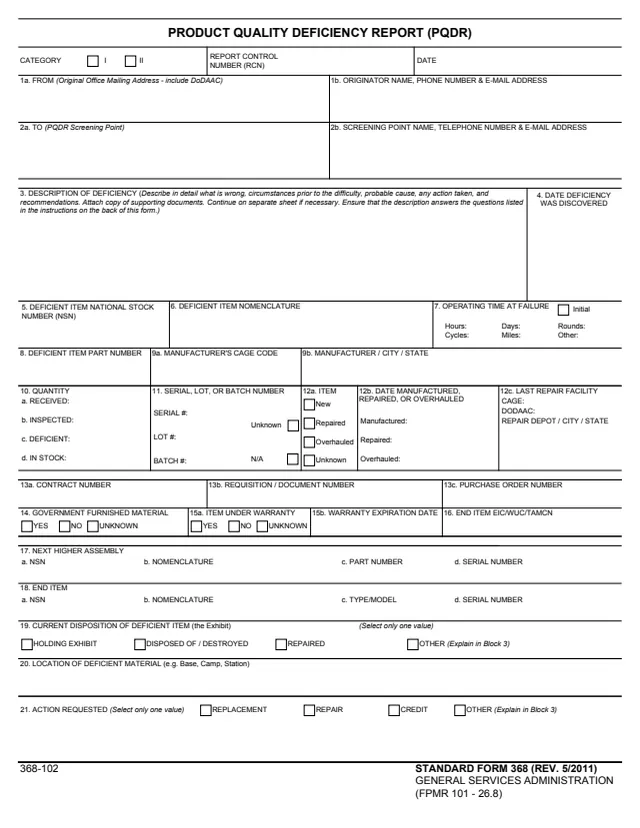
Standard Form 368 (SF 368), Product Quality Deficiency Report (PQDR), reports a deficient item: what is wrong with it, how it was found, who made it, the contract and requisition it came under, where it is now and the action requested. Its footer prints STANDARD FORM 368 (REV. 5/2011), GENERAL SERVICES ADMINISTRATION (FPMR 101 - 26.8), and GSA hosts a copy in its forms library.
The front has a category, a Report Control Number (RCN), a date and blocks 1a to 21. The back gives instructions for every block. The form says a Category I PQDR is an item that could cause loss of life or catastrophic failure of a major weapon system, and Category II PQDRs are all those which are not Category I. The report goes from the originating office in block 1a to the PQDR Screening Point in block 2a.
You can fill it out free in your browser on this page and download the result without an account.
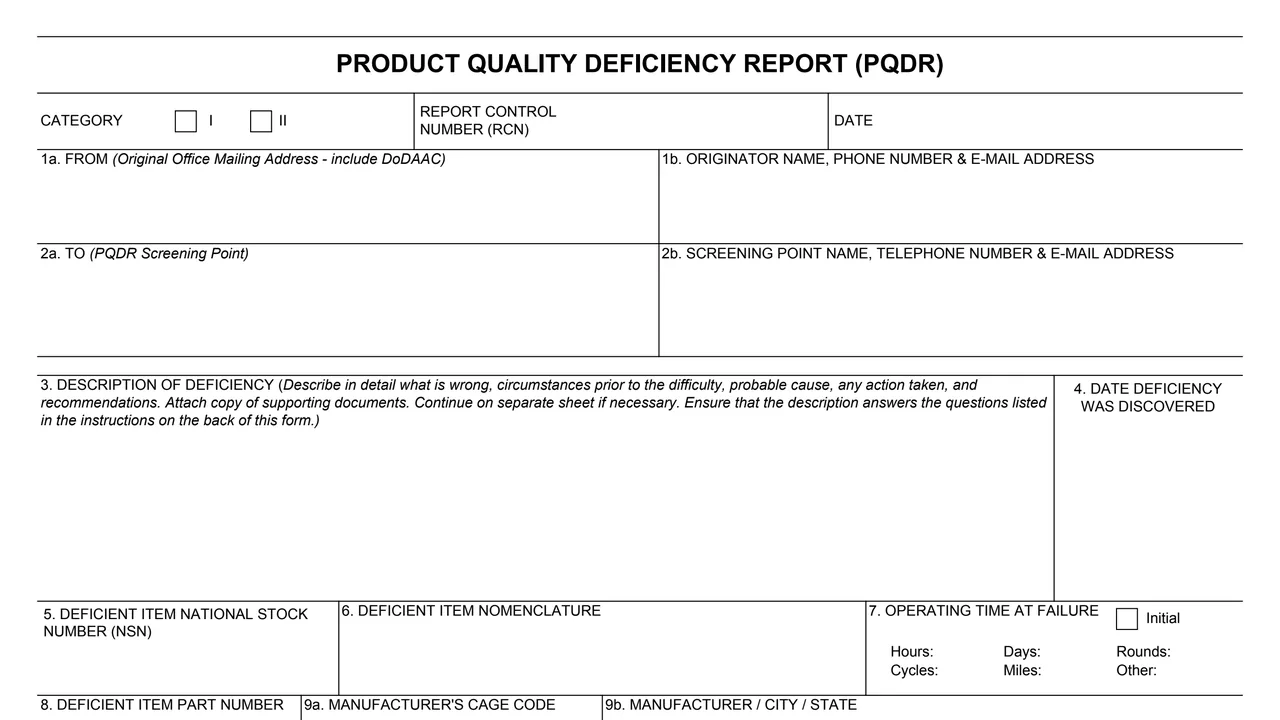
Category I or II, Report Control Number, date, the originating office and originator, and the PQDR Screening Point with its contact.
A detailed description of what is wrong, circumstances prior to the difficulty, probable cause, any action taken and recommendations, plus the date the deficiency was discovered.
National Stock Number, nomenclature, operating time at failure in hours, days, rounds, cycles, miles or other, part number, manufacturer's CAGE code and manufacturer, city and state.
Quantity received, inspected, deficient and in stock; serial, lot or batch number; whether the item is new, repaired or overhauled, with dates and the last repair facility.
Contract, requisition or document and purchase order numbers, Government furnished material, warranty and its expiration date, end item EIC/WUC/TAMCN, next higher assembly and end item.
Current disposition of the deficient item, the location of the deficient material, and the action requested: replacement, repair, credit or other.
Mark Category I or II. The instructions say Category I justification shall be provided in Description of Deficiency, Block 3.
The RCN is the six position originating activity DODAAC, a two digit calendar year and a four position serial number, for example M12000-10-0001. The date is the date the SF368 is filled out.
The instructions list what Block 3 covers, such as the condition of packaging when received, whether the defect was found before or after installation, how it was discovered and confirmed, and whether pictures are available.
The NSN is the four digit FSC and nine digit NIIN. The instructions say the NSN and contract number can often be found on the attached paperwork (DD250 or 1348 form), the product packaging, or the item itself.
Select one value for the current disposition in block 19 and give the location in block 20. The instructions say packaging, packing and shipping containers are held along with the exhibits.
In block 21 check replacement, repair, credit or other. If none fits, the instructions say to check OTHER and explain in Block 3.
You get the real form, filled in a browser tab, with nothing standing between you and the finished PDF.
The PDF gives no fixed address. The originating point enters in block 2a the screening point where the report needs to be sent.
The instructions say exhibits are held by the Originating Point until disposition instructions are received, and that a follow-up with the Screening or Action Point is initiated if instructions have not been received by 30 days.
Block 14 is answered YES, NO or UNKNOWN. The instructions say to select YES only if the deficient material was furnished by the Government to a Contractor for production purposes.
The instructions describe it as the original MILSTRIP document number, a 14 digit code, and say this information is key to getting the activity refunds or credits.
Block 7 gives the time the item had been in operation since new, overhauled or repaired. The instructions say to enter Initial if the deficiency occurred with no operation time.
The instructions on the back describe these roles.
No tool matches that search.
The footer prints STANDARD FORM 368 (REV. 5/2011), GENERAL SERVICES ADMINISTRATION (FPMR 101 - 26.8). GSA hosts it in its forms library.
The form says a Category I PQDR is an item that could cause loss of life or catastrophic failure of a major weapon system. Category II PQDRs are all those which are not Category I.
The instructions say it is the six position originating activity DODAAC, a two digit calendar year and a unique four position serial number, for example M12000-10-0001.
The instructions say exhibits are held by the Originating Point until disposition instructions are received from an appropriate Screening or Action Point, together with any packaging, packing and shipping containers.
The instructions say they can often be found on the attached paperwork (DD250 or 1348 form), the product packaging, and in some cases on the item itself, such as a manufacturer label or nameplate.
The instructions say to check the boxes for Unknown or N/A, and to list any extra numbers in Block 3.