Items 1 to 11: applicant information
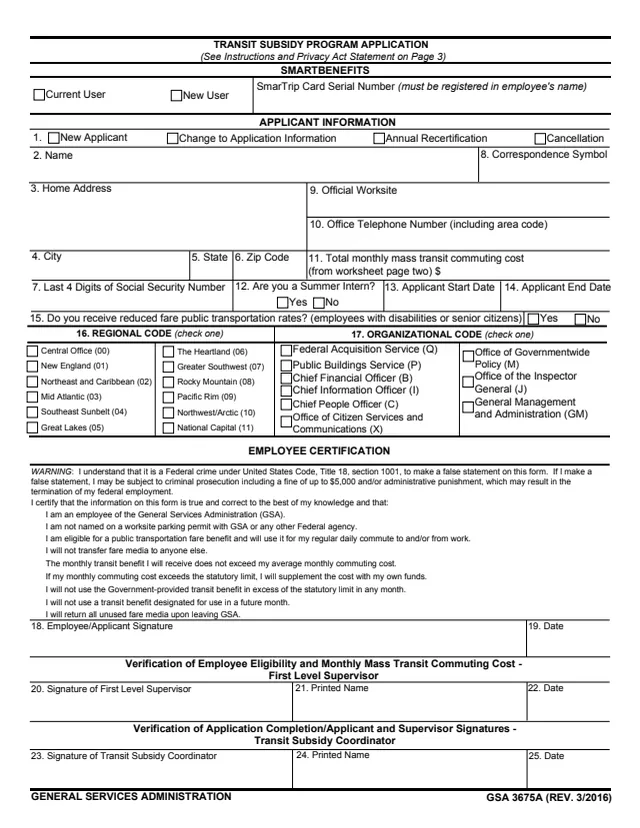
Application type, name, home address, last 4 digits of the Social Security Number, correspondence symbol, official work site, office telephone and the total monthly mass transit commuting cost from page 2.
GSA3675
Transit Subsidy Program Application
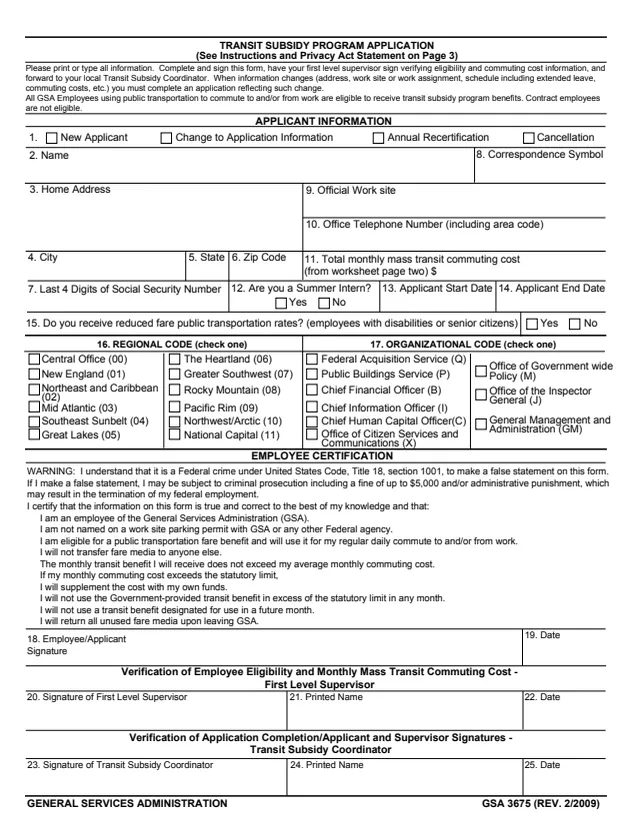
GSA Form 3675, Transit Subsidy Program Application, is a three-page GSA form. The footer reads GENERAL SERVICES ADMINISTRATION and GSA 3675 (REV. 2/2009), and GSA hosts it in its forms library.
The Privacy Act statement says the form is used to collect data from GSA employees applying for benefits under the Transit Subsidy Program. Page 1 is the application, with an employee certification and signature blocks for the employee, the first level supervisor and the Transit Subsidy Coordinator. Page 2 is a worksheet for the total monthly mass transit commuting cost. Page 3 holds the instructions and the Privacy Act statement.
Item 1 marks the application as a new applicant, a change to application information, the annual recertification or a cancellation. You can fill it out free in your browser on this page and download the result without an account.
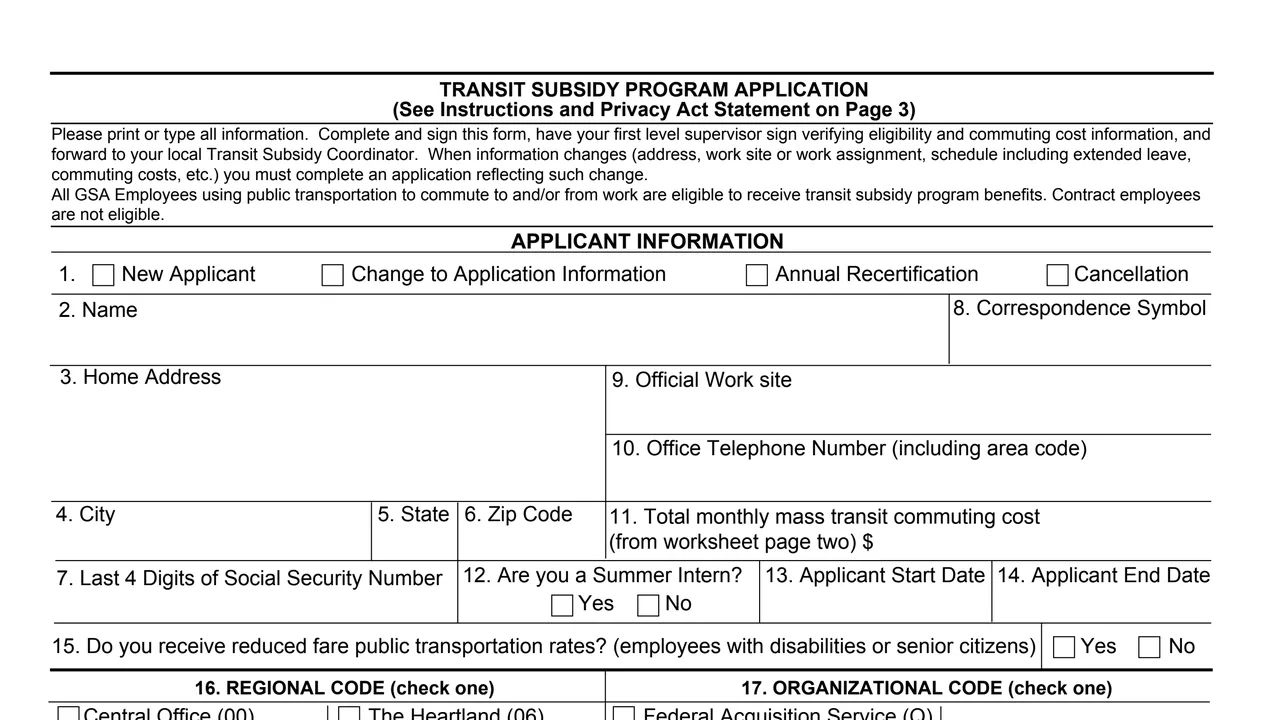
Application type, name, home address, last 4 digits of the Social Security Number, correspondence symbol, official work site, office telephone and the total monthly mass transit commuting cost from page 2.
Summer intern dates, whether you receive reduced fare rates, and one regional code and one organizational code, each checked from a printed list.
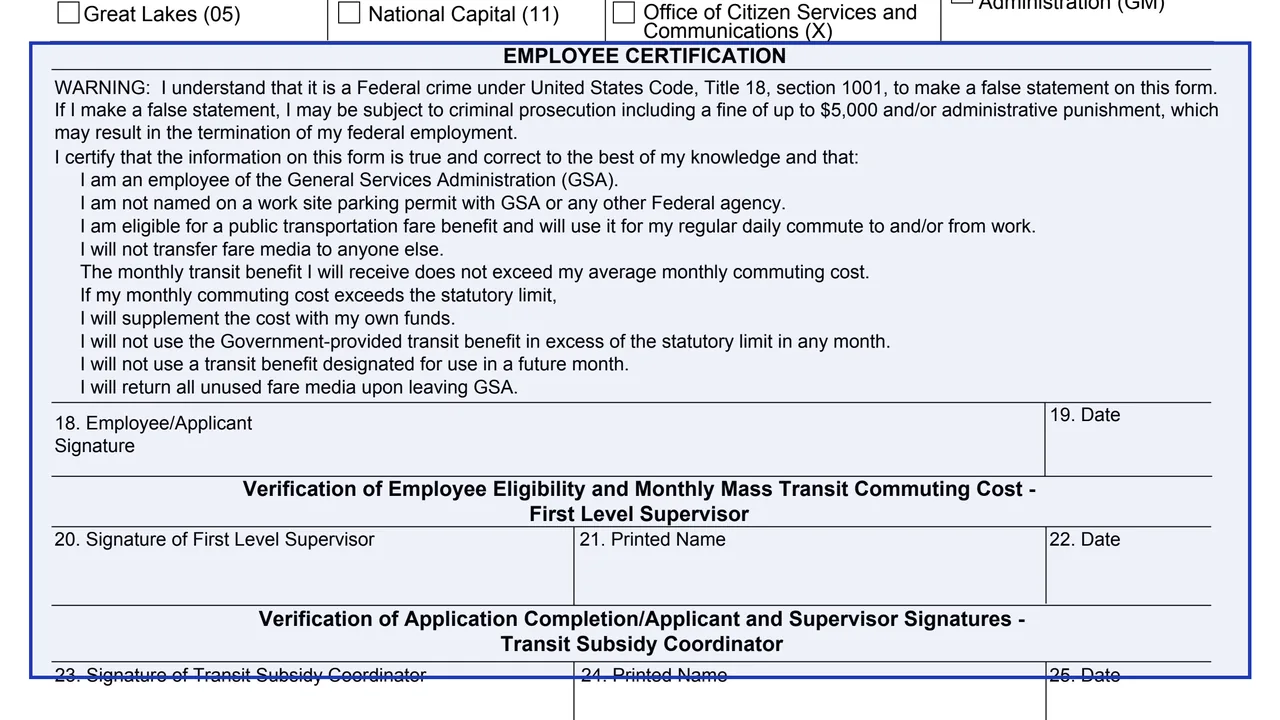
A false statement warning under United States Code, Title 18, section 1001, and statements about GSA employment, worksite parking permits, fare media and the statutory limit, then the signature and date in items 18 and 19.
Signature, printed name and date for the first level supervisor (items 20 to 22) and the Transit Subsidy Coordinator (items 23 to 25).
Rows for each mode to and from work (bus, light rail, subway, train or other) with company, starting and ending points and daily, weekly or monthly cost, a van pool row, and a conversion table.
Item-by-item instructions for page 1, notes on the worksheet and absences, and the Privacy Act statement.
In item 1, check new applicant, change to application information, annual recertification, or cancellation (withdrawal or no longer eligible for the program).
On page 2, list each mode in the daily, weekly or monthly column by how you pay. The form says parking fees are not allowed and cannot be included, and reduced fares are counted at the amount actually paid.
Multiply the daily cost by the days per month you commute by mass transit, starting from an average 21-day work month, or the weekly cost by 4. The form says to round to the nearest dollar, with $.50 or more rounded up.
Enter the worksheet total in item 11, your correspondence symbol, official worksite (not a telework location) and office telephone, and check one regional and one organizational code.
Read the certification statements, then sign and date items 18 and 19. The instructions say to submit the completed application to your immediate supervisor.
The form says to have your first level supervisor sign verifying eligibility and commuting cost information, and to forward it to your local Transit Subsidy Coordinator.
These steps follow the instructions on page 3.
You get the real form, filled in a browser tab, with nothing standing between you and the finished PDF.
To the first level supervisor for signature and then to the local Transit Subsidy Coordinator. The PDF prints no mailing address.
The form says a new application is completed when information changes, such as address, work site or work assignment, schedule including extended leave, or commuting costs.
If your actual commuting cost falls below your transit benefit, the form says a lesser amount is taken at the next distribution. Its example: $105.00 per month less $50.00 for ten days not using mass transit gives a request of $55.00.
The certification warns that a false statement is a Federal crime under United States Code, Title 18, section 1001, and may lead to criminal prosecution including a fine of up to $5,000 and/or administrative punishment.
Authorities: Public Law 101-509; Executive Order 13150; and the Federal Employees Clean Air Incentives Act (section 2(a) of Public Law 103-172, found at 5 USC 7905). Furnishing the information is voluntary, but the form says without it the request cannot be approved.
The top of page 1 describes who completes, signs and receives the application.
No tool matches that search.
The footer reads GENERAL SERVICES ADMINISTRATION and GSA 3675 (REV. 2/2009). GSA hosts the form in its forms library.
The employee signs the certification, the first level supervisor signs to verify eligibility and commuting cost, and the Transit Subsidy Coordinator signs to verify the application is complete and signed.
No. The worksheet says parking fees are not allowed and cannot be included when computing monthly transit costs.
It starts from an average 21 workdays per month and subtracts days you do not commute by mass transit, such as for an alternate work schedule, telework or regular travel. It says to subtract 2 days for a 5/4/9 schedule and 4 days for a 4/10 schedule.
Item 15 asks about reduced fare rates. The form says transit benefits are based on the amount you actually pay.
The form lists four types: new applicant, change to application information, annual recertification and cancellation. It says a new application is completed when information such as address, work site, schedule or commuting costs changes.
Item 7 asks for the last 4 digits. The Privacy Act statement says furnishing the information is voluntary, but without it the request for a transit subsidy benefit cannot be approved.