Caption
The district and division of the United States District Court, the plaintiffs and defendants, the case number to be filled in by the Clerk's Office, and a jury trial yes or no box.
Pro Se 8
Complaint for Violations of Fair Labor Standards
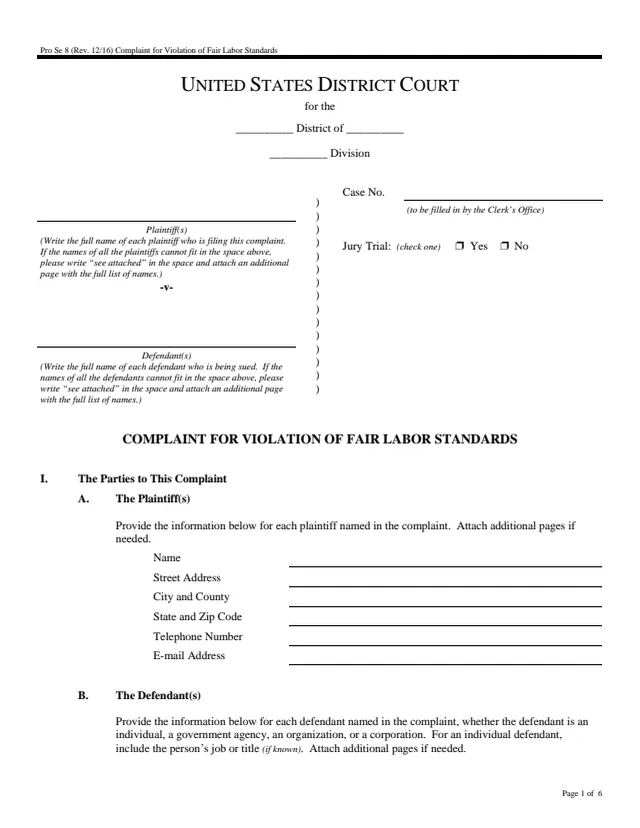
Pro Se 8, Complaint for Violations of Fair Labor Standards, is a pleading form from the U.S. Courts for a case in a United States district court. It is one of the Civil Pro Se Forms, which the U.S. Courts page says are limited to types of cases often filed in federal courts by people who represent themselves or who may not have much experience in federal courts.
The 6-page form asks for the parties and the place of employment, the laws the action is brought under (the Fair Labor Standards Act, 29 U.S.C. §§ 201 to 209, and relevant state, city or county law), a statement of claim about the job, the pay and the hours worked, the alleged violations, the relief requested, and a signed certification under Federal Rule of Civil Procedure 11. The printed form is marked Rev. 12/16, and the page lists it as effective on December 1, 2016, as a PDF and a Word file.
The page says no form provides legal advice or substitutes for having or consulting a lawyer. This page explains the form in plain words and is not legal advice. You can fill it out free in your browser on this page and download the result without an account.
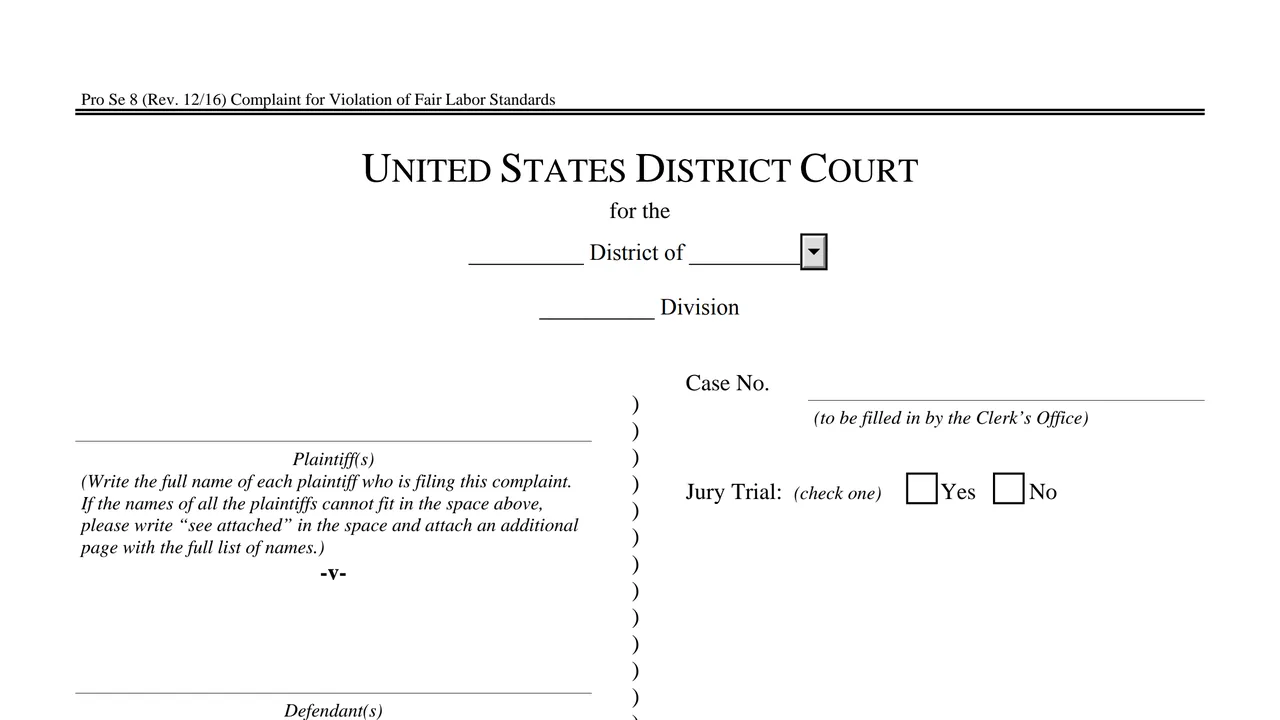
The district and division of the United States District Court, the plaintiffs and defendants, the case number to be filled in by the Clerk's Office, and a jury trial yes or no box.
Contact details for each plaintiff, up to four defendants with an individual's job or title if known, and the name and address of the place where the plaintiff is or was employed.
Check all that apply: the Fair Labor Standards Act, 29 U.S.C. §§ 201 to 209, relevant state law, or relevant city or county law.
The nature of the employer's business, the dates of employment, the job title and kind of work done, the rate, method and frequency of wage payment, and the hours actually worked each week in which a violation is claimed.
Boxes for failure to pay the minimum wage, failure to pay required overtime, and other violations, each with room to explain, then the dates of the alleged violations and any additional facts.
The damages or other relief requested, with amounts and their basis, then the Rule 11 certification and signatures for a party without an attorney or for an attorney.
The U.S. Courts page says no form provides legal advice, a form may call for more or less information than a particular court requires, and to consult the rules and caselaw that govern in the court where the pleading is filed.
Enter the district and division and the full name of each party. If the names do not fit, the form says to write see attached and attach a page with the full list. The case number is left for the Clerk's Office.
Section I.C asks for the place of employment. In Section II, the form says to check all the laws that apply.
The form says to state the facts as briefly as possible, not to cite any cases, and to number each claim in a separate paragraph. Items A to H ask about the job, pay, hours, violations and dates. Additional pages may be attached.
The U.S. Courts page cites Federal Rule of Civil Procedure 5.2: a filing may include only the last four digits of a Social Security, taxpayer identification or financial account number, the year of birth, and a minor's initials.
Section IV asks for the damages or other relief, without legal arguments. The signer then certifies under Rule 11 in Section V and adds the date and printed name.
You get the real form, filled in a browser tab, with nothing standing between you and the finished PDF.
The form is captioned for a United States District Court, district and division. The page says to consult the rules and caselaw that govern in the court where the pleading is filed.
The form and its page do not print a filing fee.
The page says the forms give no guidance on when pleadings, claims or defenses have to be raised or who has to be sued, and that some have to be raised within a certain period of time.
The page says that if you are not a lawyer and are suing or have been sued, it is best to have or consult a lawyer if possible.
The U.S. Courts page offers Pro Se 8 as a PDF and as a Word document.
Pro Se 7
99 fields, 6 pages
Pro Se 1
76 fields, 5 pages
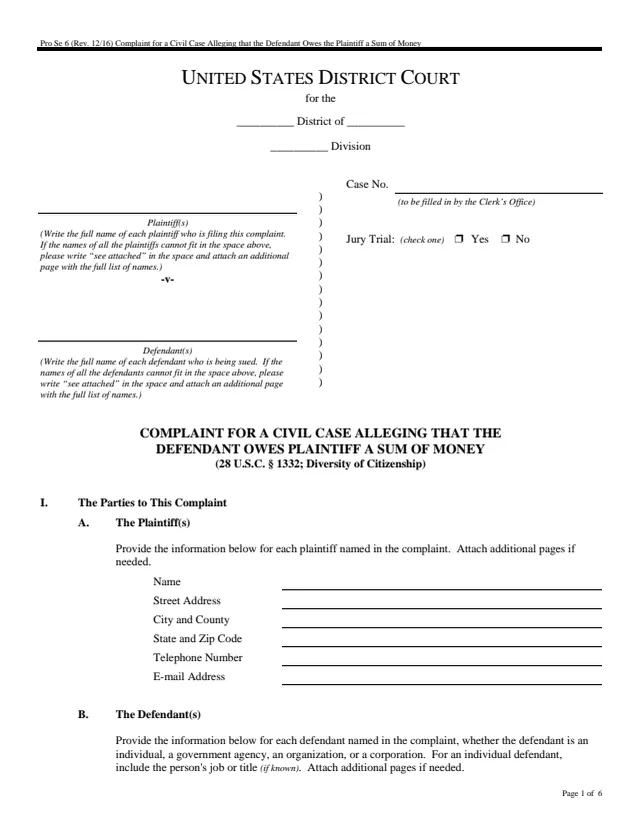
Pro Se 6
95 fields, 6 pages
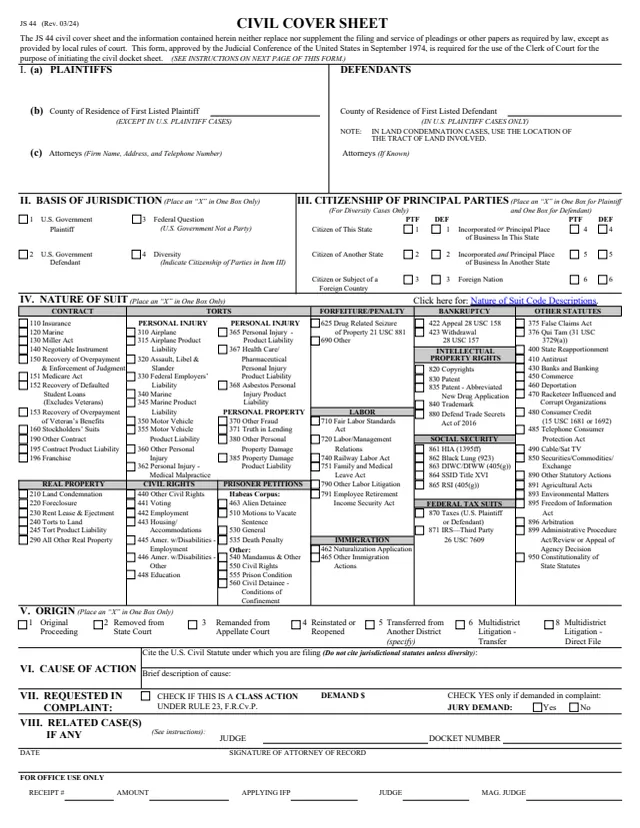
JS 44
35 fields, 2 pages
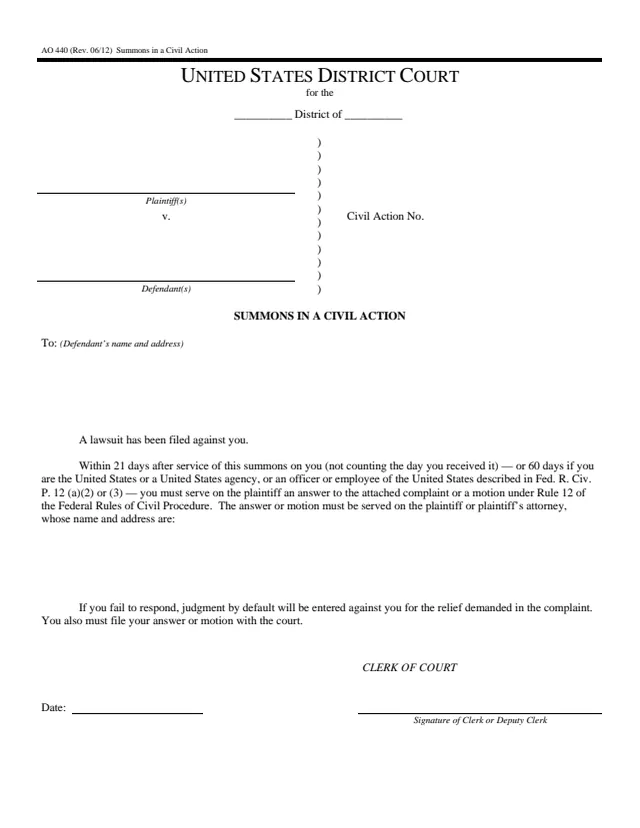
AO 440
34 fields, 2 pages
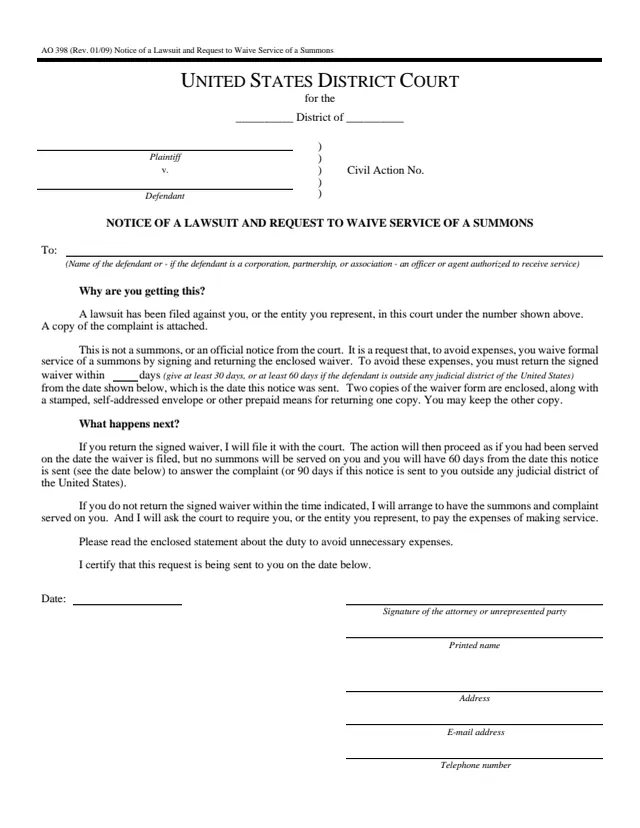
AO 398
15 fields, 1 page
The form and its U.S. Courts page describe these filers. The page says to use the form that fits your case.
No tool matches that search.
No. The U.S. Courts page says no form provides legal advice or substitutes for having or consulting a lawyer, and that following a form does not guarantee a pleading is legally or factually correct or sufficient.
This page cannot say. The U.S. Courts page says some forms apply to different types of cases and others only to specific types, and to use the form that fits your case. It says it is best to have or consult a lawyer if possible.
Section II lists the Fair Labor Standards Act, as codified, 29 U.S.C. §§ 201 to 209, relevant state law, and relevant city or county law, and says to check all that apply.
Section III.F has boxes for failure to pay the minimum wage, failure to pay required overtime, and other violations, and asks for an explanation of each one checked.
The form says not to cite any cases. It asks for the facts as briefly as possible, with each claim numbered in a separate paragraph.
The U.S. Courts page says Rule 5.2 limits a filing to the last four digits of a Social Security, taxpayer identification or financial account number, the year of someone's birth, and a minor's initials.
No. The page says the forms give no guidance on timing or on who has to be sued, and that some claims have to be raised within a certain period of time.