Pro Se 10

Complaint for the Conversion of Property

Agency
U.S. Courts
Revision
Rev. 12/16
Fillable fields
75
Pages
5
Official source
U.S. Courts form page
Checked
October 20, 2026
Fill Pro Se 10 online
Page 1 of form Pro Se 10

Pro Se 10: Complaint for the Conversion of Property

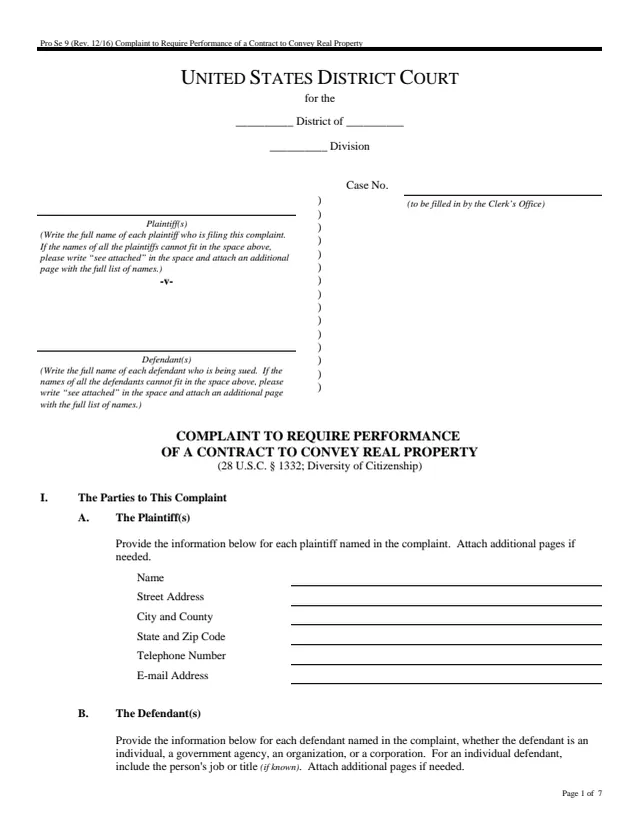
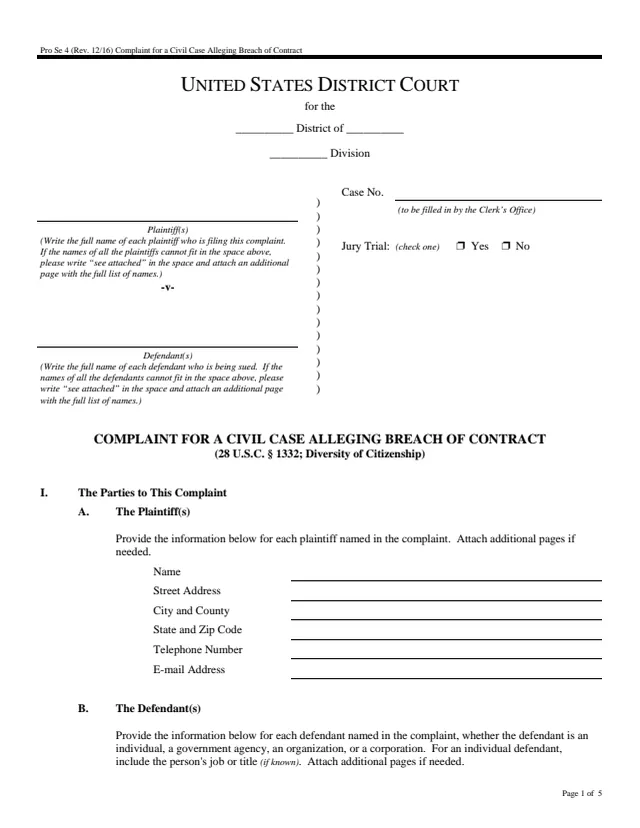
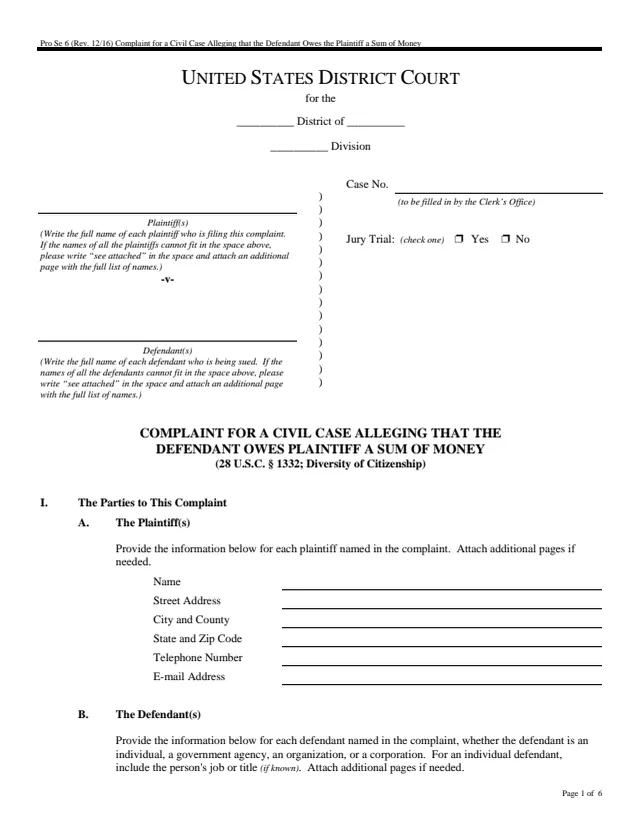
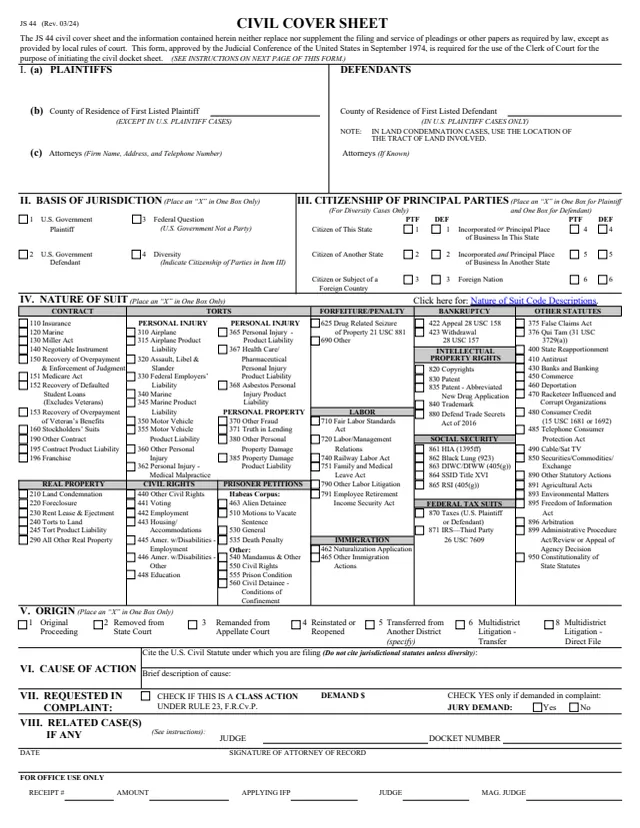
Pro Se 10, Complaint for the Conversion of Property, is a pleading form from the U.S. Courts for a civil case in a United States district court. It is one of the Civil Pro Se Forms, which the U.S. Courts page says are limited to types of cases often filed in federal courts by people who represent themselves or who may not have much experience in federal courts.

The form is headed 28 U.S.C. § 1332; Diversity of Citizenship. It asks for the parties, how the jurisdictional requirements are met, a statement of claim about the property and how the defendant came to possess it, the relief requested, and a signed certification under Federal Rule of Civil Procedure 11. The page notes that no form provides legal advice or substitutes for having or consulting a lawyer, and that a court may require more or less information than a form asks for.

The U.S. Courts offers it as a PDF and a Word file, effective on December 1, 2016. You can fill it out free in your browser on this page and download the result without an account.

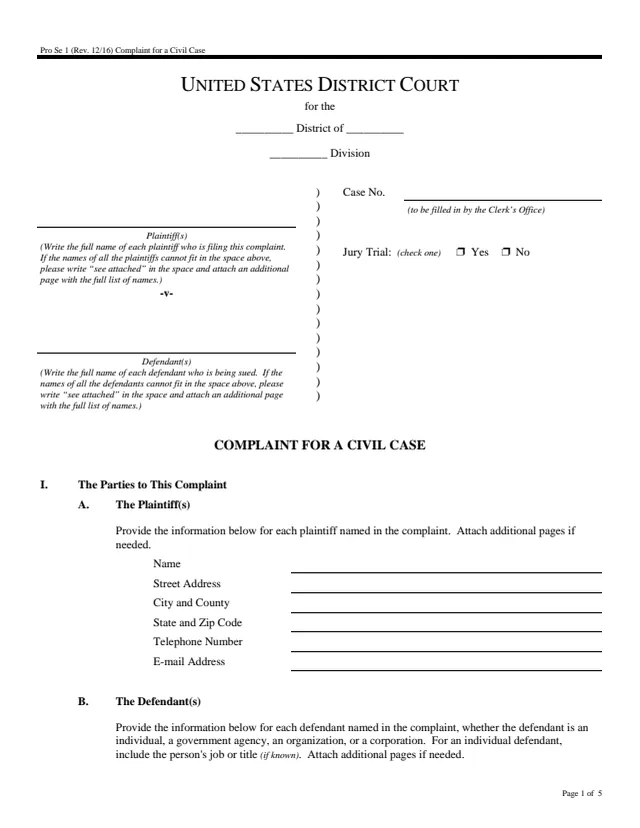
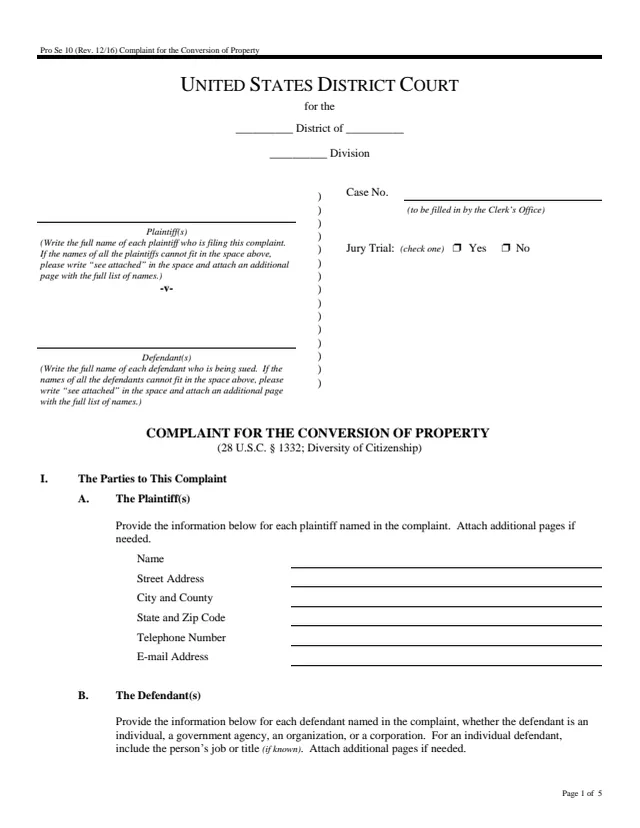
Top of page 1 of Pro Se 10: Complaint for the Conversion of Property, as printed by COURTS

What's on Pro Se 10

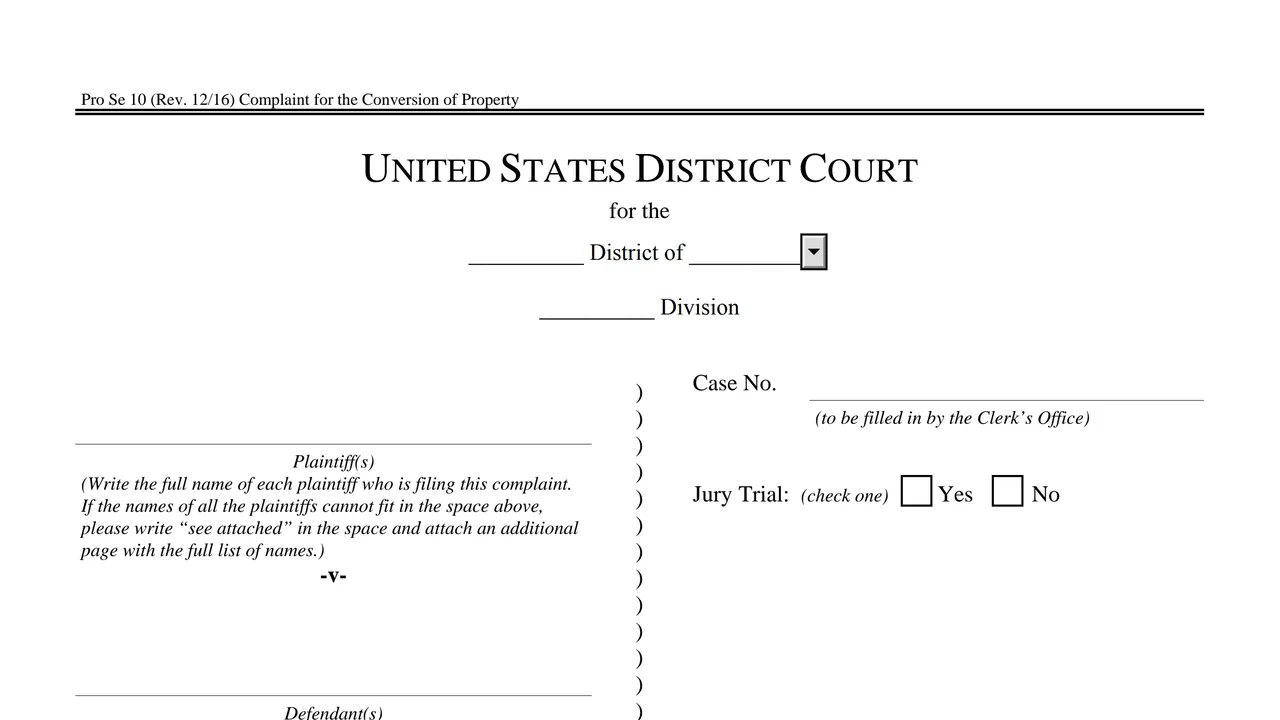
Caption

The district and division, the full name of each plaintiff and defendant, a yes or no choice for a jury trial, and a case number left for the Clerk's Office. Names that do not fit go on an attached page, with "see attached" written in the space.
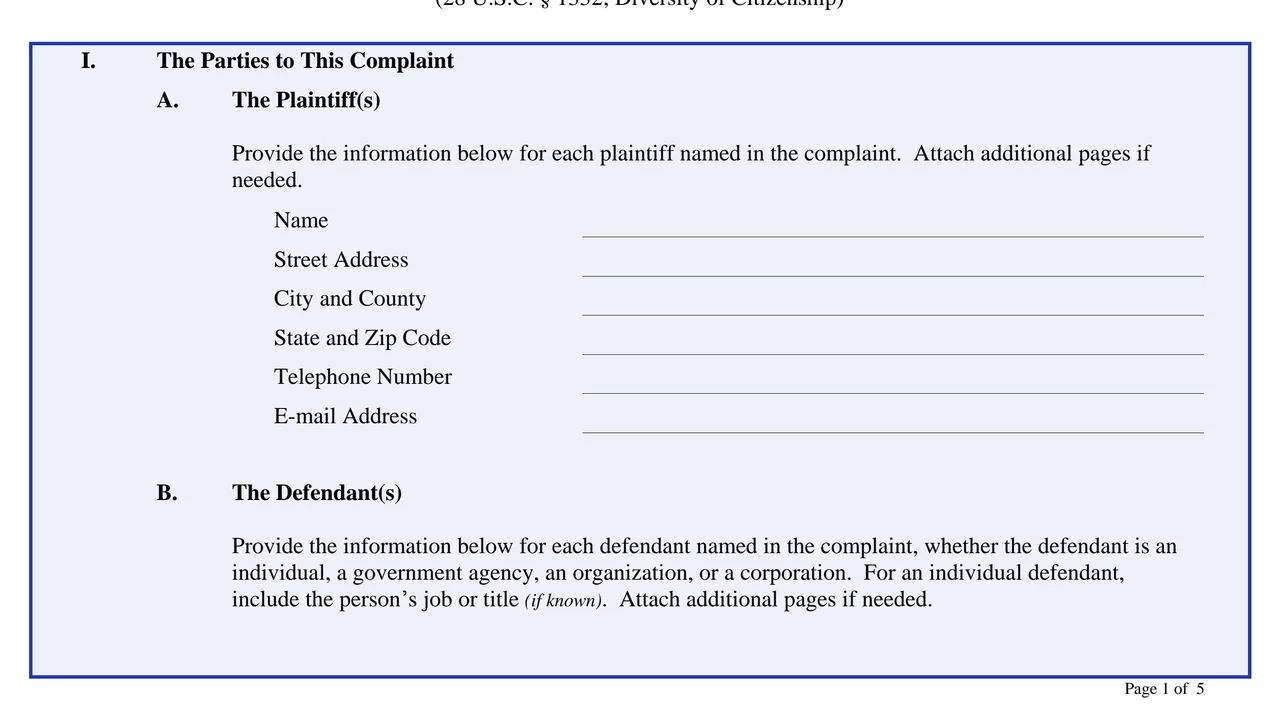
I. The Parties

Name, address, phone and email for each plaintiff, and for each defendant, whether an individual, government agency, organization or corporation, with an individual's job or title if known. There is room for four defendants.

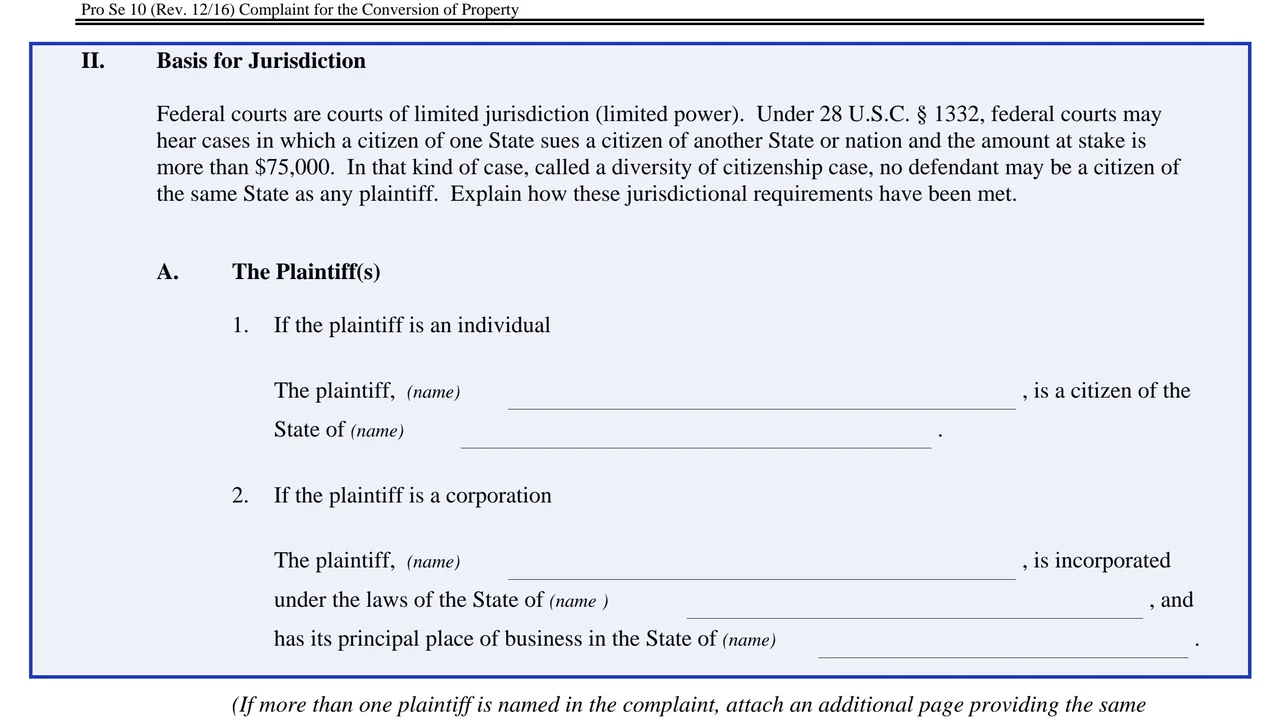
II. Basis for Jurisdiction

The citizenship of each plaintiff and defendant, or a corporation's place of incorporation and principal place of business, and why the amount in controversy is more than $75,000, not counting interest and costs of court.

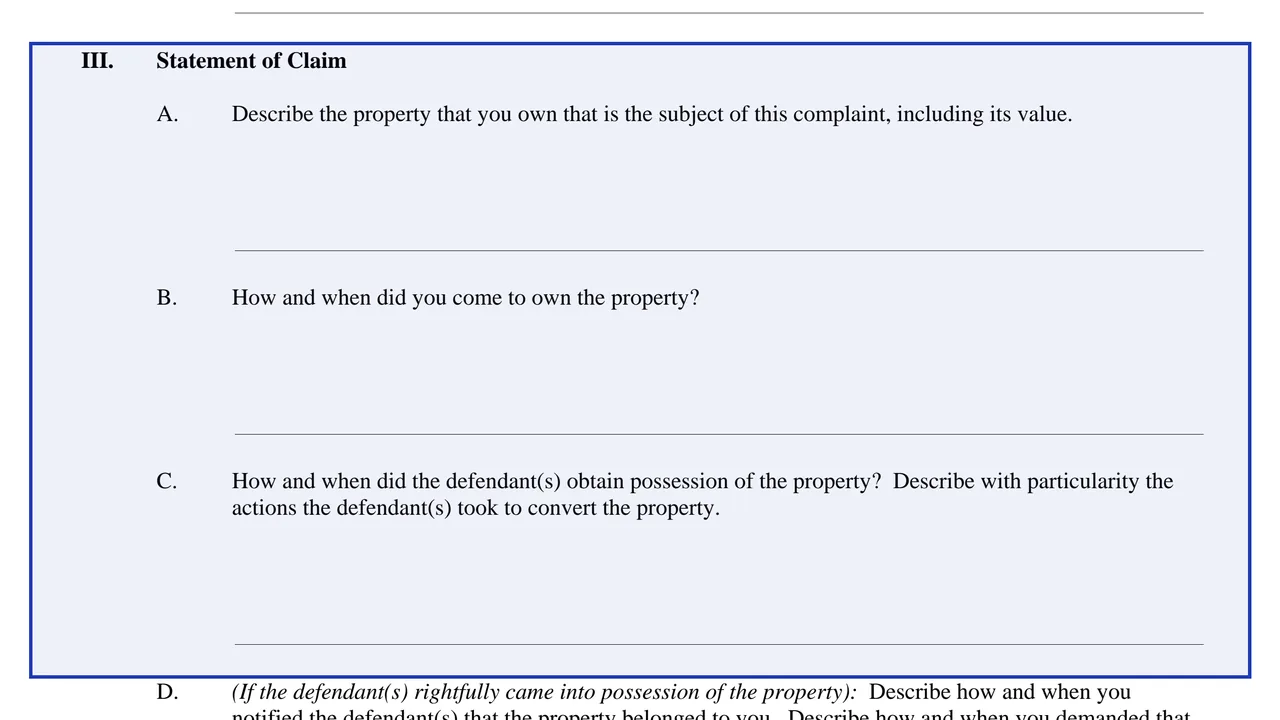
III. Statement of Claim

Four questions: the property and its value, how and when the plaintiff came to own it, how and when the defendant obtained possession and what the defendant did to convert it, and any notice and demand for its return.

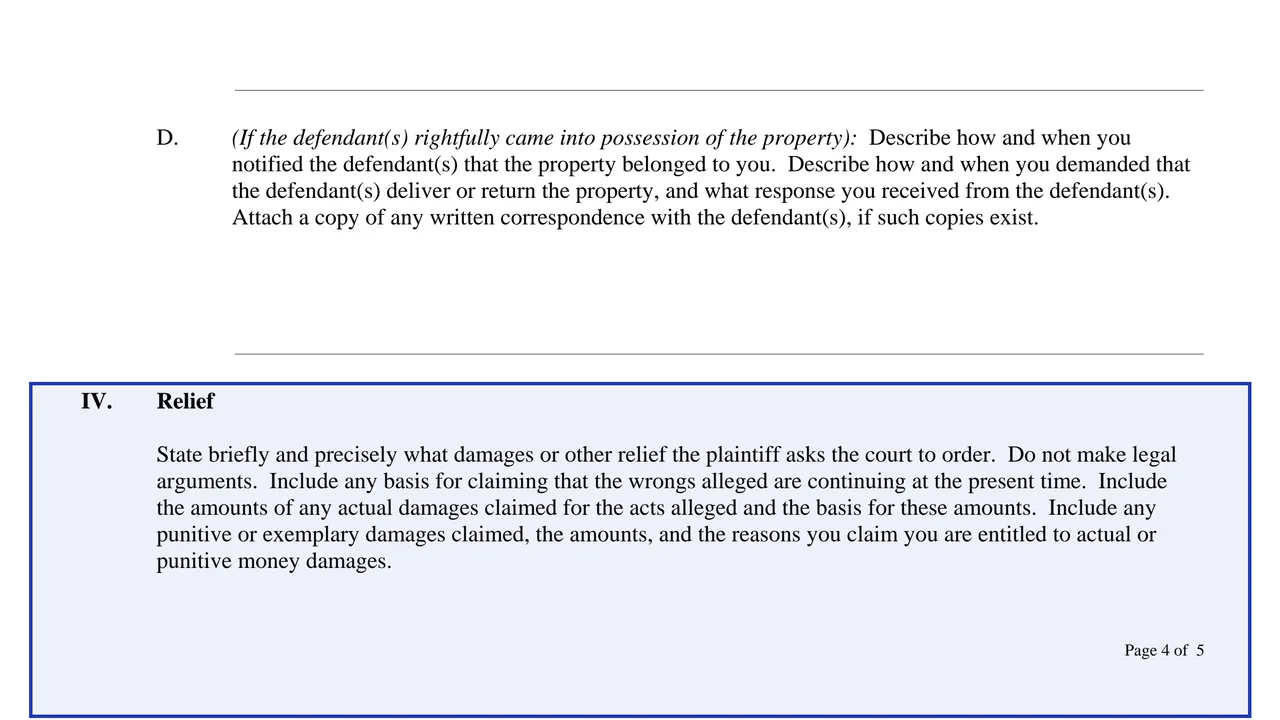
IV. Relief

The damages or other relief asked for, any basis for saying the wrongs are continuing, the amounts of actual damages and their basis, and any punitive or exemplary damages with amounts and reasons.

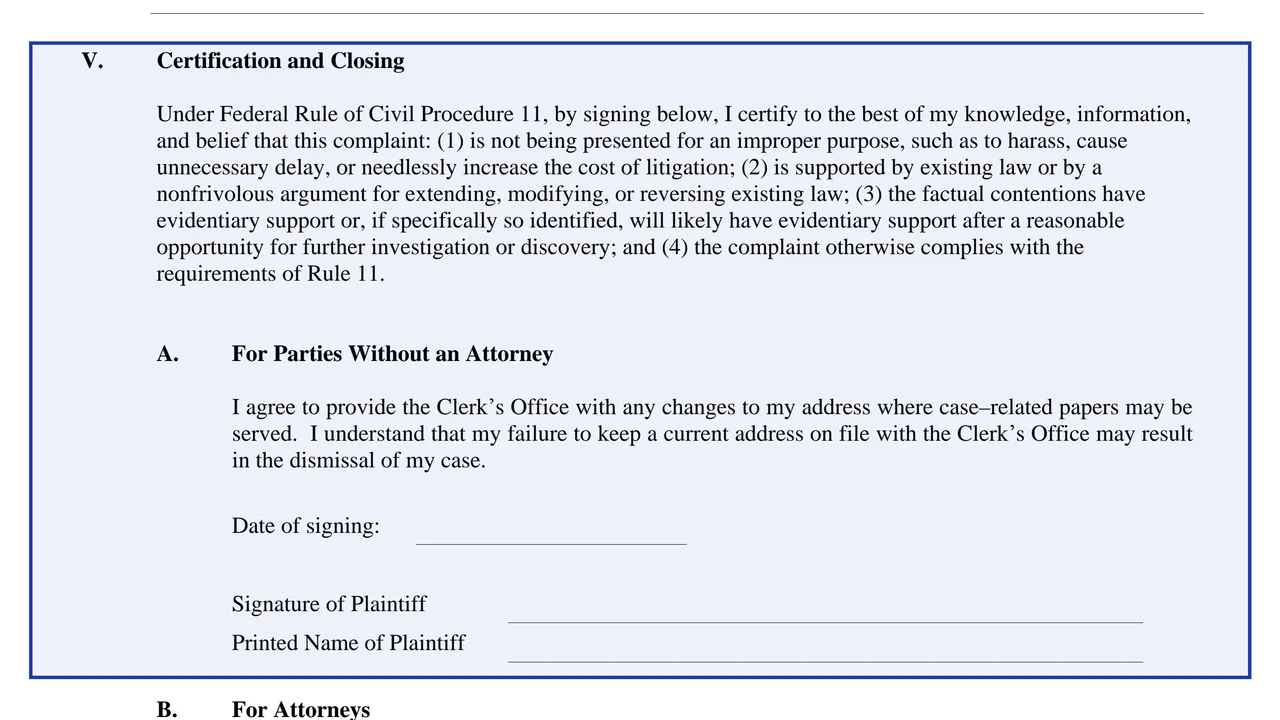
V. Certification and Closing

A certification under Federal Rule of Civil Procedure 11, then the date, signature and printed name of the plaintiff, or the attorney's details.

How to fill out Pro Se 10

  1. 1

    Read the notes on the form page

    The U.S. Courts page says no form provides legal advice, a court may require more or less than a form asks, and to consult the rules and caselaw that govern in the court where you file.

  2. 2

    Fill in the caption and parties

    Enter the district, division and the full names of the parties, choose yes or no for a jury trial, and leave the case number for the Clerk's Office.

  3. 3

    Explain the jurisdiction

    Section II asks for each party's citizenship and why the amount at stake is more than $75,000. For more plaintiffs or defendants, the form says to attach a page with the same information for each.

  4. 4

    Describe the property and the facts

    Section III asks to describe the property and its value, and to describe with particularity what the defendant did. If the defendant rightfully came into possession, it asks about notice and demand, with copies of any written correspondence.

  5. 5

    Leave out private details

    The page cites Federal Rules of Civil Procedure 5.2: a filing may show only the last four digits of a social-security, taxpayer identification or financial-account number, the year of birth, and a minor's initials.

  6. 6

    Sign and date

    Sign under the Rule 11 certification and print your name. Parties without an attorney also agree to keep their address current with the Clerk's Office.

Why fill Form Pro Se 10 on indox

You get the real form, filled in a browser tab, with nothing standing between you and the finished PDF.

  • Fill the form right in your browser, no software to install
  • Free to fill and free to download, with no account
  • The official blank straight from the U.S. Courts, not a copy someone retyped
  • Works on a phone, tablet or computer

Court, timing and help

Court

The form is captioned for a United States District Court, district and division. The page says to consult the rules and caselaw that govern in the court where the pleading is filed.

Fees

The form and its page do not print a filing fee.

Timing

The page says the forms give no guidance on when pleadings, claims or defenses have to be raised or who has to be sued, and that some have to be raised within a certain period of time.

A lawyer

The page says that if you are not a lawyer and are suing or have been sued, it is best to have or consult a lawyer if possible.

Formats

The U.S. Courts page offers Pro Se 10 as a PDF and as a Word document.

Who uses Pro Se 10?

  • People representing themselves

    Section V.A is for parties without an attorney. They agree to tell the Clerk's Office about any address change, and the form says a missing current address may result in dismissal of the case.

  • Plaintiffs in a diversity of citizenship case

    The form says that under 28 U.S.C. § 1332, federal courts may hear cases where a citizen of one State sues a citizen of another State or nation and the amount at stake is more than $75,000, with no defendant a citizen of the same State as any plaintiff.

  • Individuals and corporations

    Section II has separate lines for a party who is an individual (the State or foreign nation of citizenship) and a party that is a corporation (the place of incorporation and principal place of business).

  • Attorneys

    Section V.B has a signature block for an attorney, with bar number, law firm, address, phone and email.

The page describes the Civil Pro Se Forms as examples for people who represent themselves or have little experience in federal courts, and says to use the form that fits your case.

Official sources and the blank

Do it all with indox

View all 94 tools

Questions about Form Pro Se 10

Is Pro Se 10 legal advice?

No. The U.S. Courts page says no form provides legal advice or substitutes for having or consulting a lawyer, and that following a form does not guarantee a pleading is legally or factually correct or sufficient.

Is Pro Se 10 the right form for my case?

This page cannot say. The U.S. Courts page says some forms apply to different types of cases and others only to specific types, and to use the form that fits your case and the type of pleading you want to file. It says it is best to have or consult a lawyer if possible.

Who fills in the case number?

The form says the case number is filled in by the Clerk's Office.

What does the $75,000 on the form refer to?

The form says that under 28 U.S.C. § 1332, federal courts may hear cases where a citizen of one State sues a citizen of another State or nation and the amount at stake is more than $75,000. Section II.C asks the plaintiff to explain why the amount in controversy is more than $75,000, not counting interest and costs of court.

What does Section III.D ask?

If the defendant rightfully came into possession of the property, it asks how and when the plaintiff said the property belonged to them, how and when they demanded its delivery or return, and the response. It asks for copies of any written correspondence, if such copies exist.

What personal details does a complaint leave out?

The page cites Federal Rules of Civil Procedure 5.2: papers filed with the court should not contain anyone's full social-security number or full birth date, the name of a person known to be a minor, or a complete financial-account number.

What if there are more than four defendants?

Write "see attached" in the caption and attach a page with the full list of names. Section I says to attach additional pages if needed.