Caption and To line
The United States District Court and district, United States of America v. the defendant, a case number, and the name of the person the subpoena is directed to.
AO 89B
Subpoena to Produce Documents, Information, or Objects in a Criminal Case
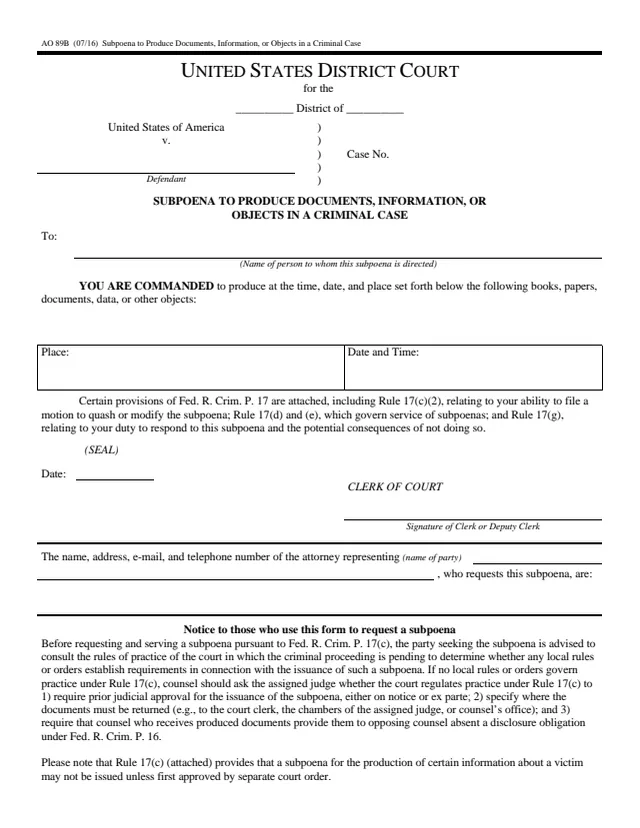
AO 89B, Subpoena to Produce Documents, Information, or Objects in a Criminal Case, is a United States District Court form from the U.S. Courts. The U.S. Courts page lists it under Criminal Forms, effective on July 1, 2016, and the PDF prints the edition AO 89B (07/16).
It is a subpoena the court issues, signed by the Clerk or Deputy Clerk with the court's seal, at the request of the attorney representing a party, whose name, address, e-mail and telephone number appear on page 1. It commands the person named to produce the listed books, papers, documents, data or other objects at a place, date and time. Page 2 is the Proof of Service, completed by the person who serves it, and page 3 prints Federal Rule of Criminal Procedure 17 (c), (d), (e), and (g). It is not a form a member of the public files.
This page explains the form in plain words and is not legal advice. You can fill it out free in your browser on this page and download the result without an account.
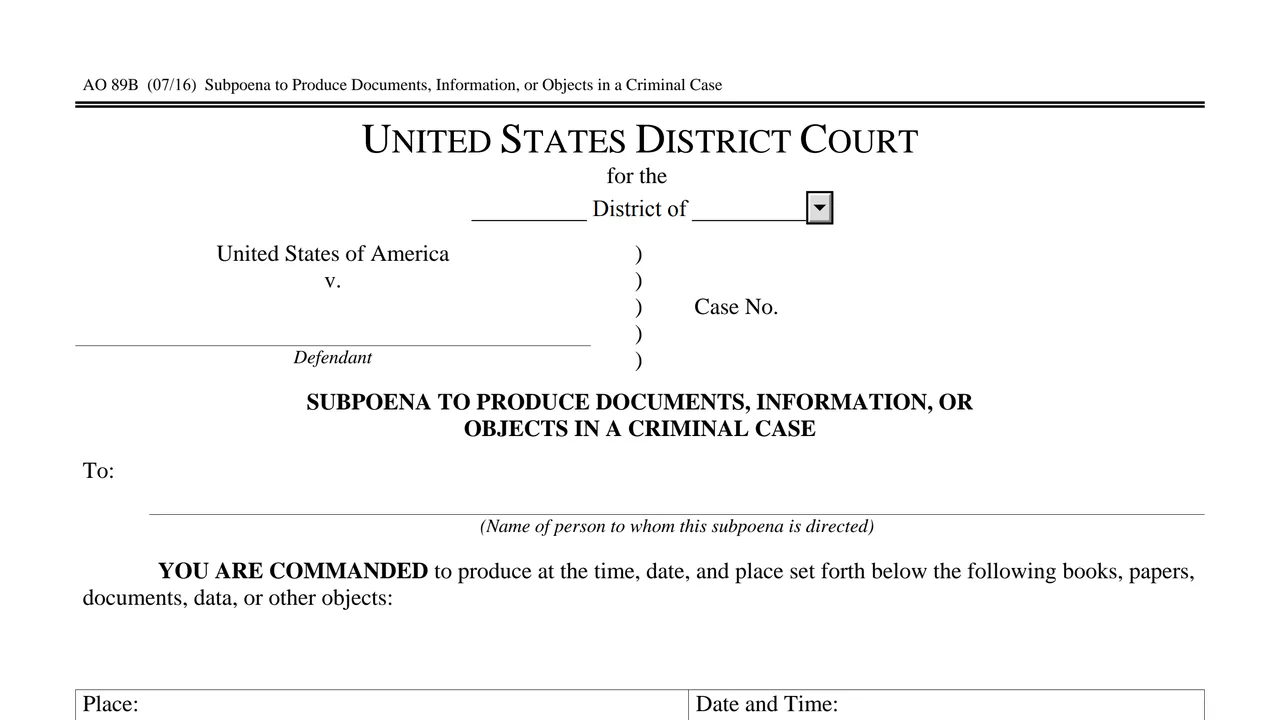
The United States District Court and district, United States of America v. the defendant, a case number, and the name of the person the subpoena is directed to.
The command to produce the books, papers, documents, data or other objects listed, with boxes for the place and the date and time.
A note that provisions of Fed. R. Crim. P. 17 are attached, then the date, seal and clerk's signature, and the contact details of the attorney who requests the subpoena.
A notice about local rules or orders on issuing a Rule 17(c) subpoena, and that a subpoena for certain information about a victim may not be issued unless first approved by separate court order.
Who the subpoena was for and the date received, served by delivery or returned unexecuted and why, lines for witness fees and mileage tendered and the server's travel and service fees, and the server's declaration.
Federal Rule of Criminal Procedure 17 (c), (d), (e), and (g), marked Effective 12/1/08: producing documents and objects, service, place of service, and contempt.
The notice says the party seeking the subpoena is advised to consult the rules of practice of the court where the criminal proceeding is pending. If no local rules or orders govern Rule 17(c), it says counsel should ask the assigned judge.
The district, the defendant and the case number are entered, and the name of the person the subpoena is directed to goes on the To line.
The books, papers, documents, data or other objects to produce are listed, with the place and the date and time for production.
The Clerk or Deputy Clerk dates and signs, and the party represented and the requesting attorney's name, address, e-mail and telephone number are entered.
The server fills in who the subpoena was for and when it was received, checks served or returned unexecuted with the details, enters any witness fees and mileage tendered and the server's fees, and signs under penalty of perjury.
You get the real form, filled in a browser tab, with nothing standing between you and the finished PDF.
The subpoena is captioned for a United States District Court, with the district named at the top, in a case titled United States of America v. the defendant.
The form says Rule 17(c) provides that a subpoena for the production of certain information about a victim may not be issued unless first approved by separate court order. Rule 17(c)(3) on page 3 adds that, unless there are exceptional circumstances, the court requires giving notice to the victim before entering the order.
Rule 17(d) on page 3 says the server delivers a copy to the witness and tenders one day's witness-attendance fee and the legal mileage allowance, except when the United States, a federal officer, or a federal agency requested the subpoena. The form prints no fee amounts.
Page 1 says Rule 17(c)(2) relates to the ability to file a motion to quash or modify the subpoena, and Rule 17(g) to the duty to respond and the potential consequences of not doing so.
The U.S. Courts page offers AO 89B as a PDF (1.01 MB). The PDF has Print, Save As, Add Attachment and Reset buttons.
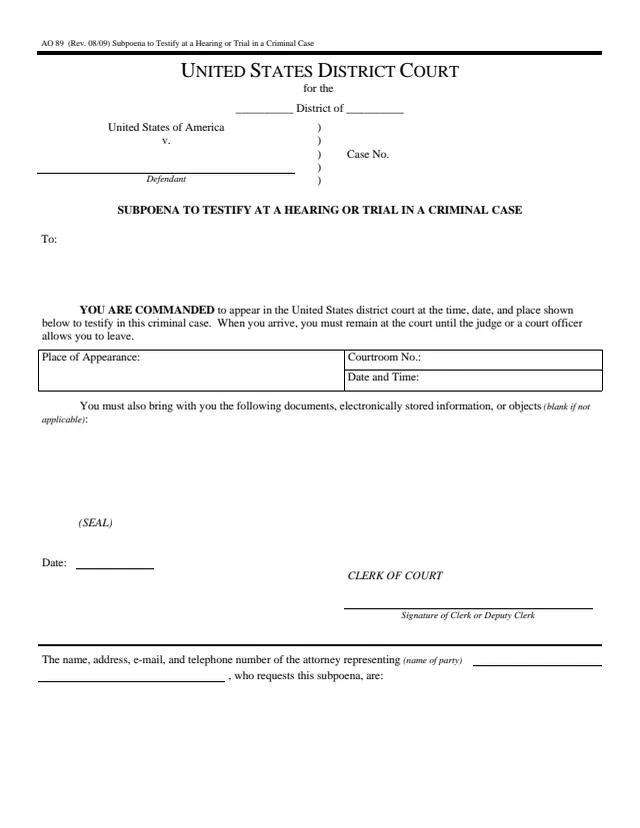
AO 89
35 fields, 2 pages
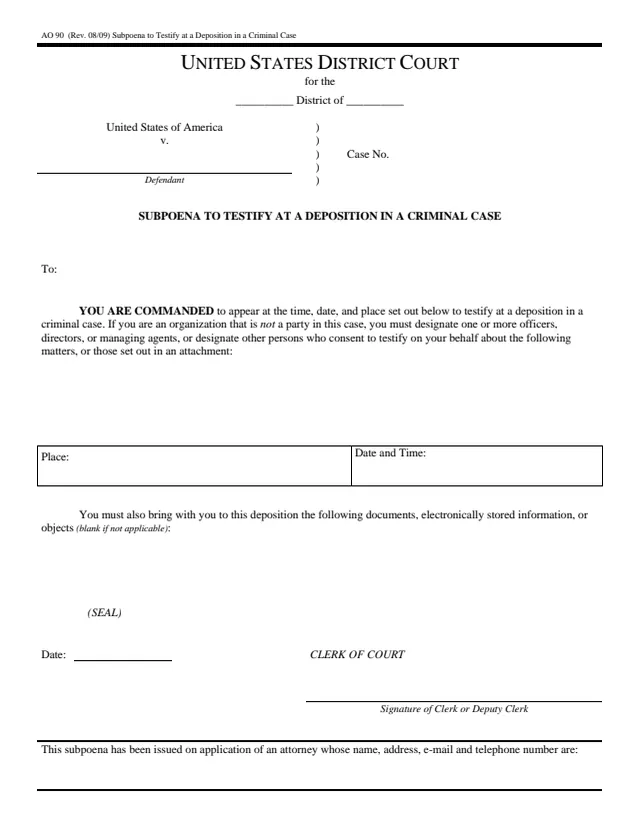
AO 90
33 fields, 2 pages
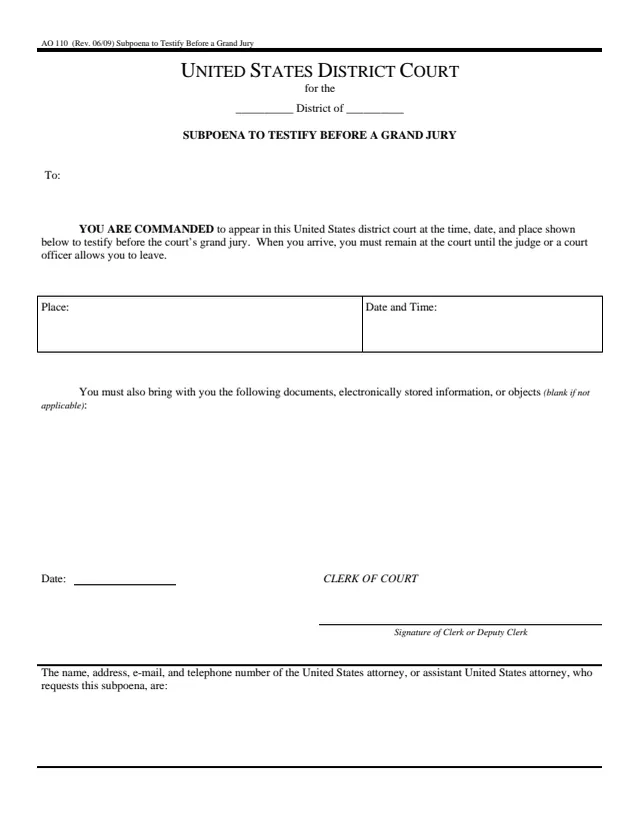
AO 110
26 fields, 2 pages
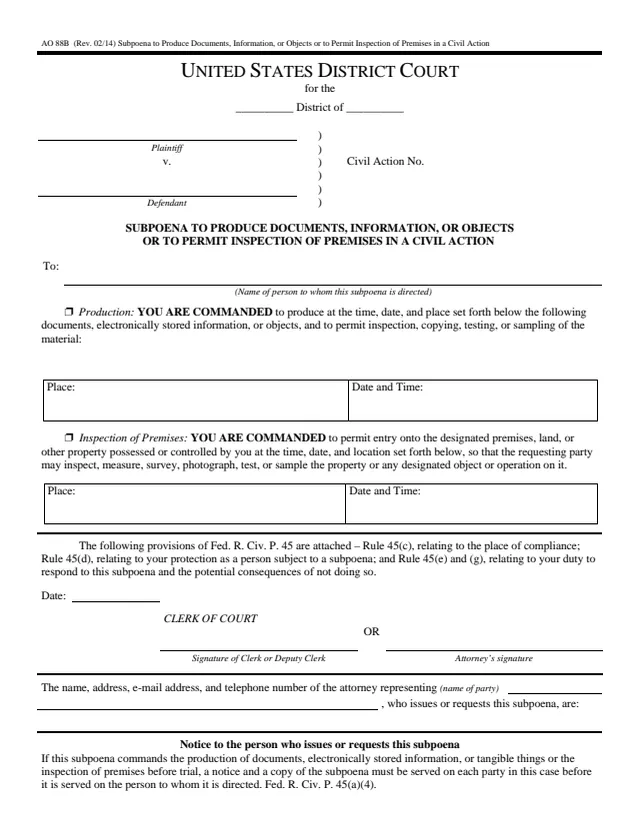
AO 88B
40 fields, 3 pages
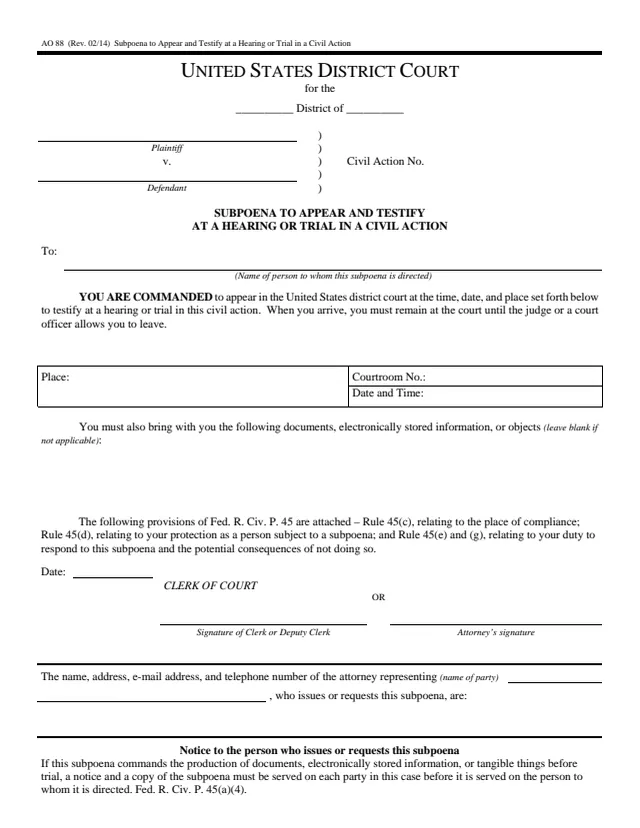
AO 88
37 fields, 3 pages
The form names who signs it, who requests it, who receives it and who serves it.
No tool matches that search.
The form is signed by the Clerk or Deputy Clerk under CLERK OF COURT, with the court's seal, and page 1 lists the attorney representing the party who requests the subpoena. It is not a form a member of the public files.
The form commands the person named to produce the listed books, papers, documents, data or other objects at the time, date and place set forth on page 1.
Page 1 says the attached Rule 17(c)(2) relates to the ability to file a motion to quash or modify the subpoena. Page 3 prints that rule: on motion made promptly, the court may quash or modify the subpoena if compliance would be unreasonable or oppressive.
The form says that under Rule 17(c) a subpoena for the production of certain information about a victim may not be issued unless first approved by separate court order. Page 3 prints Rule 17(c)(3), on personal or confidential information about a victim after a complaint, indictment, or information is filed.
Rule 17(d), printed on page 3, says a marshal, a deputy marshal, or any nonparty who is at least 18 years old may serve a subpoena. The server completes the Proof of Service on page 2.
Page 1 has a place, date and time. The notice says that if no local rules or orders govern Rule 17(c), counsel should ask the assigned judge whether the court specifies where the documents are returned, for example to the court clerk, the chambers of the assigned judge, or counsel's office.
No. This page explains the form in plain words and is not legal advice. The page does not say what a person named in a subpoena should do.