Caption
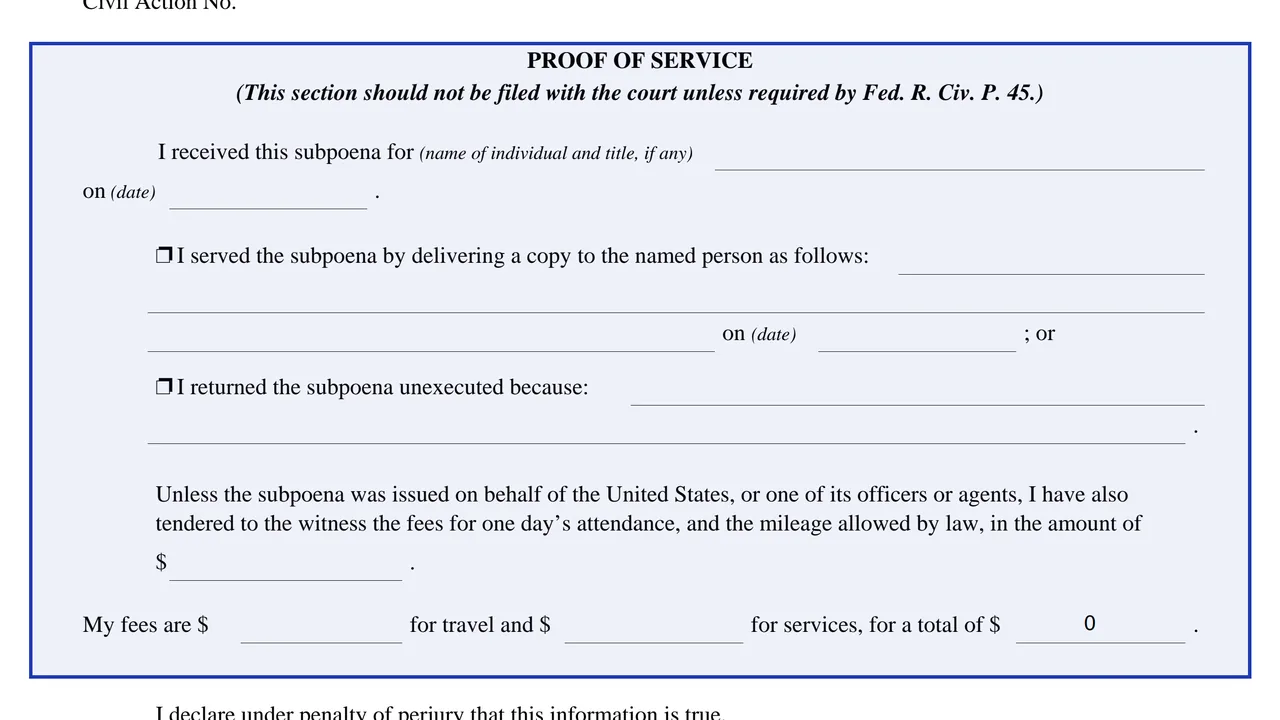
The United States District Court and the district, the plaintiff and defendant, and the Civil Action No.
AO 88
Subpoena to Appear and Testify at a Hearing or Trial in a Civil Action
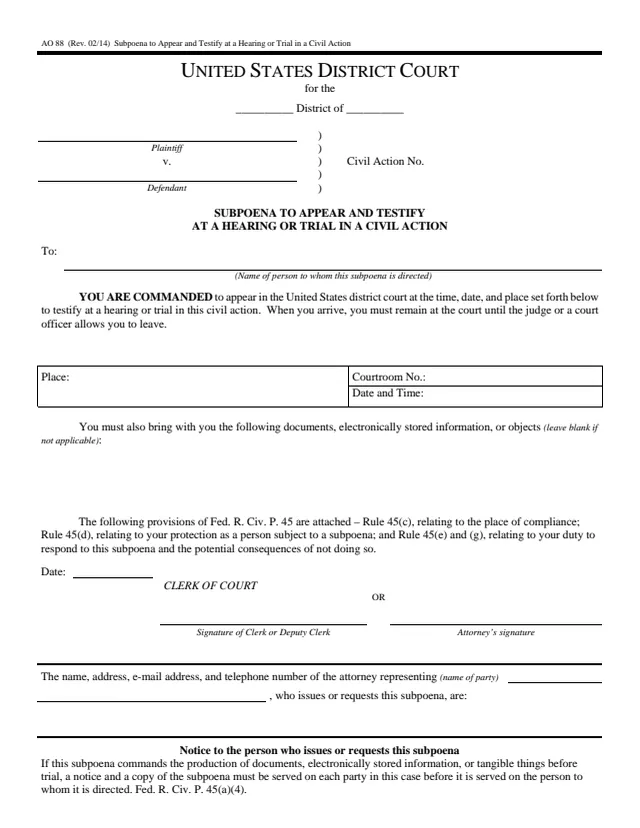
AO 88, Subpoena to Appear and Testify at a Hearing or Trial in a Civil Action, is a U.S. Courts form for a civil action in a United States district court. It commands the person named in it to appear in the district court at the time, date and place shown to testify at a hearing or trial. The U.S. Courts page lists it under Notice of Lawsuit, Summons, Subpoena, effective on February 1, 2014, and the form is marked Rev. 02/14.
Page 1 is the subpoena, signed by the Clerk of Court or a Deputy Clerk, or by an attorney. Page 2 is a Proof of Service for the person who serves it. Page 3 prints Federal Rule of Civil Procedure 45 (c), (d), (e), and (g) (Effective 12/1/13), which the form says are attached.
This page explains the form in plain words and is not legal advice. You can fill it out free in your browser on this page and download the result without an account.
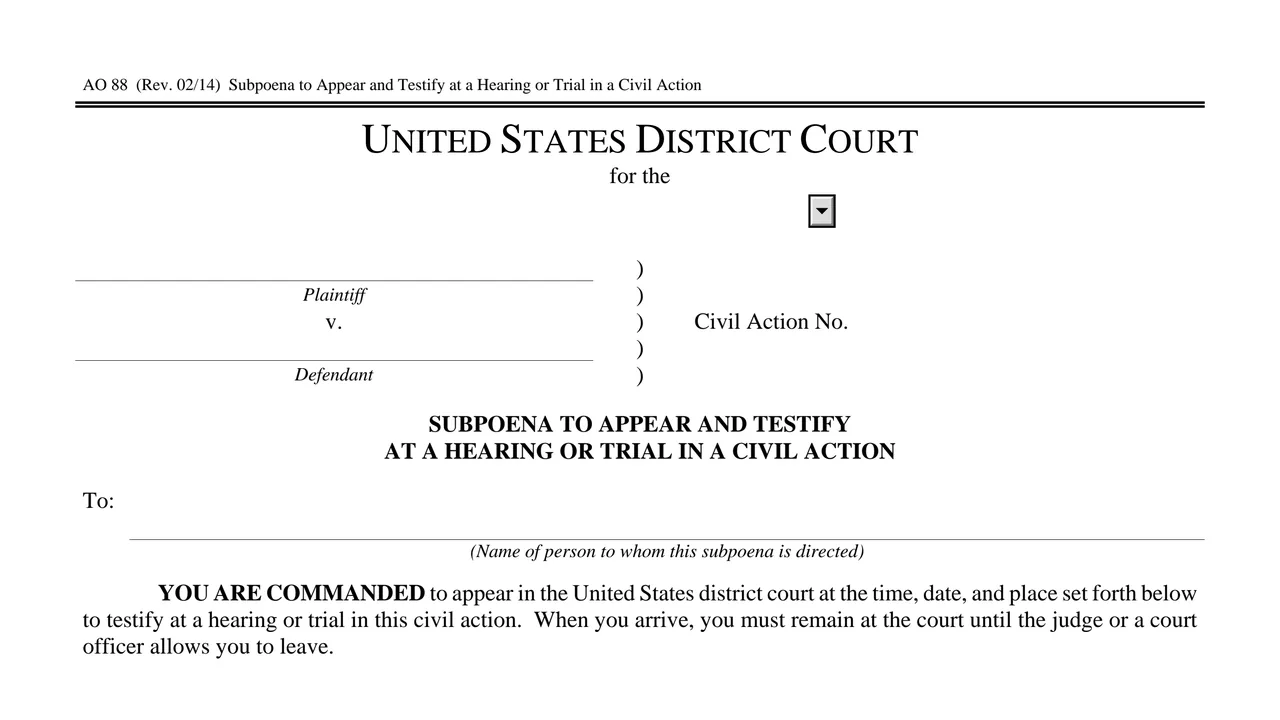
The United States District Court and the district, the plaintiff and defendant, and the Civil Action No.
The name of the person, then the place, courtroom number, date and time, and any documents, electronically stored information or objects to bring, which the form says to leave blank if not applicable.
The date, the clerk's or attorney's signature, the contact details of the attorney who issues or requests the subpoena, and the Rule 45(a)(4) notice.
Page 2: the date received, delivery to the named person or return unexecuted, witness fees and mileage tendered, the server's travel and service fees, the declaration under penalty of perjury, and notes on attempted service.
Page 3 prints Rule 45(c) on the place of compliance, 45(d) on protecting a person subject to a subpoena, 45(e) on duties in responding, and 45(g) on contempt.
Enter the district, the plaintiff and defendant names, and the civil action number.
Fill in the To line, the place, courtroom number, date and time, and list any documents, electronically stored information or objects to bring, or leave that space blank if not applicable.
Date the form. It is signed by the Clerk of Court or a Deputy Clerk, or by an attorney, and lists the name, address, email and phone of the attorney who issues or requests it.
The notice at the bottom of page 1 covers a subpoena that commands production of documents, electronically stored information or tangible things before trial, citing Fed. R. Civ. P. 45(a)(4).
The server fills in page 2: the date received, how it was served or why it was returned unexecuted, the fees, and signs with a printed name, title and address.
The form says the provisions of Fed. R. Civ. P. 45(c), (d), (e) and (g) are attached. Page 3 prints them.
You get the real form, filled in a browser tab, with nothing standing between you and the finished PDF.
The form is captioned for a United States District Court in a civil action. The person named appears in the United States district court at the place shown.
Page 2 says the Proof of Service section should not be filed with the court unless required by Fed. R. Civ. P. 45.
The form does not print a fee amount. The proof of service has blanks for the witness fees for one day's attendance and the mileage allowed by law, unless the subpoena was issued on behalf of the United States or one of its officers or agents, and for the server's travel and service fees.
The attached Rule 45(c)(1) says a subpoena may command a person to attend a trial, hearing, or deposition only within 100 miles of where the person resides, is employed, or regularly transacts business in person, or within the state in the cases it lists.
The attached Rule 45(g) says the court for the district where compliance is required may hold in contempt a person who, having been served, fails without adequate excuse to obey the subpoena or an order related to it.
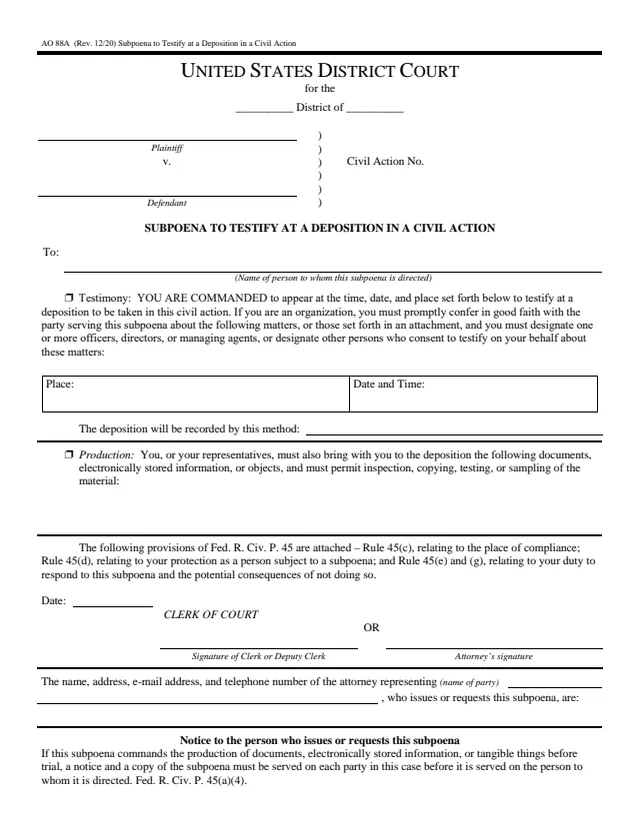
AO 88A
40 fields, 3 pages
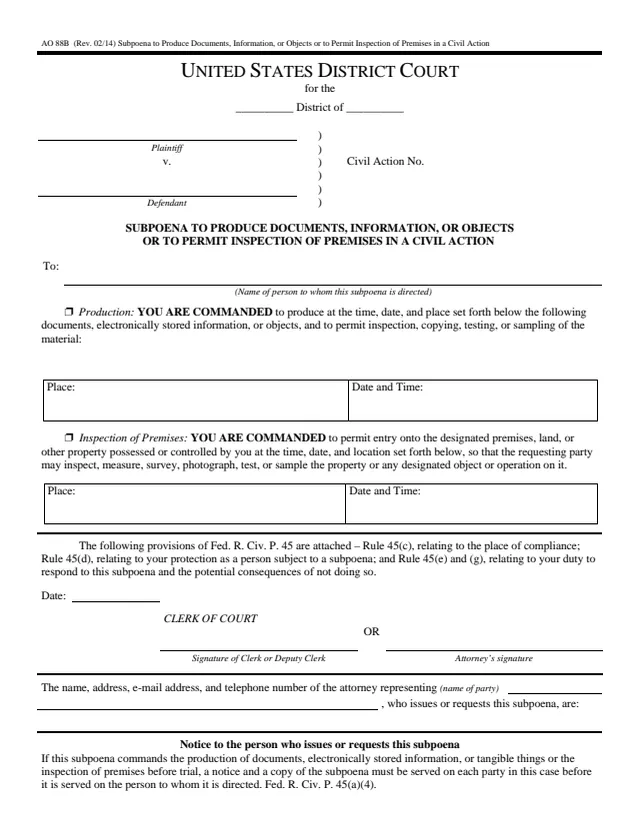
AO 88B
40 fields, 3 pages
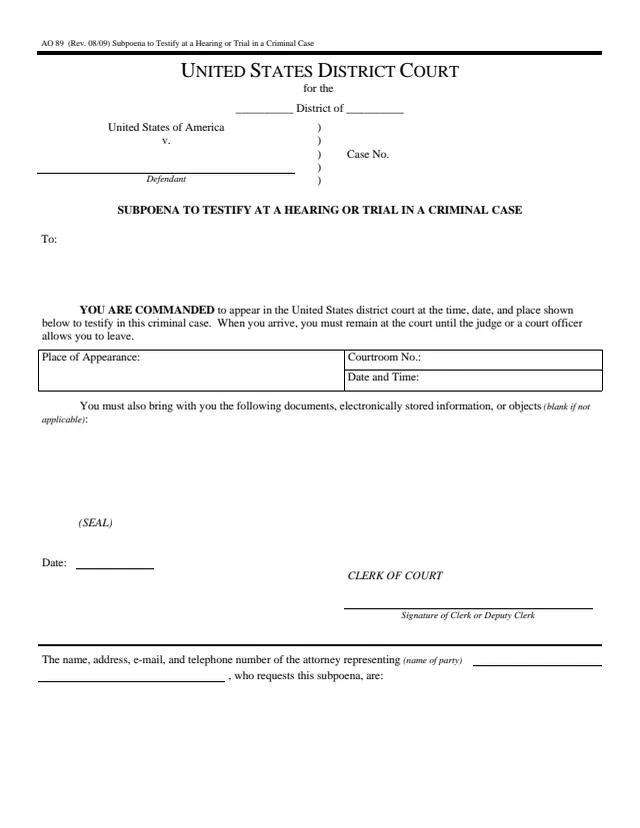
AO 89
35 fields, 2 pages
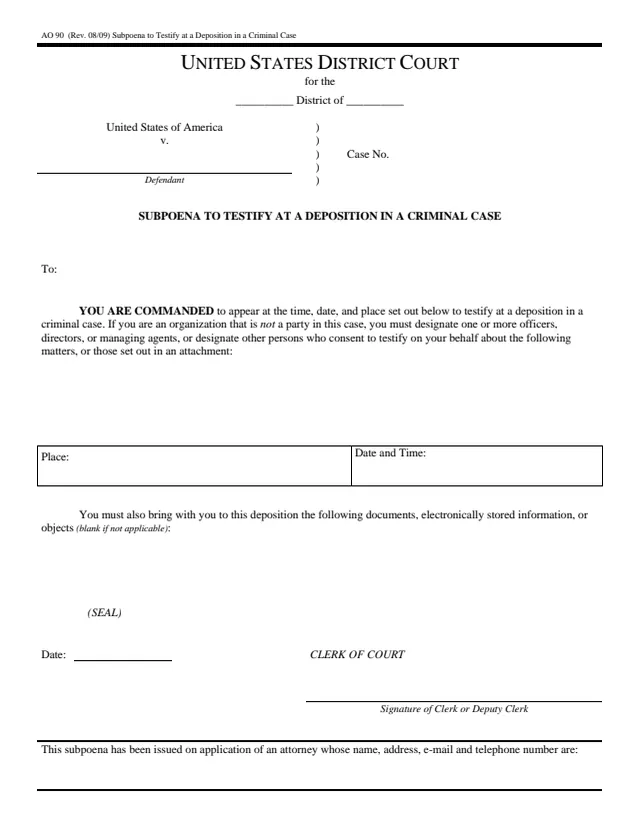
AO 90
33 fields, 2 pages
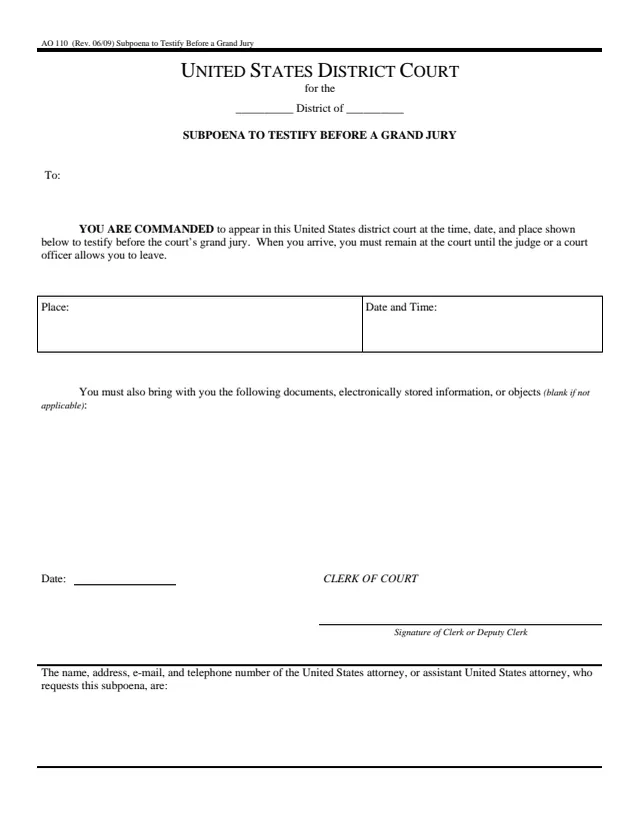
AO 110
26 fields, 2 pages
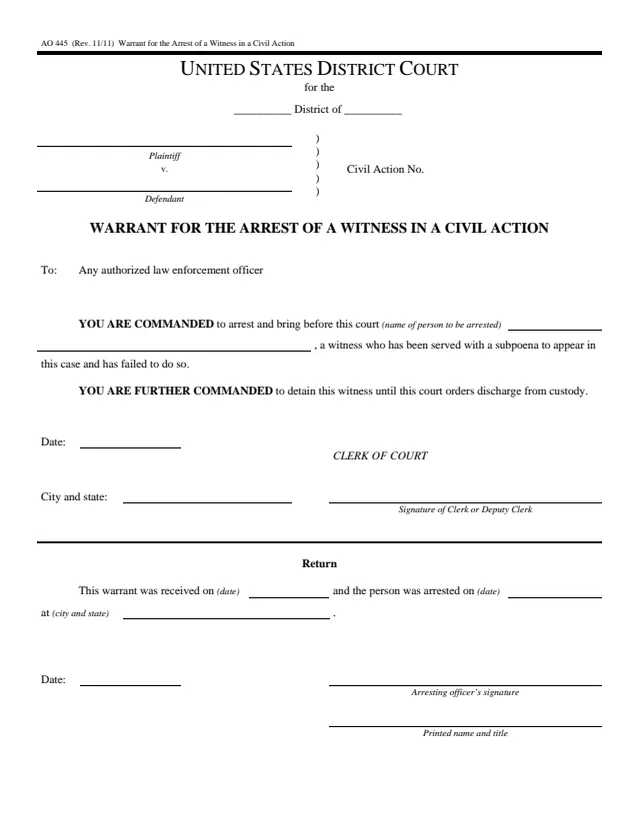
AO 445
46 fields, 2 pages
The form names the people who sign it, receive it and serve it.
No tool matches that search.
Page 1 has a signature line for the Clerk of Court or a Deputy Clerk, or, as the alternative, an attorney's signature. The server signs the Proof of Service on page 2.
Page 1 has a space for documents, electronically stored information or objects the person brings along. The form says to leave it blank if not applicable.
The form says that on arrival the person remains at the court until the judge or a court officer allows them to leave.
Rule 45(c)(1), printed on page 3, says a subpoena may command attendance at a trial, hearing, or deposition only within 100 miles of where the person resides, is employed, or regularly transacts business in person, or within the state if the person is a party or a party's officer, or is commanded to attend a trial and would not incur substantial expense.
Page 2 says it should not be filed with the court unless required by Fed. R. Civ. P. 45.
Rule 45(d)(3)(A), as printed on page 3, says that on timely motion the court for the district where compliance is required must quash or modify a subpoena that fails to allow a reasonable time to comply, requires compliance beyond the limits in Rule 45(c), requires disclosure of privileged or other protected matter if no exception or waiver applies, or subjects a person to undue burden.
No. This page explains what the form and its attached rule text say in plain words. It does not say how to respond to a subpoena or whether to issue one.