Caption
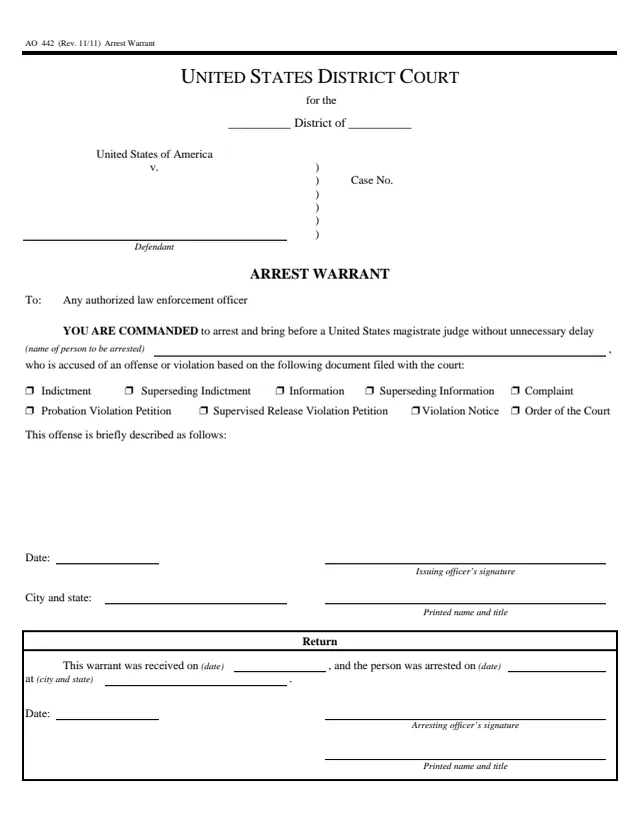
The district, United States of America v. the defendant, and the case number.
AO 83
Summons in a Criminal Case
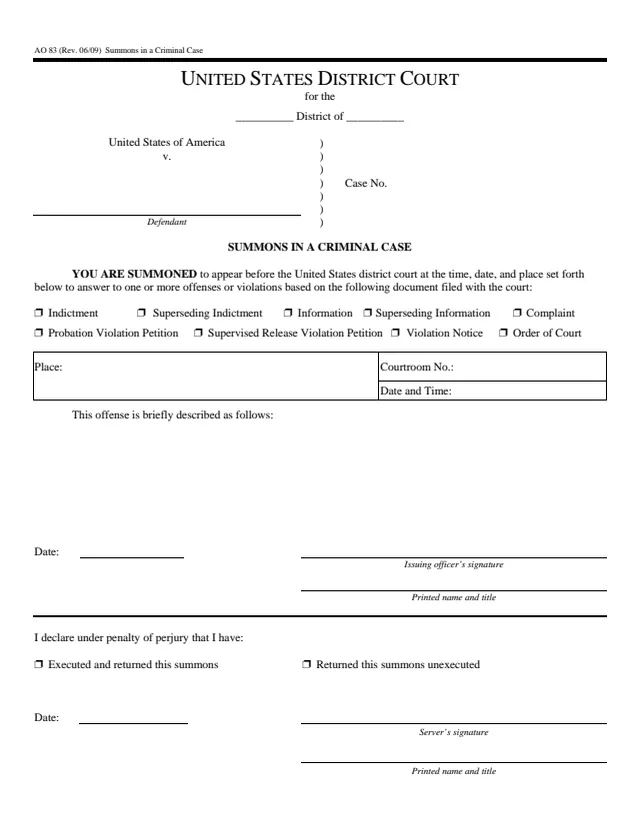
AO 83, Summons in a Criminal Case, is a United States District Court summons that tells a defendant to appear before the court to answer to one or more offenses or violations. The U.S. Courts list it under Law Enforcement, Grand Jury, and Prosecution Forms. The current version is Rev. 06/09, and the U.S. Courts page lists it as effective on June 1, 2009.
Page 1 names the court, the defendant and the case number, marks the document filed with the court that the summons is based on, sets the place, courtroom, date and time, and briefly describes the offense. It is signed by an issuing officer, and the server then declares whether it was executed and returned or returned unexecuted. Page 2 holds information for service and the proof of service, and the form says it contains personal identifiers. It is a court-issued summons, not a form members of the public file.
This page explains the form in plain words and is not legal advice. You can fill it out free in your browser on this page and download the result without an account.
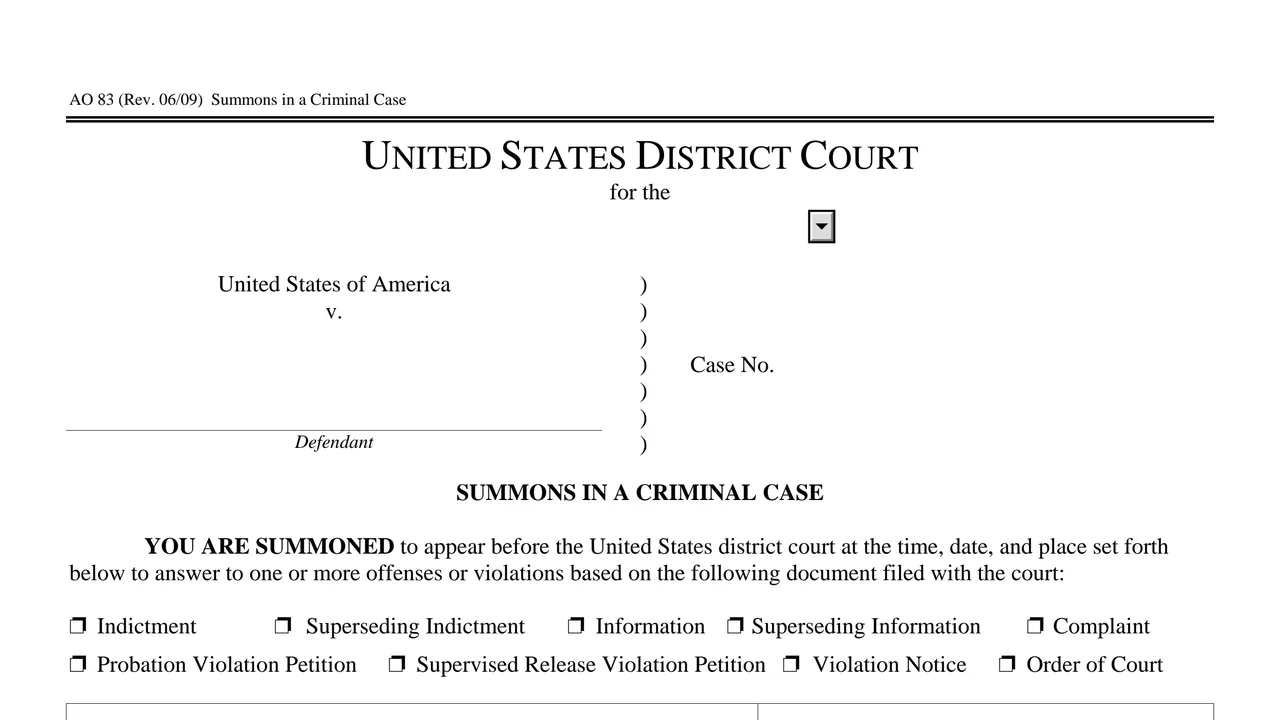
The district, United States of America v. the defendant, and the case number.
Boxes for an Indictment, Superseding Indictment, Information, Superseding Information, Complaint, Probation Violation Petition, Supervised Release Violation Petition, Violation Notice or Order of Court.
Where and when the defendant appears, with a courtroom number, followed by a space where the offense is briefly described.
The date and the issuing officer's signature, printed name and title, then the server's declaration under penalty of perjury that the summons was executed and returned or returned unexecuted.
The case number, the name of the defendant or offender, the last known residence, the usual place of abode if different, and the organization details. The page is marked Not for Public Disclosure.
The date received, how the summons was served or why it was returned unexecuted, the date returned, the server's signature, printed name and title, and remarks.
Enter the district, the defendant's name and the case number.
Check the box for the document filed with the court that the summons is based on, such as an indictment, an information, a complaint or a violation petition.
Fill in the place, courtroom number, date and time, and the brief description of the offense.
The issuing officer dates and signs page 1 and prints a name and title.
The server fills in page 2 with the service information and how the summons was served, then signs the return on page 1 and the proof of service on page 2 under penalty of perjury.
The form says the second page contains personal identifiers and therefore should not be filed in court with the summons unless under seal.
You get the real form, filled in a browser tab, with nothing standing between you and the finished PDF.
The summons is captioned for a United States District Court and tells the defendant to appear before that court at the place, courtroom, date and time it sets.
Personal service on the defendant; leaving it at the individual's residence or usual place of abode with a person of suitable age and discretion who resides there and mailing a copy to the last known address; or, for an organization, delivering a copy to an individual authorized to receive service and mailing a copy to its last known address within the district or its principal place of business elsewhere in the United States.
The form has a box and a line for the reason a summons was returned unexecuted.
Page 2 is marked Not for Public Disclosure. The form says it contains personal identifiers and should not be filed in court with the summons unless under seal.
The form does not print a fee or a service fee line.
The summons names who issues it, who it is addressed to and who serves it.
No tool matches that search.
The issuing officer signs page 1 and prints a name and title. The person who serves it signs the return on page 1 and the proof of service on page 2 under penalty of perjury.
The form lists an Indictment, Superseding Indictment, Information, Superseding Information, Complaint, Probation Violation Petition, Supervised Release Violation Petition, Violation Notice and Order of Court.
The form says the second page contains personal identifiers and therefore should not be filed in court with the summons unless under seal. It is marked Not for Public Disclosure.
The server checks Returned this summons unexecuted on page 1, and the proof of service on page 2 has a box and a line for the reason it was returned unexecuted.
No. It is a summons the court issues, signed by an issuing officer and served on the defendant. The U.S. Courts page lists it under Law Enforcement, Grand Jury, and Prosecution Forms.
No. This page explains what the printed form contains in plain words. It does not say what a summons means for any case.