Header and caption
The form number, edition and title, the district, United States of America v. the defendant, and a Case No. line.
AO 471
Order to Detain a Defendant Temporarily Under 18 U.S.C. § 3142(d)
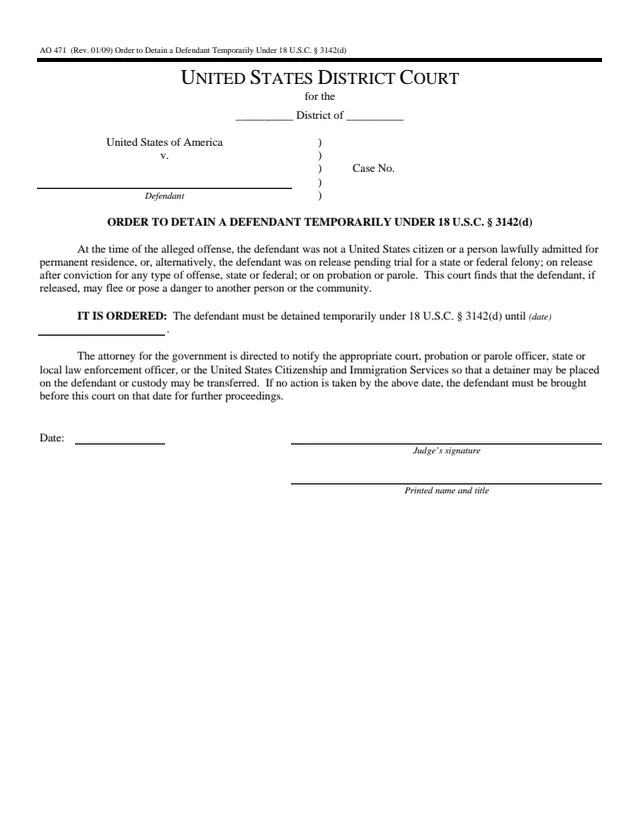
AO 471, Order to Detain a Defendant Temporarily Under 18 U.S.C. § 3142(d), is an order a United States District Court issues in a criminal case brought by the United States of America against a defendant. The U.S. Courts page lists it under Pretrial Detention Forms, effective on January 1, 2009, and the PDF prints the edition (Rev. 01/09).
It is an order of the court, not a form the public files. The one-page order states the defendant's status at the time of the alleged offense, records the court's finding that the defendant, if released, may flee or pose a danger to another person or the community, and orders the defendant detained temporarily under 18 U.S.C. § 3142(d) until a date the court fills in. It directs the attorney for the government to give notice so that a detainer may be placed on the defendant or custody may be transferred. A judge signs it.
This page explains the form in plain words and is not legal advice. You can fill it out free in your browser on this page and download the result without an account.
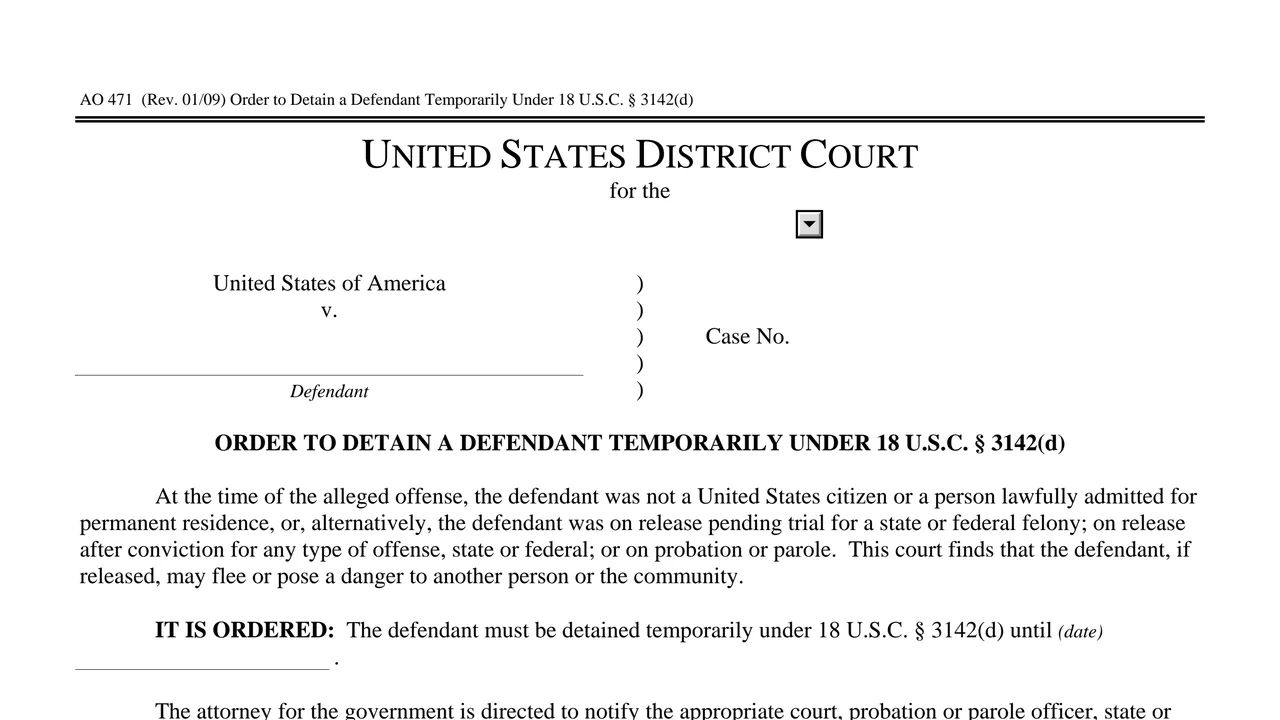
The form number, edition and title, the district, United States of America v. the defendant, and a Case No. line.
The form says that at the time of the alleged offense, the defendant was not a United States citizen or a person lawfully admitted for permanent residence, or was on release pending trial for a state or federal felony, on release after conviction for any type of offense, or on probation or parole.
"This court finds that the defendant, if released, may flee or pose a danger to another person or the community."
IT IS ORDERED: the defendant must be detained temporarily under 18 U.S.C. § 3142(d) until a date written on the line after "until (date)".
The attorney for the government is directed to give notice. If no action is taken by that date, the form says the defendant must be brought before this court on that date for further proceedings.
A date line, the judge's signature, and the judge's printed name and title.
Enter the district, the defendant's name and the case number in the caption.
The paragraph on the defendant's status at the time of the alleged offense and the finding about flight or danger are printed on the form.
Write the date until which the defendant is detained temporarily on the line after "until (date)".
The judge dates and signs the order and adds a printed name and title.
You get the real form, filled in a browser tab, with nothing standing between you and the finished PDF.
AO 471 is an order signed by a judge. It is not an application that a defendant or the public files.
The attorney for the government is directed to notify the appropriate court, probation or parole officer, state or local law enforcement officer, or the United States Citizenship and Immigration Services.
The form says that if no action is taken by the date written on it, the defendant must be brought before this court on that date for further proceedings.
The form does not print a fee.
The PDF prints Rev. 01/09. The U.S. Courts page lists the form under Pretrial Detention Forms, effective on January 1, 2009.
The form is an order of the court. It names these people and offices.
No tool matches that search.
The court. The form is an order signed by a judge, and it has no part for the defendant or the public to fill in.
Until the date the court writes on the form. The form says that if no action is taken by that date, the defendant must be brought before this court on that date for further proceedings.
The form names the appropriate court, probation or parole officer, state or local law enforcement officer, or the United States Citizenship and Immigration Services, so that a detainer may be placed on the defendant or custody may be transferred.
"This court finds that the defendant, if released, may flee or pose a danger to another person or the community."
18 U.S.C. § 3142(d), in its title and in the order that the defendant be detained temporarily.
No. This page explains the form in plain words and is not legal advice.