Header and caption
The form number, edition and title, the district, United States of America v. the defendant, and a Case No. line.
AO 468
Waiver of a Preliminary Hearing
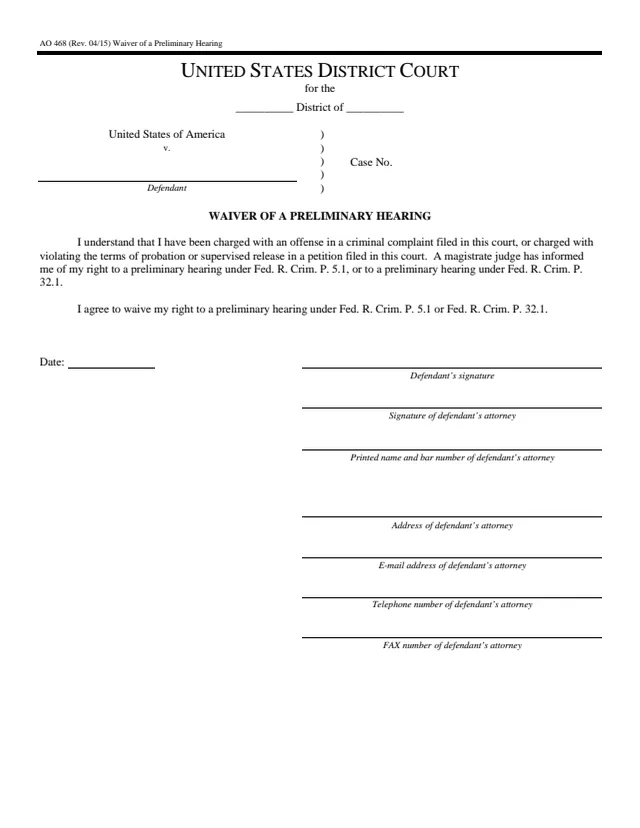
AO 468, Waiver of a Preliminary Hearing, is a one-page form for a criminal case in a United States District Court, captioned United States of America v. the defendant. The PDF prints the edition (Rev. 04/15), and the U.S. Courts page lists the form under Defendant Consent and Waiver Forms, effective on January 1, 2009.
The form is a statement in the defendant's own words. It says the defendant has been charged with an offense in a criminal complaint filed in this court, or charged with violating the terms of probation or supervised release in a petition filed in this court, and that a magistrate judge has informed the defendant of the right to a preliminary hearing under Fed. R. Crim. P. 5.1, or to a preliminary hearing under Fed. R. Crim. P. 32.1. It then reads: "I agree to waive my right to a preliminary hearing under Fed. R. Crim. P. 5.1 or Fed. R. Crim. P. 32.1." The defendant and the defendant's attorney sign it.
This page explains the form in plain words and is not legal advice. You can fill it out free in your browser on this page and download the result without an account.
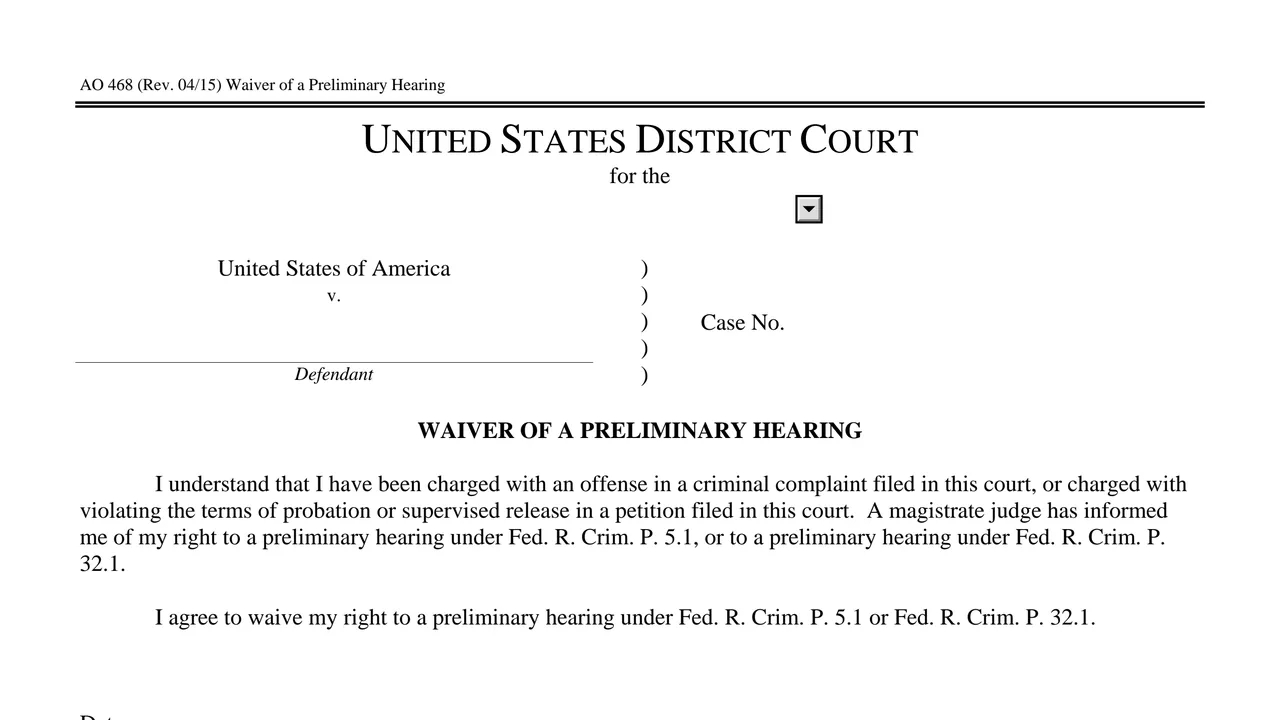
The form number, edition and title, the district, United States of America v. the defendant, and a Case No. line.
The defendant states being charged with an offense in a criminal complaint, or with violating the terms of probation or supervised release in a petition, filed in this court.
The defendant states that a magistrate judge has informed the defendant of the right to a preliminary hearing under Fed. R. Crim. P. 5.1, or to a preliminary hearing under Fed. R. Crim. P. 32.1.
One sentence: "I agree to waive my right to a preliminary hearing under Fed. R. Crim. P. 5.1 or Fed. R. Crim. P. 32.1."
A date line, the defendant's signature, the signature of the defendant's attorney, and the attorney's printed name and bar number, address, e-mail, telephone and FAX lines.
Enter the district, the defendant's name and the case number in the caption.
The printed text names a criminal complaint or a probation or supervised release petition, and preliminary hearings under Fed. R. Crim. P. 5.1 or Fed. R. Crim. P. 32.1.
Enter the date. The defendant signs on the Defendant's signature line.
The defendant's attorney signs and fills in the printed name and bar number, address, e-mail address, telephone number and FAX number.
You get the real form, filled in a browser tab, with nothing standing between you and the finished PDF.
The form is captioned for a United States District Court and says the complaint or petition was filed in this court.
The form does not print a fee.
The PDF prints Rev. 04/15. The U.S. Courts page lists the form under Defendant Consent and Waiver Forms, effective on January 1, 2009.
The form has signature lines for the defendant and the defendant's attorney, and it names these people.
No tool matches that search.
The defendant and the defendant's attorney. The form has a line for the defendant's signature and a block for the attorney's signature, printed name and bar number, address, e-mail address, telephone number and FAX number.
Fed. R. Crim. P. 5.1 and Fed. R. Crim. P. 32.1. The form says a magistrate judge has informed the defendant of the right to a preliminary hearing under them.
An offense charged in a criminal complaint filed in this court, or a charge of violating the terms of probation or supervised release in a petition filed in this court.
No. The PDF has lines for the date, the defendant's signature and the defendant's attorney, and no judge's signature line.
The PDF prints Rev. 04/15. The U.S. Courts page lists the form as effective on January 1, 2009.
No. This page explains the form in plain words and is not legal advice.