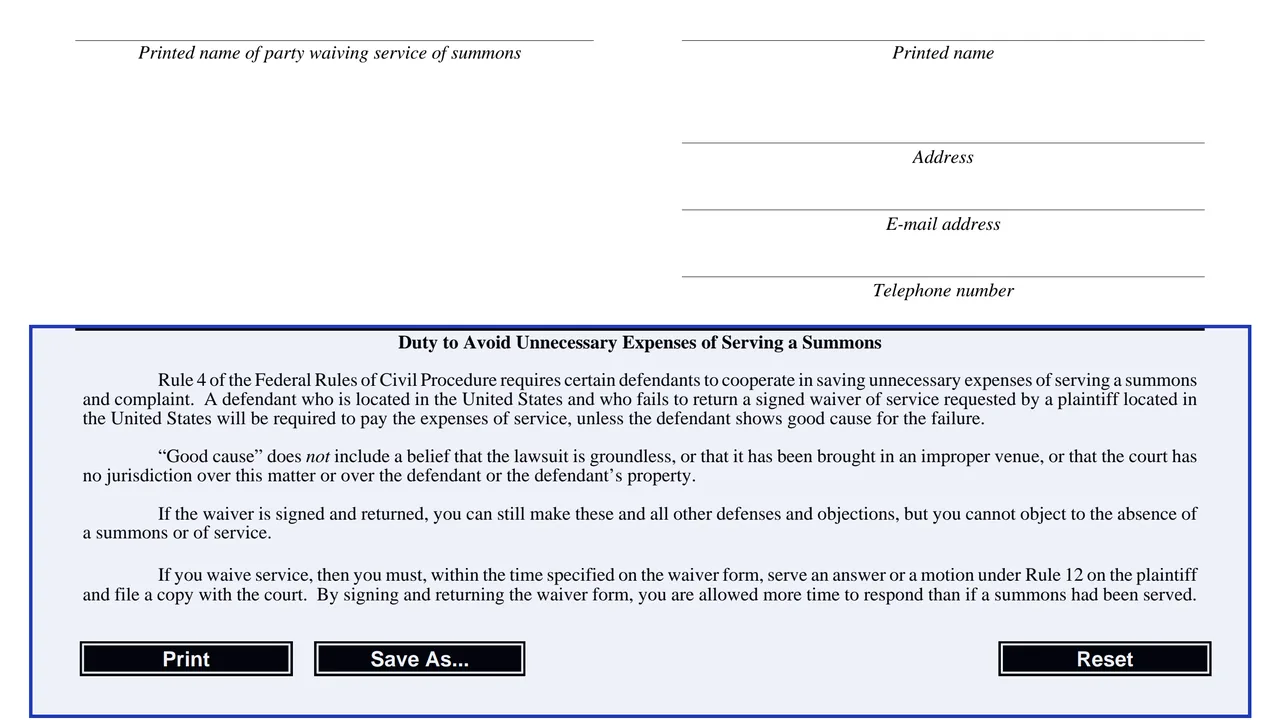
Caption and To line
The United States District Court and district, the plaintiff and defendant names, the civil action number, and the name of the plaintiff's attorney or unrepresented plaintiff.
AO 399
Waiver of the Service of Summons
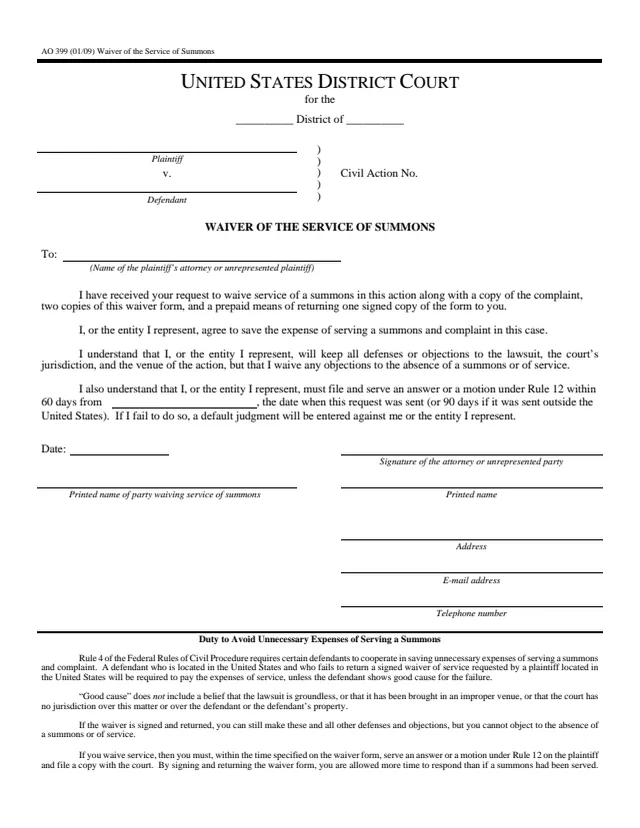
AO 399, Waiver of the Service of Summons, is a U.S. Courts form for a civil action in a United States District Court. The U.S. Courts page lists it under Notice of Lawsuit, Summons, Subpoena, effective on January 1, 2009, and the PDF is dated 01/09.
It is signed by the attorney or unrepresented party for the party waiving service, and is addressed to the plaintiff's attorney or unrepresented plaintiff. The signer confirms receiving a request to waive service with a copy of the complaint and agrees to save the expense of serving a summons and complaint. The form says all defenses or objections to the lawsuit, the court's jurisdiction and the venue are kept, while objections to the absence of a summons or of service are waived. A closing statement explains the duty under Rule 4 of the Federal Rules of Civil Procedure to avoid unnecessary expenses of serving a summons.
This page explains the form in plain words and is not legal advice. You can fill it out free in your browser on this page and download the result without an account.
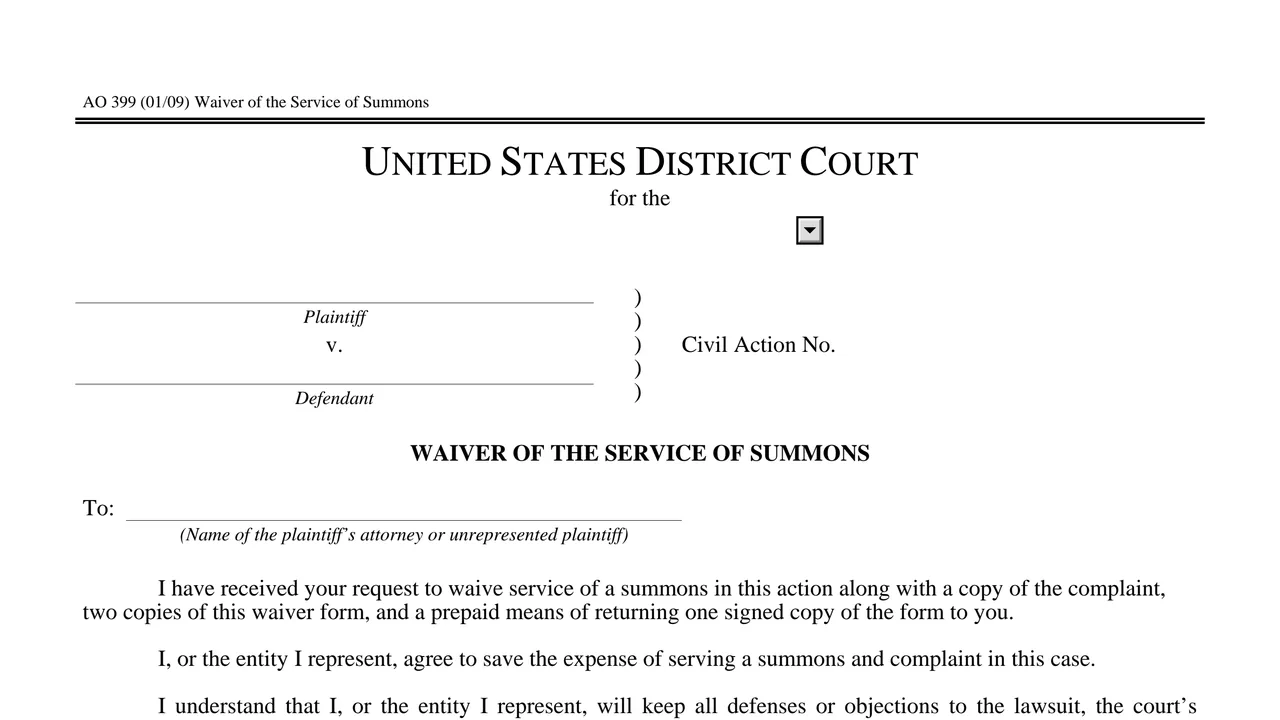
The United States District Court and district, the plaintiff and defendant names, the civil action number, and the name of the plaintiff's attorney or unrepresented plaintiff.
Confirms receipt of the request to waive service, a copy of the complaint, two copies of the waiver form and a prepaid means of returning one signed copy, and agrees to save the expense of serving a summons and complaint.
States that all defenses or objections to the lawsuit, the court's jurisdiction and the venue of the action are kept, and that objections to the absence of a summons or of service are waived.
States that an answer or a motion under Rule 12 is to be filed and served within 60 days from the date the request was sent (or 90 days if it was sent outside the United States), and that a default judgment will be entered otherwise.
Date, signature of the attorney or unrepresented party, printed name of the party waiving service of summons, printed name, address, email address and telephone number.
Explains that Rule 4 of the Federal Rules of Civil Procedure requires certain defendants to cooperate in saving unnecessary expenses of serving a summons and complaint, and what good cause does not include.
Enter the district, the plaintiff and defendant names and the civil action number of the case.
Write the name of the plaintiff's attorney or unrepresented plaintiff on the To line.
The blank after 60 days from is the date when the request was sent. The form counts the answer period from that date.
The statement at the bottom explains Rule 4 of the Federal Rules of Civil Procedure, what good cause does not include, and that signing allows more time to respond than if a summons had been served.
Date and sign, then print the name of the party waiving service and the signer's name, address, email address and phone. The form says the request came with a prepaid means of returning one signed copy.
You get the real form, filled in a browser tab, with nothing standing between you and the finished PDF.
Back to the plaintiff's attorney or unrepresented plaintiff named on the To line, using the prepaid means of return that came with the request.
The form says an answer or a motion under Rule 12 is to be filed and served within 60 days from the date the request was sent, or 90 days if it was sent outside the United States, and that a default judgment will be entered if that is not done.
The form does not print a filing fee. Its duty statement says a defendant located in the United States who fails to return a signed waiver requested by a plaintiff located in the United States will be required to pay the expenses of service, unless the defendant shows good cause for the failure.
The form says good cause does not include a belief that the lawsuit is groundless, that it has been brought in an improper venue, or that the court has no jurisdiction over the matter or over the defendant or the defendant's property.
The U.S. Courts page offers AO 399 as a PDF.
AO 398
15 fields, 1 page
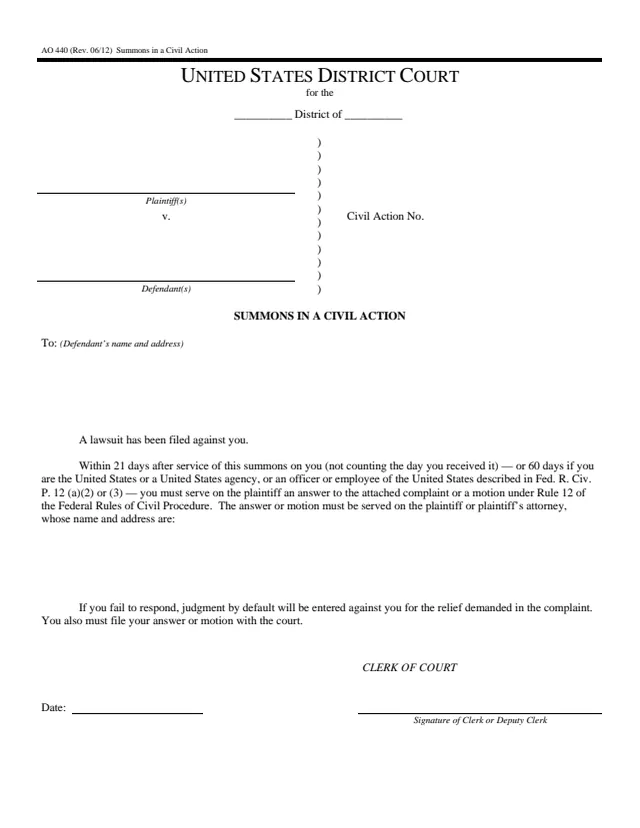
AO 440
34 fields, 2 pages
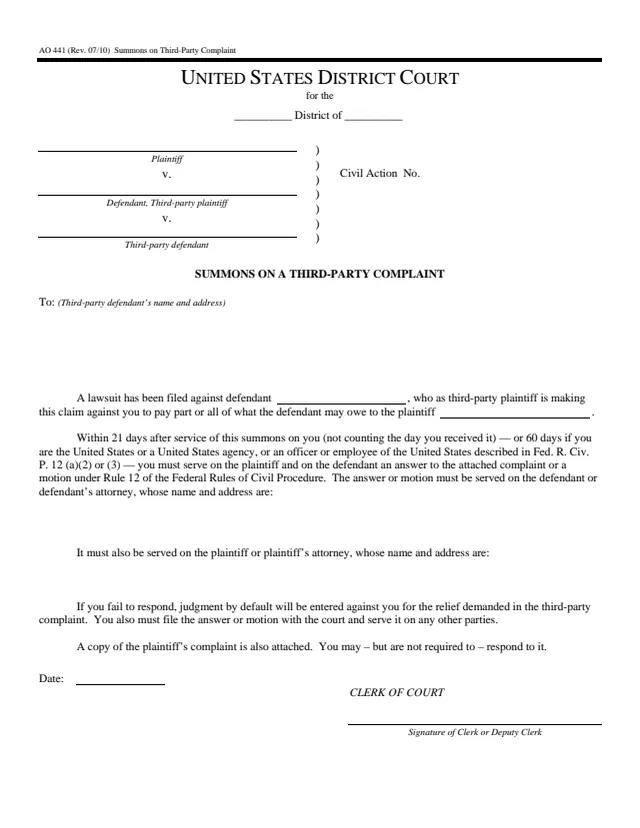
AO 441
40 fields, 2 pages
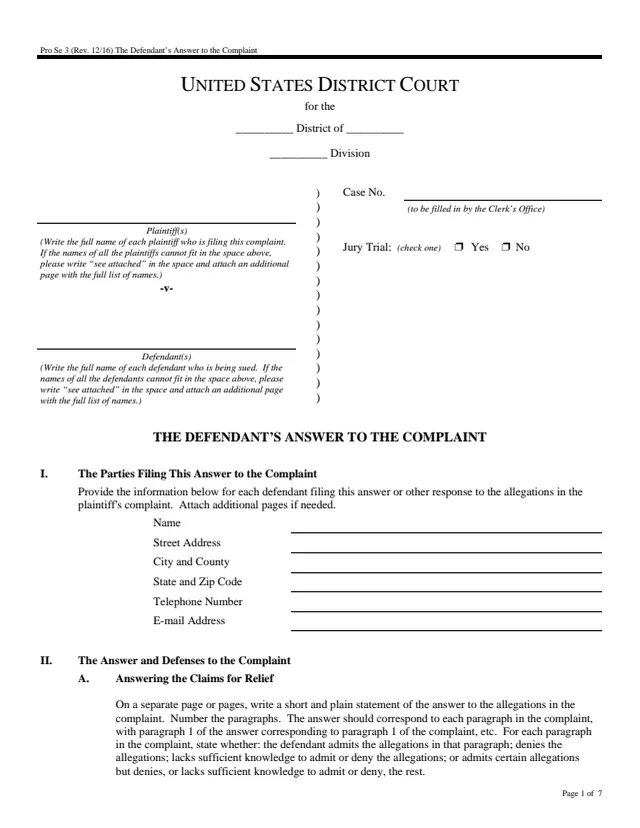
Pro Se 3
65 fields, 7 pages
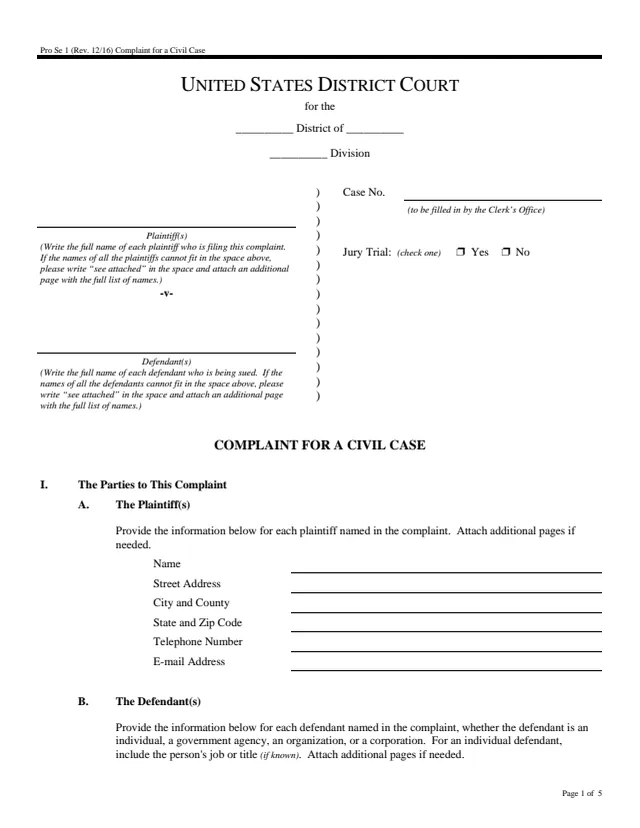
Pro Se 1
76 fields, 5 pages
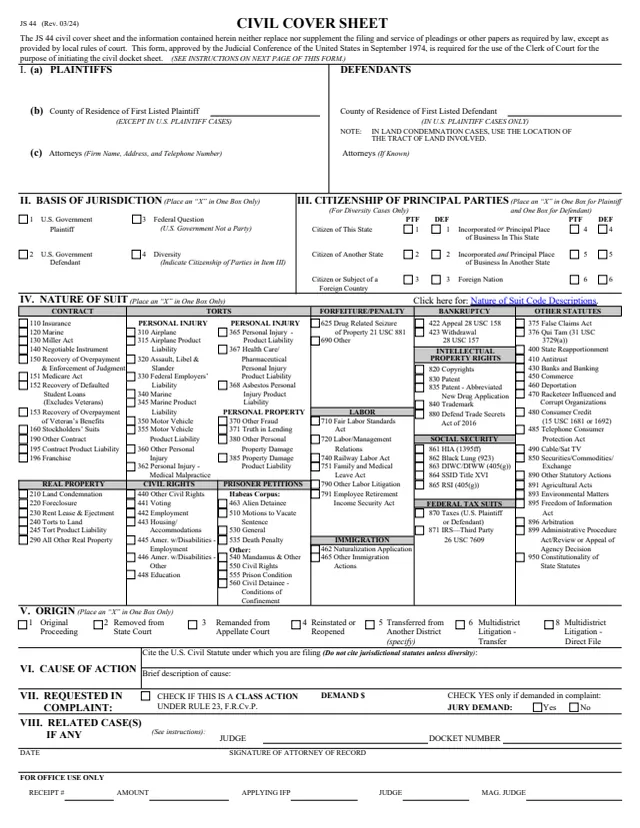
JS 44
35 fields, 2 pages
The form is written in the voice of the party waiving service, the defendant or the entity the defendant represents.
No tool matches that search.
The form says the signer keeps all defenses or objections to the lawsuit, the court's jurisdiction and the venue of the action, but waives any objections to the absence of a summons or of service.
The form says an answer or a motion under Rule 12 is to be filed and served within 60 days from the date the request was sent, or 90 days if it was sent outside the United States. The duty statement adds that signing allows more time to respond than if a summons had been served.
The plaintiff's attorney or unrepresented plaintiff named on the To line, who sent the request with a prepaid means of returning one signed copy.
The duty statement says a defendant located in the United States who fails to return a signed waiver requested by a plaintiff located in the United States will be required to pay the expenses of service, unless the defendant shows good cause for the failure.
The form says good cause does not include a belief that the lawsuit is groundless, that it has been brought in an improper venue, or that the court has no jurisdiction over the matter or over the defendant or the defendant's property.
No. The form does not print a fee. Its cost wording is about the expenses of serving a summons.