Heading
AO 390, the word Apostille and (Convention de La Haye du 5 octobre 1961). The PDF prints no edition date.
AO 390
Apostille (Convention de La Haye, 5 Octobre 1961)
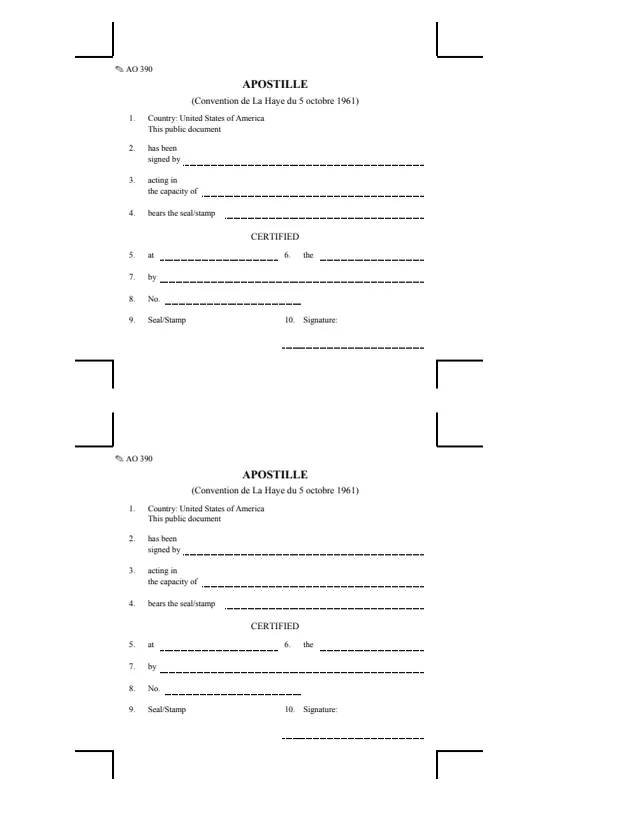
AO 390, Apostille (Convention de La Haye, 5 Octobre 1961), is a U.S. Courts form with ten numbered lines that certify a public document. The PDF prints the heading Apostille (Convention de La Haye du 5 octobre 1961), fills in United States of America as the country, and prints the apostille twice on one page. The U.S. Courts page lists it under Other Forms, effective on May 1, 1981. The PDF prints no edition date.
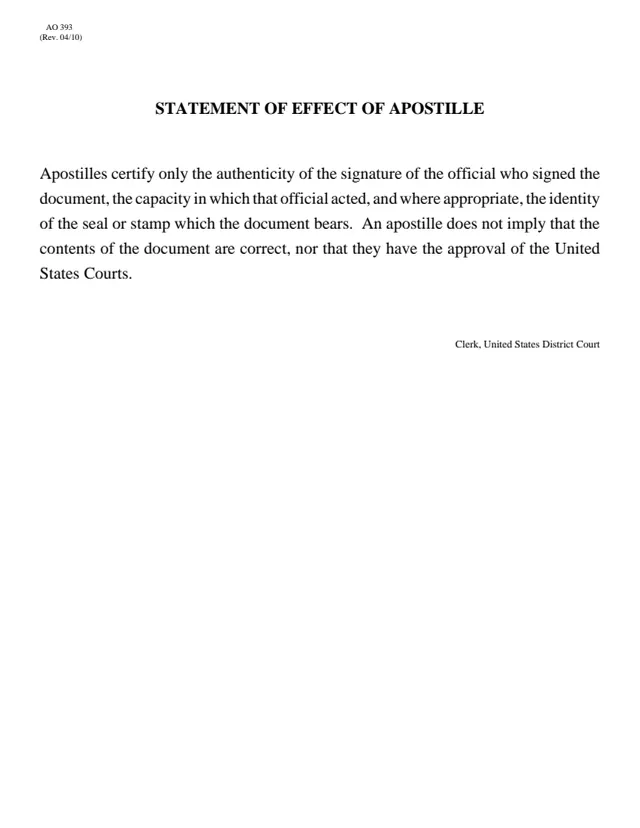
The first four lines identify who signed the public document, the capacity in which they acted, and the seal or stamp it bears. Under the word Certified, the remaining lines are printed as at, the, by, No., Seal/Stamp and Signature. The U.S. Courts statement on AO 393 says apostilles certify only the authenticity of the signature, the capacity of the official and, where appropriate, the seal or stamp, and do not imply that the contents of the document are correct.
AO 390 is a certificate completed by the certifying office, not a form the public files. This page explains the form in plain words and is not legal advice. You can fill it out free in your browser on this page and download the result without an account.
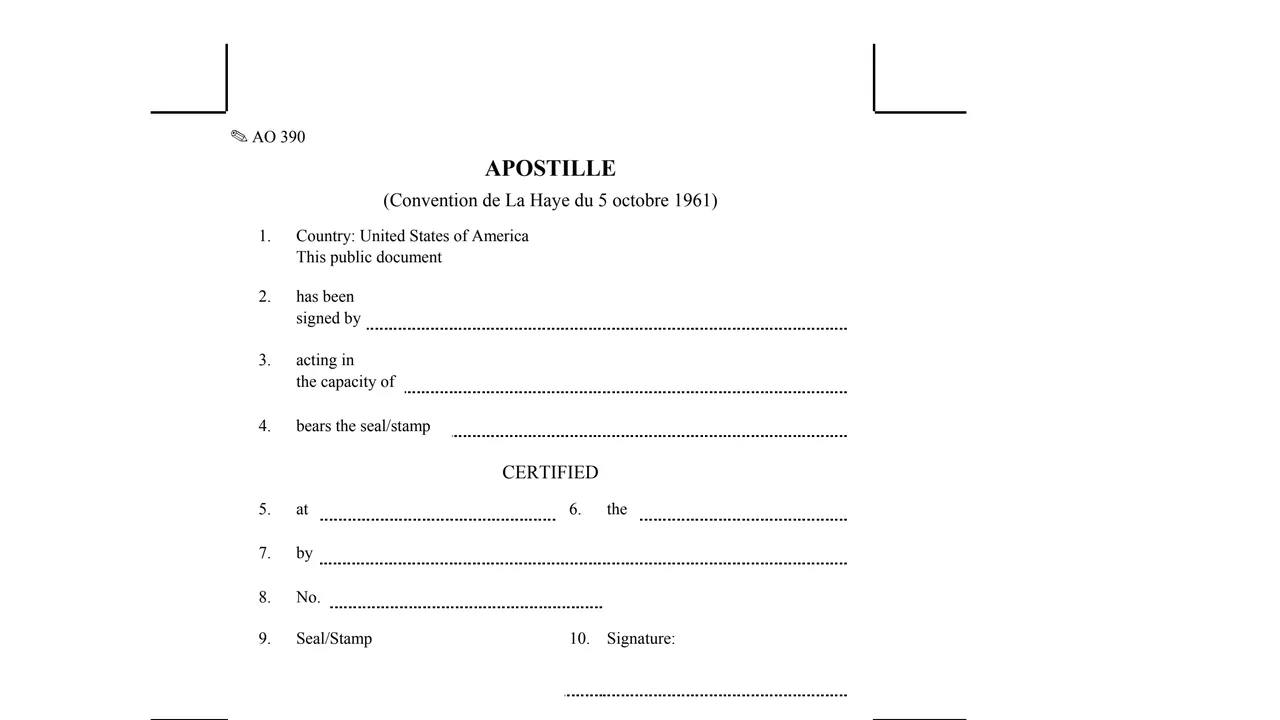
AO 390, the word Apostille and (Convention de La Haye du 5 octobre 1961). The PDF prints no edition date.
Preprinted as Country: United States of America, followed by the words This public document.
Has been signed by, acting in the capacity of, and bears the seal/stamp, each with a blank line.
Under the word Certified, four blank lines printed as 5. at, 6. the, 7. by, and 8. No.
Line 9 is a space for a seal or stamp and line 10 is the signature line.
The PDF prints the same apostille twice on one page, each with the full set of ten lines.
On lines 2 and 3, enter the name of the person who signed the public document and the capacity in which they acted.
On line 4, enter the seal or stamp the public document bears.
Fill in lines 5 to 7, printed as at, the and by, under the word Certified.
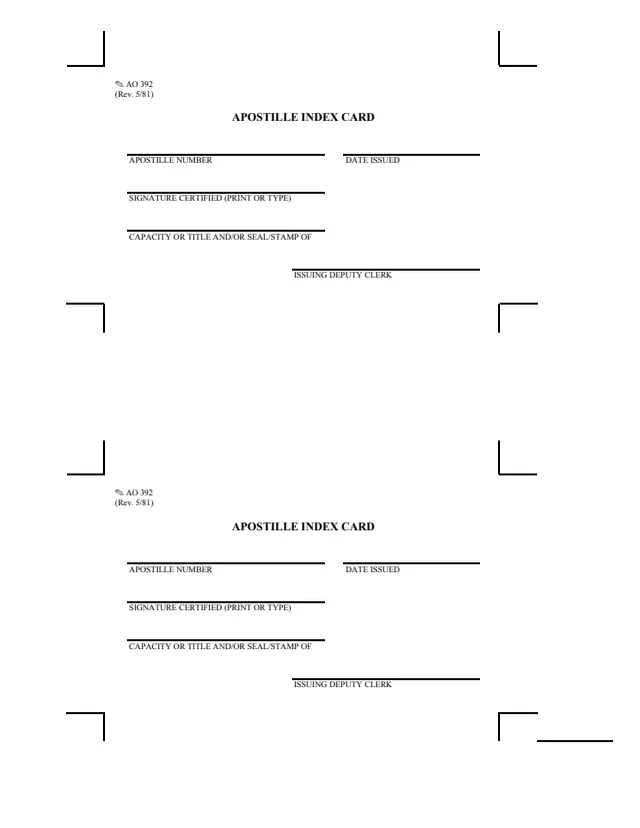
Line 8 is printed as No. AO 392, the Apostille Index Card, has lines for an apostille number and the date issued.
Place the seal or stamp in the space on line 9 and sign on line 10.
The lines are completed in their printed order.
You get the real form, filled in a browser tab, with nothing standing between you and the finished PDF.
AO 390 does not print the title of the certifying official. In the same series, AO 392 has a line for the issuing deputy clerk and AO 393 is signed by the Clerk, United States District Court.
AO 393 says apostilles certify only the authenticity of the signature of the official who signed the document, the capacity in which that official acted, and where appropriate, the identity of the seal or stamp.
AO 393 says an apostille does not imply that the contents of the document are correct, nor that they have the approval of the United States Courts.
AO 390 does not print a fee.
The U.S. Courts page offers AO 390 as a PDF under Other Forms, effective on May 1, 1981.
The form names the official whose signature is certified and has lines for the person who certifies it. It does not print the certifying official's title.
No tool matches that search.
The U.S. Courts statement on AO 393 says apostilles certify only the authenticity of the signature of the official who signed the document, the capacity in which that official acted, and where appropriate, the identity of the seal or stamp which the document bears.
No. AO 393 says an apostille does not imply that the contents of the document are correct, nor that they have the approval of the United States Courts.
Line 10 is the signature line, and line 7, printed as by, follows the word Certified. AO 390 does not print the official's title. In the same series, AO 392 has a line for the issuing deputy clerk and AO 393 is signed by the Clerk, United States District Court.
The PDF does not print one. The U.S. Courts page lists AO 390 as effective on May 1, 1981.
AO 390 does not print a fee.
No. This page explains the form in plain words and is not legal advice.