Case details
The case number, a vendor code reserved for the clerk's office if a record exists in the JIFMS accounting system, and the Victim Identification Number (VIN) if known.
AO 213R
Electronic Payment Information Request for Restitution Payees
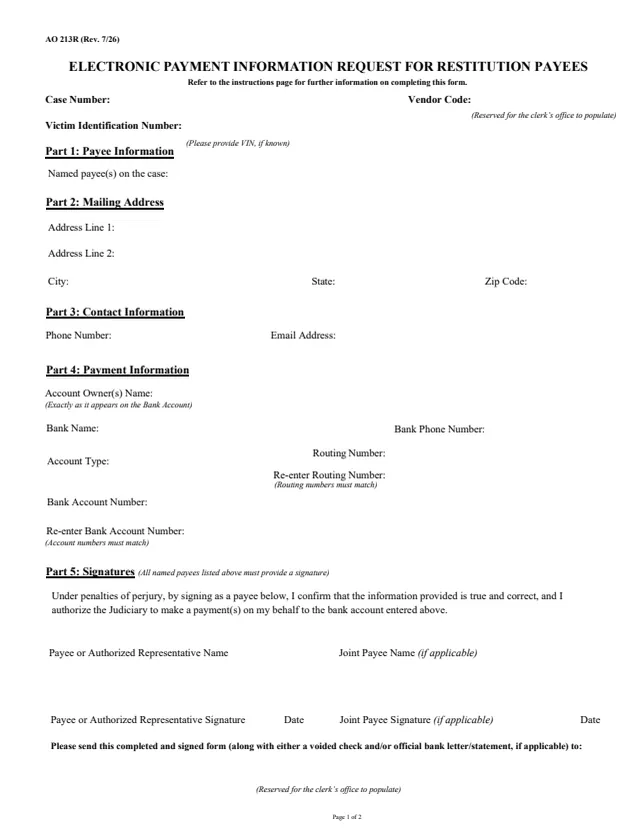
AO 213R, Electronic Payment Information Request for Restitution Payees, is the form the Judiciary uses to collect payee information for electronic restitution payments. The instructions say it authorizes the Judiciary to make a payment or payments on behalf of the payees to the bank account entered. The U.S. Courts page lists it under Other Forms, effective on July 15, 2026, and the PDF is dated Rev. 7/26.
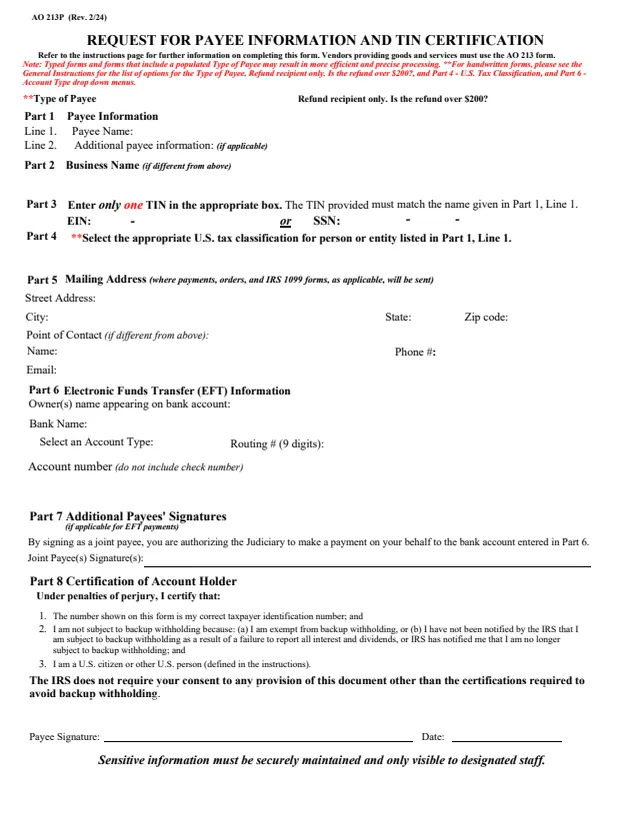
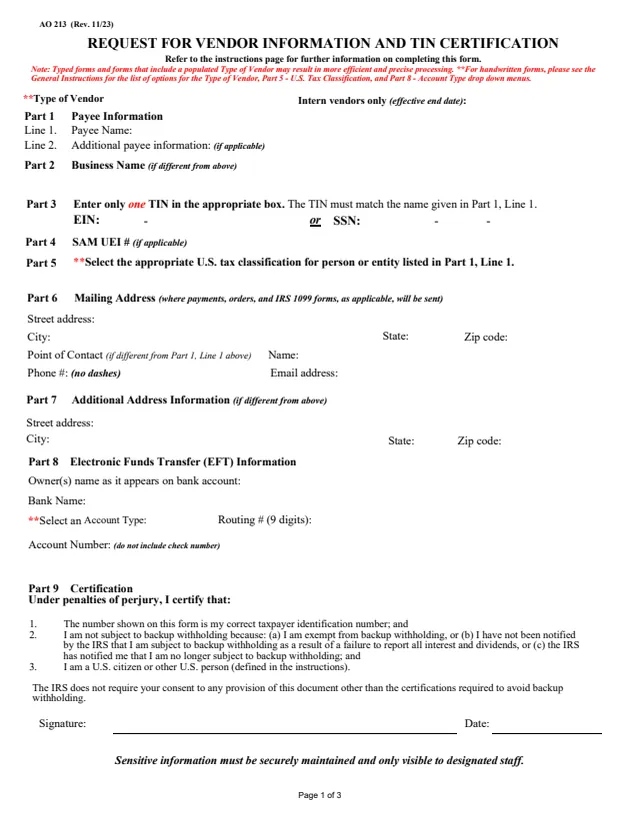
Page 1 asks for the case number and Victim Identification Number, then has five parts: payee information, mailing address, contact information, payment information and signatures. A vendor code and the address to send the form to are reserved for the clerk's office to fill in. Page 2 holds the General Instructions.
This page explains the form in plain words and is not legal advice. You can fill it out free in your browser on this page and download the result without an account.
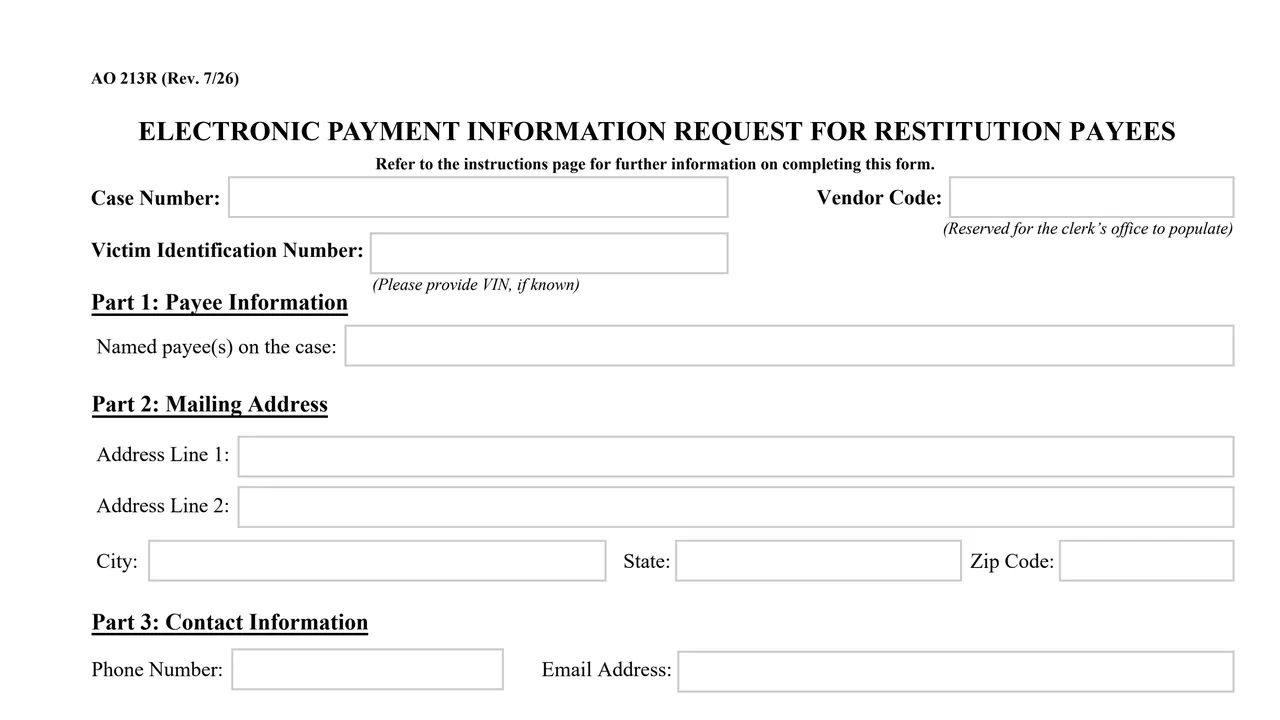
The case number, a vendor code reserved for the clerk's office if a record exists in the JIFMS accounting system, and the Victim Identification Number (VIN) if known.
The named payee or payees on the case, entered as listed on the order or judgment.
The primary mailing address, where P.O. Boxes are accepted, and a phone number and email address. With multiple payees, both belong to the primary owner of the bank account.
The account owner names exactly as on the bank account, the bank name and phone, the account type, and the routing and account numbers, each entered twice.
All named payees sign. Under penalties of perjury, the signer confirms the information is true and correct and authorizes the Judiciary to make a payment or payments to the bank account.
A space at the bottom, reserved for the clerk's office, for the address to send the completed and signed form to, along with a voided check or official bank letter or statement if applicable.
The instructions say a payee who does not know the case number, or is named in multiple cases across multiple districts, can reach out to the local clerk's office for help. The VIN is provided by the Department of Justice.
Enter the named payee or payees as listed on the order or judgment. The instructions say separate, individual payments require a court order, and funds cannot be disbursed to a third party.
Give the primary mailing address, a mobile or business phone number and an email address. With multiple payees, use those of the primary owner of the bank account.
The instructions say the routing number has nine digits and is entered twice, the account number is entered twice, and both are verified with the financial institution before submission.
All named payees or authorized representatives sign and date Part 5. The instructions say to send the form to the clerk's office where the criminal case is located, or to the local clerk's office if that is unknown.
You get the real form, filled in a browser tab, with nothing standing between you and the finished PDF.
The instructions say to send it to the clerk's office where the criminal case is located, or to the local clerk's office if the location of the case is unknown. The send-to address on the form is reserved for the clerk's office to fill in.
The form does not print a fee.
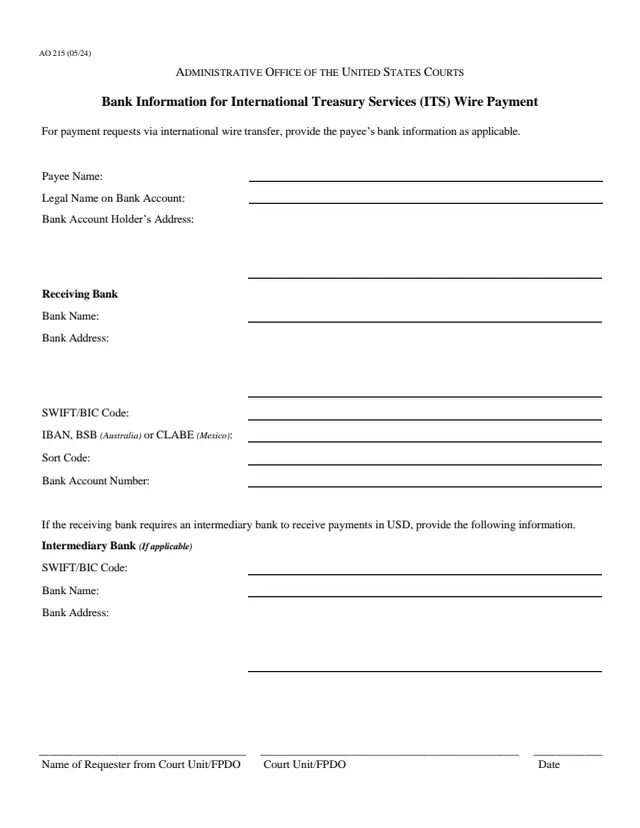
The instructions say EFT payments are available only to bank accounts within the United States, and to contact the local clerk's office for information and authorization if payments need to go to a foreign account.
The instructions recommend, as optional, a voided check or official bank verification letter or statement showing the account holder's name, address, routing number and account number.
The instructions say the payee notifies the clerk's office of any changes that affect payment distribution, such as a name change or new bank account, and completes a new form.
The form is for payees named in a criminal case who receive restitution payments electronically. It names these people.
No tool matches that search.
The form says the vendor code is reserved for the clerk's office to populate, if a current record exists in the JIFMS accounting system.
The instructions say the VIN is provided by the Department of Justice and allows access to the Victim Notification System, which provides case information and updates. It is entered if known.
The instructions say EFT payments are available only to bank accounts within the United States, and to contact the local clerk's office to request information and authorization for a foreign account.
The instructions say separate, individual payments require a court order. Otherwise EFT payments go to a single bank account owned by at least one of the payees listed on the case.
The instructions call it two-pass verification, required to ensure accuracy and prevent errors, and ask payees to verify both numbers with the financial institution before submission.
The instructions list it as optional and recommend a voided check or official bank verification letter or statement for accurate payment processing.
The instructions say the payee notifies the clerk's office of any changes that affect payment distribution, and a new form is completed when the information changes.