Type of Vendor
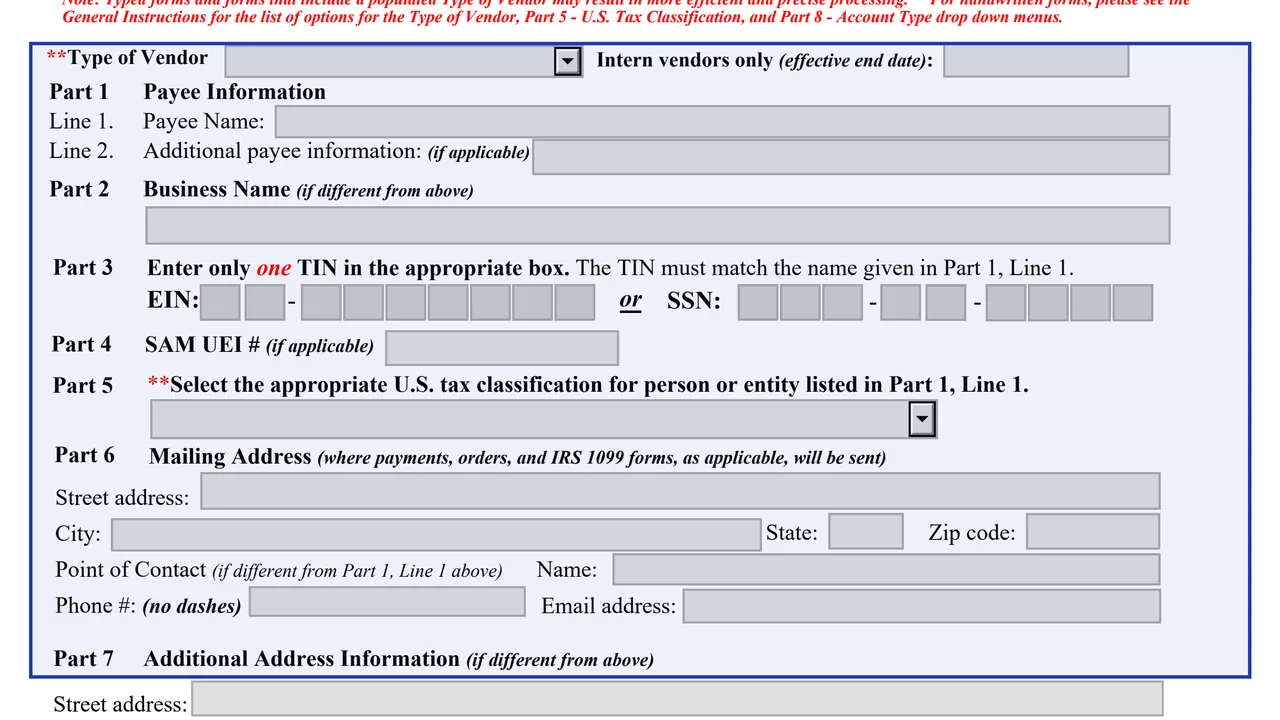
A drop-down with seven choices, plus an effective end date for intern vendors. The form says handwritten forms use the lists in the General Instructions.
AO 213
Vendor Information/Certification
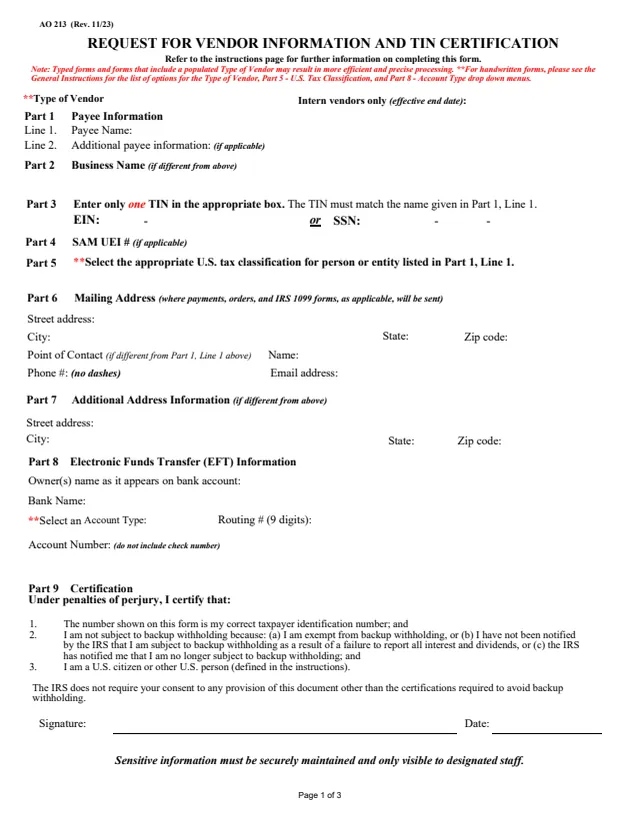
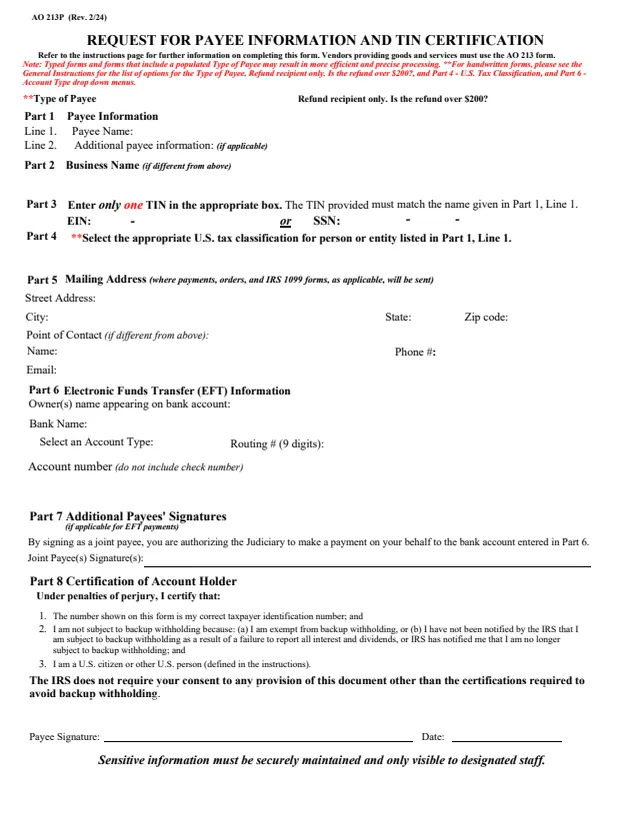
AO 213, printed on the form as Request for Vendor Information and TIN Certification, is the form the Judiciary uses to collect the information needed to make a payment. The U.S. Courts page lists it as Vendor Information/Certification under Other Forms, effective on November 20, 2023, and the PDF is dated Rev. 11/23.
The form's General Instructions say that for many payments the Judiciary files an information return such as a 1099-MISC, 1099-NEC or 1099-INT with the IRS, so it collects payees' correct names and taxpayer identification numbers (TINs). Page 1 has nine parts: payee name, business name, TIN, SAM UEI, U.S. tax classification, mailing address, additional address, electronic funds transfer details and a certification signed under penalties of perjury. Pages 2 and 3 are the instructions.
This page explains the form in plain words and is not legal or tax advice. You can fill it out free in your browser on this page and download the result without an account.
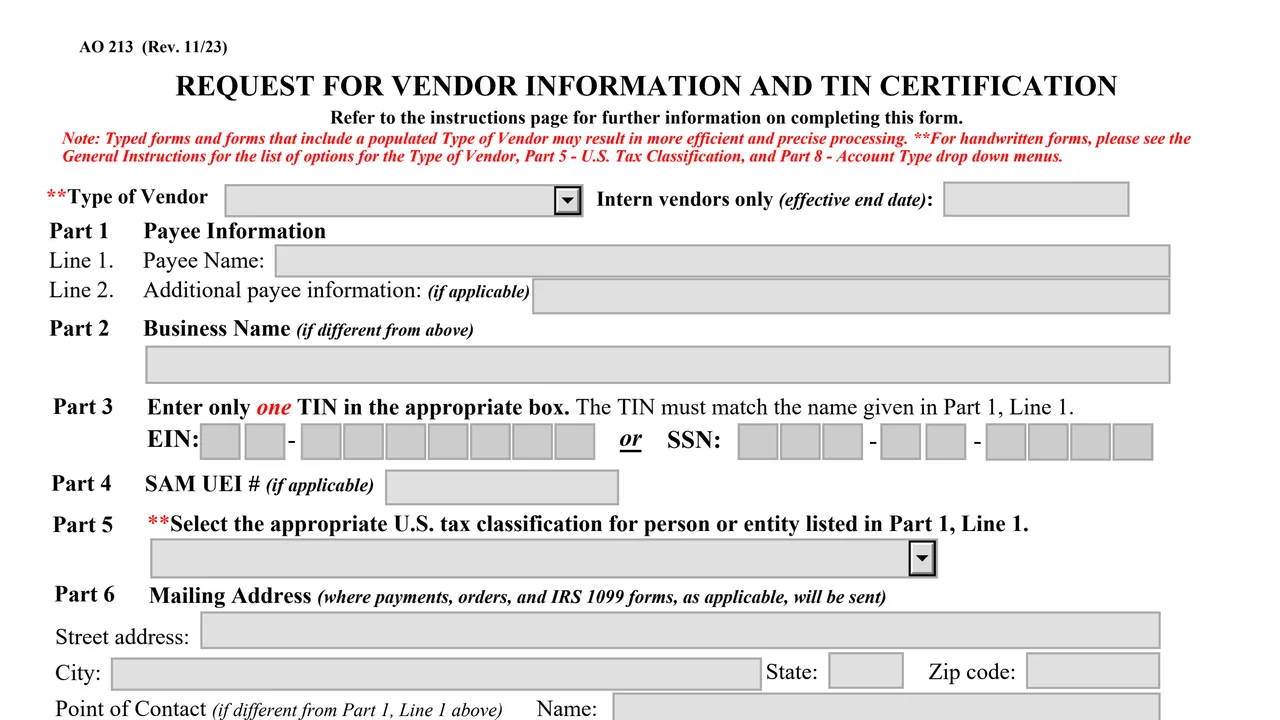
A drop-down with seven choices, plus an effective end date for intern vendors. The form says handwritten forms use the lists in the General Instructions.
Line 1 is one name that matches the U.S. tax return, Line 2 is any additional payee information, and Part 2 is a business or DBA name if different.
Part 3 takes only one TIN, an EIN or an SSN, which has to match the name on Line 1. Part 4 is the 12 alpha-numeric SAM Unique Entity Identifier, if applicable.
A drop-down of 14 classifications, from Individual and Sole Proprietor to C Corporation, LLC types, Non-Profit and Trust/Estate.
Part 6 is the mailing address where payments, orders and IRS 1099 forms are sent, with an optional point of contact. Part 7 is an additional address. Part 8 is the account owner, bank name, account type, 9-digit routing number and account number.
Signed and dated under penalties of perjury: the TIN is correct, the signer is not subject to backup withholding, and the signer is a U.S. citizen or other U.S. person.
The instructions say to select the option that most accurately reflects current business operations or the type of individual needing a payment. The form notes that typed forms with a Type of Vendor filled in may be processed more efficiently.
The instructions say not to leave Line 1 blank and to enter only one name, matching the name on the U.S. tax return. Extra names such as and or or, or care of details, go on Line 2.
The instructions say a resident alien without an SSN who is not eligible for one enters an ITIN in the SSN box, a sole proprietor with an EIN may enter either, and an LLC classified as a corporation or partnership enters the entity's EIN.
Part 6 is where information returns are mailed. The instructions say a point of contact is entered when it differs from the Line 1 name, the routing number has nine digits, and to consult the financial institution if unsure of banking information.
The instructions say item 2 is crossed out if the IRS has notified the signer that they are currently subject to backup withholding for failing to report all interest and dividends.
You get the real form, filled in a browser tab, with nothing standing between you and the finished PDF.
The form does not print an address to send it to. Part 6 is the address where payments, orders and IRS 1099 forms are sent.
The form does not print a fee.
The instructions say that if a TIN is not provided, a payee may be subject to backup withholding, where the Judiciary withholds a certain percentage so the IRS receives any tax due on the payment.
The instructions say payments the Treasury disburses for the Judiciary collect payee TINs under the Treasury's TIN Policy, and TINs from this form may be used to collect and report delinquent amounts owed to the government.
The form prints: Sensitive information must be securely maintained and only visible to designated staff.
The Type of Vendor list on the form names the kinds of payees it covers: Billing/Accounts Receivable, Business Entity, Court Reporter, Fed Pub Defender, Intern, Juror and Other.
No tool matches that search.
The instructions say the Judiciary uses it to collect the information needed to make a payment, including the payee's correct name and TIN for the information returns it files with the IRS.
Part 3 has boxes for one full EIN or SSN, and the TIN has to match the name on Part 1, Line 1. The form says sensitive information is to be securely maintained and only visible to designated staff.
The instructions list a U.S. citizen or U.S. resident alien; a partnership, corporation, company or association created or organized in or under the laws of the United States; an estate other than a foreign estate; and a domestic trust as defined in 26 CFR 301.7701-7.
The instructions describe it as a 12 alpha-numeric SAM Unique Entity Identifier, entered if applicable.
Checking or savings. The instructions say the account type is identified so the payment is accepted by the financial institution, and the routing number has nine digits.
No. The form prints neither a fee nor a deadline.