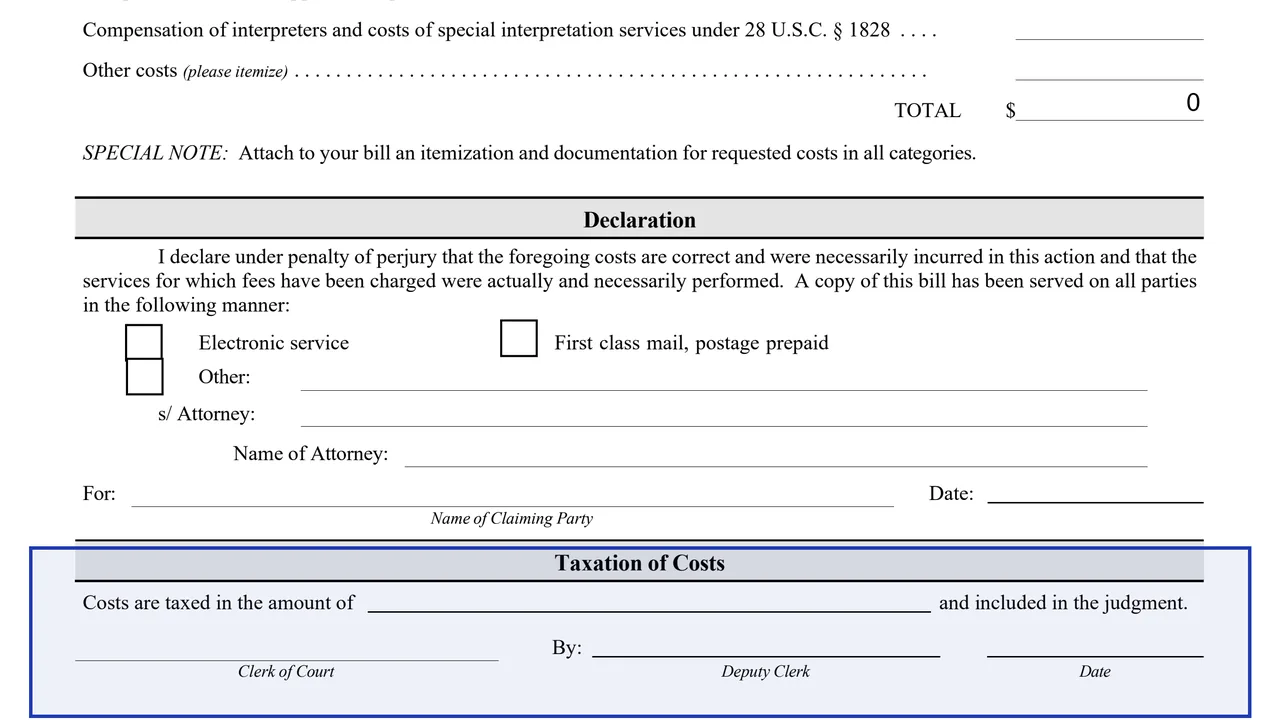
Caption
The United States District Court and district, the parties on each side of the v., and the case number.
AO 133
Bill of Costs (District Court)
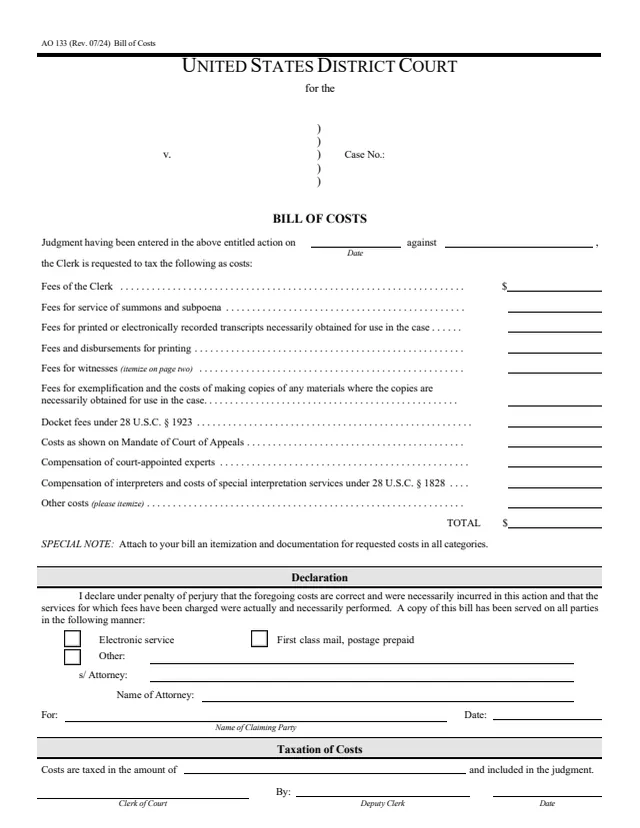
AO 133, Bill of Costs (District Court), is a U.S. Courts form that asks the clerk of a United States District Court to tax costs after judgment has been entered in a case. The U.S. Courts page lists it under Other Forms, effective on December 1, 2009 and updated on July 16, 2024, and the PDF is dated Rev. 07/24.
Page 1 lists the categories of costs, from fees of the clerk and service fees to transcripts, printing, witnesses, exemplification and copies, docket fees, interpreters and other costs, then a declaration under penalty of perjury signed for the claiming party and a Taxation of Costs section for the clerk. Page 2 computes witness fees and prints a notice quoting Sections 1924 and 1920 of Title 28, U.S. Code, and Federal Rules of Civil Procedure 54(d)(1), 6(d) and 58(e).
This page explains the form in plain words and is not legal advice. You can fill it out free in your browser on this page and download the result without an account.
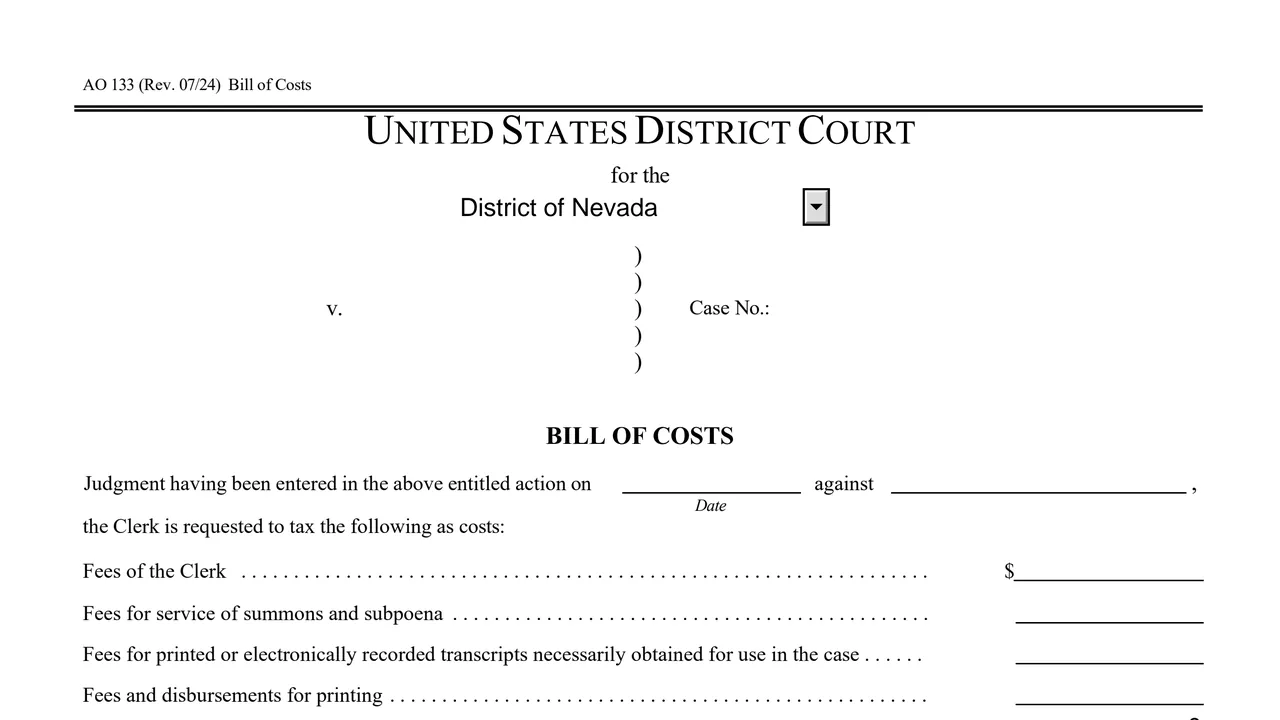
The United States District Court and district, the parties on each side of the v., and the case number.
The date judgment was entered and the party it was entered against, then amounts for fees of the clerk, service of summons and subpoena, transcripts, printing, witnesses, exemplification and copies, docket fees under 28 U.S.C. § 1923, costs on a Court of Appeals mandate, court-appointed experts, interpreters under 28 U.S.C. § 1828 and other costs, with a total.
The form says to attach to the bill an itemization and documentation for requested costs in all categories.
A declaration under penalty of perjury that the costs are correct and were necessarily incurred, how the bill was served on all parties, and the attorney's signature, name of claiming party and date.
The amount of costs taxed and included in the judgment, signed by the clerk of court or a deputy clerk with the date.
A witness fee table (computation, cf. 28 U.S.C. § 1821 for statutory fees) with days, miles and totals for each witness, and a notice quoting Sections 1924 and 1920 of Title 28 and Rules 54(d)(1), 6(d) and 58(e).
Enter the district, the names of the parties and the case number.
Fill in the date judgment was entered and the party it was entered against.
Enter an amount on each line that applies. The form says to itemize witness fees on page two and to itemize other costs.
The special note says to attach an itemization and documentation for requested costs in all categories. The notice quotes 28 U.S.C. § 1924, which calls for an affidavit that each item is correct and has been necessarily incurred in the case.
Check how a copy of the bill was served on all parties: electronic service, first class mail, postage prepaid, or other.
The declaration is signed s/ Attorney with the attorney's name, the claiming party and the date. The Taxation of Costs section below has lines for the clerk of court and a deputy clerk.
You get the real form, filled in a browser tab, with nothing standing between you and the finished PDF.
With the United States District Court named in the caption. The notice quotes Section 1920 of Title 28: a bill of costs shall be filed in the case and, upon allowance, included in the judgment or decree.
The notice quotes Rule 54(d)(1): the clerk may tax costs on 14 days' notice, and on motion served within the next 7 days, the court may review the clerk's action. The form does not print a deadline for filing the bill itself.
The notice quotes Rule 6(d): when service is made under Rule 5(b)(2)(C) (mail), (D) (leaving with the clerk), or (F) (other means consented to), 3 days are added after the period would otherwise expire under Rule 6(a).
The notice quotes Rule 58(e): ordinarily, the entry of judgment may not be delayed, nor the time for appeal extended, in order to tax costs or award fees.
The notice quotes Rule 54(d)(1): costs against the United States, its officers, and its agencies may be imposed only to the extent allowed by law.
The form does not print a filing fee.
AO 450
26 fields, 1 page
AO 145
23 fields, 1 page
AO 132
24 fields, 1 page
AO 440
34 fields, 2 pages
AO 88
37 fields, 3 pages
The form has a part for the party claiming costs, signed by its attorney, and a part for the clerk.
No tool matches that search.
The declaration is signed s/ Attorney with the attorney's name, the name of the claiming party and the date. The Taxation of Costs section is signed by the clerk of court or a deputy clerk.
Fees of the clerk, fees for service of summons and subpoena, transcripts necessarily obtained for use in the case, printing, witnesses, exemplification and copies, docket fees under 28 U.S.C. § 1923, costs on a Court of Appeals mandate, court-appointed experts, interpreters under 28 U.S.C. § 1828, and other costs, itemized.
The form's list of costs has no line for attorney's fees. The notice quotes Rule 54(d)(1), titled Costs Other than Attorneys' Fees, and Rule 58(e), which refers to a timely motion for attorney's fees under Rule 54(d)(2).
The special note says to attach an itemization and documentation for requested costs in all categories. Witness fees are itemized on page two.
The form does not print a deadline for filing the bill. Its notice quotes Rule 54(d)(1): the clerk may tax costs on 14 days' notice, and on motion served within the next 7 days, the court may review the clerk's action.
Each witness gets a row with name, city and state of residence, days and cost for attendance and subsistence, miles and cost for travel, and a total for each witness. The heading says computation, cf. 28 U.S.C. § 1821 for statutory fees.
No. This page explains the form in plain words and is not legal advice.